Nebraska Notice of Extended Absence in Excess of Seven Days for Residential from Tenant to Landlord
What this document covers
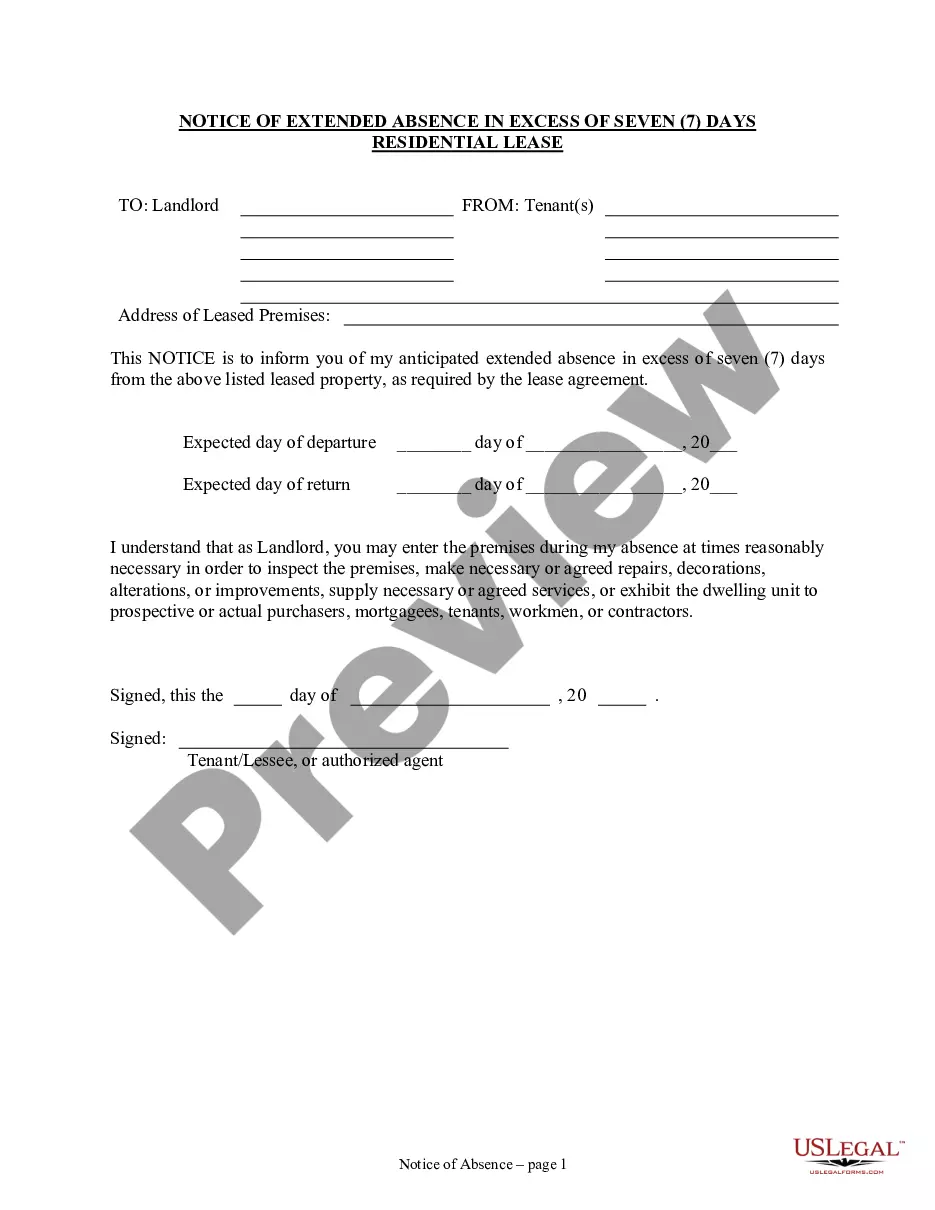
This Notice of Extended Absence in Excess of Seven Days is a legal document that tenants use to formally notify their landlord about an impending absence from a residential property for more than seven days. This form serves to comply with typical lease provisions and ensures that both parties are informed regarding access to the property during the tenant's absence. Unlike other tenant notifications, this notice specifically addresses extended absences, helping to clarify responsibilities under the lease agreement.
Key components of this form
- Identification of the parties: Includes the names of the tenant(s) and landlord.
- Property address: Specifies the address of the leased premises.
- Dates of absence: Fields for indicating the expected departure and return dates.
- Landlord's rights: Acknowledgment of the landlord's right to enter the premises during the tenant's absence as per lease terms.
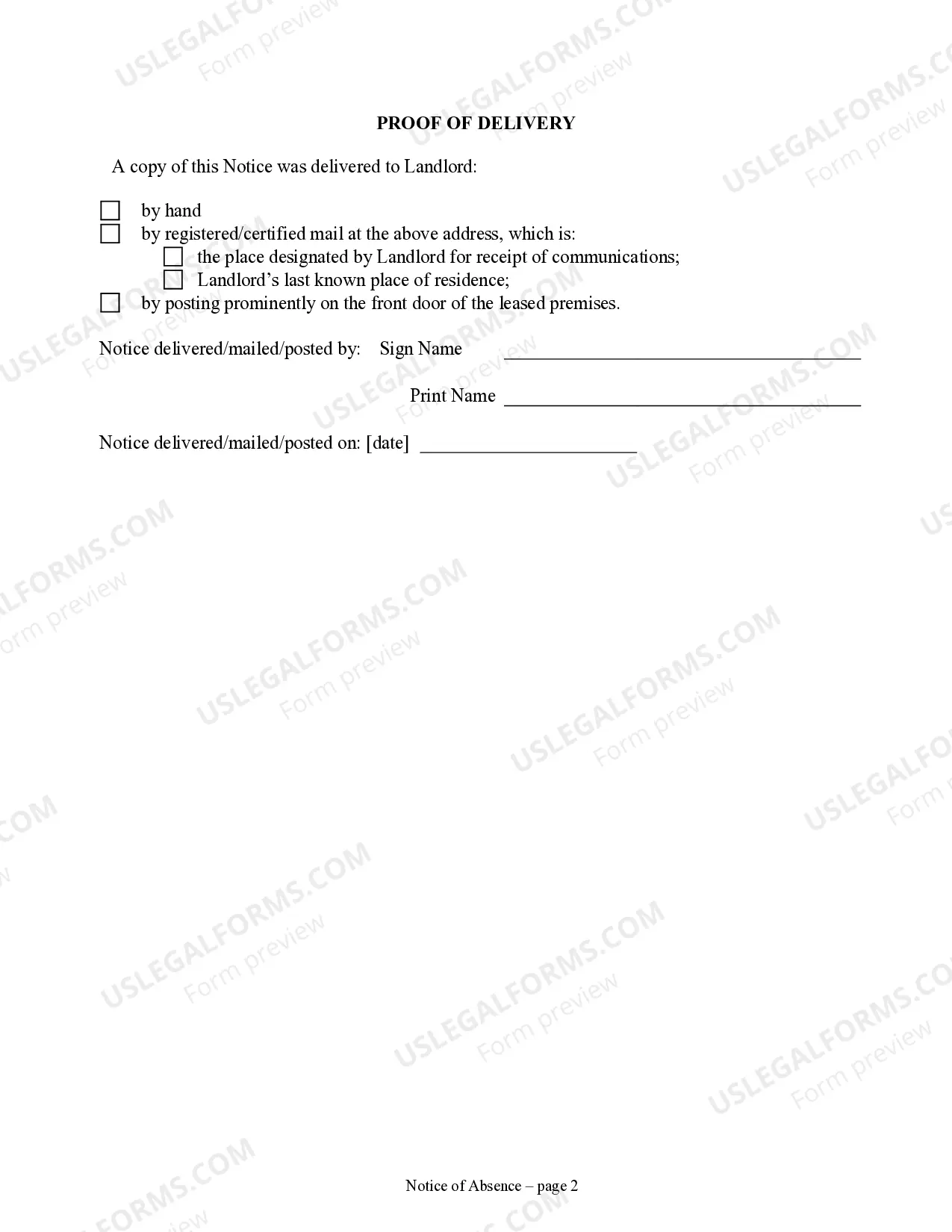
- Delivery method: Options to document how the notice was delivered to the landlord.
Common use cases
This form should be used whenever a tenant plans to be away from their rented residence for more than seven consecutive days. Common scenarios include long vacations, temporary job relocations, or extended visits with family. Providing this notice helps maintain clear communication with the landlord and ensures compliance with the lease agreement while away.
Who needs this form
- Tenants who have entered into a lease agreement for a residential property.
- Individuals planning an extended absence from their rental residence of over seven days.
- Anyone wishing to inform their landlord officially to prevent misunderstandings regarding property access during their absence.
Completing this form step by step
- Identify the parties: Fill in the names of the tenant(s) and the landlord.
- Specify the property: Clearly write down the address of the leased premises.
- Enter dates: Indicate the expected day of departure and return.
- Acknowledge landlord's rights: Review the section that outlines the landlord's rights to enter the property during your absence.
- Deliver the notice: Choose a method of delivery (e.g., hand delivery, registered/certified mail) and fill in the relevant details.
Notarization guidance
This form does not typically require notarization unless specified by local law. Ensure compliance with your lease agreement and local regulations to confirm if notarization is necessary.
Get your form ready online
Our built-in tools help you complete, sign, share, and store your documents in one place.
Make edits, fill in missing information, and update formatting in US Legal Forms—just like you would in MS Word.
Download a copy, print it, send it by email, or mail it via USPS—whatever works best for your next step.
Sign and collect signatures with our SignNow integration. Send to multiple recipients, set reminders, and more. Go Premium to unlock E-Sign.
If this form requires notarization, complete it online through a secure video call—no need to meet a notary in person or wait for an appointment.
We protect your documents and personal data by following strict security and privacy standards.

Make edits, fill in missing information, and update formatting in US Legal Forms—just like you would in MS Word.

Download a copy, print it, send it by email, or mail it via USPS—whatever works best for your next step.

Sign and collect signatures with our SignNow integration. Send to multiple recipients, set reminders, and more. Go Premium to unlock E-Sign.

If this form requires notarization, complete it online through a secure video call—no need to meet a notary in person or wait for an appointment.

We protect your documents and personal data by following strict security and privacy standards.
Mistakes to watch out for
- Failing to provide the exact dates of absence.
- Not sending the notice in the proper manner as specified in the lease.
- Neglecting to keep a copy of the notice for personal records.
- Assuming that the landlord is aware of the absence without notifying them formally.
Advantages of online completion
- Convenience of downloading and filling out the form from home.
- Editability allows for easy customization based on individual needs.
- Reliability of using a legally vetted document created by licensed attorneys.
Main things to remember
- This form is essential for tenants planning to be absent for over seven days.
- It serves to keep the landlord informed and complies with lease agreements.
- Using this form online saves time and provides assurance of legal accuracy.
Looking for another form?
Form popularity
FAQ
Step 1: Mention the Reason for Giving a Notice. Step 2: Use Formal Language. Step 3: Mention the Date for Vacating. Step 4: Address the Formalities to Be Taken Care Of. Step 5: Proofread the Letter.
Dear (Name of landlord or manager), This letter constitutes my written (number of days' notice that you need to give based on your lease agreement)-day notice that I will be moving out of my apartment on (date), the end of my current lease. I am leaving because (new job, rent increase, etc.)
The Housing Act clearly states the landlord must give the tenant two months written notice (normally by Section 21, this is different to the Section 21 Notice during a fixed term), however, a tenant can give notice by way of the same way they pay rent.
Ending a periodic tenancy: A tenant must give the landlord at least 21 days' written notice to end the tenancy. A landlord must give the tenant at least 90 days' written notice to end the tenancy. In some situations, the landlord can give 42 days' written notice.
1 month's notice if your tenancy runs from month to month. 4 weeks' notice if your tenancy runs from week to week. If you live with your landlord. You don't have to give a set amount of notice (unless your tenancy agreement says otherwise).
Weekly tenancyThe tenant or landlord must give one week of notice.
They have to give you at least 28 days notice, but this could be longer depending on your agreement. If you don't leave by the time your notice ends, your landlord has to go to court to get a court order to make you leave.
In Colorado, evictions are sometimes referred to as forcible entry & detainer (FED). Before you can file for eviction, you must generally provide 10 days' notice (increased from 3 days prior) for tenants to correct a deficiency or leave the property, except in certain circumstances.
Grace periods are quite common, usually varying between three and five days. Grace periods provide tenants extra time to pay rent before the landlord can legally charge a late fee.