Wisconsin Quitclaim Deed from Corporation to Two Individuals
What this document covers
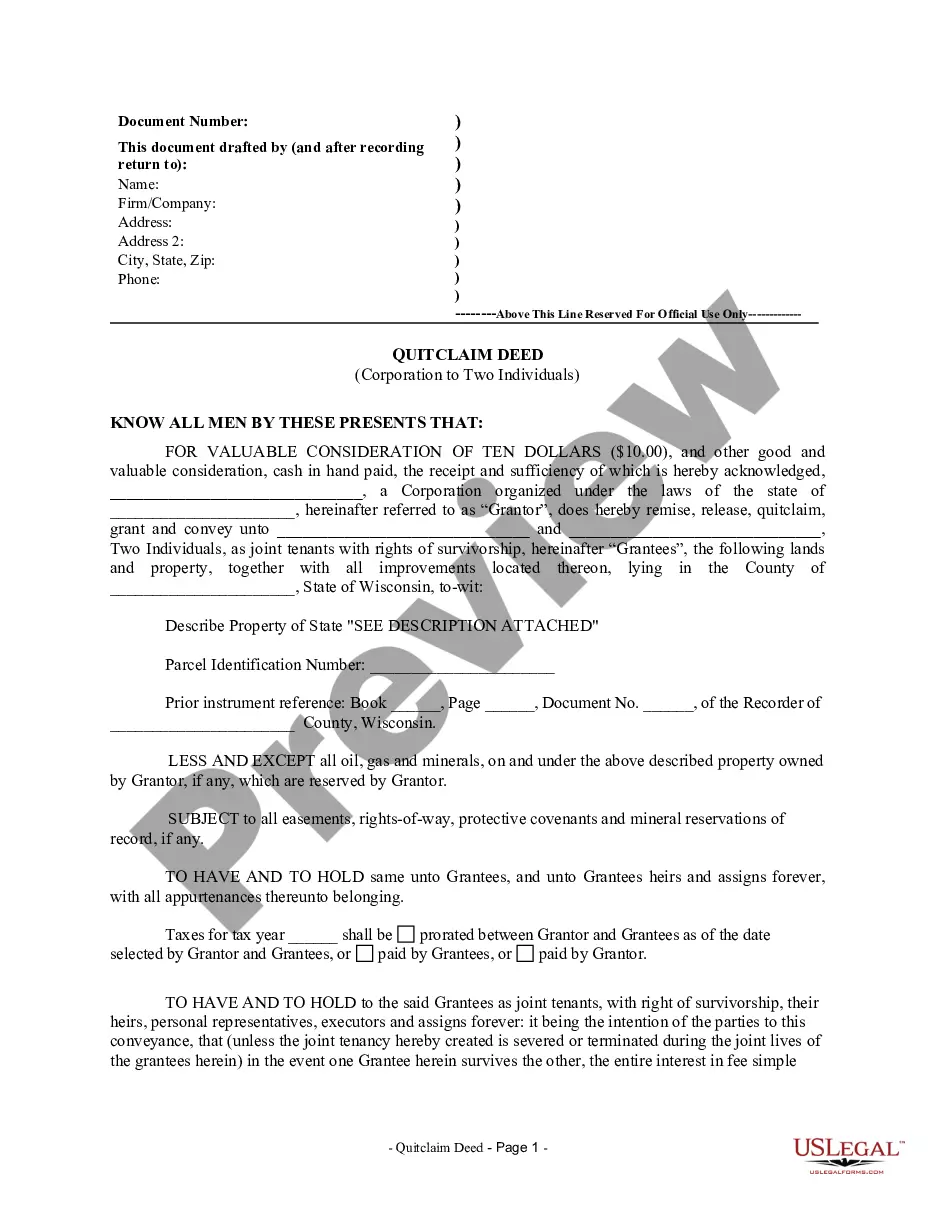
The Quitclaim Deed from Corporation to Two Individuals is a legal document that allows a corporation (the Grantor) to transfer ownership of a property to two individuals (the Grantees). Unlike a warranty deed, a quitclaim deed does not guarantee that the property title is clear of any claims. This form is specifically designed for situations where a corporation is transferring property to two individuals, ensuring compliance with state laws while excluding certain mineral rights.
What’s included in this form
- Description of the property being conveyed.
- Parcel identification number for record-keeping.
- Prior instrument reference for tracing ownership history.
- Reservation of mineral rights retained by the Grantor.
- Details on taxes to be prorated between Grantor and Grantees.
- Joint tenancy provisions including right of survivorship.
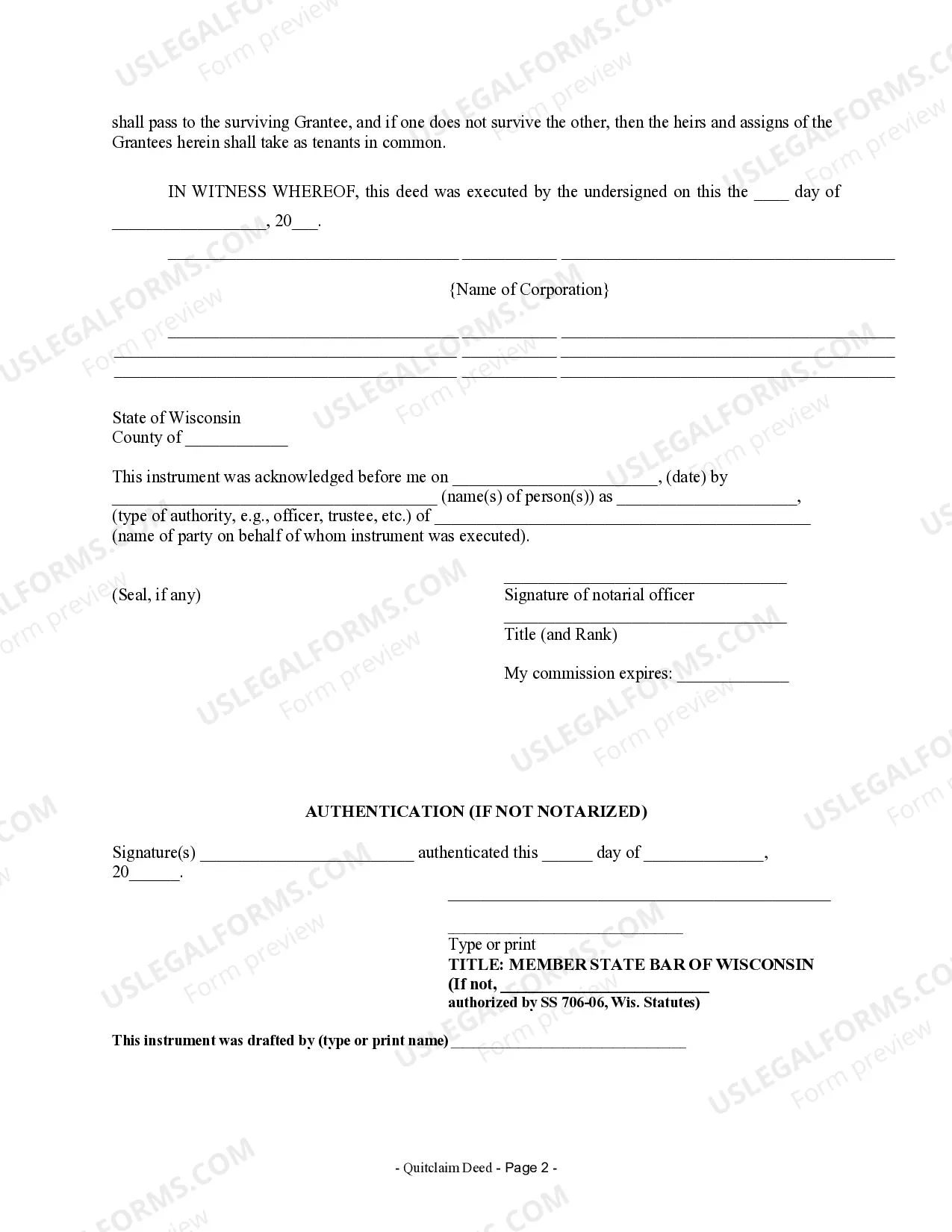
- Execution section for signatures of involved parties and acknowledgment by a notary public.




Situations where this form applies
This form is needed when a corporation wishes to transfer property ownership to two individuals without making any guarantees about the title. Common scenarios include family transfers, business reorganizations, or resolving property ownership disputes. It is also used when the corporation wants to transfer the property while retaining certain rights, such as mineral rights.
Intended users of this form
- Corporations looking to transfer real estate to individual parties.
- Individuals receiving property from a corporation.
- Real estate professionals involved in corporate property transactions.
- Legal advisors assisting clients with property transfers.
Completing this form step by step
- Identify the full legal name of the corporation transferring the property.
- Clearly describe the property being transferred, including the parcel identification number.
- Specify any reservations, such as oil, gas, or mineral rights being retained.
- Include information on how taxes will be handled between the Grantor and Grantees for the tax year.
- Sign and date the document in the appropriate sections, ensuring acknowledgment by a notary public.
Does this form need to be notarized?
Yes, this form must be notarized to be legally valid. US Legal Forms offers integrated online notarization services, available twenty-four hours a day through secure video calls. This process ensures legal equivalence and eliminates the need for travel, making it easy to complete your transaction.
Get your form ready online
Our built-in tools help you complete, sign, share, and store your documents in one place.
Make edits, fill in missing information, and update formatting in US Legal Forms—just like you would in MS Word.
Download a copy, print it, send it by email, or mail it via USPS—whatever works best for your next step.
Sign and collect signatures with our SignNow integration. Send to multiple recipients, set reminders, and more. Go Premium to unlock E-Sign.
If this form requires notarization, complete it online through a secure video call—no need to meet a notary in person or wait for an appointment.
We protect your documents and personal data by following strict security and privacy standards.

Make edits, fill in missing information, and update formatting in US Legal Forms—just like you would in MS Word.

Download a copy, print it, send it by email, or mail it via USPS—whatever works best for your next step.

Sign and collect signatures with our SignNow integration. Send to multiple recipients, set reminders, and more. Go Premium to unlock E-Sign.

If this form requires notarization, complete it online through a secure video call—no need to meet a notary in person or wait for an appointment.

We protect your documents and personal data by following strict security and privacy standards.
Common mistakes to avoid
- Failing to include the correct parcel identification number.
- Not specifying any mineral rights that are retained by the Grantor.
- Overlooking the necessity of notarization for the form to be valid.
- Neglecting to clarify tax responsibilities for both parties.
Advantages of online completion
- Convenience of downloading and filling in the form at your pace.
- Editability allows for adjustments before finalization.
- Access to legally vetted templates drafted by licensed attorneys.
- Immediate access to the latest updates and state-specific requirements.
What to keep in mind
- The Quitclaim Deed transfers property from a corporation to two individuals.
- It reserves certain mineral rights for the corporation.
- Proper completion includes notarization and accurate tax responsibilities.
- This form is compliant with state laws, specifically in Wisconsin.
Looking for another form?
Form popularity
FAQ
Under California law, a deed that purports to convey title (ownership) or any other interest in real property, such as an easement, is completely void if the conveyancing party's signature on the deed is forged.
Fill out the quit claim deed form, which can be obtained online, or write your own using the form as a guide. The person giving up the interest in the property is the grantor, and the person receiving the interest is the grantee.
An unrecorded quit claim deed is still valid.Failure to record a deed could render transfer or mortgaging of the property impossible and create numerous legal difficulties. The purpose of the recording a quit claim deed is to give notice to the world that there has been a change in ownership.
But you might be wondering if an owner can transfer a deed to another person without a real estate lawyer. The answer is yes. Parties to a transaction are always free to prepare their own deeds.A quitclaim deed, for example, is far simpler than a warranty deed.
A Quitclaim Deed must be notarized by a notary public or attorney in order to be valid. What does "Grantee's assigns" mean? Grantee's assigns refers to any person that the Grantee transfers the property to, after having received the property from the Grantor.
If the quitclaim deed requires the signature of all co-owners, the deed is invalid unless all co-owners have signed it and the deed is then delivered to the grantee.If one individual owns real estate and desires to add a co-owner such as a spouse, a quitclaim deed might be used.
It's usually a very straightforward transaction, but it's possible for a quitclaim deed to be challenged. If a quitclaim deed is challenged in court, the issue becomes whether the property was legally transferred and if the grantor had the legal right to transfer the property.
Yes, you can use a Quitclaim Deed to transfer a gift of property to someone. You must still include consideration when filing your Quitclaim Deed with the County Recorder's Office to show that title has been transferred, so you would use $10.00 as the consideration for the property.
A quitclaim deed transfers title but makes no promises at all about the owner's title.A person who signs a quitclaim deed to transfer property they do not own results in no title at all being transferred since there is no actual ownership interest. The quitclaim deed only transfers the type of title you own.