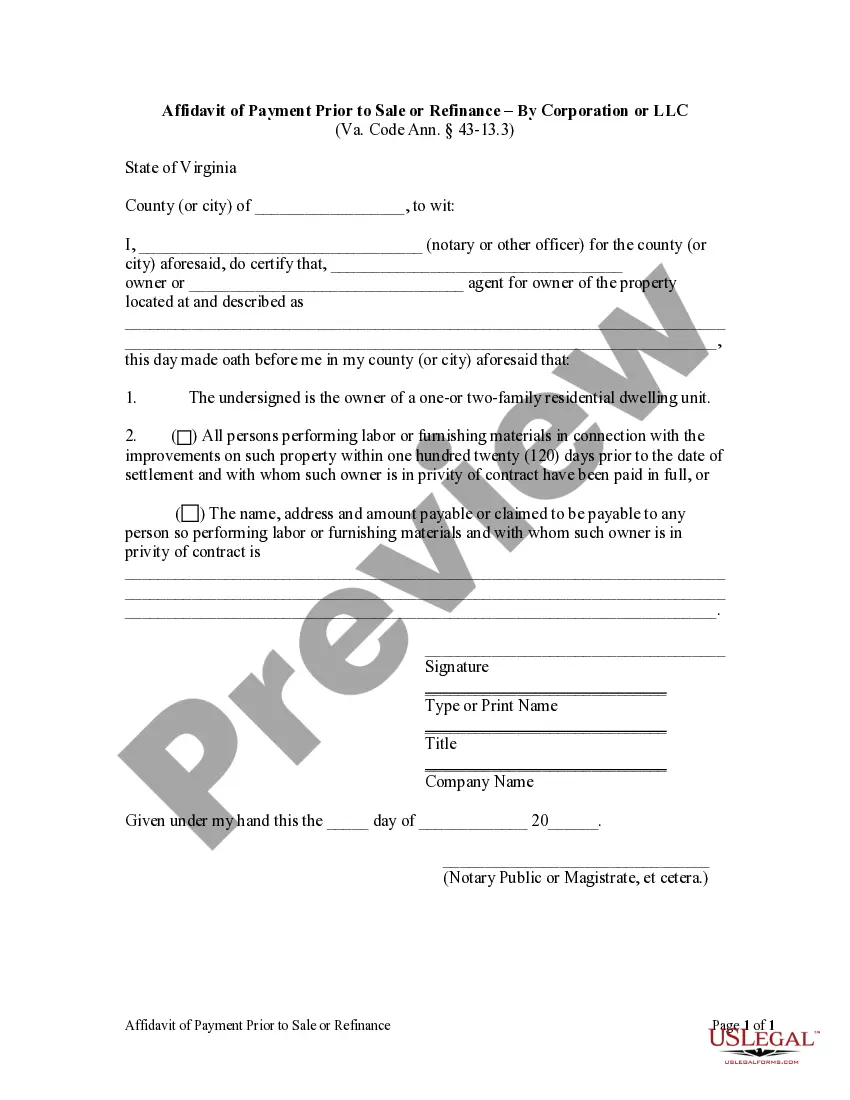
Virginia Affidavit of Payment Prior to Sale or Refinance - Corporation
Understanding this form
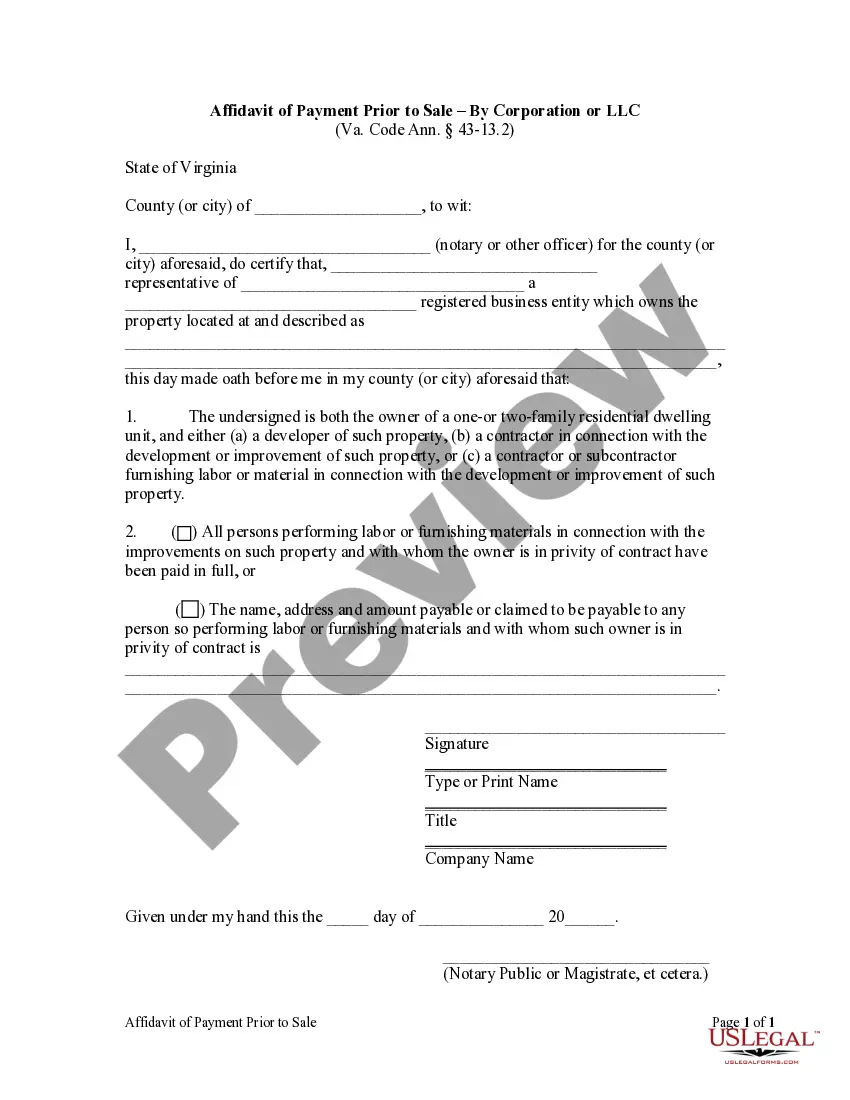
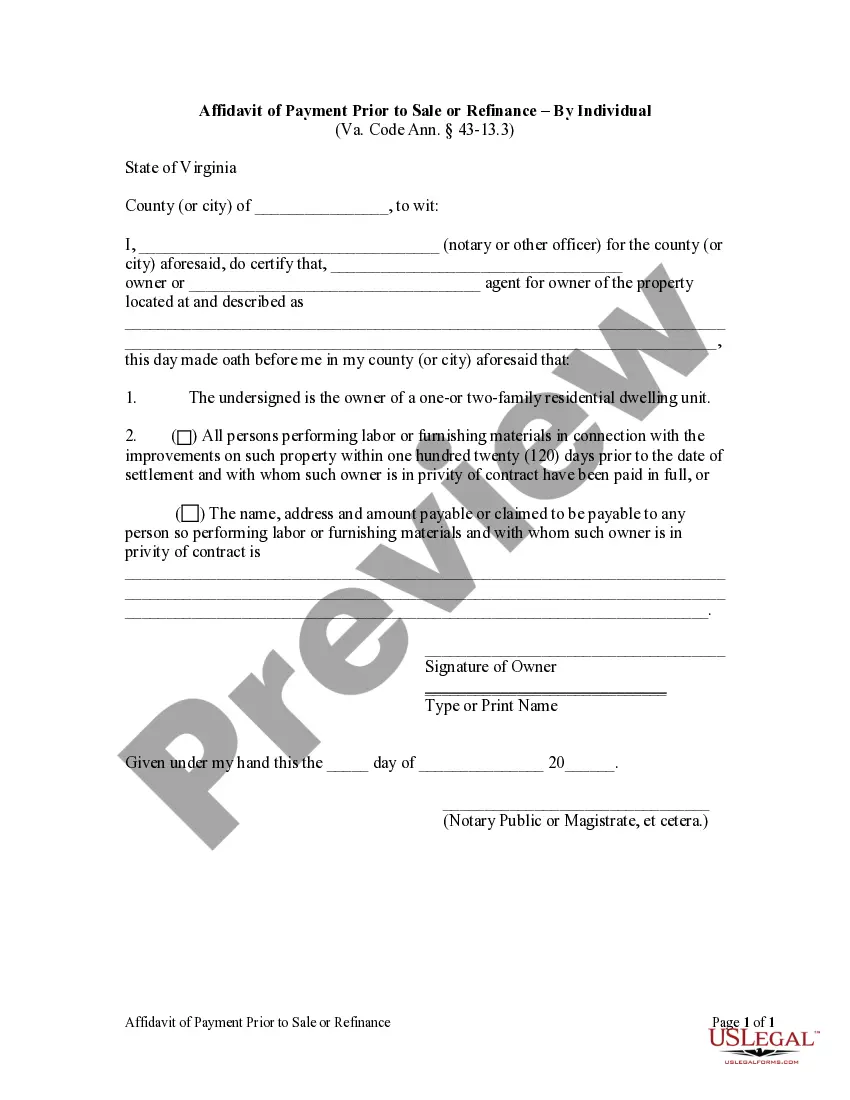
The Affidavit of Payment Prior to Sale or Refinance for Corporation is a legal document required in Virginia for the sale or refinancing of one-family or two-family residential properties. It serves to confirm that all contractors and suppliers involved in property improvements have either been paid in full or lists any outstanding payments. This form helps protect buyers and lenders from future claims against the property related to unpaid labor or materials, ensuring a smoother transaction process.
Main sections of this form
- Identification of the property owner or their agent.
- Statement confirming payment status of labor and materials related to property improvements.
- Details of any unpaid balances, including the names, addresses, and amounts owed.
- Signature and title of the affiant, ensuring legal compliance.
- Notary section for certification of the affidavit.

When to use this document
This form should be used during the closing process of a sale or refinance of a residential property in Virginia. It is particularly useful when an owner has made recent improvements to a property and must assure the buyer or lender that all contractors have been compensated or disclose any outstanding payments. Using this affidavit helps avoid disputes about unpaid work that could arise after the transaction is completed.
Who can use this document
- Homeowners or property owners of one-family or two-family residential units.
- Agents representing owners in the sale or refinance process.
- Real estate professionals facilitating the closing of property transactions.
How to prepare this document
- Identify and enter the jurisdiction (county or city) where the property is located.
- Provide the name of the owner or the owner's agent and their title.
- Clearly state the property address and any pertinent details.
- Select the appropriate checkbox to confirm payment status or to provide details of unpaid claims.
- Sign the affidavit and enter the date of completion; ensure notarization occurs as required.
Does this form need to be notarized?
Yes, this form must be notarized to be legally valid. US Legal Forms offers integrated online notarization services, available 24/7, ensuring a secure video call experience that meets legal standards without the need for travel.
Get your form ready online
Our built-in tools help you complete, sign, share, and store your documents in one place.
Make edits, fill in missing information, and update formatting in US Legal Forms—just like you would in MS Word.
Download a copy, print it, send it by email, or mail it via USPS—whatever works best for your next step.
Sign and collect signatures with our SignNow integration. Send to multiple recipients, set reminders, and more. Go Premium to unlock E-Sign.
If this form requires notarization, complete it online through a secure video call—no need to meet a notary in person or wait for an appointment.
We protect your documents and personal data by following strict security and privacy standards.

Make edits, fill in missing information, and update formatting in US Legal Forms—just like you would in MS Word.

Download a copy, print it, send it by email, or mail it via USPS—whatever works best for your next step.

Sign and collect signatures with our SignNow integration. Send to multiple recipients, set reminders, and more. Go Premium to unlock E-Sign.

If this form requires notarization, complete it online through a secure video call—no need to meet a notary in person or wait for an appointment.

We protect your documents and personal data by following strict security and privacy standards.
Avoid these common issues
- Leaving the property address or owner details incomplete.
- Failing to notate any unpaid balances accurately.
- Not obtaining notarization, which could render the affidavit invalid.
- Using outdated versions of the form which may not comply with current legal standards.
Advantages of online completion
- Convenient access for immediate download and completion.
- Editable format allowing users to fill in information easily.
- Reliable templates drafted by licensed attorneys, ensuring legal compliance.
Looking for another form?


Form popularity
FAQ
Generally, the lender sends the documents to be recorded after the closing. The recording fees are included in your closing costs. Typically, the lender will provide you with a copy of the deed of trust after the closing. The original warranty deeds are often mailed to the grantee after they are recorded.
Do You Get a New Title When You Refinance?Usually, you will not be issued a new title at the end of the process. An owner's policy is only brought at the original closing. For each separate loan transaction, only a loan policy is purchased.
Mortgage refinancing is not always the best idea, even when mortgage rates are low and friends and colleagues are talking about who snagged the lowest interest rate. This is because refinancing a mortgage can be time-consuming, expensive at closing, and will result in the lender pulling your credit score.
The refinancing lender provides a new deed of trust containing the terms of the new loan. A new trustee also is designated.
You can transfer a mortgage to another person if the terms of your mortgage say that it is assumable. If you have an assumable mortgage, the new borrower can pay a flat fee to take over the existing mortgage and become responsible for payment. But they'll still typically need to qualify for the loan with your lender.
Can I refinance a property without being on the title/deed? You can NOT refinance a property you don't own. you will need to be on the note or deed to refinance and show that you have been the person making the mortgage payment, but if you are not on the deed or the note then no you are not able to refinance a home.
Title Insurance and Refinancing Your Home For homeowners considering a refinance, you'll need to purchase lender's title insurance, as lenders won't fund your mortgage without it. Choosing to purchase an owner's title insurance policy is optional.
Yes, you can get a mortgage in your name only even if you are married. Your married partner may still have a claim on the property even if their name is not in the mortgage or title deeds.
1. Pay Stubs. When applying for a home loan refinance, your lender will need proof of income. Lenders want to ensure that you have the financial means to pay off your new mortgage, as well as any other long-term debts (such as car loans) or other living expenses.