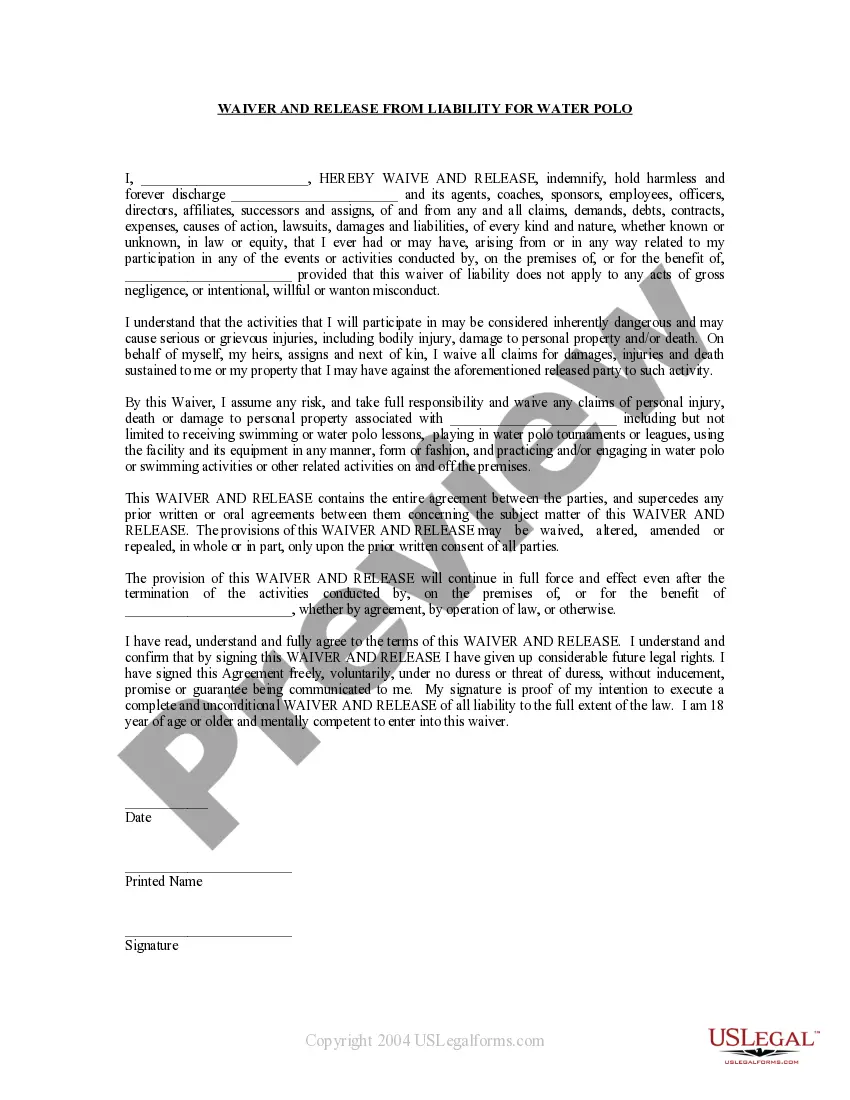
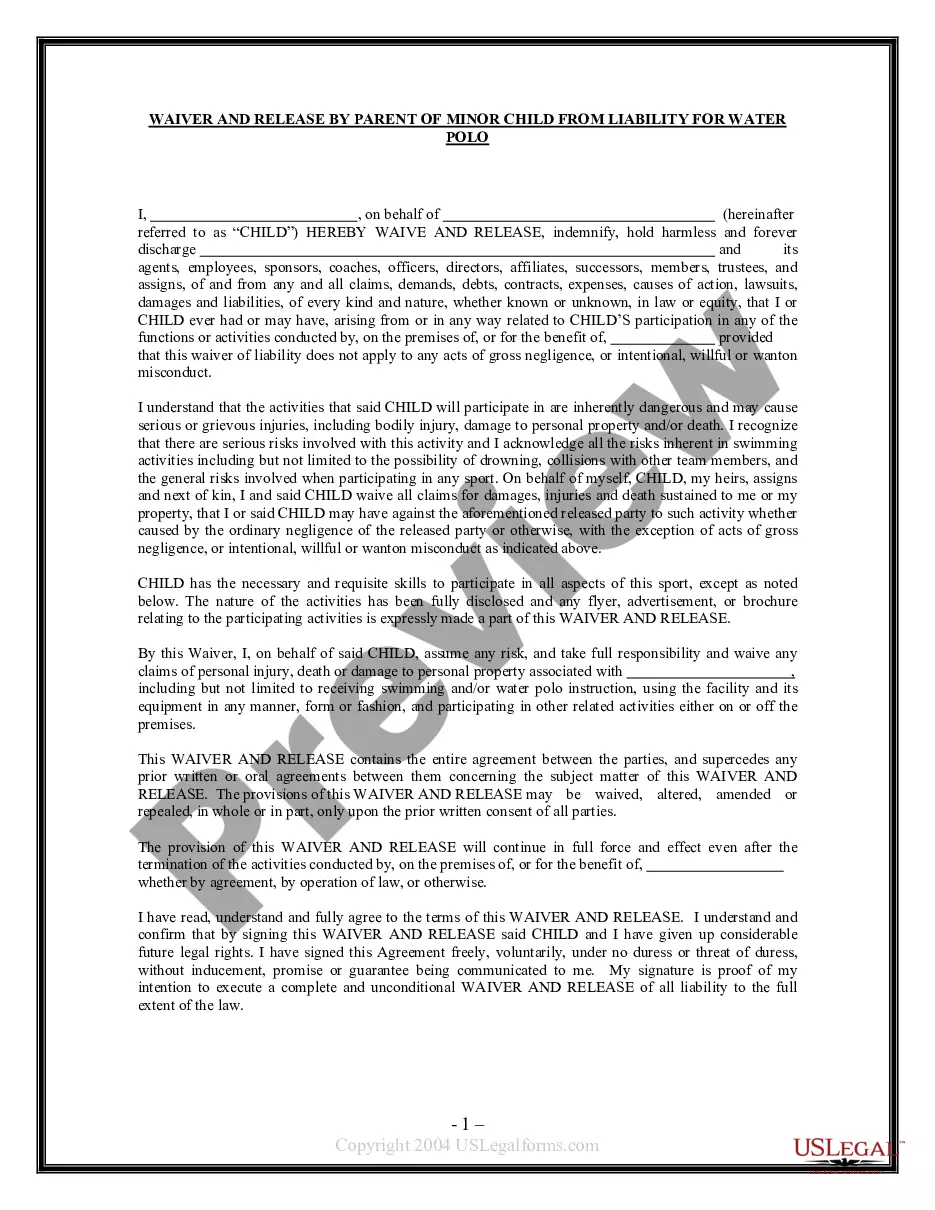
Waiver and Release From Liability For Adult for Water Polo
Overview of this form
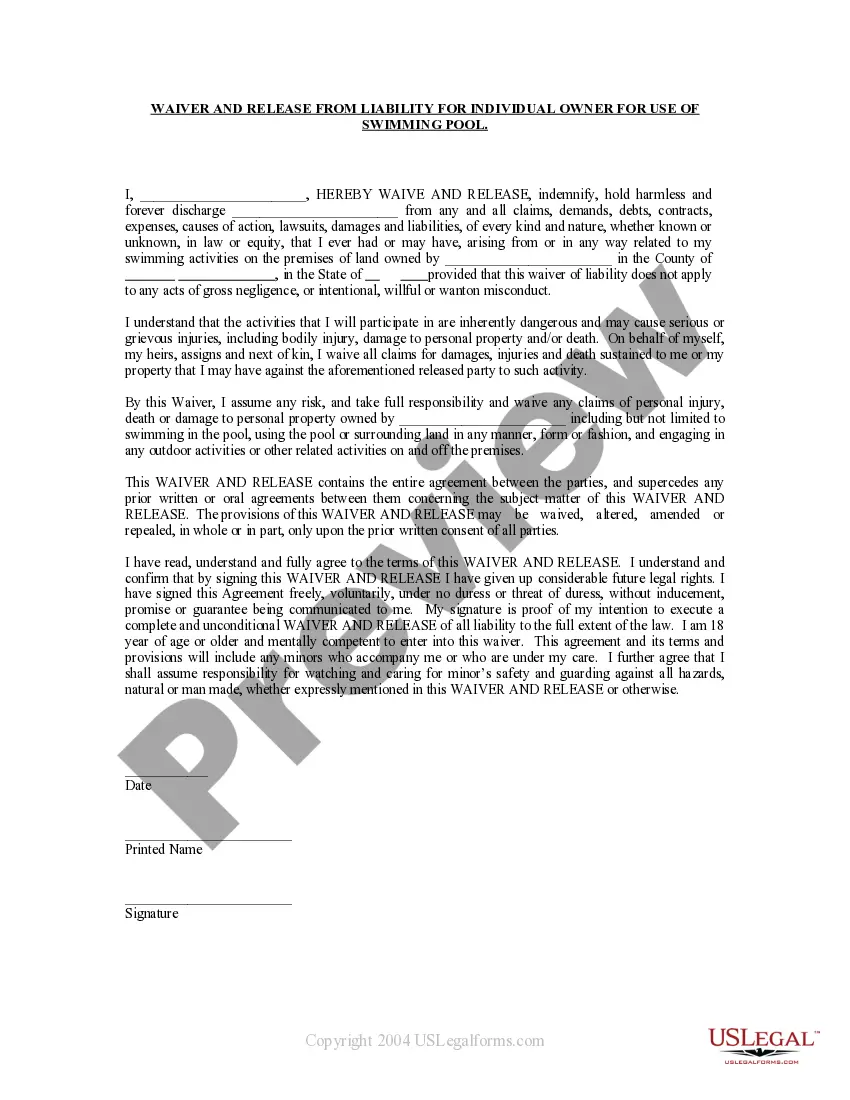
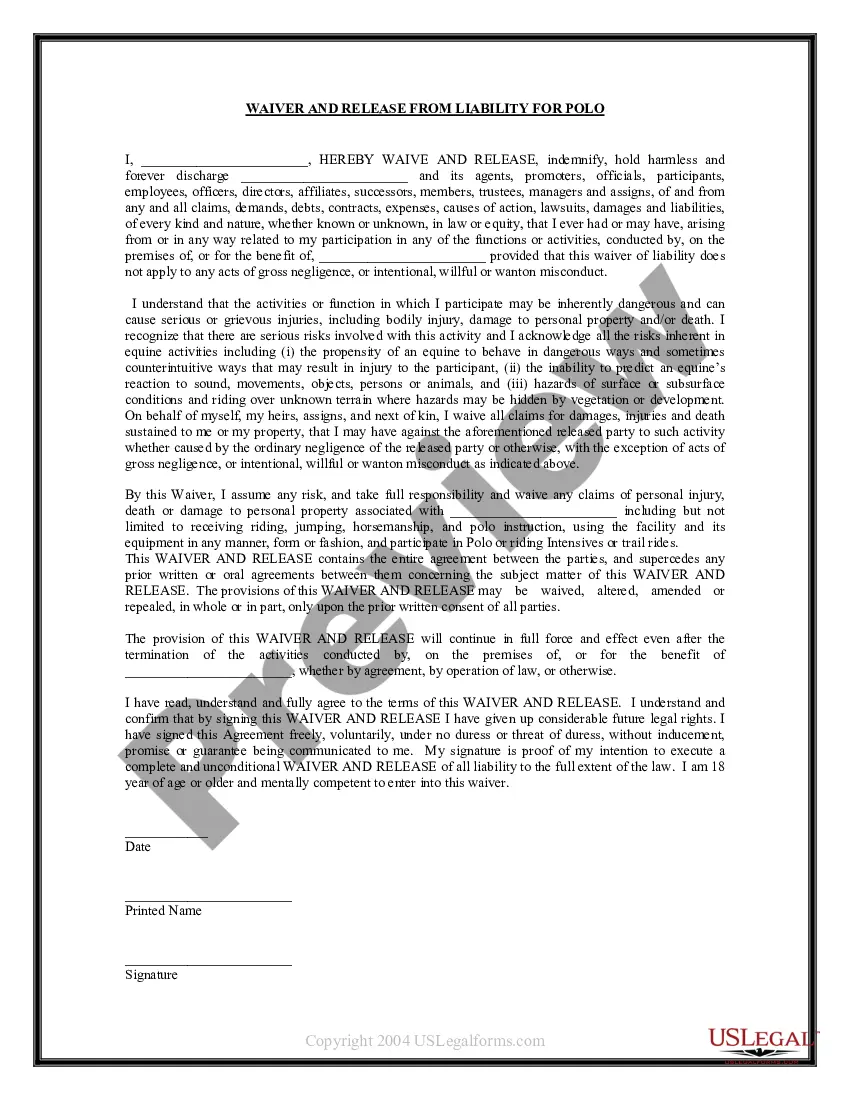
This Waiver and Release From Liability for Water Polo is a legal document that protects property owners from claims arising from injuries or damages that may occur during water polo activities. By signing this form, participants acknowledge the risks involved and agree not to hold property owners accountable for any unfortunate events that may happen during these inherently dangerous activities. This form is specifically tailored for adult participants, distinguishing it from waivers designed for minors or different sports activities.
Key components of this form
- Participant's name and signature confirming understanding of the waiver.
- Release of liability clause for the property owner and associated parties.
- Indemnification clause protecting the property owner against claims.
- Acknowledgment of the risks associated with participation in water polo.
- Statement confirming the participant's age and mental competence.
- Provision that the waiver survives the termination of activities.
When to use this form
This Waiver and Release From Liability should be used when an individual wishes to participate in water polo events or activities, such as tournaments, practices, or lessons. It is especially important before engaging in any water-related sports under the supervision of a property owner or organization to ensure that liabilities are clearly defined and understood.
Who needs this form
This form is intended for:
- Adult participants (aged 18 or older) in water polo activities.
- Property owners or organizations facilitating water polo events.
- Coaches and instructors involved in training or overseeing participants.
Instructions for completing this form
- Fill in your full name in the designated space.
- Sign and date the form to confirm your agreement to the terms.
- Ensure all relevant activities and risks are acknowledged within the form.
- Submit the completed form to the property owner or organizer prior to participating.
- Keep a copy of the signed waiver for your records.
Does this form need to be notarized?
This form usually doesn’t need to be notarized. However, local laws or specific transactions may require it. Our online notarization service, powered by Notarize, lets you complete it remotely through a secure video session, available 24/7.
Get your form ready online
Our built-in tools help you complete, sign, share, and store your documents in one place.
Make edits, fill in missing information, and update formatting in US Legal Forms—just like you would in MS Word.
Download a copy, print it, send it by email, or mail it via USPS—whatever works best for your next step.
Sign and collect signatures with our SignNow integration. Send to multiple recipients, set reminders, and more. Go Premium to unlock E-Sign.
If this form requires notarization, complete it online through a secure video call—no need to meet a notary in person or wait for an appointment.
We protect your documents and personal data by following strict security and privacy standards.

Make edits, fill in missing information, and update formatting in US Legal Forms—just like you would in MS Word.

Download a copy, print it, send it by email, or mail it via USPS—whatever works best for your next step.

Sign and collect signatures with our SignNow integration. Send to multiple recipients, set reminders, and more. Go Premium to unlock E-Sign.

If this form requires notarization, complete it online through a secure video call—no need to meet a notary in person or wait for an appointment.

We protect your documents and personal data by following strict security and privacy standards.
Avoid these common issues
- Failing to read the terms thoroughly before signing.
- Not including or missing required signatures or dates.
- Assuming the waiver applies to activities not specified in the document.
- Not keeping a copy of the signed waiver for personal records.
Why complete this form online
- Convenient access to the form anytime and anywhere.
- Ability to customize information easily to fit personal circumstances.
- Retain a digital copy for records and future reference.
Legal use & context
- This waiver effectively limits the liability of the released parties unless there is gross negligence.
- It is enforceable as long as it adheres to state law and is clearly articulated.
- Participants should understand that signing this waiver could relinquish their rights to pursue legal claims for injuries sustained during activities.
Quick recap
- The waiver protects property owners from liability related to water polo activities.
- Adults aged 18 and older must sign this document before participating.
- Participants should be aware of the risks associated with water polo and acknowledge them through this waiver.
Looking for another form?







Form popularity
FAQ
Liability insurance provides protection against claims resulting from injuries and damage to people and/or property. Liability insurance covers legal costs and payouts for which the insured party would be found liable.
Property damage liability coverage is required by law in most states. It typically helps cover the cost of repairs if you are at fault for a car accident that damages another vehicle or property such as a fence or building front. Property damage liability coverage usually does not cover damage to your own vehicle.
It does not cover water damage due to a maintenance issue, like a slow leak or leaving your window open during a rainstorm.Comprehensive coverage is generally optional, although your lender may require it if you have an auto loan.
A The landlord upstairs owes you a duty of care to take reasonable steps to prevent damage being caused to your flat. If you want to get the landlord to carry out the repairs caused by the overflow at his expense you would have to take him to court on the basis of his negligence.
No, not all types will cover flood damage. You may be able to claim for flood damage if you have fully comprehensive car insurance. But it's most unlikely that your car will be covered for flood damage on a third-party fire and theft policy.You may only be covered if you've done what's necessary to keep your car safe.
If you cause an accident that damages someone else's property (their car, for example), property damage liability coverage helps pay for repairs. For example, if you rear-end another car, this coverage can help prevent you from paying out of pocket to repair the other driver's vehicle.
Yes, you probably can sue your neighbor for the loss. You can also ask your neighbor and see if he or she would be willing to write you a check for the $500 rather than have to go through the whole motion of filing suit. We hope your neighbor would agree and pay for the damage he or she caused you.
Water damage is not covered by a liability-only policy. Instead, you would need comprehensive coverage on your auto insurance policy.Comprehensive insurance will only cover losses that are beyond your control, such as flooding from a hurricane.
Homeowners insurance may help cover damage caused by leaking plumbing if the leak is sudden and accidental, such as if a washing machine supply hose suddenly breaks or a pipe bursts. However, homeowners insurance does not cover damage resulting from poor maintenance.