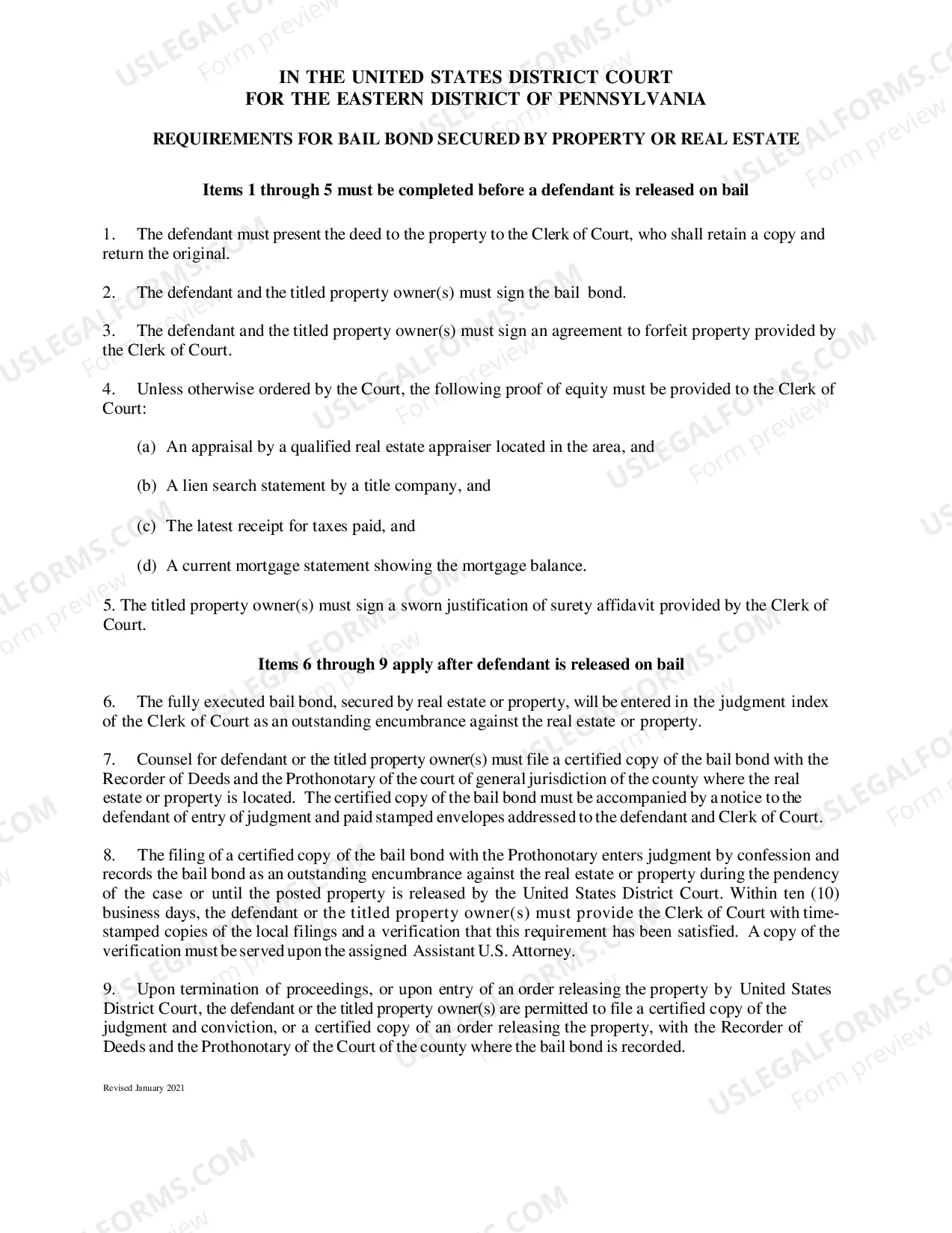
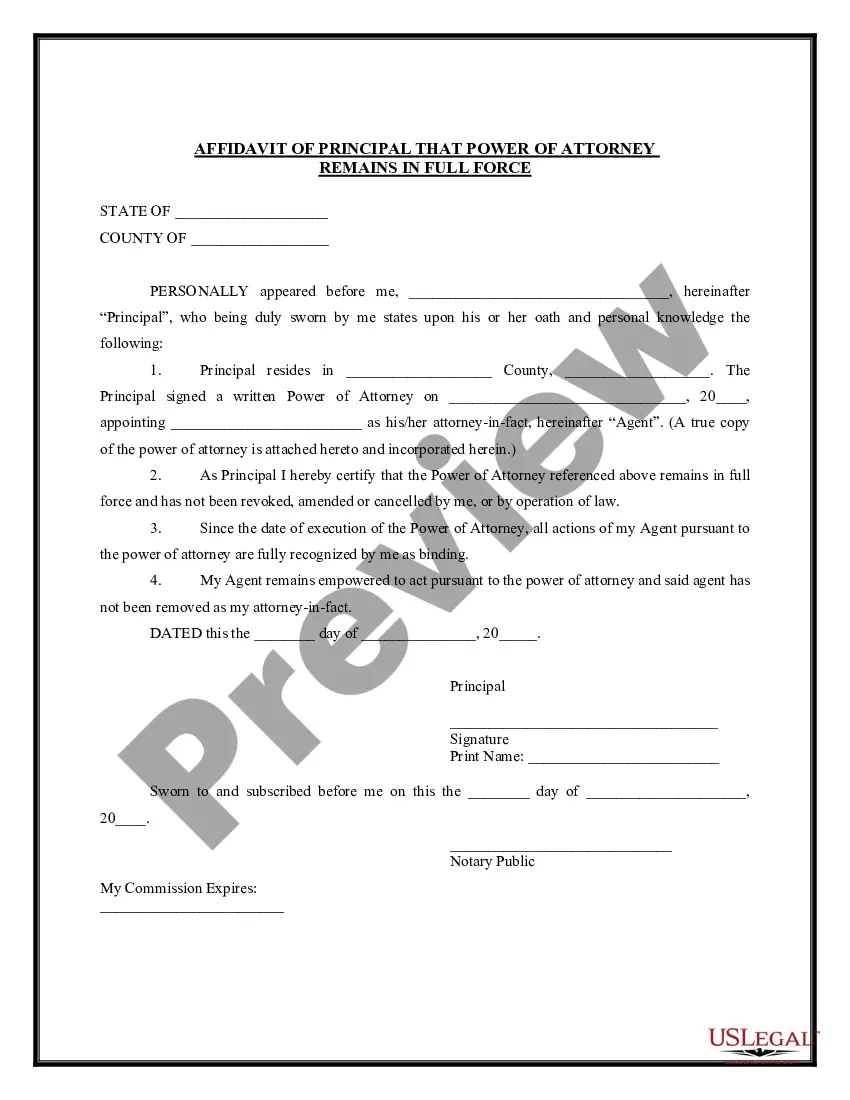
Affidavit of Principal that Power of Attorney not Revoked and in Full Force
About this form
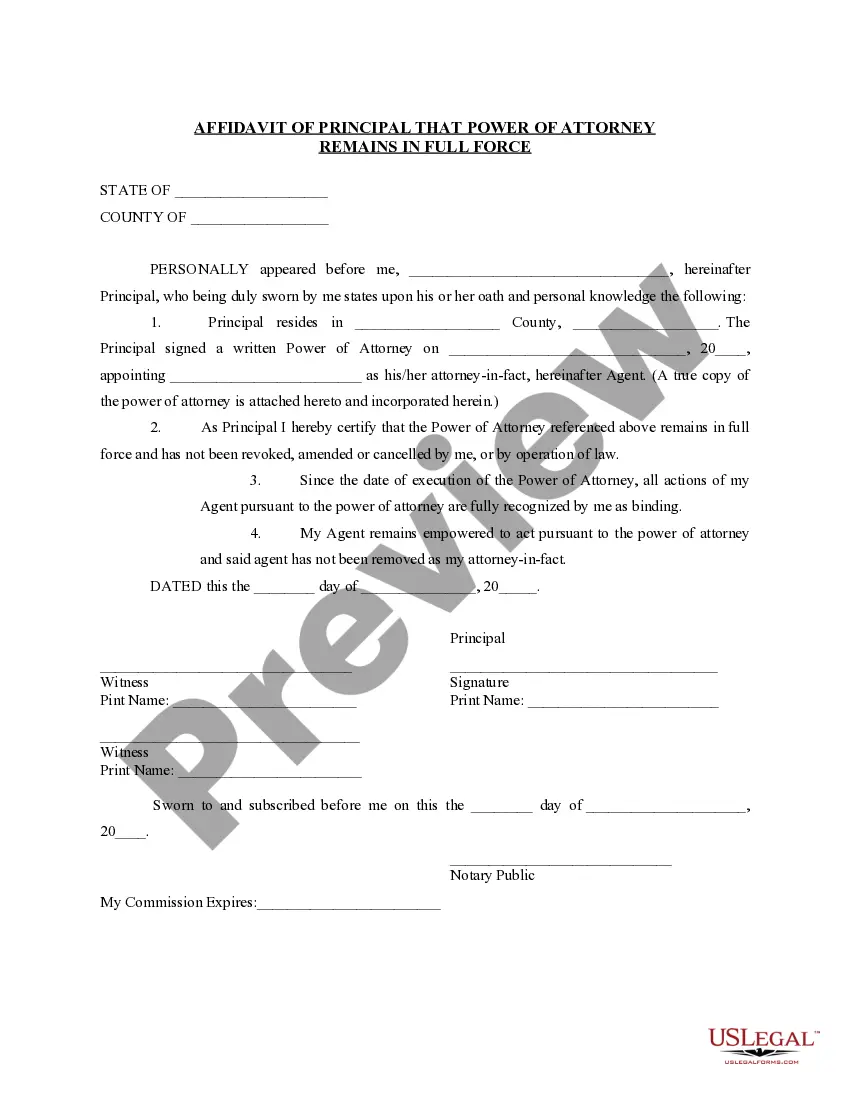
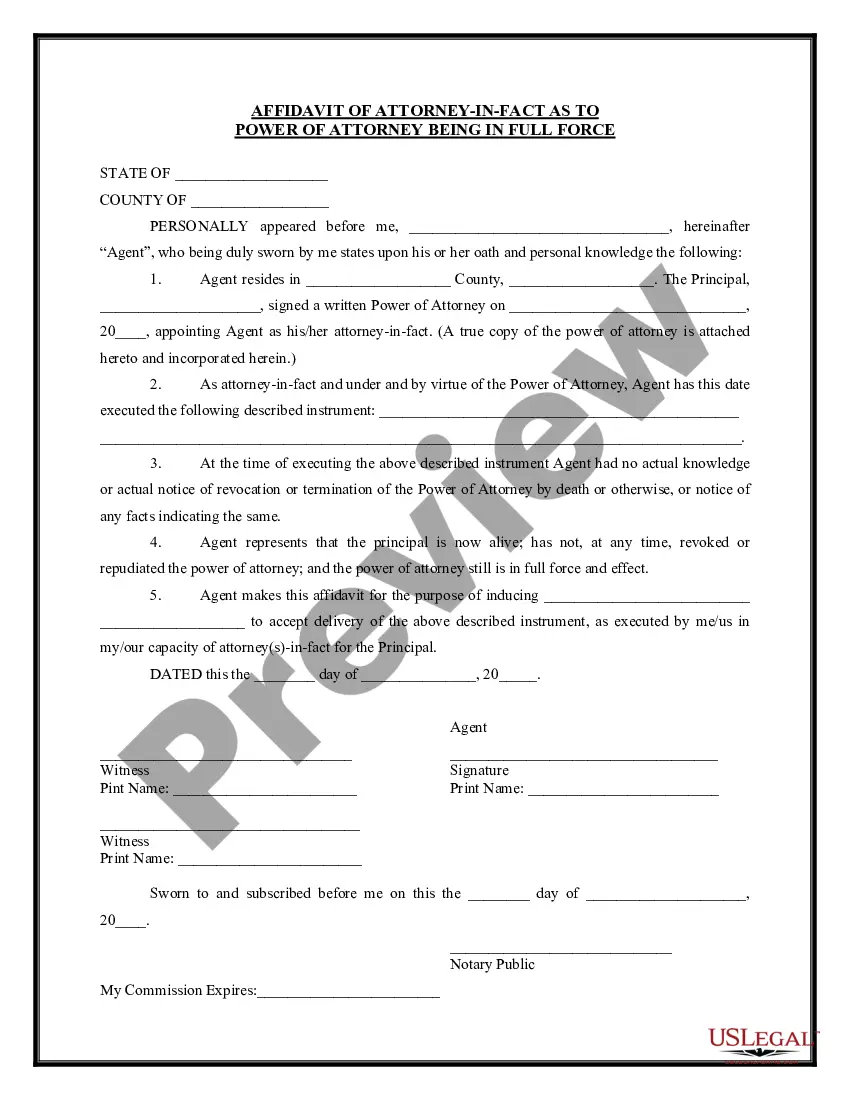
The Affidavit of Principal that Power of Attorney not Revoked and in Full Force serves as a legal declaration by a Principal. This document certifies that the Power of Attorney they granted remains active and has not been revoked. Unlike other power of attorney forms, this affidavit emphasizes its continued validity and serves as an essential confirmation for various legal and financial transactions.
Main sections of this form
- Identification of the Principal and Agent.
- Date of the original Power of Attorney execution.
- Certification that the Power of Attorney remains in full force.
- Principal's signature and date of affirmation.
- Notary acknowledgment to affirm the Principal's identity and signature.
Common use cases
This affidavit is typically used when a Principal needs to assert that their Power of Attorney is still valid. Common scenarios include financial transactions, real estate dealings, or healthcare decisions, where third parties may require confirmation that the Agent can act on behalf of the Principal without any restrictions.
Who should use this form
- Individuals who have appointed an Agent under a Power of Attorney.
- Principals wishing to provide assurance to third parties regarding the validity of their Power of Attorney.
- Agents needing verification of their authority to act on behalf of the Principal.
Instructions for completing this form
- Provide the state and county where the affidavit is executed.
- Fill in your name as the Principal, along with your residency information.
- Specify the date when the Power of Attorney was signed.
- Identify your Agent by name and ensure a copy of the original Power of Attorney is attached.
- Sign and date the affidavit before a notary public.
Notarization requirements for this form
This form must be notarized to be legally valid. US Legal Forms provides secure online notarization powered by Notarize, allowing you to complete the process through a verified video call.
Get your form ready online
Our built-in tools help you complete, sign, share, and store your documents in one place.
Make edits, fill in missing information, and update formatting in US Legal Forms—just like you would in MS Word.
Download a copy, print it, send it by email, or mail it via USPS—whatever works best for your next step.
Sign and collect signatures with our SignNow integration. Send to multiple recipients, set reminders, and more. Go Premium to unlock E-Sign.
If this form requires notarization, complete it online through a secure video call—no need to meet a notary in person or wait for an appointment.
We protect your documents and personal data by following strict security and privacy standards.

Make edits, fill in missing information, and update formatting in US Legal Forms—just like you would in MS Word.

Download a copy, print it, send it by email, or mail it via USPS—whatever works best for your next step.

Sign and collect signatures with our SignNow integration. Send to multiple recipients, set reminders, and more. Go Premium to unlock E-Sign.

If this form requires notarization, complete it online through a secure video call—no need to meet a notary in person or wait for an appointment.

We protect your documents and personal data by following strict security and privacy standards.
Common mistakes
- Not providing an attached copy of the original Power of Attorney.
- Failing to have the form notarized, if required.
- Leaving any required fields blank, such as dates or signatures.
Benefits of using this form online
- Convenience of downloading and filling the form at your own pace.
- Editable template allows for easy customization to reflect your specifics.
- Reliability of forms drafted by licensed attorneys.
Key takeaways
- The affidavit confirms that a Power of Attorney is still valid and has not been revoked.
- This form helps satisfy the needs of third parties that require proof of authority.
- Correct completion and notarization are essential for legal acceptance.
Looking for another form?




Form popularity
FAQ
The answer is Yes. If you change your mind about the person you chose to make decisions for you under a durable power of attorney, you can change it. In order to make changes to your Power of Attorney, however, you must have Legal Mental Capacity.
If you decide that you want to cancel / revoke a PoA that is registered with us, you will need to tell us. A PoA can only be cancelled / revoked by you, the granter, if you are capable of making and understanding this decision.
If you're mentally competent and no longer wish to have someone appointed as your power of attorney, you can cancel it by submitting a formal revocation form, as well as notifying the individual and other relevant third parties, in writing. You may want to cancel your power of attorney for several reasons.
A principal can revoke the power of attorney while he or she is still mentally competent. A principal can complete a formal written document requesting the revocation of a power of attorney at any time, for any reason, while he or she is still competent. The principal must sign and notarize the revocation request.
Unless the power of attorney states otherwise, and they usually don't, a revocation of a POA must be made in writing. A verbal revocation may not be enough.A revocation will reference the existing POA and the current attorney-in-fact and revoke the document and the powers granted.
A revocable POA which has only been notarized can be cancelled or revoked by issuing a notice/letter of revocation to the Attorney. Once the deed is drafted and registered, copy of it should be sent to the Attorney intimating him of the revocation.
After you make a power of attorney, you can revoke it at any time, as long as you are of sound mind. But to make the revocation legally effective, you must carefully follow all the procedures set out in this section.
A principal can rescind a Power of Attorney at any time, even if the Power of Attorney has a specified end date, so long as the principal is competent and the attorney-in-fact is notified. Third parties (such as a bank or the Land Titles Office) should also be notified of the revocation.