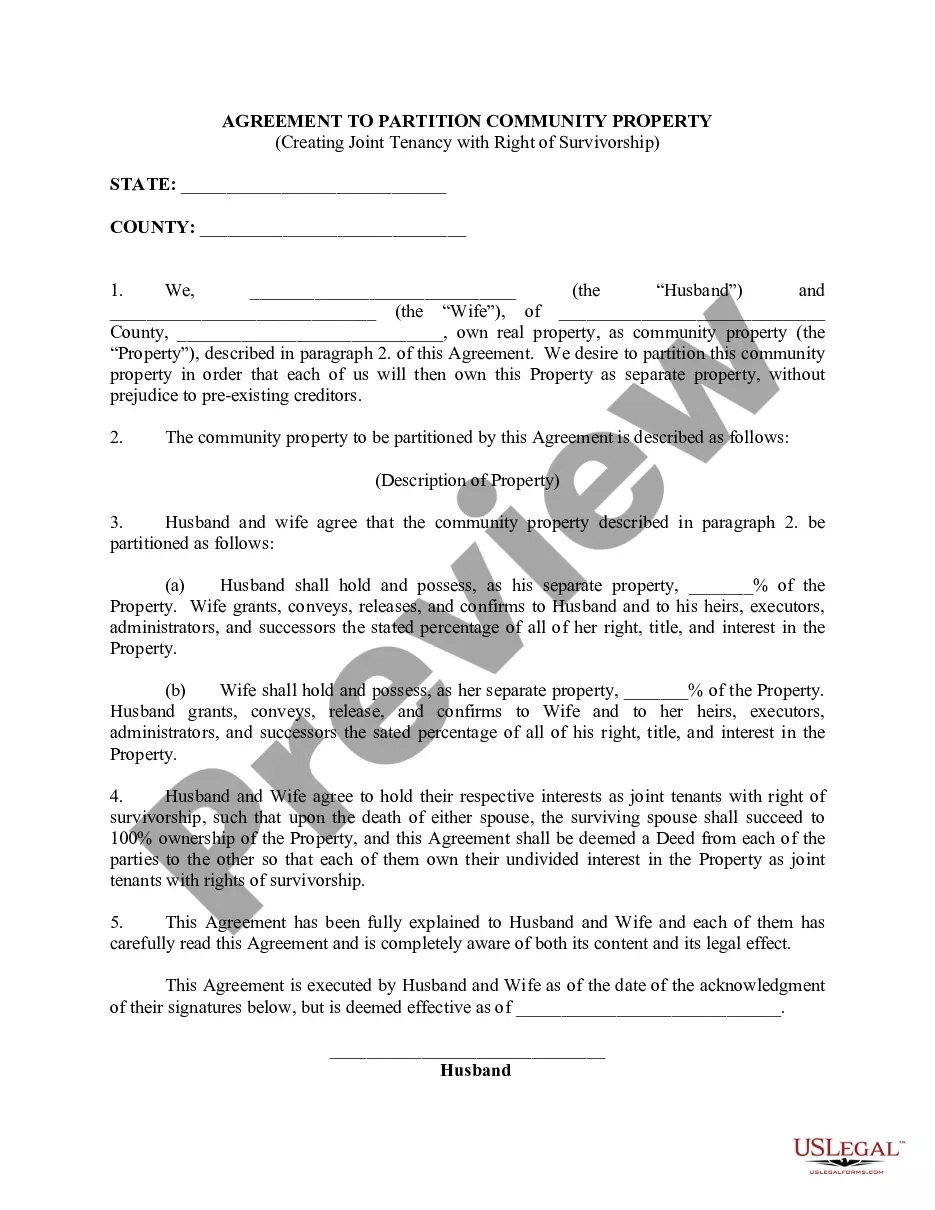
Agreement to Partition Community Property Creating Joint Tenancy with Right of Survivorship
What is this form?
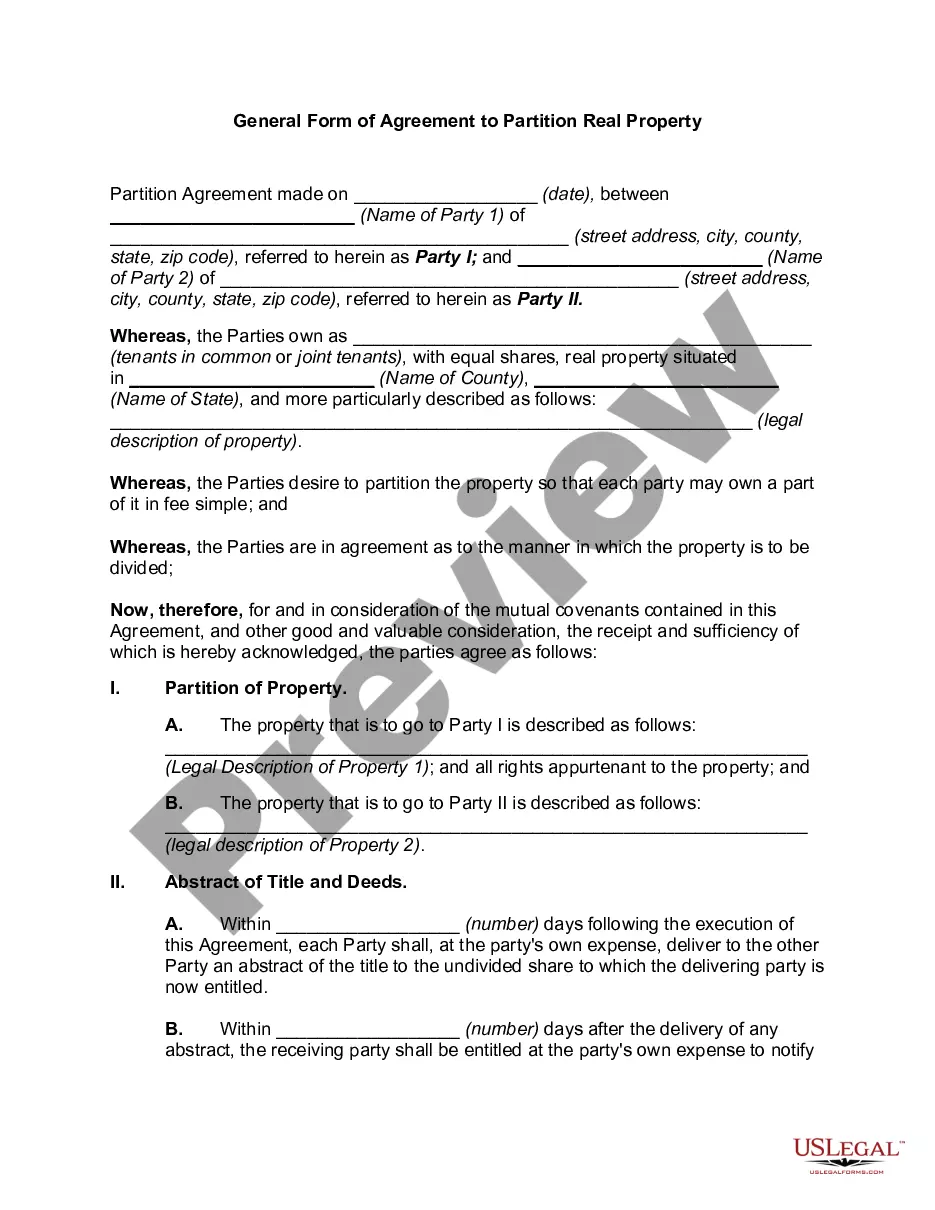
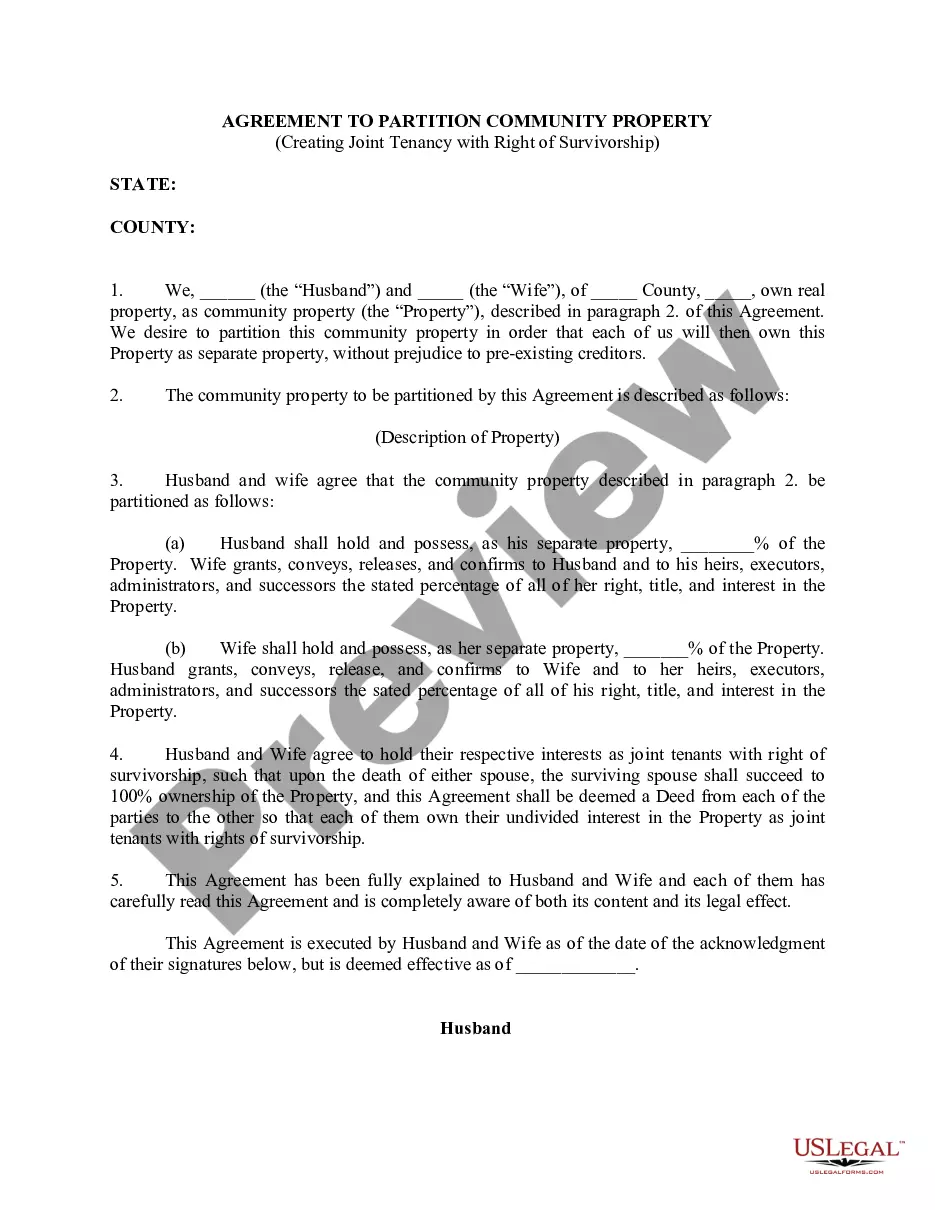
The Agreement to Partition Community Property Creating Joint Tenancy with Right of Survivorship is a legal document used in community property states, such as Texas. This form allows spouses to divide their community property into separate interests while establishing joint tenancy with the right of survivorship. This means that upon the death of one spouse, the other automatically inherits their share of the property, simplifying estate management and ensuring a smooth transfer of ownership.
Main sections of this form
- Identifies the spouses and their county of residence.
- Describes the community property to be partitioned.
- Outlines how each spouse will hold and possess their respective interests in the property.
- Establishes joint tenancy with right of survivorship for the property interests.
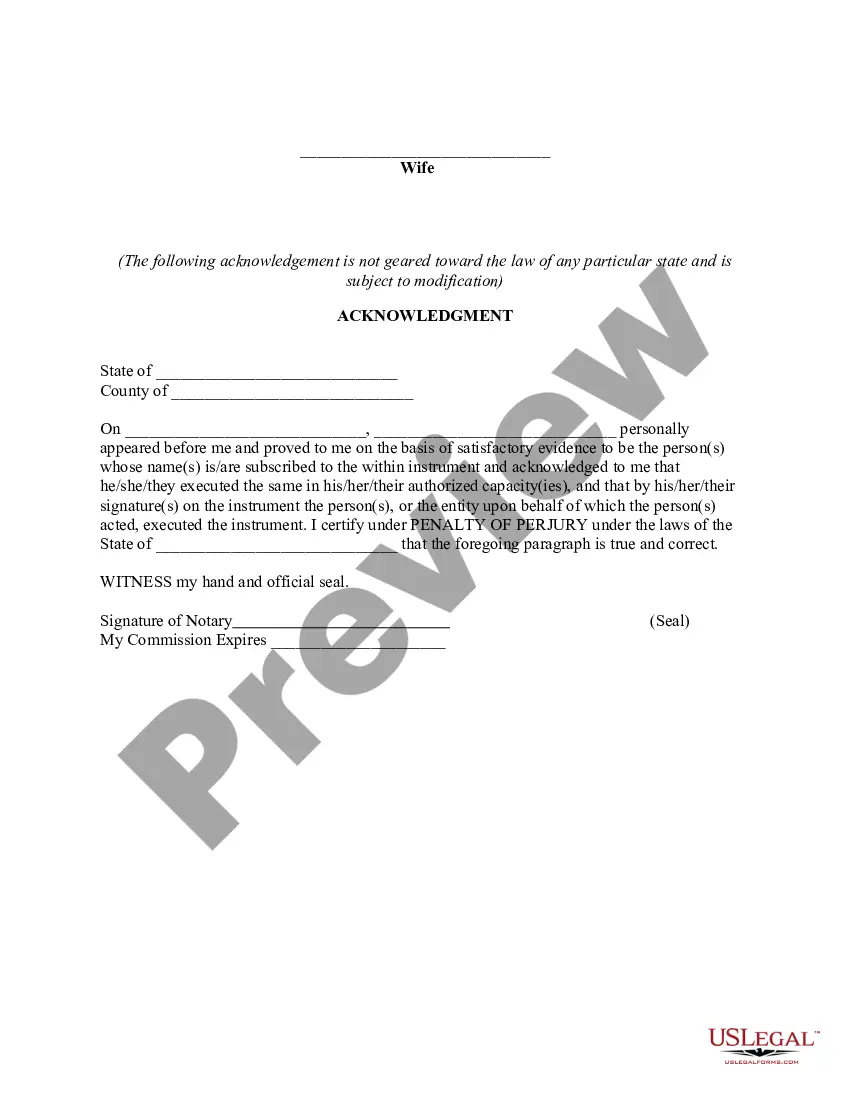
- Includes space for signatures of both spouses and a notary acknowledgment.
When to use this form
This form is typically used when a married couple wishes to clarify ownership of community property, particularly when they want to ensure that their respective shares transfer seamlessly to the surviving spouse upon death. It is also beneficial when spouses want to convert their shared ownership into separate interests while still maintaining joint rights after partition.
Intended users of this form
- Married couples looking to partition their community property.
- Spouses who want to create a joint tenancy with right of survivorship.
- Couples in community property states, particularly Texas, considering estate planning options.
Steps to complete this form
- Identify both parties by entering their full names and county.
- Describe the community property that is being partitioned.
- Specify what percentage of the property each spouse will own as separate property.
- Ensure both spouses agree to hold their interests as joint tenants with right of survivorship.
- Have both spouses sign the agreement in the presence of a notary public.
Is notarization required?
This document requires notarization to meet legal standards. US Legal Forms provides secure online notarization powered by Notarize, allowing you to complete the process through a verified video call, available 24/7.
Get your form ready online
Our built-in tools help you complete, sign, share, and store your documents in one place.
Make edits, fill in missing information, and update formatting in US Legal Forms—just like you would in MS Word.
Download a copy, print it, send it by email, or mail it via USPS—whatever works best for your next step.
Sign and collect signatures with our SignNow integration. Send to multiple recipients, set reminders, and more. Go Premium to unlock E-Sign.
If this form requires notarization, complete it online through a secure video call—no need to meet a notary in person or wait for an appointment.
We protect your documents and personal data by following strict security and privacy standards.

Make edits, fill in missing information, and update formatting in US Legal Forms—just like you would in MS Word.

Download a copy, print it, send it by email, or mail it via USPS—whatever works best for your next step.

Sign and collect signatures with our SignNow integration. Send to multiple recipients, set reminders, and more. Go Premium to unlock E-Sign.

If this form requires notarization, complete it online through a secure video call—no need to meet a notary in person or wait for an appointment.

We protect your documents and personal data by following strict security and privacy standards.
Common mistakes to avoid
- Failing to describe the property accurately can lead to disputes.
- Not having the document notarized, which may invalidate the agreement.
- Neglecting to specify the percentage of the property each spouse will receive.
- Not understanding the implications of joint tenancy and survivorship rights.
Why use this form online
- Convenience of completing the form from home at any time.
- Editability allows for easy corrections or updates before finalizing.
- Access to forms crafted by licensed attorneys for reliability and compliance.
What to keep in mind
- The Agreement to Partition Community Property is essential for married couples seeking clear ownership rights.
- This document facilitates the establishment of joint tenancy with right of survivorship.
- It is vital to have the form notarized for legal validity.
- Taking care to accurately fill in all details can help avoid common mistakes and ensure enforceability.
Looking for another form?

Form popularity
FAQ
The General Rule. In the great majority of states, if you and the other owners call yourselves "joint tenants with the right of survivorship," or put the abbreviation "JT WROS" after your names on the title document, you create a joint tenancy. A car salesman or bank staffer may assure you that other words are enough.
Tenants in common and joint tenants can petition a court to partition the property. This means that the court is being asked to divide the property into different lots or sections. There are two general types of partitions.
Property held in joint tenancy, tenancy by the entirety, or community property with right of survivorship automatically passes to the survivor when one of the original owners dies. Real estate, bank accounts, vehicles, and investments can all pass this way. No probate is necessary to transfer ownership of the property.
This is true even if the decedent created a will and bequeathed their interest in the property to someone else. This is known as the right of survivorship.The decedent's portion of the property receives a step-up in basis as of the date of their passing.
This is known as 'Severing the Joint Tenancy'. It requires service of a written notice of change the 'severance'. It can be done without the other owner's cooperation or agreement. It is recorded at the Land Registry, and the other owner will know it has been done but only 'after the event' so to speak.
Joint Tenancy With Survivorship In this arrangement, tenants have an equal right to the account's assets. They are also afforded survivorship rights in the event of the death of another account holder. In simple terms, it means that when one partner or spouse dies, the other receives all of the money or property.
Unity of time. Unity of title. Unity of interest. Unity of possession.