Traffic Signals and Street Lights Ordinance
About this form
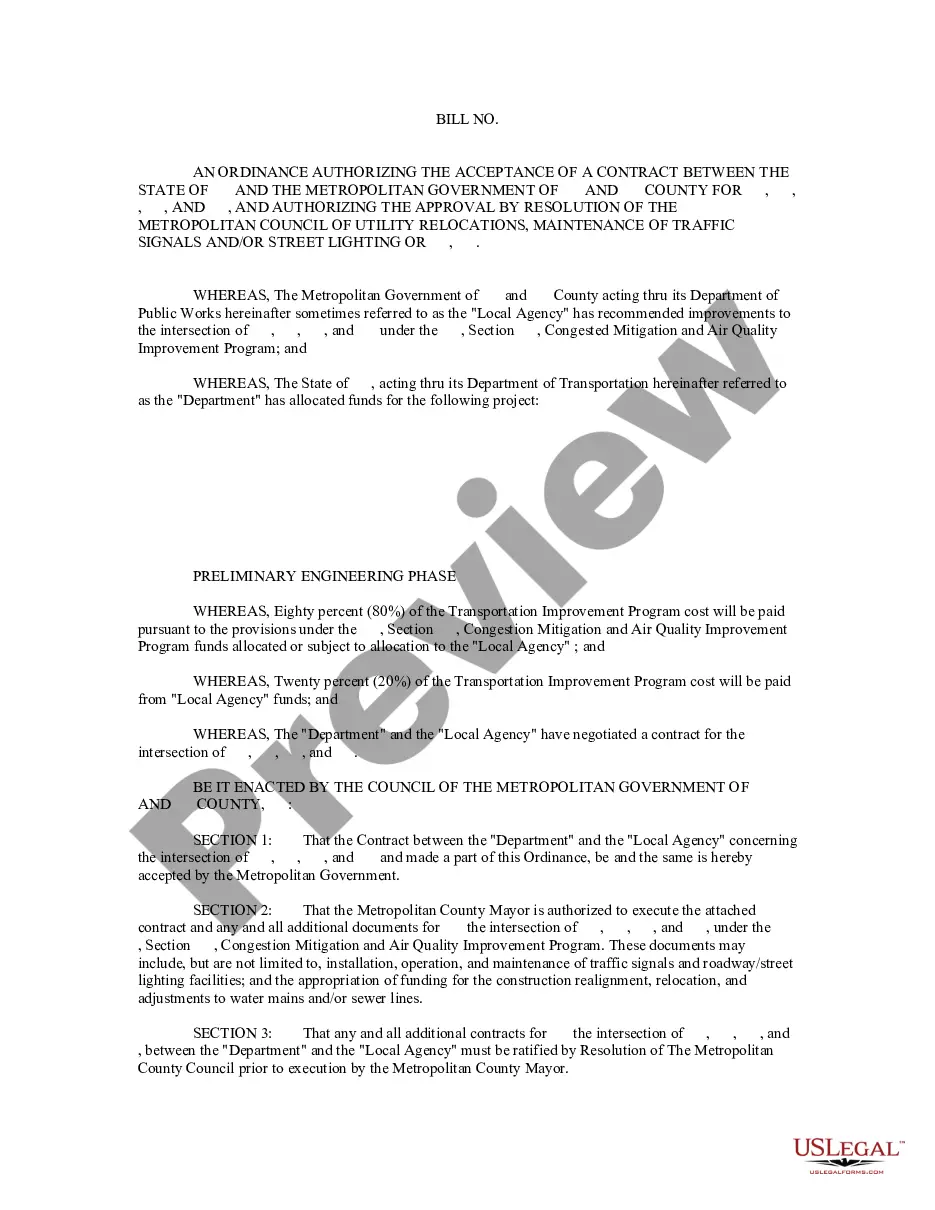
The Traffic Signals and Street Lights Ordinance is a legal document that authorizes the acceptance of a contract between the state and local government regarding the installation, maintenance, and operation of traffic signals and street lighting. This ordinance outlines the responsibilities of municipal and state agencies while ensuring improvements to traffic management and public safety.
Key parts of this document
- Authorization for the acceptance of the contract involving traffic signal and street light improvements.
- Details of the funding allocation from state and local agencies for the project.
- Provisions for execution and ratification by local government officials.
- Clauses on the effective date and constitutional integrity of the ordinance.





When to use this document
This form should be used when a local government seeks to implement changes to existing traffic signals and street lighting systems. It is necessary when funding from state transportation programs is involved and when local agencies must outline their responsibilities regarding utility relocations and maintenance.
Who can use this document
- Municipal governments planning to improve intersections or street lighting systems.
- Local agencies collaborating with state transportation departments.
- City councils and mayors responsible for traffic management and public safety initiatives.
Steps to complete this form
- Identify the parties involved, including state and local government agencies.
- Enter the details of the traffic signal and street lighting improvements, including the project location.
- Specify the funding breakdown from state and local sources.
- Include signature lines for municipal officials, such as the mayor or council chair.
- Ensure adoption and passage by the municipal council prior to execution.
Notarization requirements for this form
In most cases, this form does not require notarization. However, some jurisdictions or signing circumstances might. US Legal Forms offers online notarization powered by Notarize, accessible 24/7 for a quick, remote process.
Get your form ready online
Our built-in tools help you complete, sign, share, and store your documents in one place.
Make edits, fill in missing information, and update formatting in US Legal Forms—just like you would in MS Word.
Download a copy, print it, send it by email, or mail it via USPS—whatever works best for your next step.
Sign and collect signatures with our SignNow integration. Send to multiple recipients, set reminders, and more. Go Premium to unlock E-Sign.
If this form requires notarization, complete it online through a secure video call—no need to meet a notary in person or wait for an appointment.
We protect your documents and personal data by following strict security and privacy standards.

Make edits, fill in missing information, and update formatting in US Legal Forms—just like you would in MS Word.

Download a copy, print it, send it by email, or mail it via USPS—whatever works best for your next step.

Sign and collect signatures with our SignNow integration. Send to multiple recipients, set reminders, and more. Go Premium to unlock E-Sign.

If this form requires notarization, complete it online through a secure video call—no need to meet a notary in person or wait for an appointment.

We protect your documents and personal data by following strict security and privacy standards.
Avoid these common issues
- Failing to include all necessary parties in the contract.
- Omitting funding details or miscalculating allocation percentages.
- Not ratifying additional contracts by municipal council resolution.
Benefits of completing this form online
- Convenient access to the ordinance template anytime, allowing for quick downloads.
- Editability ensures that municipalities can tailor the document to their specific needs.
- Access to reliable legal forms drafted by licensed attorneys, promoting compliance with local laws.
Legal use & context
- This ordinance serves as a binding agreement between local and state governments regarding traffic management.
- It is enforceable upon passage; however, courts may invalidate sections without affecting the entire document.
- Local agencies must follow prescribed procedures for the adoption and implementation of this ordinance.
Main things to remember
- The Traffic Signals and Street Lights Ordinance establishes legal authority for traffic improvement projects.
- Proper completion and passage of the form are essential for legal enforceability.
- Consult local regulations for potential notarization and procedural requirements.
Looking for another form?


Form popularity
FAQ
Essential Energy is responsible for the maintenance and billing of around 160,000 streetlights for 85 Councils across NSW and southern Queensland, from Bega Valley in the south to Tweed Heads in the north and Broken Hill in the west.
There are no laws prohibiting that activity in traffic, as long as you pull over first or have a passenger do it. (We do have a state law against texting and driving.)
In a modern streetlight, a small circuit replaces the bird and turns the light on when the amount of light falls below a certain threshold. If a small amount of current flows from emitter to base, then a large amount of current can flow from emitter to collector.It really is a very simple circuit!
A: There are 6 types of signals, viz- Traffic Control Signals, Fixed time signals, Manually operated signals, Traffic actuated (automatic) signals, Pedestrian signals, Special traffic signals.
The street light circuit contained an automatic current regulator, preventing the current from increasing as lamps burned out, preserving the life of the remaining lamps.
It is the duty of the Municipal Corporation of the city to replace the streetlights.
The most common traffic lights work on simple timers.In these situations, sensor-based traffic signals maximize traffic efficiency by only functioning when traffic is present. Rather than timers, "smart" or "intelligent" sensor-based traffic signals rely upon a system of sensors to detect when vehicles are present.
Streetlights are run by photovoltaic (solar) cells. So when the light of the sun comes up, there's enough electricity generated within the component, which opens the circuit, to make the light switch off, and vice versa.
Abstract: In China, the methods of time-control, optical-control and time-optical-control are in common used to control street lamp, particularly in small and medium-sized cities.