Declaration and Power of Attorney for Patent Application
What is this form?
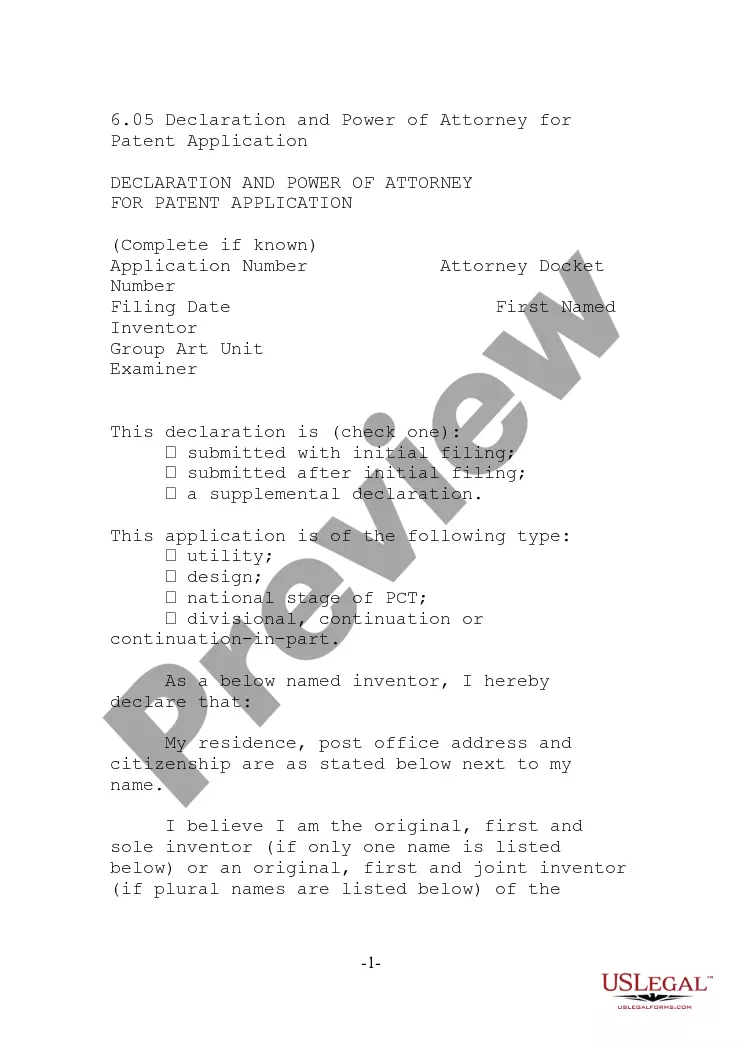
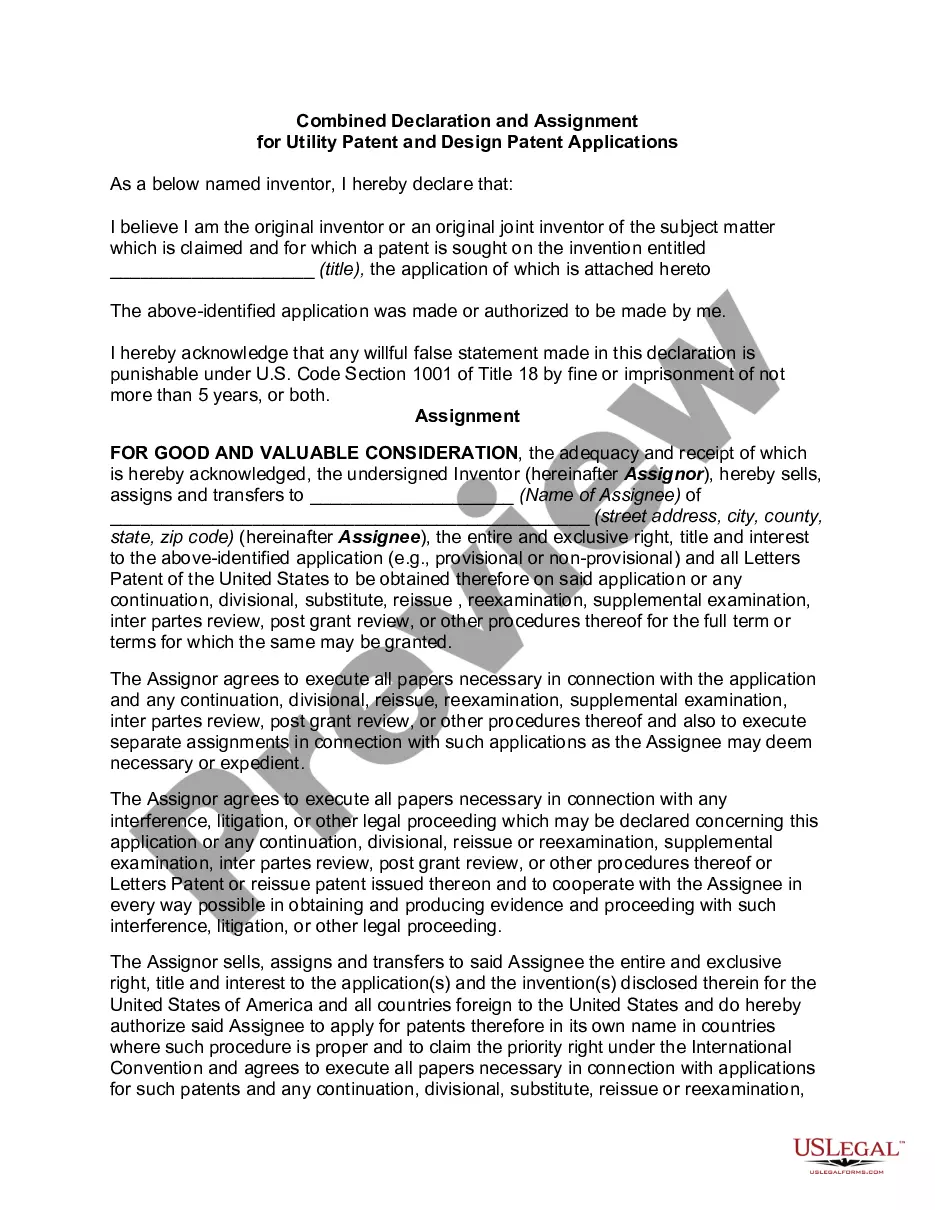
The Declaration and Power of Attorney for Patent Application is a legal document that empowers an individual or entity to file and manage a patent application on behalf of the inventor(s). This form is essential for declaring the inventorship of a patentable invention and allows an attorney to act on behalf of the inventor(s) during the patent process. Unlike other power of attorney documents, this form is specifically tailored for patent applications and includes sections for declaring inventorship and any priority claims.
Key components of this form
- Application Number and Attorney Docket Number fields
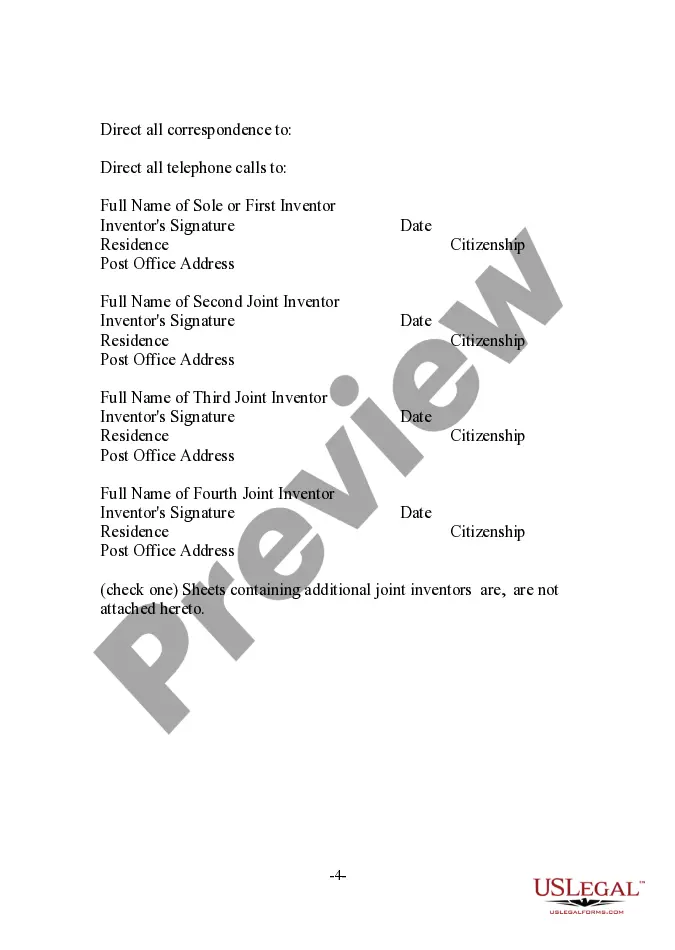
- Declaration of inventorship and citizenship details
- Specification of the type of patent application (utility, design, etc.)
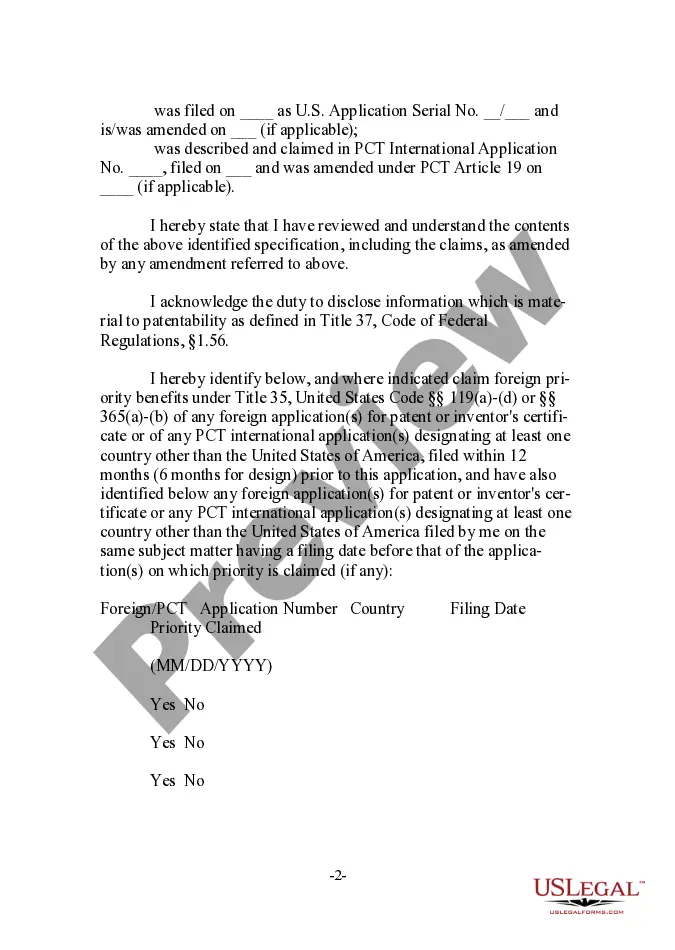
- Claim for priority benefits and related foreign applications
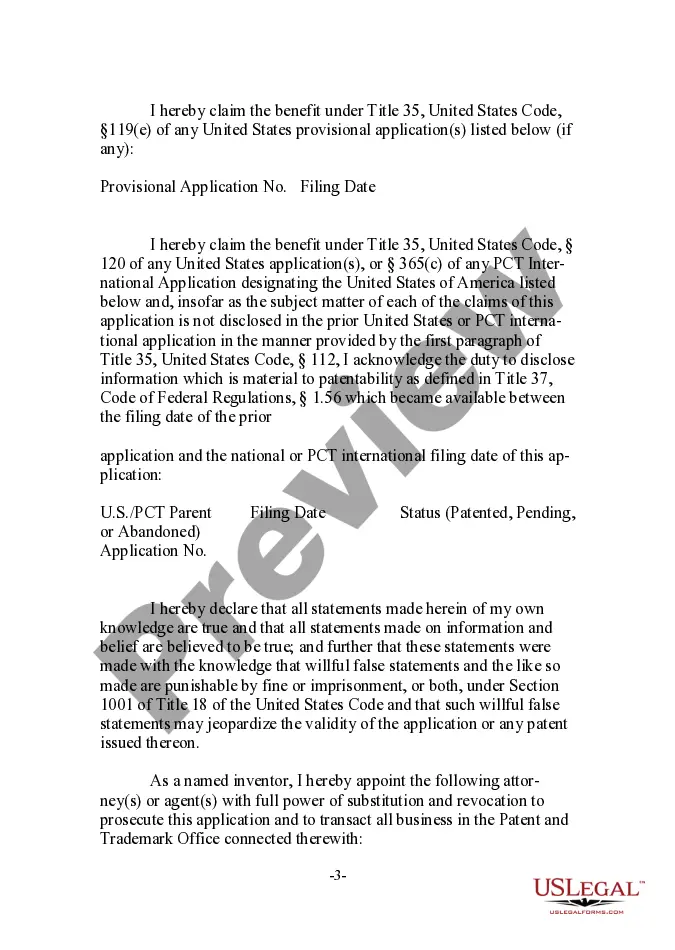
- Appointment of an attorney or agent for prosecution of the application
- Signatures and dates of the inventors
Situations where this form applies
This form should be used when an inventor is ready to file a patent application with the United States Patent and Trademark Office (USPTO). It is necessary when one or more inventors need to officially declare their invention and appoint an attorney to represent them in the patent filing process. Additionally, this form is required if there are claims of priority based on prior applications or if the application is being amended.
Intended users of this form
- Inventors of a new product or innovation seeking patent protection
- Individuals or entities intending to file a patent on behalf of the original inventor(s)
- Attorneys or agents representing inventors in the patent application process
- Co-inventors needing to declare their joint interests in an invention
Instructions for completing this form
- Enter the application number, attorney docket number, and filing date.
- Provide the residence, post office address, and citizenship for each inventor.
- Select the type of patent application and indicate if this is an initial, supplemental, or subsequent declaration.
- Identify any foreign applications for which priority is being claimed.
- Sign and date the form, ensuring all inventors provide their signatures as required.
Does this form need to be notarized?
This form does not typically require notarization unless specified by local law. Always check your jurisdiction's requirements to confirm whether notarization is necessary for your patent application.
Get your form ready online
Our built-in tools help you complete, sign, share, and store your documents in one place.
Make edits, fill in missing information, and update formatting in US Legal Forms—just like you would in MS Word.
Download a copy, print it, send it by email, or mail it via USPS—whatever works best for your next step.
Sign and collect signatures with our SignNow integration. Send to multiple recipients, set reminders, and more. Go Premium to unlock E-Sign.
If this form requires notarization, complete it online through a secure video call—no need to meet a notary in person or wait for an appointment.
We protect your documents and personal data by following strict security and privacy standards.

Make edits, fill in missing information, and update formatting in US Legal Forms—just like you would in MS Word.

Download a copy, print it, send it by email, or mail it via USPS—whatever works best for your next step.

Sign and collect signatures with our SignNow integration. Send to multiple recipients, set reminders, and more. Go Premium to unlock E-Sign.

If this form requires notarization, complete it online through a secure video call—no need to meet a notary in person or wait for an appointment.

We protect your documents and personal data by following strict security and privacy standards.
Typical mistakes to avoid
- Failing to sign the form, which invalidates the declaration.
- Incorrectly listing inventors or omitting co-inventors.
- Not providing complete addresses and citizenship information for all inventors.
- Neglecting to check the appropriate type of application being submitted.
Why use this form online
- Convenient access to a legally vetted document tailored for patent applications.
- Ability to edit the form as needed before finalizing your submission.
- Access to templates developed by licensed attorneys, ensuring they meet legal standards.
Legal use & context
- The form establishes inventorship, which is critical for patent validity.
- Submit the form with the patent application to comply with USPTO regulations.
- Provides legal authority for an attorney to act on behalf of the inventor(s).
Key takeaways
- The Declaration and Power of Attorney for Patent Application is essential for patent filings.
- Complete the form accurately to avoid processing delays.
- This form allows inventors to appoint legal representation effectively.
Looking for another form?
Form popularity
FAQ
Simply, a declaration is an inventor's promise or acknowledgment of the promise with the Patent Office.Third, the inventor agrees to disclose to the Patent Office any information which may be material to the patentability of the invention.
A provisional application is not required to have a formal patent claim or an oath or declaration. Provisional applications also should not include any information disclosure (prior art) statement since provisional applications are not examined.
A patent owner has the right to decide who may or may not use the patented invention for the period in which the invention is protected. In other words, patent protection means that the invention cannot be commercially made, used, distributed, imported, or sold by others without the patent owner's consent.
Patent law protects inventions (utility patents) and ornamental designs for articles of manufacture (design patents).Examples of manufactured articles protected by design patents are a design for the sole of running shoes, a design for sterling silver tableware, and a design for a water fountain.
Patent law is the branch of intellectual property law that deals with new inventions. Traditional patents protect tangible scientific inventions, such as circuit boards, car engines, heating coils, or zippers.Once granted, a patent gives the inventors the exclusive right to sell their invention for 20 years.
A patent shall confer on its owner the following exclusive rights: (a) to prevent third parties not having his consent from the acts of: making, using, offering for sale, selling, or importing footnote for these purposes the product which is the subject matter of the patent; (b) where the subject matter of a patent
A patent is the granting of a property right by a sovereign authority to an inventor. This grant provides the inventor exclusive rights to the patented process, design, or invention for a designated period in exchange for a comprehensive disclosure of the invention. They are a form of incorporeal right.
Application form in duplicate (Form 1). The provisional or complete specification in duplicate. Drawing in duplicate (if necessary). Abstract of the invention in duplicate. Information & undertaking listing the number, filing date & current status of each foreign patent application in duplicate (Form 3).
A patent is an exclusive right granted by a country to an inventor, allowing the inventor to exclude others from making, using or selling his or her invention in that country during the life of the patent.