Self-Employed Exterminator Service Contract - Pest Control
Understanding this form
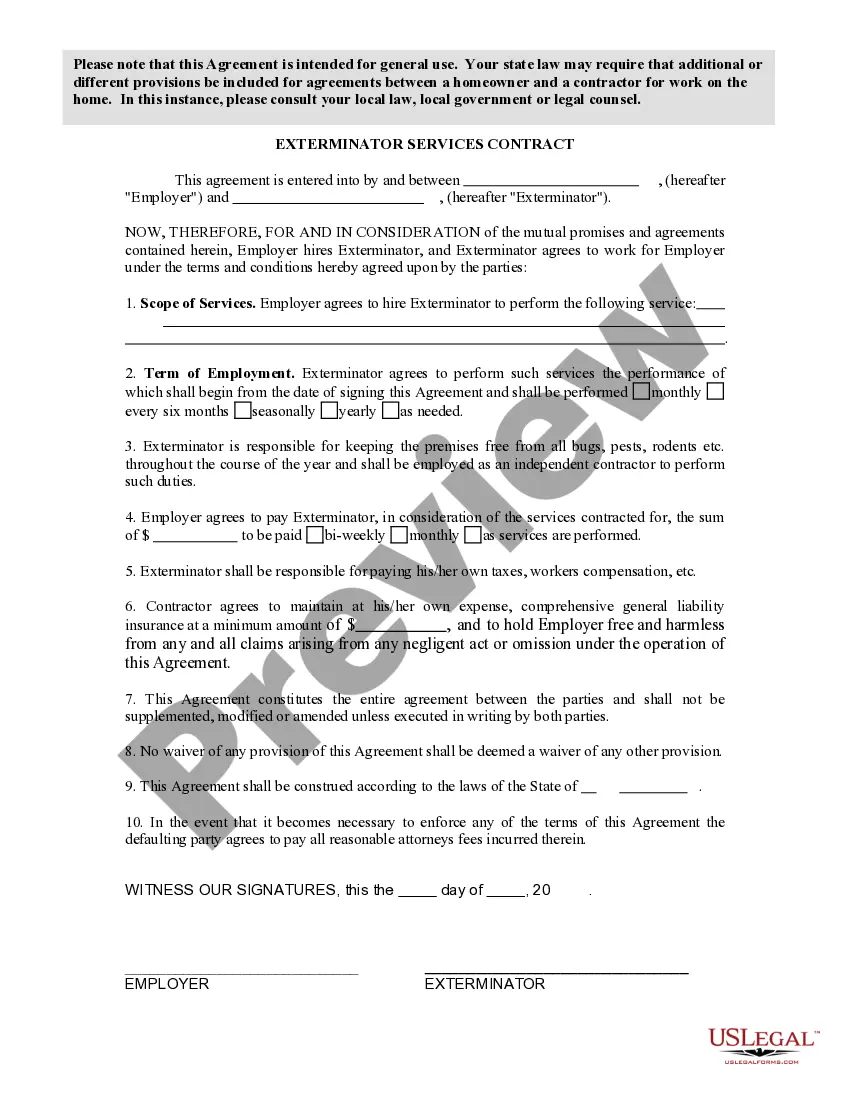
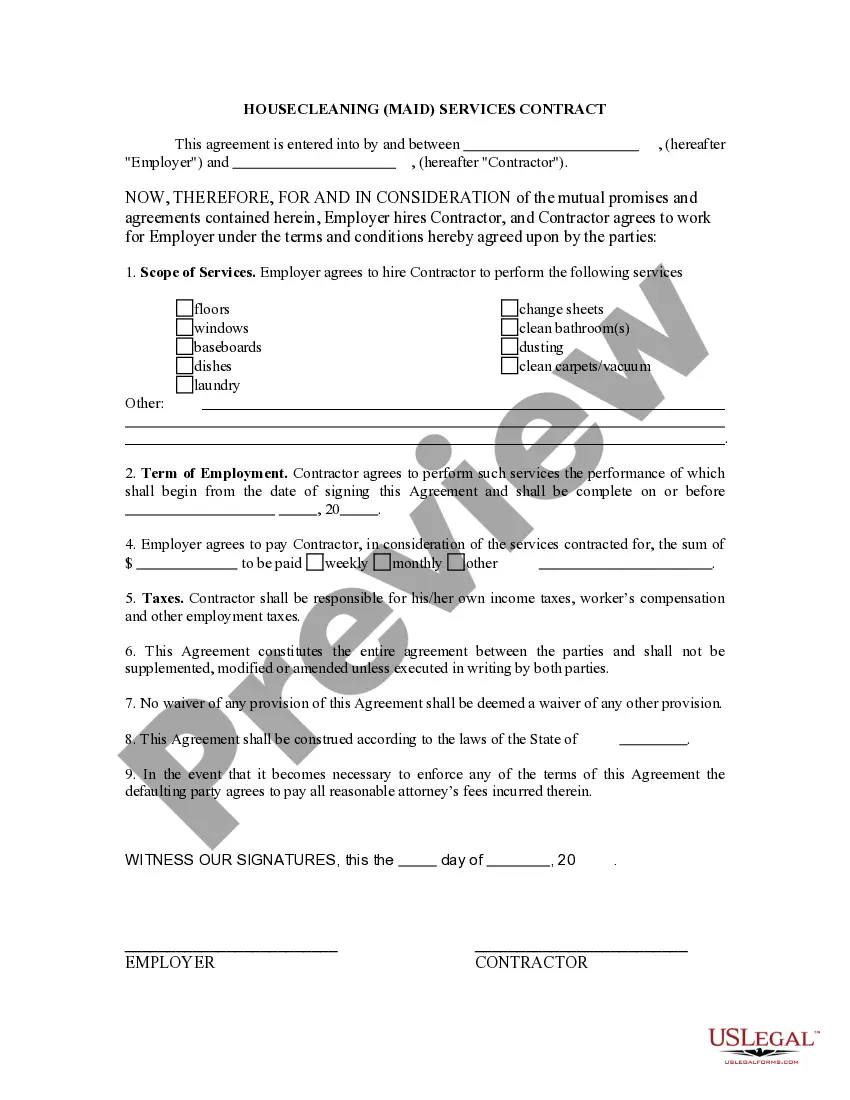
The Self-Employed Exterminator Service Contract is a legal agreement between an employer and an exterminator or entomologist who is hired to maintain a pest-free environment at a place of business. This contract outlines the scope of services and clarifies the independent contractor status. Unlike standard service agreements, this document specifically caters to pest control services, ensuring both parties understand their rights and responsibilities.
Key components of this form
- Scope of Services: Details the specific pest control services to be provided by the exterminator.
- Responsibilities: Outlines the exterminator's obligation to keep the premises free from pests throughout the year.
- Independent Contractor Status: Clarifies that the exterminator is not an employee but operates as an independent contractor.
- Payment Terms: Specifies the compensation and payment schedule for services rendered.
- Contract Duration: Indicates the duration of the contract and conditions for termination.
When to use this form
This form should be used when you need to hire an exterminator on a contractual basis for regular pest control services. It's particularly useful if you manage a business or property that requires ongoing pest management, ensuring both parties have a clear understanding of the services to be rendered and the expectations involved. Scenarios include commercial establishments like restaurants or warehouses, as well as residential properties needing professional pest control.
Who can use this document
- Business owners seeking regular pest control services.
- Property managers responsible for maintaining facilities.
- Individuals requiring pest control for residential properties.
- Exterminators or entomologists offering their services as independent contractors.
How to prepare this document
- Identify the parties involved: Enter the names of the employer and the exterminator.
- Define the scope of services: Clearly outline the pest control services to be provided.
- Set payment terms: Specify how and when the exterminator will be paid.
- Determine the contract duration: Indicate the length of the contract and termination conditions.
- Sign and date the contract: Ensure both parties sign the contract for validation.
Does this document require notarization?
Notarization is generally not required for this form. However, certain states or situations might demand it. You can complete notarization online through US Legal Forms, powered by Notarize, using a verified video call available anytime.
Get your form ready online
Our built-in tools help you complete, sign, share, and store your documents in one place.
Make edits, fill in missing information, and update formatting in US Legal Forms—just like you would in MS Word.
Download a copy, print it, send it by email, or mail it via USPS—whatever works best for your next step.
Sign and collect signatures with our SignNow integration. Send to multiple recipients, set reminders, and more. Go Premium to unlock E-Sign.
If this form requires notarization, complete it online through a secure video call—no need to meet a notary in person or wait for an appointment.
We protect your documents and personal data by following strict security and privacy standards.

Make edits, fill in missing information, and update formatting in US Legal Forms—just like you would in MS Word.

Download a copy, print it, send it by email, or mail it via USPS—whatever works best for your next step.

Sign and collect signatures with our SignNow integration. Send to multiple recipients, set reminders, and more. Go Premium to unlock E-Sign.

If this form requires notarization, complete it online through a secure video call—no need to meet a notary in person or wait for an appointment.

We protect your documents and personal data by following strict security and privacy standards.
Avoid these common issues
- Not being specific about the services provided, leading to misunderstandings.
- Failing to clarify payment and compensation arrangements.
- Not including termination conditions, which can complicate disputes.
- Using vague language that may lead to ambiguity in the contract's enforceability.
Benefits of completing this form online
- Convenience: Download the form anytime and from anywhere.
- Editability: Customize the form to fit specific needs without hassle.
- Reliability: Use templates drafted by licensed attorneys to ensure legal compliance.
Legal use & context
- The contract serves as a legally binding agreement to uphold the responsibilities of both parties.
- Clearly defined terms increase enforceability in case of disputes.
- Ensures compliance with local pest control regulations as applicable.
Key takeaways
- This form establishes a clear agreement for pest control services between an employer and an exterminator.
- It is crucial to define the scope of services and payment terms to avoid misunderstandings.
- Using a reliable, attorney-drafted template can help ensure legal compliance.
Looking for another form?
Form popularity
FAQ
A pest control company will exterminate a whole host of creepy pests in your home. They will deal with rodents, beetles, termites, wasps, mosquitoes, roaches, bed bugs, termites, and fleas.An exterminator will check for sources of the pests such as garbage or sewers.
Physical methods of pest control. This is one of the natural methods of pest control; it is a non-chemical pest control method. Chemical methods of pest control. Cultural methods of pest control. Biological methods of pest control.
Determine Which Pest Control Services You'll Provide. Develop Your Value Proposition. Build Your Brand. Licensing, Registration, and Certification. Protect Your Pest Control Business (and Yourself) with Insurance. Open a Pest Control Business Checking Account. Choose the Right Pest Control Equipment.
According to HomeGuide.com the average cost for a pest control visit from a professional contractor was $170 as of January 2018, with a general range of $100 to $270. Meanwhile, HomeAdvisor.com says the average range for a single visit $108 to $260, with the national average at $173.
If you are doing it on your own, you may need to buy different equipment and chemicals to take care of different kinds of insects. It's entirely possible a contract and ongoing cost will be a dealbreaker. But if you can afford the monthly charge, it brings many benefits you may find worthwhile.
If you just have problems like the occasional cockroach, you'll probably be fine doing everything on your own. You can find various over-the-counter sprays that will keep these pests from getting into your home (or at least kill them if they do).
Whether it's maintaining proper hygiene, using natural alternatives, employing DIY techniques, or utilizing professional services, preventative pest control is definitely worth it. The best way to deal with an infestation is to avoid one entirely in the first place.
Exterminators. An exterminator's main objective is to kill the pests. They don't always address the root of the pest problem. Exterminators rely solely on pesticides to get rid of your problem. This means sometimes using materials that are more toxic than necessary to alleviate the issue.
Exterminators rely on pesticides to eliminate the unwanted pests, using chemicals that could be more toxic than necessary whereas a pest control professional will focus on why the pests are present and look to alter the conditions that attracted them in the first place.