A Summary of Your Rights Under the Fair Credit Reporting Act
Understanding this form
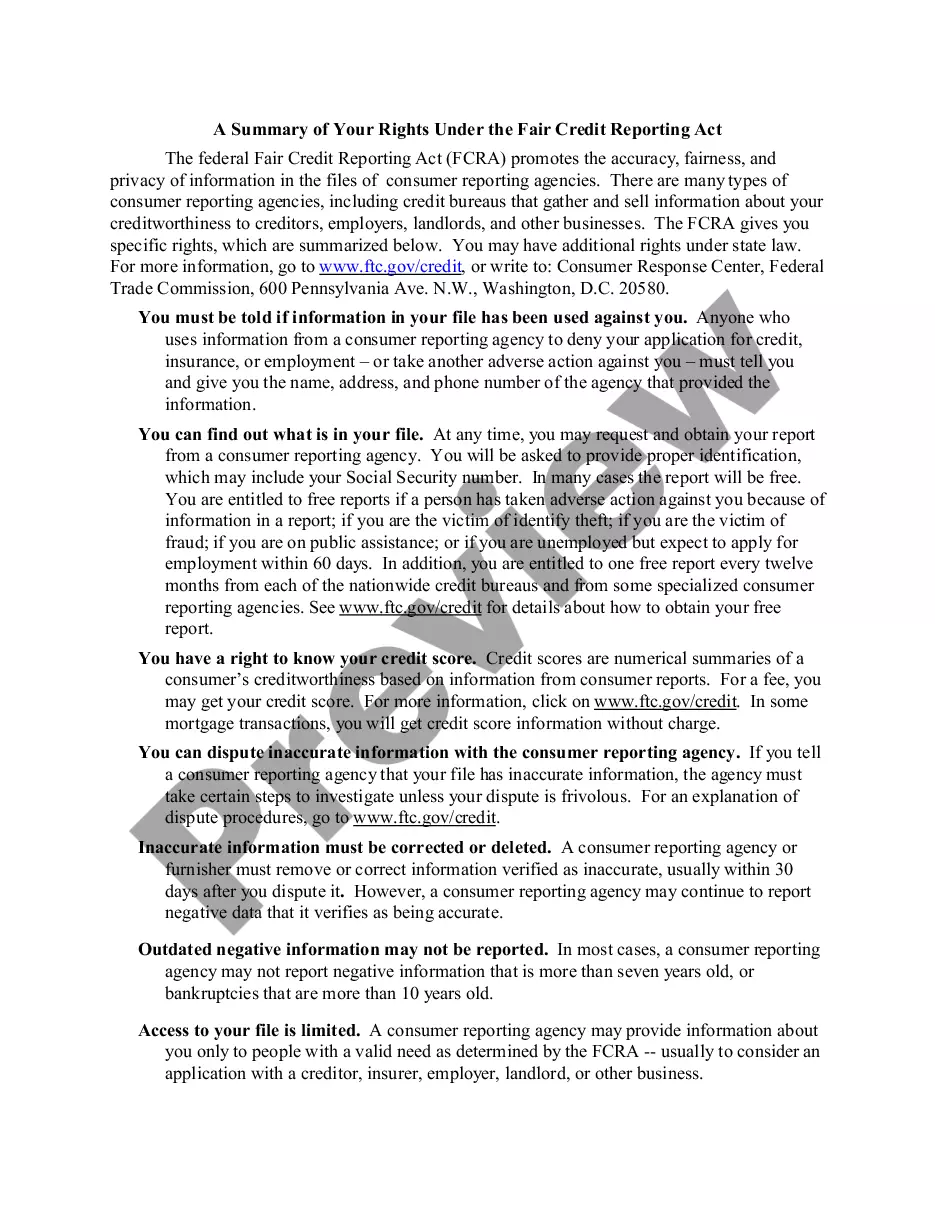
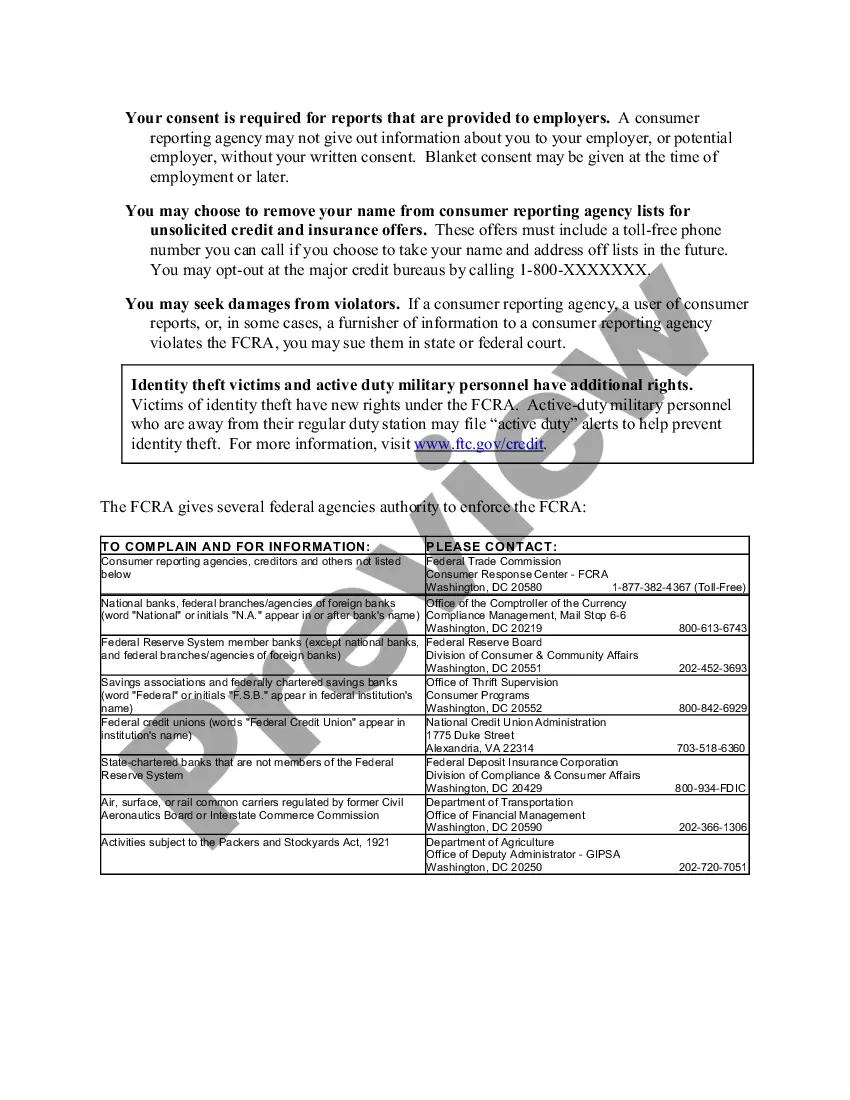
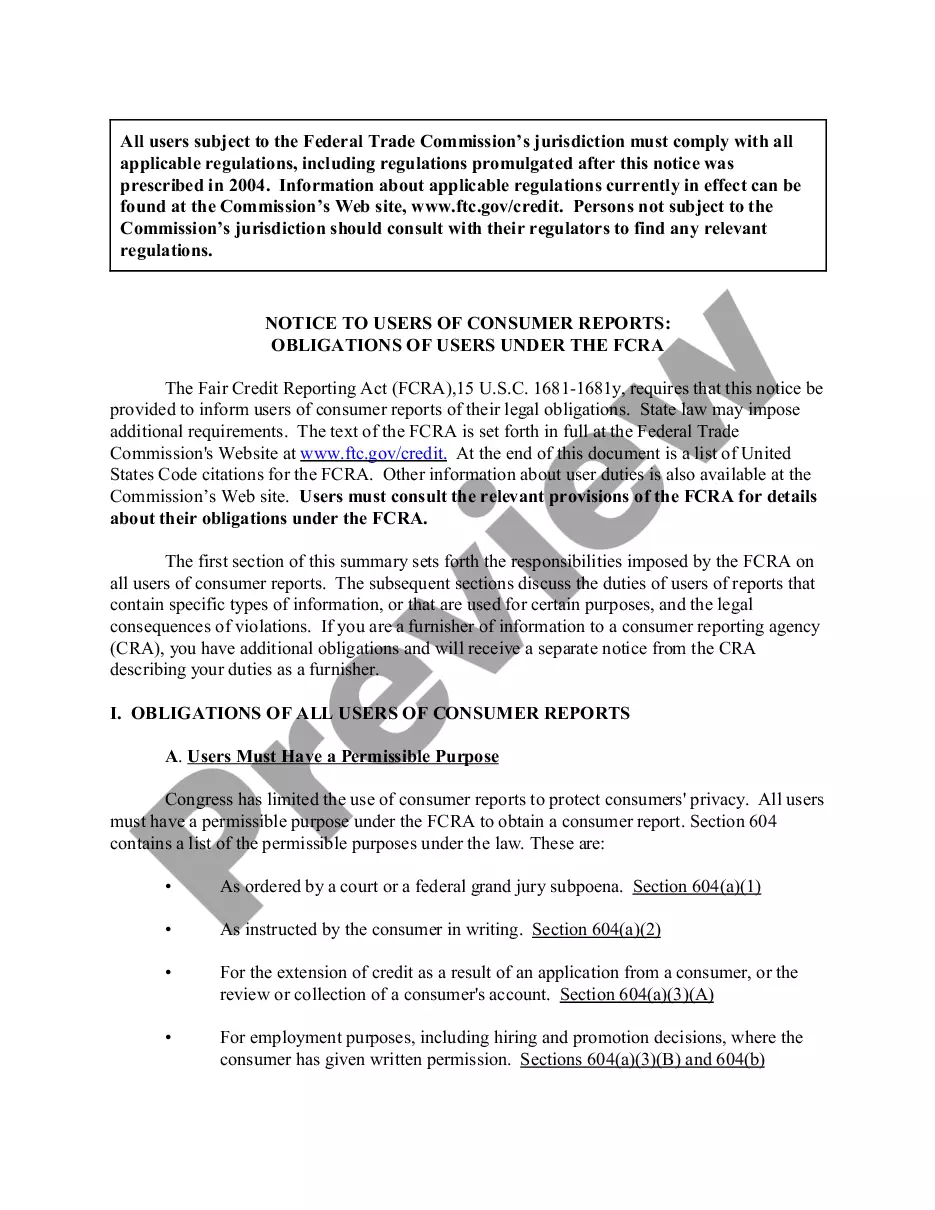
A Summary of Your Rights Under the Fair Credit Reporting Act is a document that informs consumers about their rights regarding the use of their credit reports and information by consumer reporting agencies. This form is essential for individuals looking to understand their legal protections and options in relation to credit reporting, distinct from other legal documents focusing on credit agreements or debt management.
Key parts of this document
- Clarification of your rights concerning the use of your consumer report.
- Details on how to obtain your credit report and when it is free.
- Procedures for disputing inaccurate information in your credit report.
- Information on maintaining the privacy of your consumer information.
- Rights related to identity theft and additional protections for military personnel.
Common use cases
This form is necessary when a consumer reporting agency uses information from your credit report to make decisions about credit, employment, or insurance. It is also relevant if you wish to exercise your rights to obtain your report and dispute inaccuracies, or if you suspect identity theft and want to understand your rights in that context.
Who can use this document
- Consumers who have applied for credit and wish to understand their rights.
- Job applicants who are subject to background checks by prospective employers.
- Individuals looking to dispute inaccuracies in their credit reports.
- Victims of identity theft needing guidance on their legal rights.
Instructions for completing this form
- Read the summary of your rights carefully to understand your protections.
- Identify your consumer reporting agency and note their contact information.
- Request your credit report if needed, providing necessary identification.
- Follow the outlined dispute procedures for any inaccurate information.
- Keep a record of communications and any disputes filed with agencies.
Does this form need to be notarized?
This form does not typically require notarization to be legally valid. However, some jurisdictions or document types may still require it. US Legal Forms provides secure online notarization powered by Notarize, available 24/7 for added convenience.
Get your form ready online
Our built-in tools help you complete, sign, share, and store your documents in one place.
Make edits, fill in missing information, and update formatting in US Legal Forms—just like you would in MS Word.
Download a copy, print it, send it by email, or mail it via USPS—whatever works best for your next step.
Sign and collect signatures with our SignNow integration. Send to multiple recipients, set reminders, and more. Go Premium to unlock E-Sign.
If this form requires notarization, complete it online through a secure video call—no need to meet a notary in person or wait for an appointment.
We protect your documents and personal data by following strict security and privacy standards.

Make edits, fill in missing information, and update formatting in US Legal Forms—just like you would in MS Word.

Download a copy, print it, send it by email, or mail it via USPS—whatever works best for your next step.

Sign and collect signatures with our SignNow integration. Send to multiple recipients, set reminders, and more. Go Premium to unlock E-Sign.

If this form requires notarization, complete it online through a secure video call—no need to meet a notary in person or wait for an appointment.

We protect your documents and personal data by following strict security and privacy standards.
Common mistakes to avoid
- Not requesting a free report when qualifying under the provided criteria.
- Failing to follow up after disputing inaccurate information.
- Overlooking your right to receive a report if adverse action is taken against you.
Why use this form online
- Immediate access to essential information without waiting for postal delivery.
- Easy navigation of your rights using simplified online formats.
- The ability to download and save the summary for your records.
Legal use & context
- The form reinforces consumer rights under the Fair Credit Reporting Act.
- It serves as a valuable reference for understanding actions against credit reports.
- Legal recourse is available for violations of the FCRA.
Quick recap
- This summary outlines your rights concerning credit reporting.
- You have the right to access and dispute information in your consumer reports.
- Special provisions exist for identity theft victims and military personnel.
Looking for another form?
Form popularity
FAQ
The Fair Credit Reporting Act describes the kind of data that the bureaus are allowed to collect. That includes the person's bill payment history, past loans, and current debts.
2022 You have the right to know what is in your file.report; 2022 you are the victim of identity theft and place a fraud alert in your file; 2022 your file contains inaccurate information as a result of fraud; 2022 you are on public assistance; 2022 you are unemployed but expect to apply for employment within 60 days.
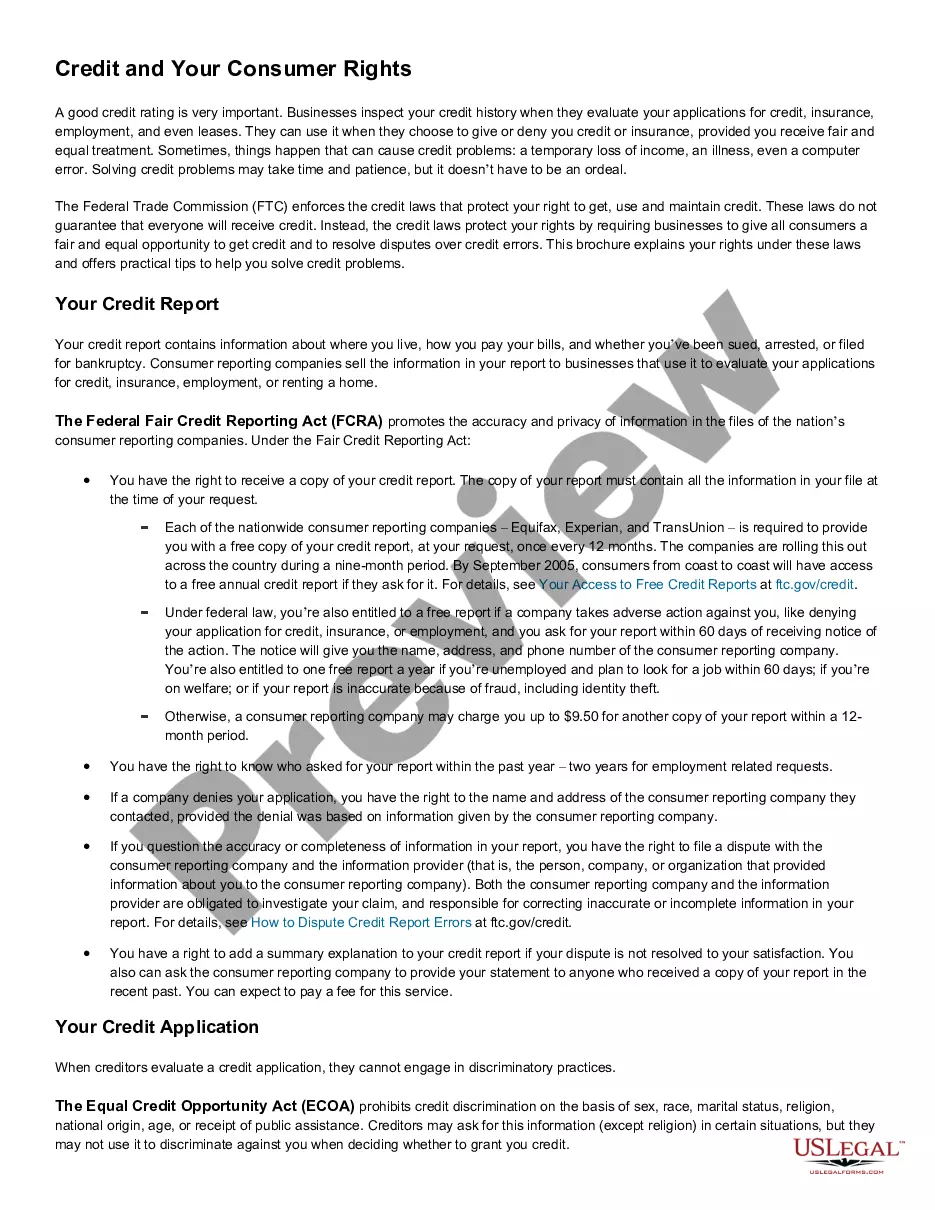
You have the right to know what's in your credit reports. The act requires credit reporting agencies to give you free access to the information they have collected about you and your financial habits once every 12 months.
The FCRA gives you the right to be told if information in your credit file is used against you to deny your application for credit, employment or insurance. The FCRA also gives you the right to request and access all the information a consumer reporting agency has about you (this is called "file disclosure").
Under the Equal Credit Opportunity Act: You cannot be denied credit based on your race, sex, marital status, religion, age, national origin, or receipt of public assistance. You have the right to have reliable public assistance considered in the same manner as other income.
The Act (Title VI of the Consumer Credit Protection Act) protects information collected by consumer reporting agencies such as credit bureaus, medical information companies and tenant screening services. Information in a consumer report cannot be provided to anyone who does not have a purpose specified in the Act.
The Summary of Consumer Rights explains certain major consumer rights under the FCRA, including the right to obtain a copy of a consumer report, the frequency and circumstances under which a consumer is entitled to receive a free consumer report, the right to dispute information in a consumer's file, and the right to
The Fair Credit Reporting Act (FCRA) is a federal law that regulates credit reporting agencies and compels them to insure the information they gather and distribute is a fair and accurate summary of a consumer's credit history.The law is intended to protect consumers from misinformation being used against them.
Your credit report does not include your marital status, medical information, buying habits or transactional data, income, bank account balances, criminal records or level of education. It also doesn't include your credit score.