Export Compliance Due Diligence Inquiries
Understanding this form
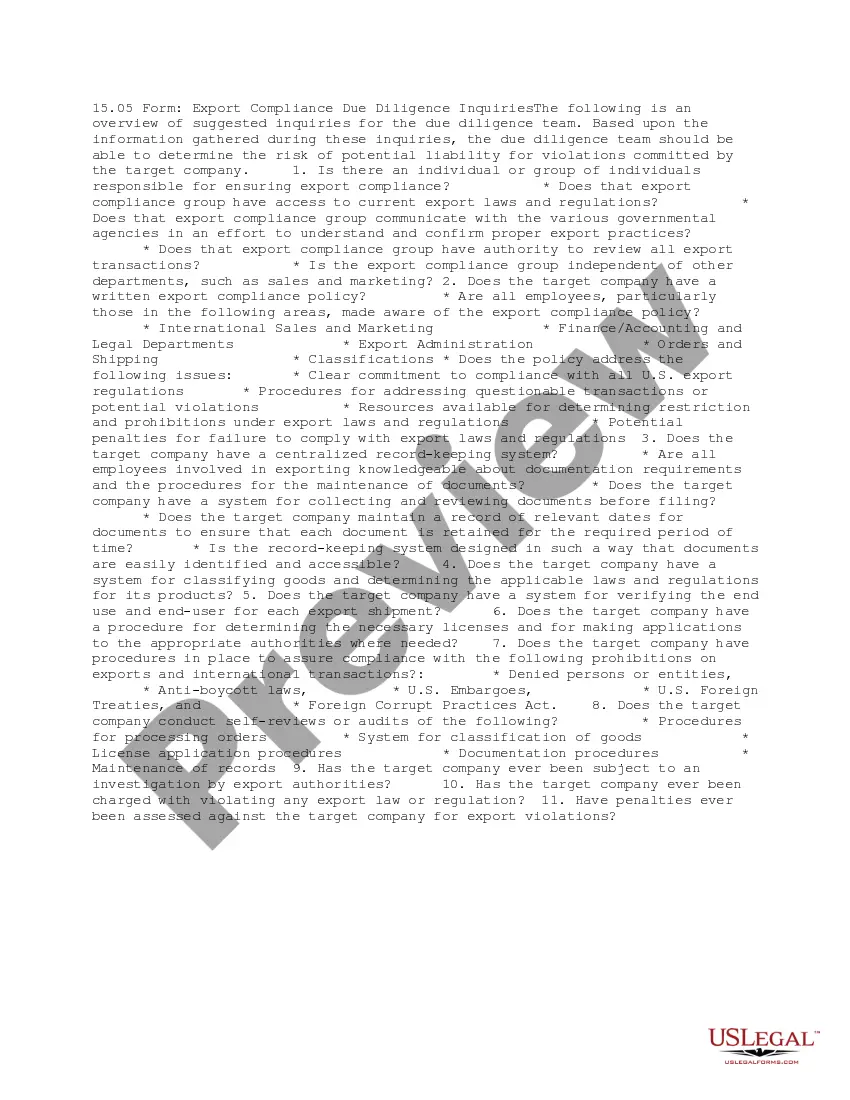
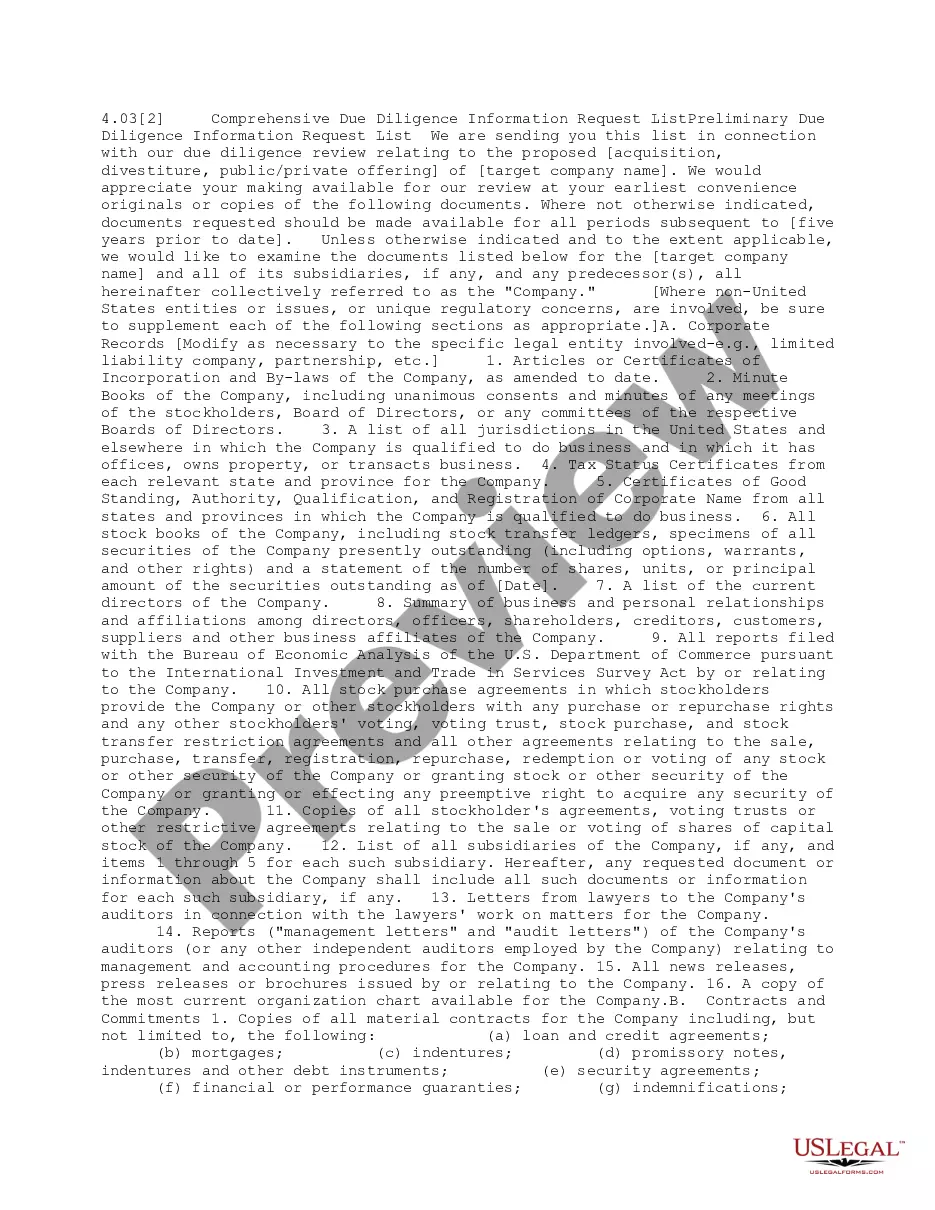
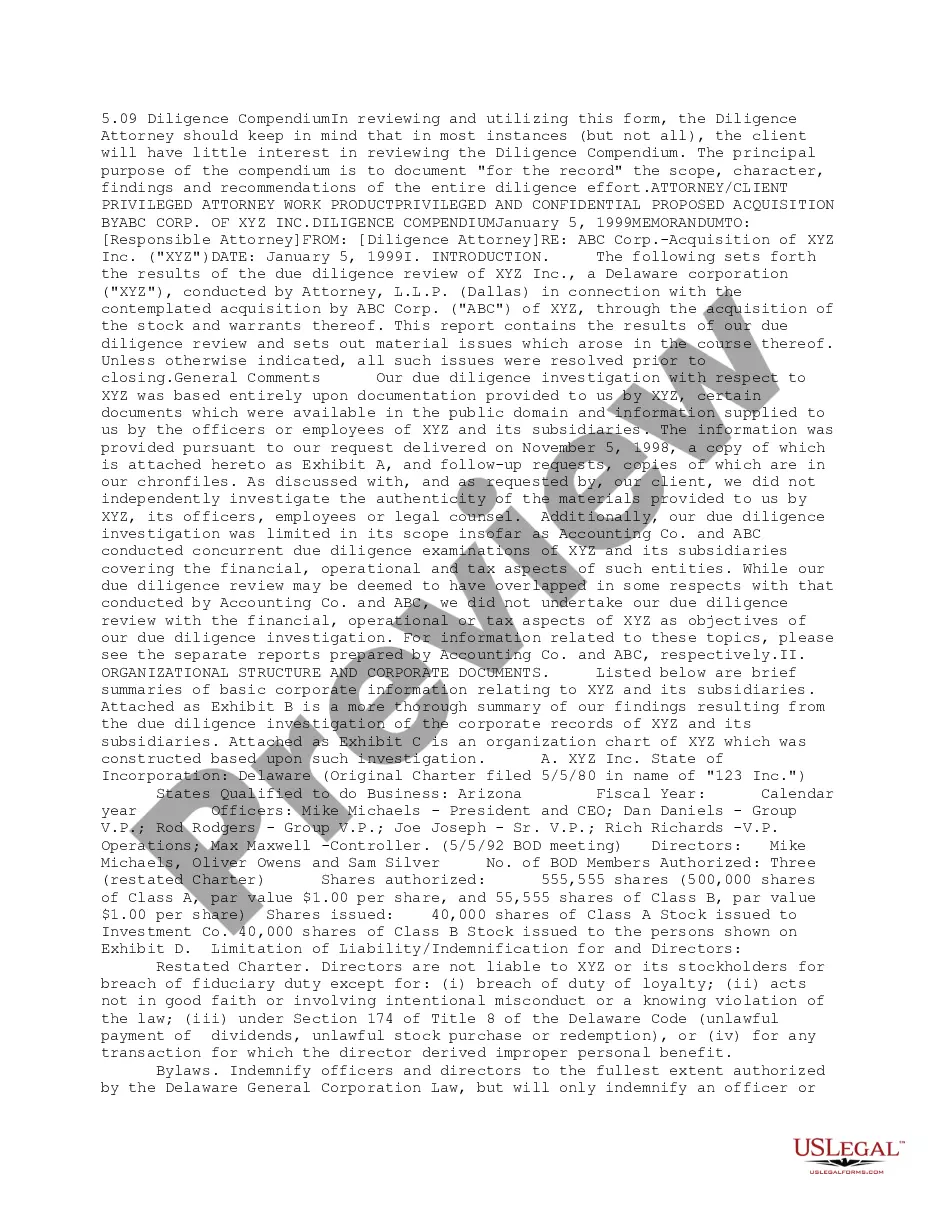
The Export Compliance Due Diligence Inquiries form is a comprehensive template designed to assist companies in assessing their export compliance processes and potential liabilities. This form streamlines the due diligence evaluation by providing a structured approach to inquiries regarding export practices, ensuring that businesses adhere to necessary regulations. Unlike similar forms, this document specifically addresses inquiries about compliance policies, record-keeping systems, and risk assessments related to export activities.
What’s included in this form
- Identification of responsible individuals or groups for export compliance.
- Evaluation of written export compliance policies and employee awareness.
- Assessment of centralized record-keeping systems for exporting documentation.
- Inquiries about licensing procedures and government communication.
- Review of procedures for compliance with various export regulations and laws.
- Consideration of past investigations or violations related to export activities.
Common use cases
This form is essential when a company is involved in exporting goods and needs to ensure compliance with U.S. export laws and regulations. It is particularly useful during mergers, acquisitions, or partnerships, where understanding export liabilities is critical. Companies conducting self-audits of their compliance processes can also utilize this form to identify areas requiring improvement.
Who needs this form
Intended users of the Export Compliance Due Diligence Inquiries form include:
- Export compliance officers and managers.
- Business owners engaged in international sales.
- Due diligence teams assessing potential liabilities.
- Legal professionals advising on export regulations.
- Auditors or consultants specializing in trade compliance.
Steps to complete this form
To complete the Export Compliance Due Diligence Inquiries form, follow these steps:
- Identify the individual or team responsible for your company's export compliance and assess their authority and resources.
- Review the company's written export compliance policy for clarity and employee engagement.
- Evaluate the record-keeping system for effectiveness in maintaining and processing export documentation.
- Confirm that there is an established procedure for verifying the end use and end-user of export transactions.
- Document any past investigations or violations to fully assess potential liabilities.
Does this form need to be notarized?
This form does not typically require notarization to be legally valid. However, some jurisdictions or document types may still require it. US Legal Forms provides secure online notarization powered by Notarize, available 24/7 for added convenience.
Get your form ready online
Our built-in tools help you complete, sign, share, and store your documents in one place.
Make edits, fill in missing information, and update formatting in US Legal Forms—just like you would in MS Word.
Download a copy, print it, send it by email, or mail it via USPS—whatever works best for your next step.
Sign and collect signatures with our SignNow integration. Send to multiple recipients, set reminders, and more. Go Premium to unlock E-Sign.
If this form requires notarization, complete it online through a secure video call—no need to meet a notary in person or wait for an appointment.
We protect your documents and personal data by following strict security and privacy standards.

Make edits, fill in missing information, and update formatting in US Legal Forms—just like you would in MS Word.

Download a copy, print it, send it by email, or mail it via USPS—whatever works best for your next step.

Sign and collect signatures with our SignNow integration. Send to multiple recipients, set reminders, and more. Go Premium to unlock E-Sign.

If this form requires notarization, complete it online through a secure video call—no need to meet a notary in person or wait for an appointment.

We protect your documents and personal data by following strict security and privacy standards.
Common mistakes
- Failing to involve all relevant departments in the export compliance review process.
- Neglecting to update the export compliance policy according to changing regulations.
- Using outdated or incomplete records for compliance verification.
- Overlooking self-audits or reviews that can identify compliance gaps.
Advantages of online completion
- Convenience of access and ability to download the form anytime.
- Structured guidance to prevent compliance oversights.
- Reliability of the form, drafted by licensed attorneys, ensuring adherence to legal standards.
- Editability of the form allows for customization to fit specific company needs.
- This form provides a robust framework for ensuring compliance with export laws.
- Employing this form can mitigate risks associated with export violations and potential legal consequences.
- While federal laws regulate export activities, compliance requirements may vary by state and industry.
Key takeaways
- The Export Compliance Due Diligence Inquiries form helps assess and improve a company's export compliance practices.
- Using this form promotes awareness and adherence to relevant export laws and regulations.
- Proper completion can reduce the risk of penalties and promote a proactive compliance culture in the organization.
Looking for another form?








Form popularity
FAQ
Export controls are U.S. laws and regulations that regulate and restrict the release of critical technologies, information, and services to foreign nationals, within and outside of the United States, and foreign countries for reasons of foreign policy and national security.
Under U.S. law it is the responsibility of the exporter to classify the item(s) and to determine if an export license is required from any United States Government agency. Please refer to Part 774 (CCL) of the Export Administration Regulations for the Commerce Control List.
For example, if a country puts export restriction on exporting minerals, natural resources, or wood stuff, it could cause market distortion that could also affect the distribution of welfare.When market prices rise due to export restrictions, the exporter gains from this high price of the goods it exports.
Good due diligence will help protect your company from problems, loss, and liability. Learn how to evaluate countries and potential buyers/partners. As your company expands into new markets, it's important to continue your due diligence efforts.
Note that even in the conduct of fundamental research, an export control license may be required if the project involves: an NDA covering the exchange of export-controlled information, access to export-controlled technology, a non-research function (e.g., a service agreement) where there is access to export-controlled
Due diligence is the investigation or exercise of care that a reasonable business or person is normally expected to take before entering into an agreement or contract with another party or an act with a certain standard of care.
It is important for businesses and institutions to have an export compliance system in place to avoid facing hefty fines and potential jail time. A compliance system should include a compliance officer who can develop, enforce and manage all compliance related issues.
Export Compliance covers all activities of import and export of goods and/or services, tangible and intangible assets (including the transfer of means of payment, that somehow are subject to regulations applicable to transactions between two different states/jurisdictions.