Amendment of Restated Certificate of Incorporation to change dividend rate on $10.50 cumulative second preferred convertible stock
About this form
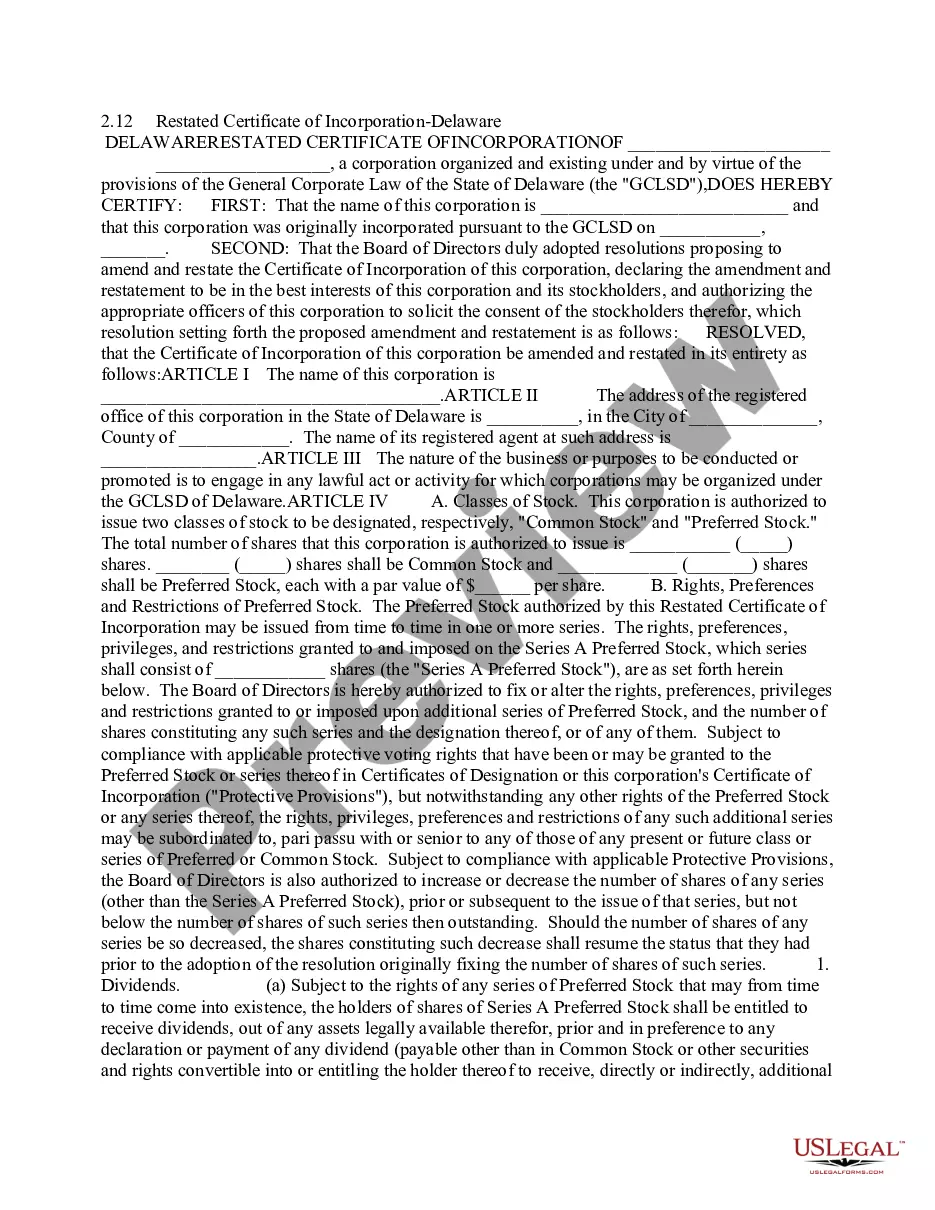
This form is an Amendment of the Restated Certificate of Incorporation, specifically designed to change the dividend rate on $10.50 cumulative second preferred convertible stock. This amendment allows corporations to modify the dividend terms associated with their preferred stock, differing from typical corporate resolutions as it specifically addresses changes in payout policies to shareholders. It is essential for corporate governance and maintaining shareholder relations.
Key parts of this document
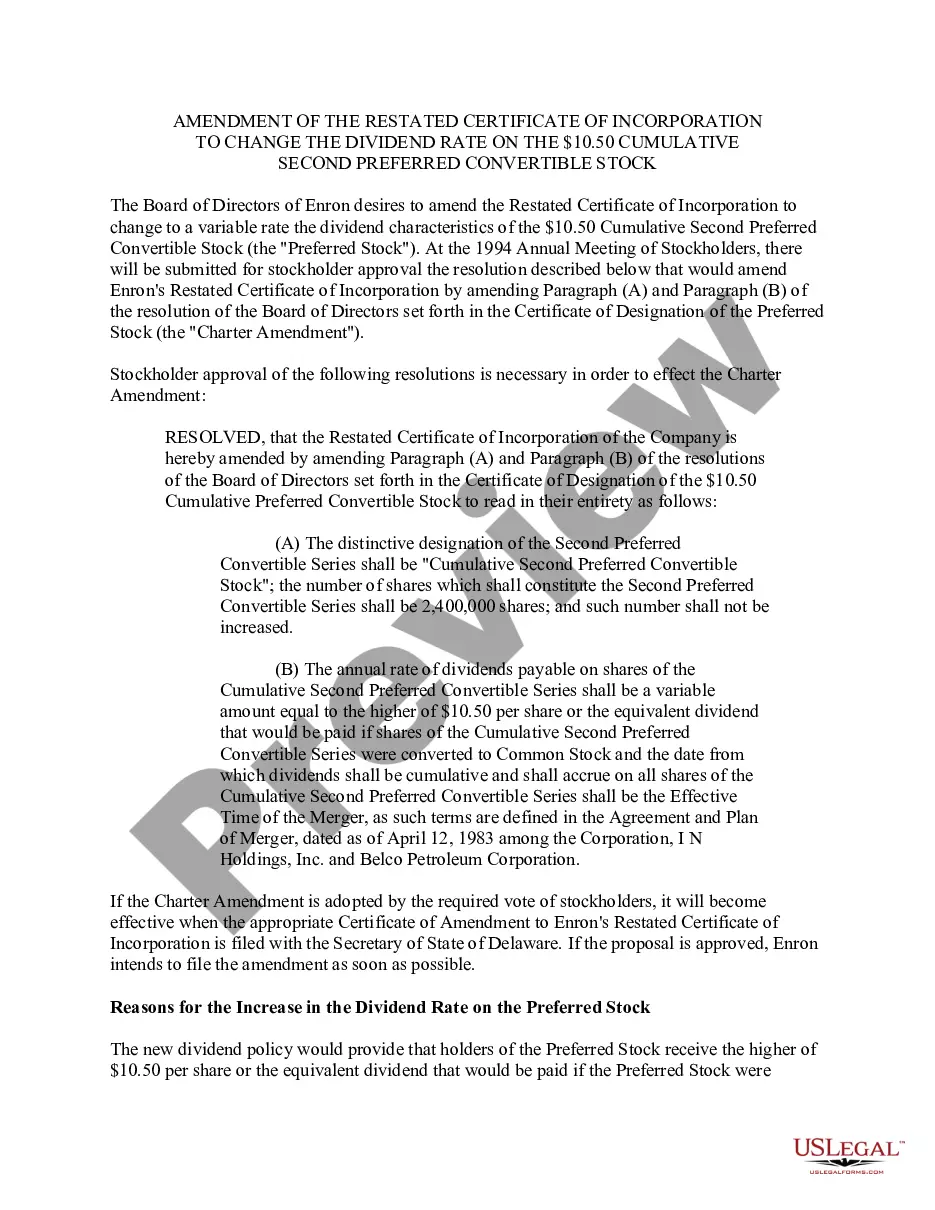
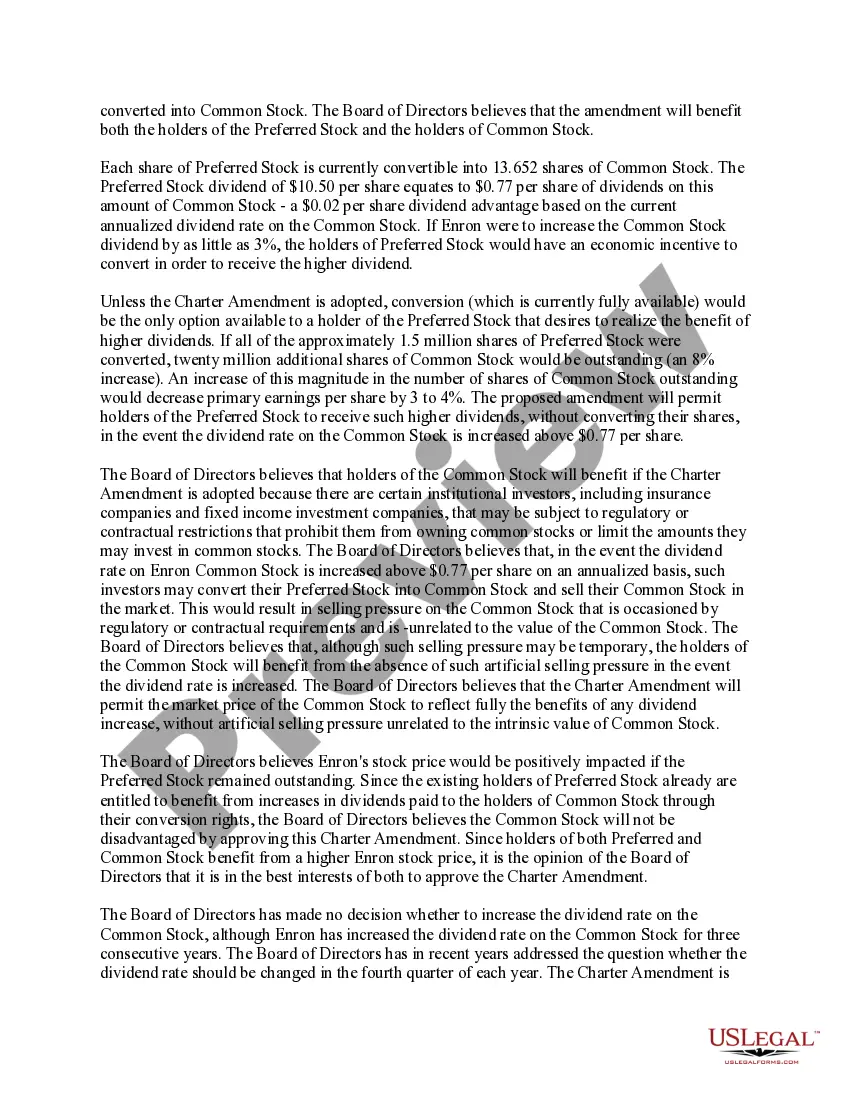
- Details of the amendment to the dividend characteristics of preferred stock.
- Provisions for stockholder approval to enact the amendment.
- Revisions to paragraphs relating to the designation and characteristics of the preferred stock.
- Structure for the new variable dividend rate calculation.
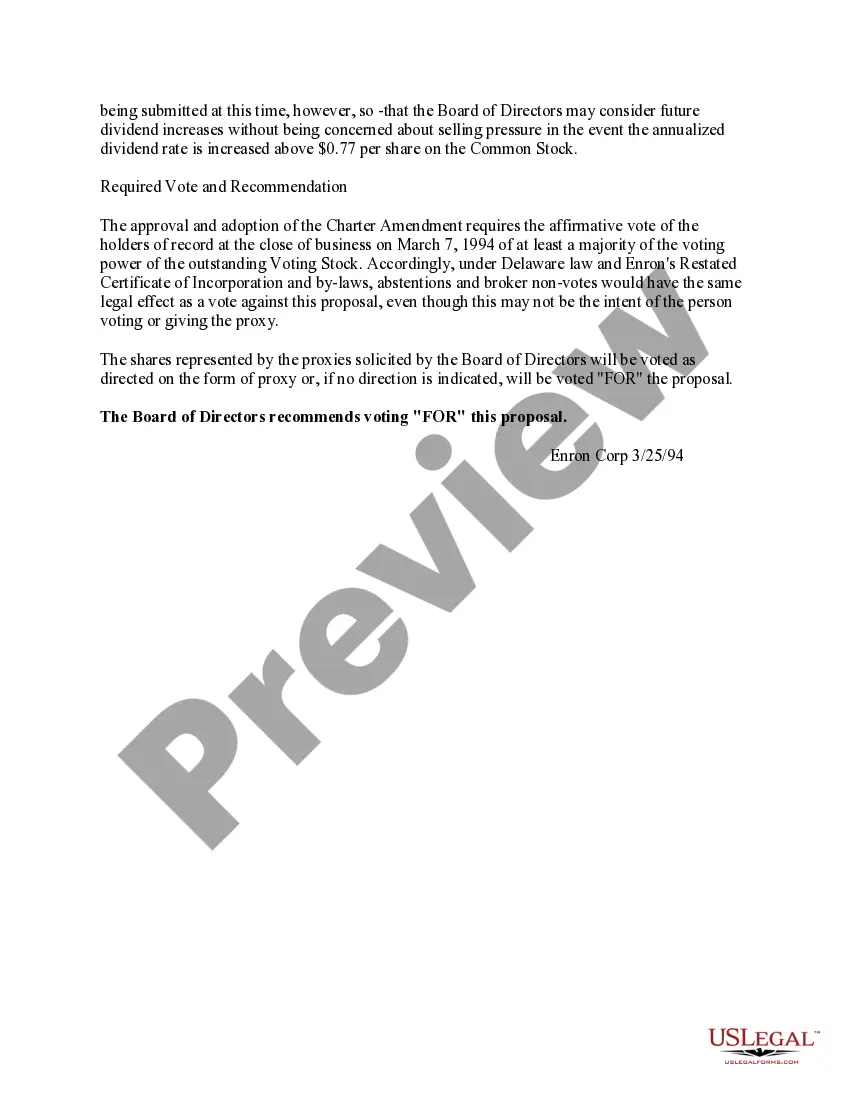
- Conditions under which the amendment becomes effective following approval.
- Reasons and justifications for the increase in the dividend rate.
Common use cases
This form should be used when a corporation wishes to modify its Restated Certificate of Incorporation to change the dividend rates associated with its preferred stock. It is particularly relevant during annual stockholder meetings or when there is a strategic decision to enhance stockholder value without forcing conversion into common stock. Companies may opt to use this form to adapt to regulatory changes or market conditions that affect shareholder dividends.
Who can use this document
- Corporate executives and board members planning to amend dividend structures.
- Legal representatives handling corporate governance issues.
- Investors or stakeholders interested in understanding changes to their dividends.
- Corporations looking to maintain compliance with state regulations while modifying financial agreements.
How to prepare this document
- Identify the corporation proposing the amendment, including its name and entity type.
- Outline the specific changes to be made to the existing dividend rate stipulations.
- Set dates for stockholder meetings and specify voting procedures for approval.
- Seek input and documentation from legal counsel to ensure all amendments are valid and enforceable.
- Submit the completed amendment to the appropriate state authorities following stockholder approval.
Does this form need to be notarized?
Notarization is not commonly needed for this form. However, certain documents or local rules may make it necessary. Our notarization service, powered by Notarize, allows you to finalize it securely online anytime, day or night.
Get your form ready online
Our built-in tools help you complete, sign, share, and store your documents in one place.
Make edits, fill in missing information, and update formatting in US Legal Forms—just like you would in MS Word.
Download a copy, print it, send it by email, or mail it via USPS—whatever works best for your next step.
Sign and collect signatures with our SignNow integration. Send to multiple recipients, set reminders, and more. Go Premium to unlock E-Sign.
If this form requires notarization, complete it online through a secure video call—no need to meet a notary in person or wait for an appointment.
We protect your documents and personal data by following strict security and privacy standards.

Make edits, fill in missing information, and update formatting in US Legal Forms—just like you would in MS Word.

Download a copy, print it, send it by email, or mail it via USPS—whatever works best for your next step.

Sign and collect signatures with our SignNow integration. Send to multiple recipients, set reminders, and more. Go Premium to unlock E-Sign.

If this form requires notarization, complete it online through a secure video call—no need to meet a notary in person or wait for an appointment.

We protect your documents and personal data by following strict security and privacy standards.
Common mistakes to avoid
- Failing to obtain the required stockholder approval before enacting changes.
- Not specifying all relevant paragraphs that are being amended in the certificate.
- Ignoring state-specific filing requirements or deadlines.
Why complete this form online
- Convenience of drafting and editing the form from anywhere with internet access.
- Access to templates created by licensed attorneys to ensure accuracy and compliance.
- Immediate download options that save time compared to traditional methods.
Legal use & context
- This amendment process is legally required to change the terms of preferred stock dividends.
- Proper filing ensures compliance with state law and corporate governance standards.
- Failure to follow established procedures may lead to legal disputes or invalidation of the amendment.
Summary of main points
- This form is essential for corporations wishing to amend their dividend rates on preferred stock.
- Approval from stockholders is necessary for enacting changes.
- Utilizing online legal forms streamlines the completion and filing process while ensuring legal correctness.
Looking for another form?
Form popularity
FAQ
Multiply the par value for the preferred stock by the dividend percentage. For example, if the dividend percentage is 7.5 percent and the stock was issued at $40 per share, the annual dividend is $3 per share.
Preferred Stock SharesDividends are usually paid quarterly, so these preferred shares will pay 50 cents per share four times a year. The dividend rate will not change as long as the preferred issue is outstanding -- which could be indefinitely.
Preferreds have fixed dividends and, although they are never guaranteed, the issuer has a greater obligation to pay them. Common stock dividends, if they exist at all, are paid after the company's obligations to all preferred stockholders have been satisfied.
Disadvantages of preferred shares include limited upside potential, interest rate sensitivity, lack of dividend growth, dividend income risk, principal risk and lack of voting rights for shareholders.
Multiply the amount stated by the number of shares issued and outstanding to calculate preferred stock dividends due. For example, if the amount is $4, which means the amount the company pays per share, and there are 50,000 preferred shares issued and outstanding, multiply $4 times 50,000 shares.
Preferred Dividend formula = Par value Rate of Dividend Number of Preferred Stocks. = $100 0.08 1000 = $8000.
Preferred dividends refer to the cash dividends that a company pays out to its preferred shareholders. One benefit of preferred stock is that it typically pays higher dividend rates than common stock of the same company.Preferred dividends must be paid out of net income before any common share dividend is considered.
Preferred dividends are paid at a fixed rate. Annual dividends are calculated as a percentage of the par value, which is the price of the preferred stock at the time it was issued.
The amount received from issuing preferred stock is reported on the balance sheet within the stockholders' equity section. Only the annual preferred dividend is reported on the income statement.