Cash Award Paid to Holders of Non-Exercisable Stock Options Upon Merger or Consolidation
What this document covers
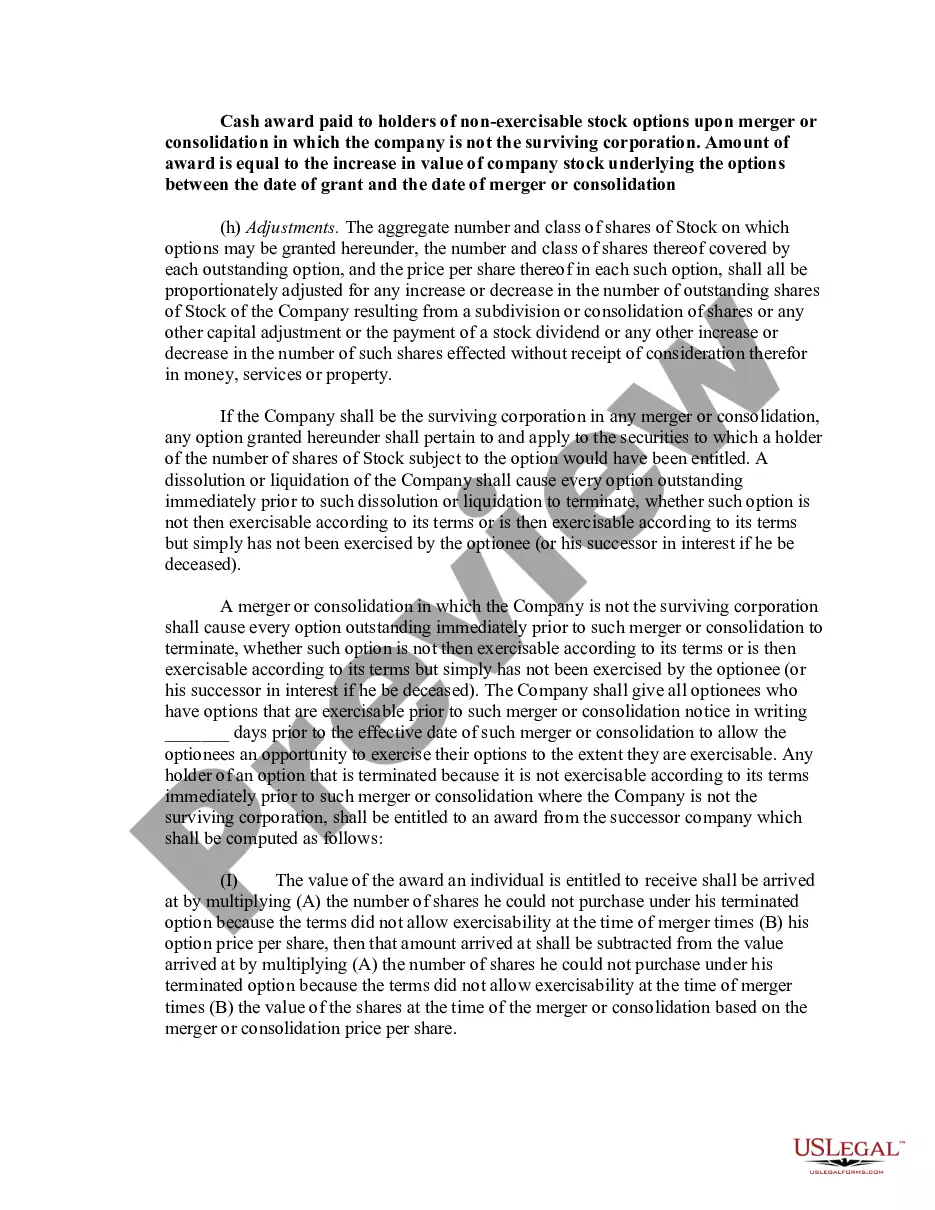
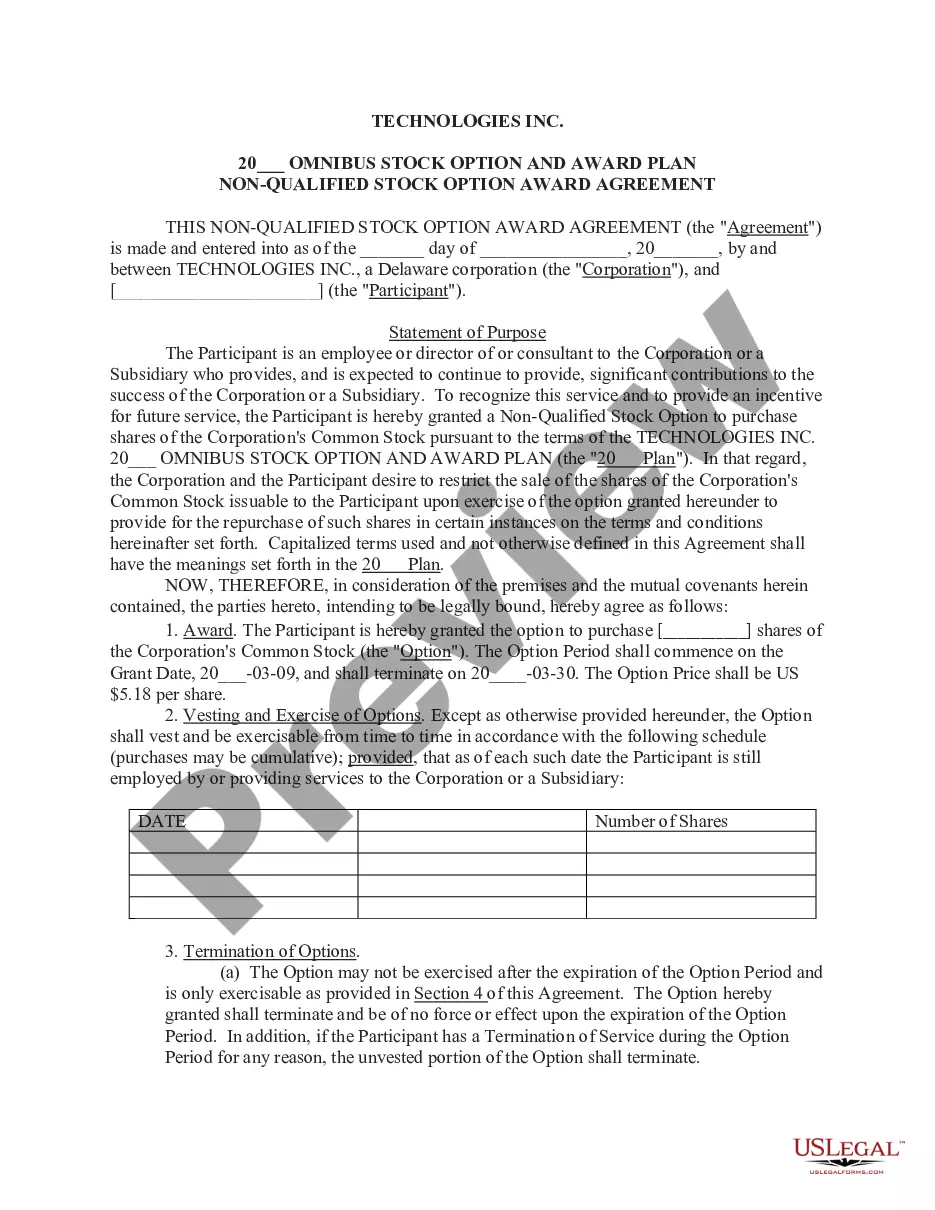
The Cash Award Paid to Holders of Non-Exercisable Stock Options Upon Merger or Consolidation is a legal document used in corporate settings. It outlines the terms under which holders of non-exercisable stock options receive a cash award when a merger or consolidation occurs. This form is essential for ensuring that affected employees and directors are compensated appropriately, while also differentiating itself from general stock option agreements by specifically addressing scenarios involving mergers and consolidations.
Form components explained
- Adjustments based on share subdivision or consolidation.
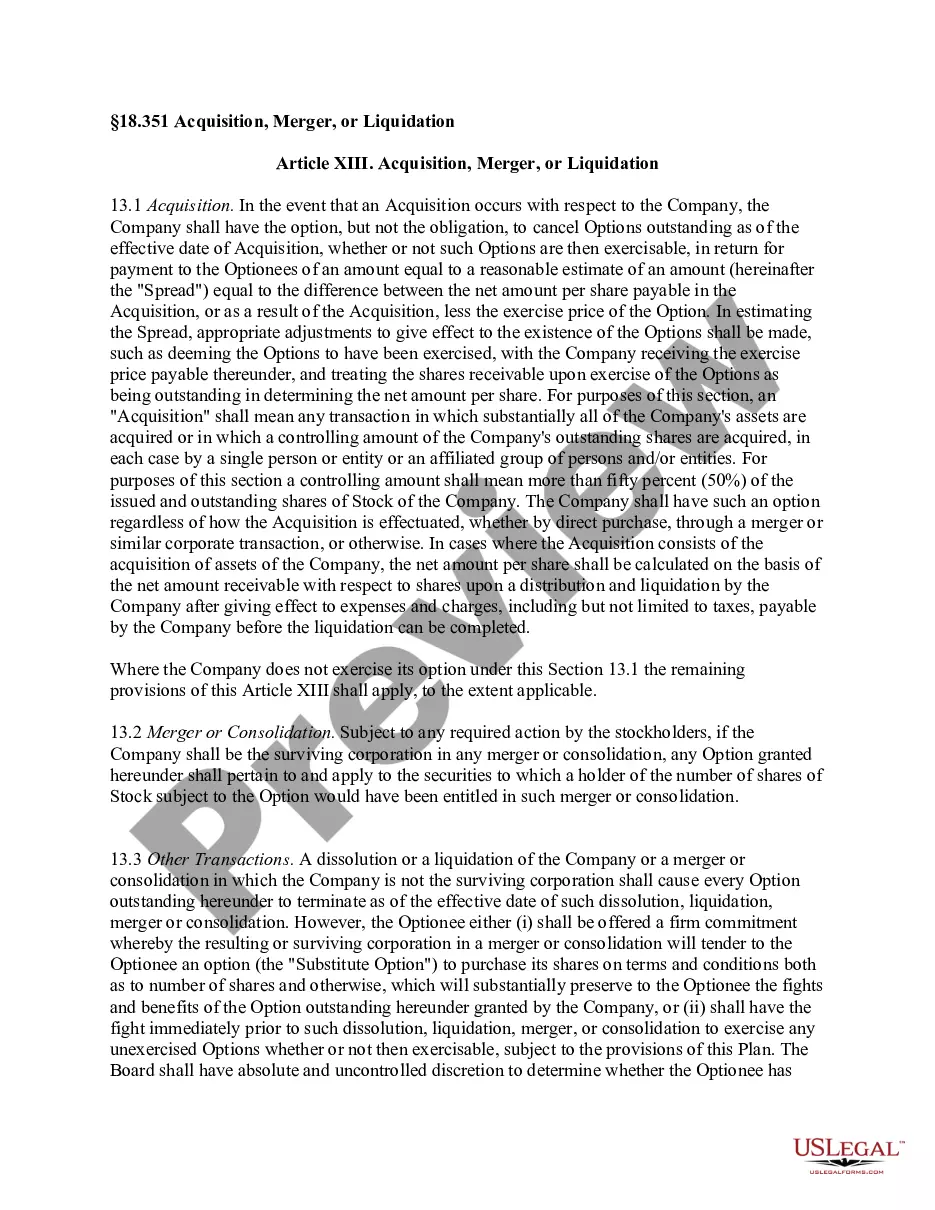
- Conditions for the termination of options during merger or consolidation.
- Notification requirements for optionees before the merger or consolidation.
- Computation formula for cash awards to terminated option holders.
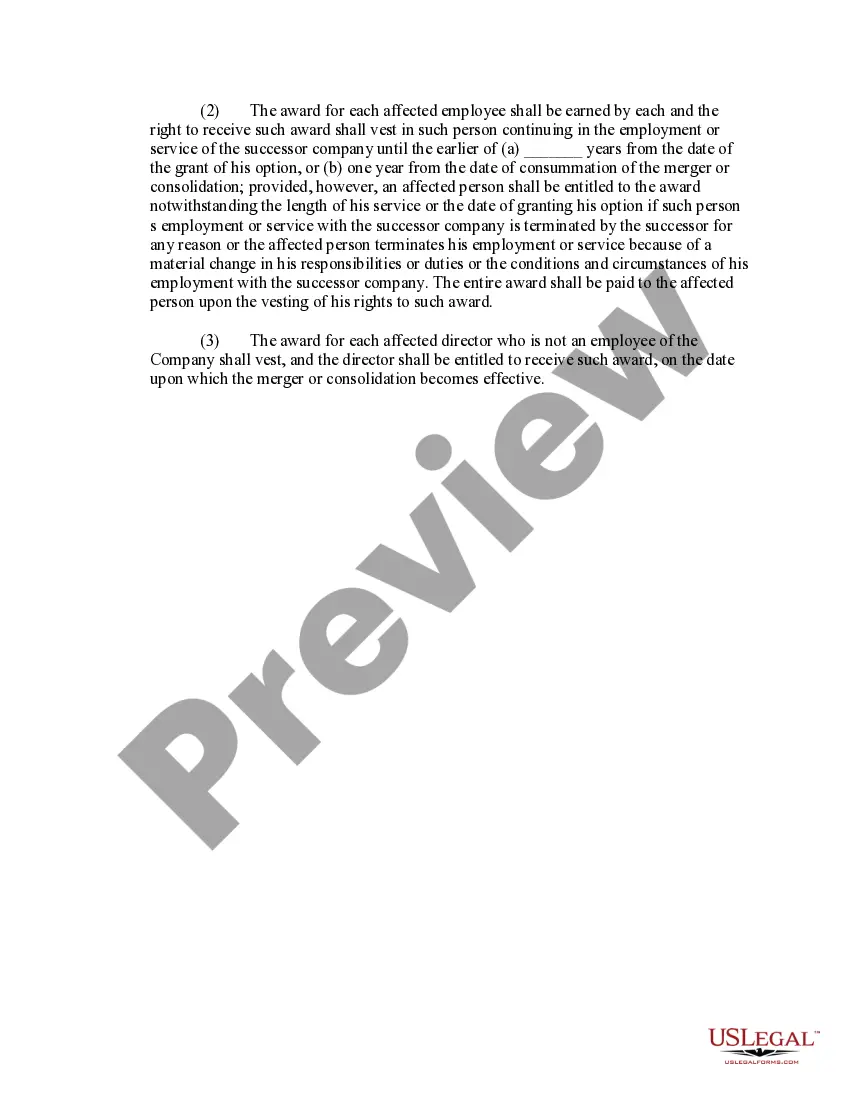
- Vesting conditions for awards based on employment with the successor company.
Common use cases
This form should be used when a company is undergoing a merger or consolidation and has outstanding stock options that are not currently exercisable. It provides necessary provisions to protect the rights of option holders and ensures they receive fair compensation in the event that their options are terminated due to the corporate transaction.
Intended users of this form
- Corporations involved in a merger or consolidation.
- Human resources or legal departments responsible for employee compensation matters.
- Employees holding non-exercisable stock options affected by the merger.
- Directors who are not employees and hold stock options in the company.
Steps to complete this form
- Identify the parties involved, including the company and option holders.
- Specify the details of the merger or consolidation, including effective dates.
- Detail the adjustments applicable to the terms of existing options.
- Enter the notification period prior to the merger for the option holders.
- Include the formula for calculating cash awards and any vesting conditions.
Notarization requirements for this form
Notarization is not commonly needed for this form. However, certain documents or local rules may make it necessary. Our notarization service, powered by Notarize, allows you to finalize it securely online anytime, day or night.
Get your form ready online
Our built-in tools help you complete, sign, share, and store your documents in one place.
Make edits, fill in missing information, and update formatting in US Legal Forms—just like you would in MS Word.
Download a copy, print it, send it by email, or mail it via USPS—whatever works best for your next step.
Sign and collect signatures with our SignNow integration. Send to multiple recipients, set reminders, and more. Go Premium to unlock E-Sign.
If this form requires notarization, complete it online through a secure video call—no need to meet a notary in person or wait for an appointment.
We protect your documents and personal data by following strict security and privacy standards.

Make edits, fill in missing information, and update formatting in US Legal Forms—just like you would in MS Word.

Download a copy, print it, send it by email, or mail it via USPS—whatever works best for your next step.

Sign and collect signatures with our SignNow integration. Send to multiple recipients, set reminders, and more. Go Premium to unlock E-Sign.

If this form requires notarization, complete it online through a secure video call—no need to meet a notary in person or wait for an appointment.

We protect your documents and personal data by following strict security and privacy standards.
Mistakes to watch out for
- Failing to specify the notification period for option holders.
- Omitting critical details regarding cash award calculations.
- Not adjusting the terms in accordance with share changes prior to a merger.
- Neglecting to account for the different rights of employees versus directors.
Why use this form online
- Convenience of instant access and downloadable formats.
- Easy customization to fit specific corporate requirements.
- Reliability through attorney-drafted templates ensuring legal compliance.
Legal use & context
- This form ensures rights are protected for option holders in corporate mergers.
- It enforces clear terms for cash compensation, fostering transparency and trust.
- Proper use of this form can prevent legal disputes during company transitions.
Quick recap
- Utilize this form during mergers to protect option holder rights.
- Be mindful of the specific terms surrounding adjustments and notifications.
- Ensure compliance with state-specific regulations as needed.
Looking for another form?
Form popularity
FAQ
All-Stock Offer With an all-stock merger, the number of shares covered by a call option is changed to adjust for the value of the buyout. The options on the bought-out company will change to options on the buyer stock at the same strike price, but for a different number of shares.
A few things can happen to your unvested options, depending on the negotiations: You may be issued a new grant with a new schedule for this amount or more in the new company's shares. They could be converted to cash and paid out over time (like a bonus that vests). They could be canceled.
What happens to SPAC stock after the merger? After a merger is completed, shares of common stock automatically convert to the new business. Other options investors have are to: Exercise their warrants.
When one company acquires another, the stock price of the acquiring company tends to dip temporarily, while the stock price of the target company tends to spike. The acquiring company's share price drops because it often pays a premium for the target company, or incurs debt to finance the acquisition.
Since you'll have to exercise your option through your employer, your employer will usually report the amount of your income on line 1 of your Form W-2 as ordinary wages or salary and the income will be included when you file your tax return.
The options on the bought-out company will change to options on the buyer stock at the same strike price, but for a different number of shares. Normally, one option is for 100 shares of the underlying stock. For example, company A buys company B, exchanging 1/2 share of A for each share of B.
After your options vest, you can exercise them that is, pay for the stock and own it.It may be couched in language such as company repurchase rights, redemption or forfeiture. But what it means is that the company can claw back your vested stock options before they become valuable.
In case the company is bought , your employer will grant you the options, they have vesting schedule attached, which is the length of time that you have to wait before you can actually exercise the option to buy share. If your options are vested, you've held the options long enough and can exercise them.