Nonqualified Stock Option Plan of Medicore, Inc., for officers, directors, consultants, key employees
About this form
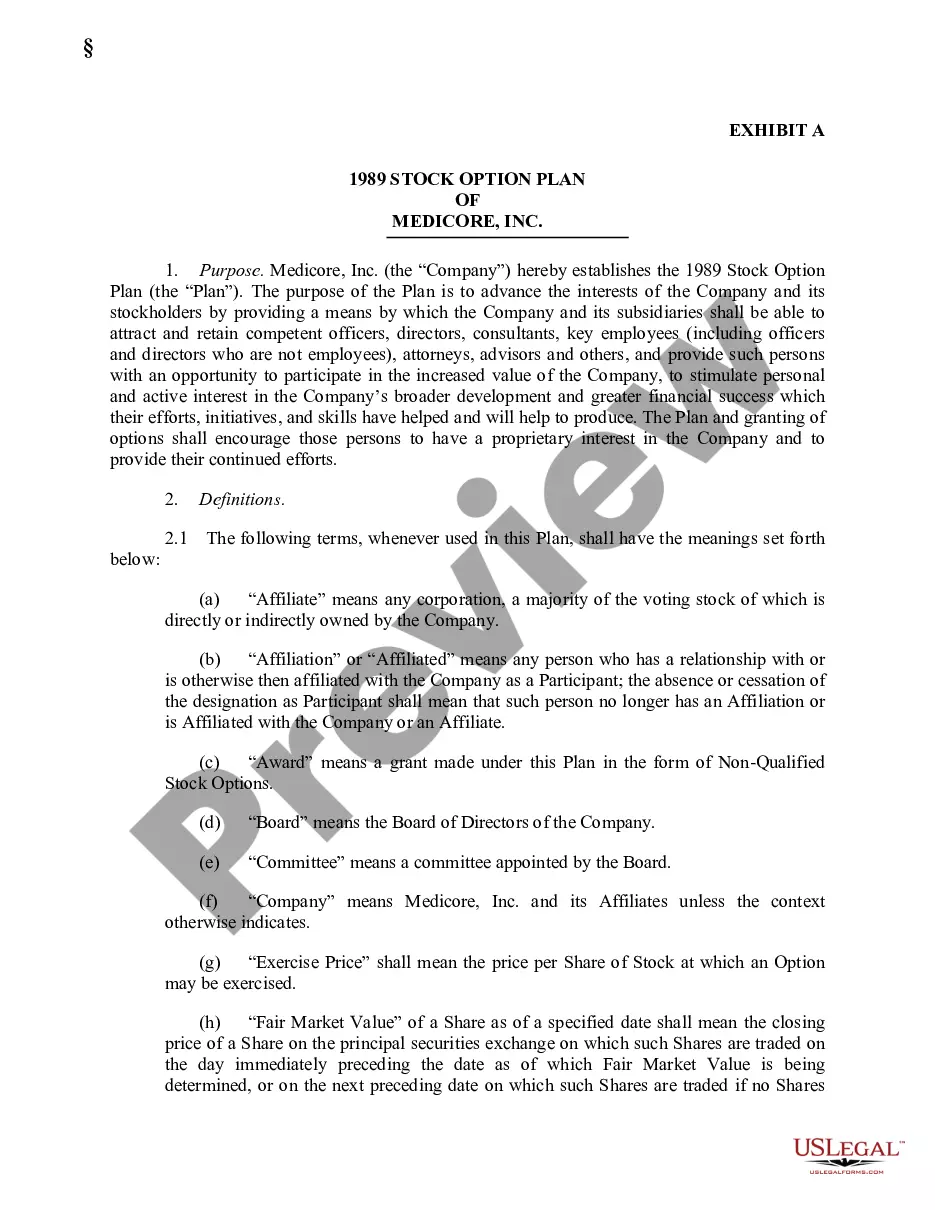
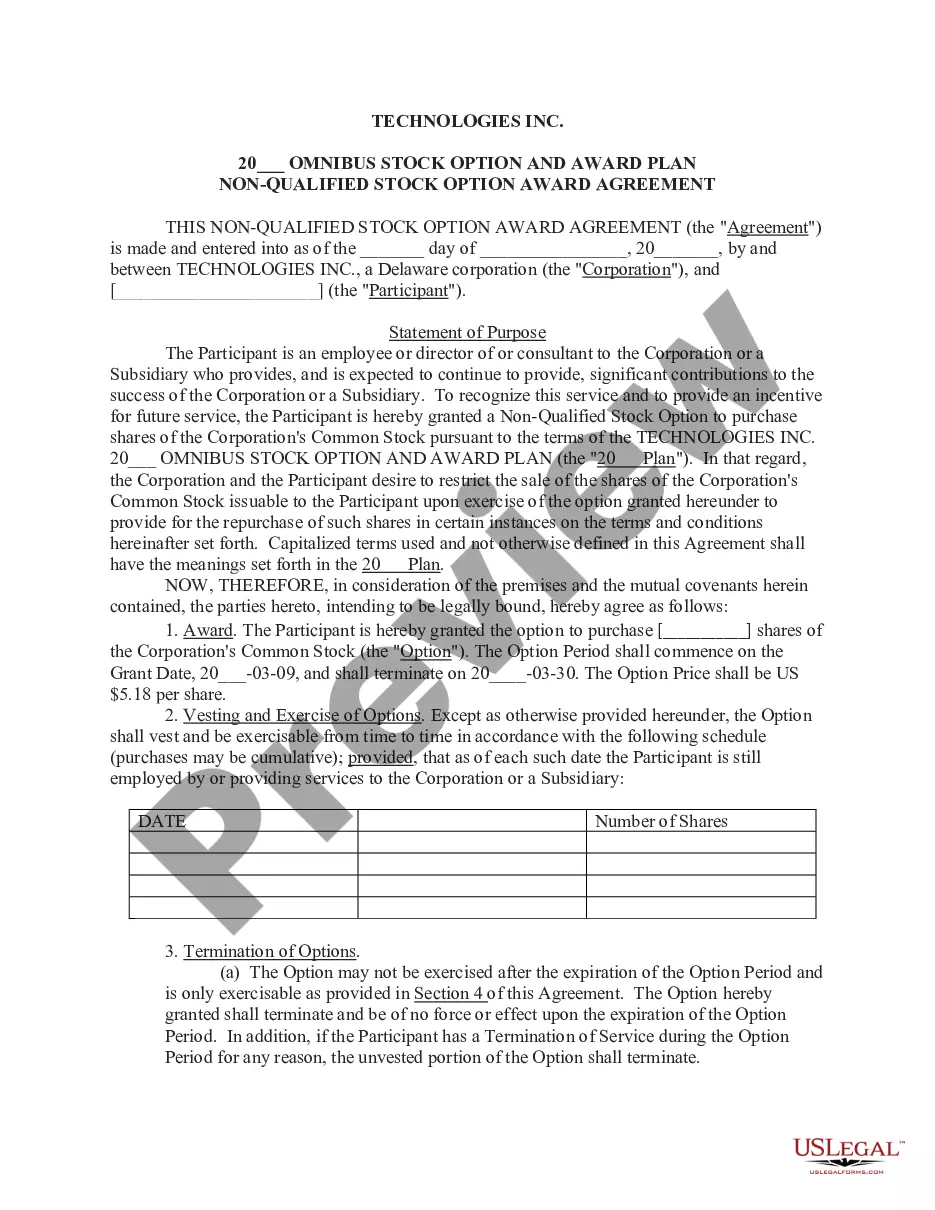
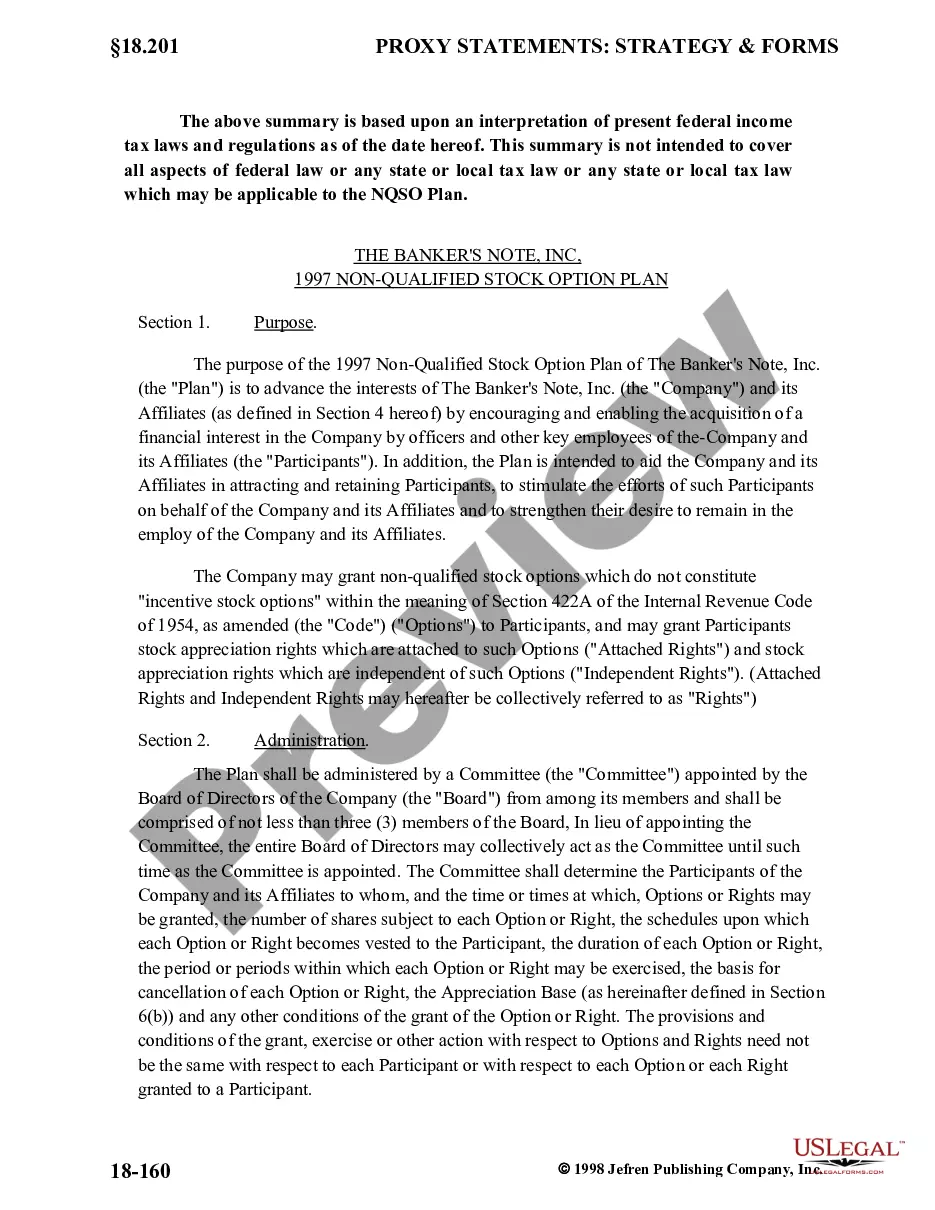
The Nonqualified Stock Option Plan of Medicore, Inc. is a legal document designed for companies to grant stock options to selected individuals, such as officers, directors, consultants, and key employees. This plan is specifically tailored to allow participants to receive stock options that provide them with ownership interests in the company, enhancing their motivation to contribute to its success. Unlike qualified stock option plans, nonqualified stock options do not adhere to specific tax regulations, allowing more flexibility for the issuing company.
Key parts of this document
- Purpose: Establishes the goals of the stock option plan to promote company interests.
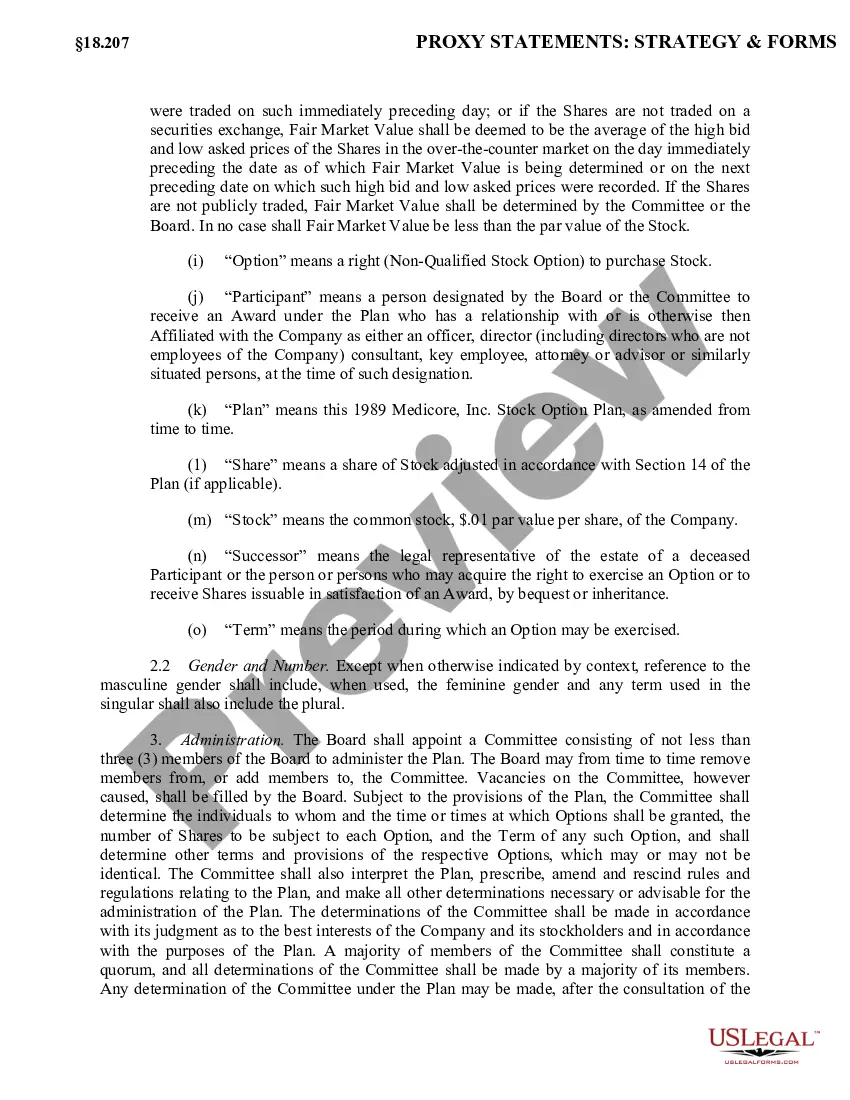
- Definitions: Clarifies key terms such as "Options," "Participant," and "Exercise Price."
- Administration: Outlines the roles of the Board and Committee in managing the plan.
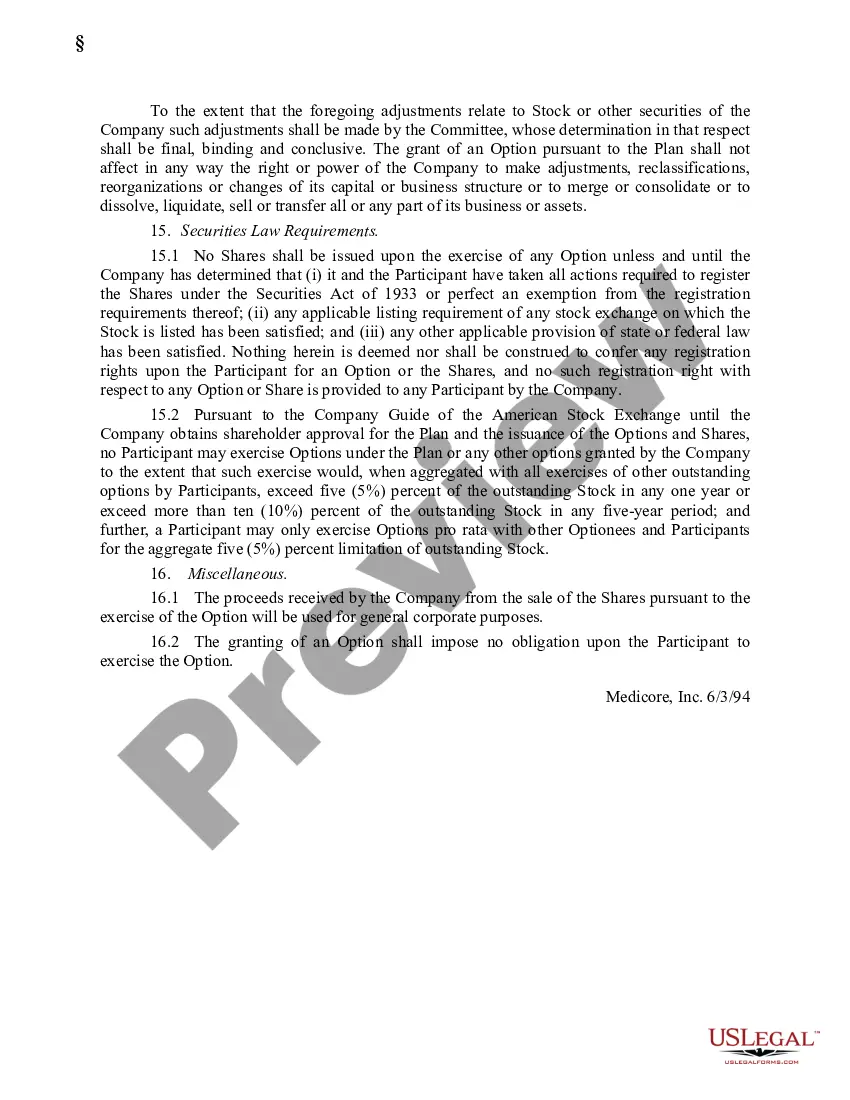
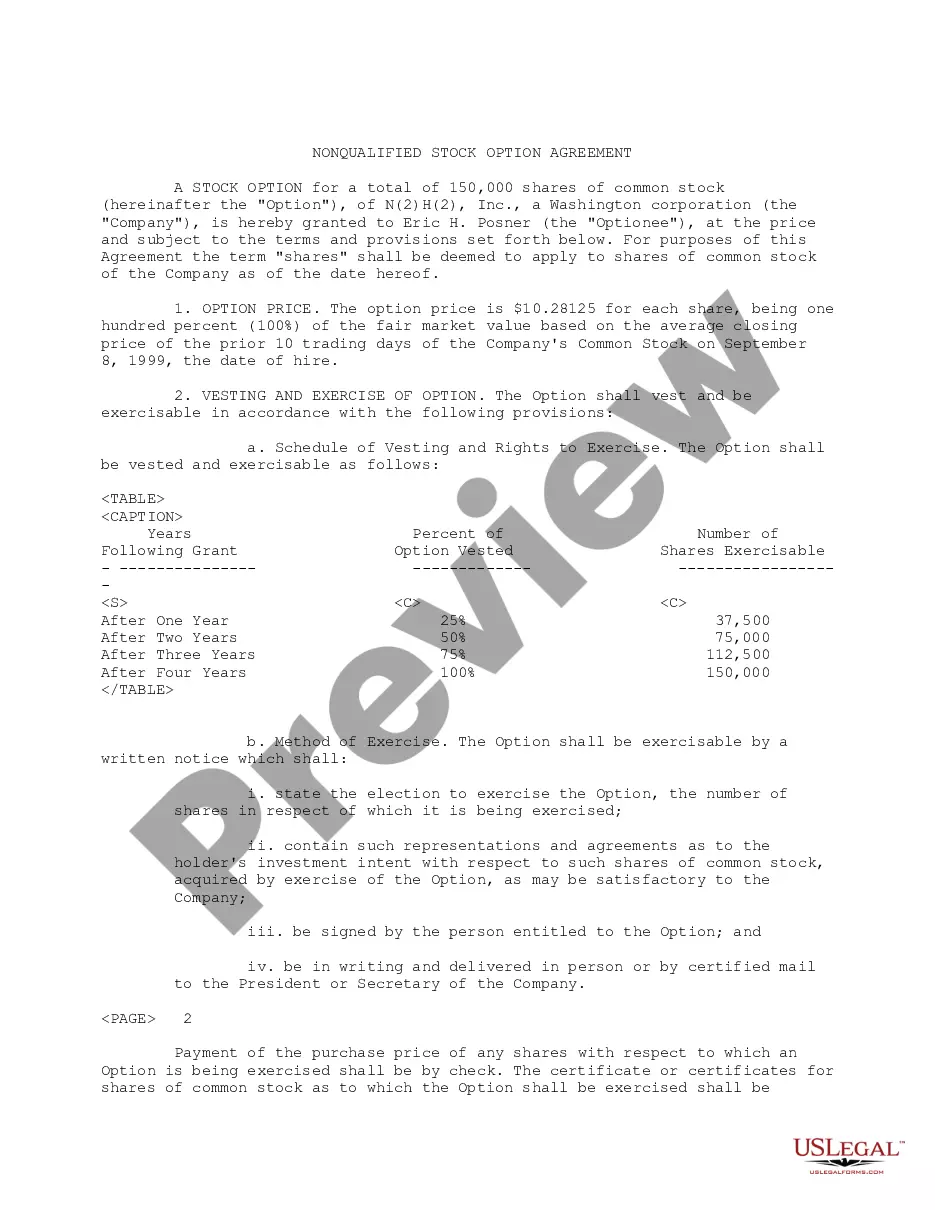
- Stock Options: Details the terms under which options can be awarded and exercised.
- Termination of Affiliation: Explains the implications of ceasing affiliation with the company.
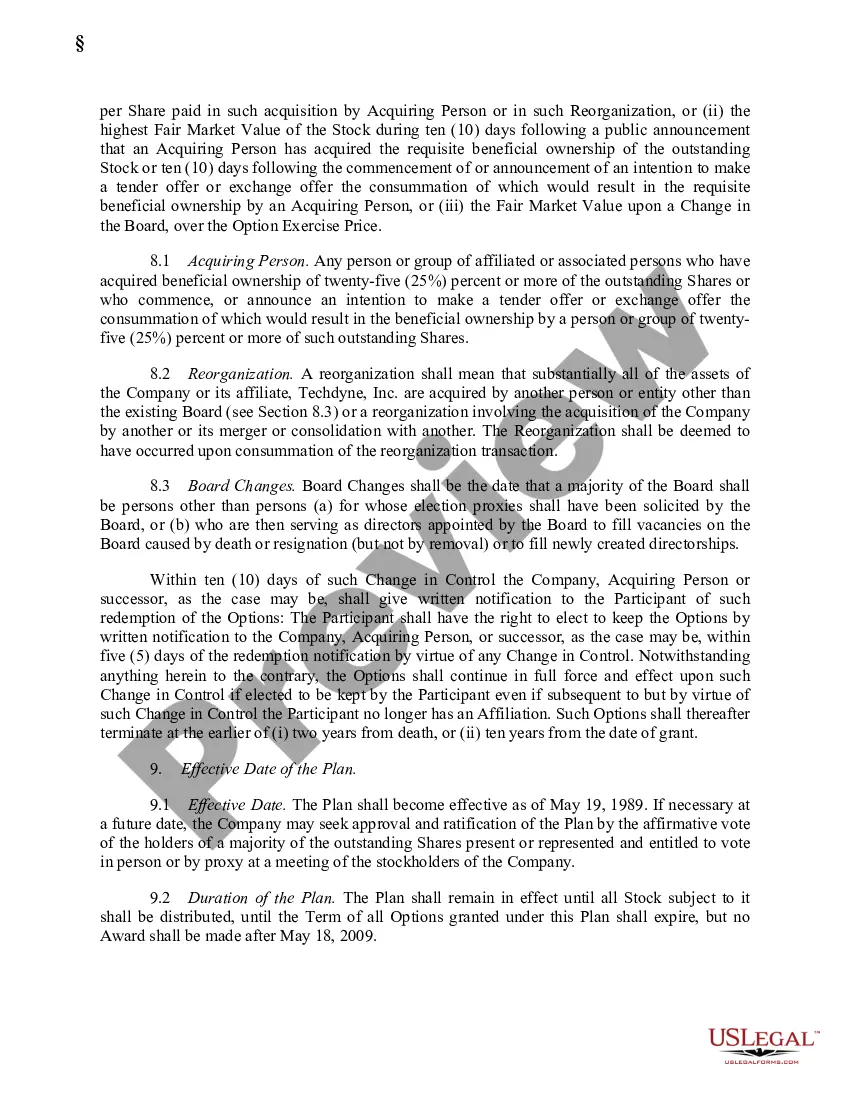
- Change in Control: Describes provisions for options in the event of a company takeover or restructuring.




When to use this document
This form should be used when a corporation, such as Medicore, Inc., intends to implement a stock option plan that is not subject to certain government regulations, hence providing flexibility in granting options to employees and key contributors. Companies looking to attract and retain talented individuals can utilize this form to establish incentives aligned with their strategic goals. It is useful in scenarios where companies wish to motivate individuals to enhance company performance and value.
Intended users of this form
This form is intended for:
- Corporations looking to create a stock option plan for their key employees.
- Corporate boards and committees responsible for employee compensation strategies.
- Business consultants assisting organizations in drafting employee incentive programs.
- Legal professionals who provide guidance on corporate affairs and stock options.
Instructions for completing this form
- Identify the parties involved, such as the company and the selected participants.
- Specify the terms of the stock options, including the exercise price and number of shares.
- Detail the duration of the options and any conditions for exercise.
- Ensure proper governance by appointing a committee to oversee the implementation of the plan.
- Obtain necessary approvals from the board and possibly from shareholders if required.
Is notarization required?
This form usually doesn’t need to be notarized. However, local laws or specific transactions may require it. Our online notarization service, powered by Notarize, lets you complete it remotely through a secure video session, available 24/7.
Get your form ready online
Our built-in tools help you complete, sign, share, and store your documents in one place.
Make edits, fill in missing information, and update formatting in US Legal Forms—just like you would in MS Word.
Download a copy, print it, send it by email, or mail it via USPS—whatever works best for your next step.
Sign and collect signatures with our SignNow integration. Send to multiple recipients, set reminders, and more. Go Premium to unlock E-Sign.
If this form requires notarization, complete it online through a secure video call—no need to meet a notary in person or wait for an appointment.
We protect your documents and personal data by following strict security and privacy standards.

Make edits, fill in missing information, and update formatting in US Legal Forms—just like you would in MS Word.

Download a copy, print it, send it by email, or mail it via USPS—whatever works best for your next step.

Sign and collect signatures with our SignNow integration. Send to multiple recipients, set reminders, and more. Go Premium to unlock E-Sign.

If this form requires notarization, complete it online through a secure video call—no need to meet a notary in person or wait for an appointment.

We protect your documents and personal data by following strict security and privacy standards.
Common mistakes
- Failing to clearly define the roles and responsibilities of the administering committee.
- Not specifying the exercise price and a mechanism for determining fair market value.
- Overlooking state regulations that may affect the enforcement of stock options.
- Not obtaining necessary board approvals before implementing the stock option plan.
Why use this form online
- Convenience: Easily accessible from anywhere and straightforward to download.
- Editability: Customize the template according to specific corporate needs.
- Reliability: Templates are drafted by licensed attorneys ensuring legal compliance.
Looking for another form?










Form popularity
FAQ
Once you exercise your non-qualified stock option, the difference between the stock price and the strike price is taxed as ordinary income. This income is usually reported on your paystub. There are no tax consequences when you first receive your non-qualified stock option, only when you exercise your option.
Non-qualified stock options (typically abbreviated NSO or NQSO) are stock options which do not qualify for the special treatment accorded to incentive stock options. Incentive stock options are only available for employees and other restrictions apply for them.
Depending upon the tax treatment of stock options, they can be classified into qualified and non-qualified stock options. Qualified stock options are also called Incentive Stock Options (ISO). Nonqualified: Employees generally don't owe tax when these options are granted.
When you exercise your non-qualified stock options, the value of the bargain element will be treated as earned income that is reported on your tax return the same way as your regular earned income.
1: Exercise and Sell When Your Non-Qualified Stock Options Vest. The vest date is when you (the stock option holder) have the right to exercise non-qualified stock options. Prior to this vesting date, you may not be able to do anything.
Once you exercise your non-qualified stock option, the difference between the stock price and the strike price is taxed as ordinary income. This income is usually reported on your paystub.If you hold the shares for less than one year, any gain is taxed at your ordinary income tax rates, which are usually higher.
What Is a Non-Qualified Stock Option (NSO)? A non-qualified stock option (NSO) is a type of employee stock option wherein you pay ordinary income tax on the difference between the grant price and the price at which you exercise the option.
The Cost Basis of Your Non-Qualified Stock Options The cost basis is equal to the exercise price, multiplied by the number of shares exercised. In our example above, the cost basis is equal to 2,000 shares times $50/share, or $100,000.
Restricted stock is considered supplemental wages, following the same tax rules and W-2 reporting that apply to grants of nonqualified stock options.As a result, any appreciation in the stock price above the grant date value is taxed at capital gains rates when you sell the stock after vesting.