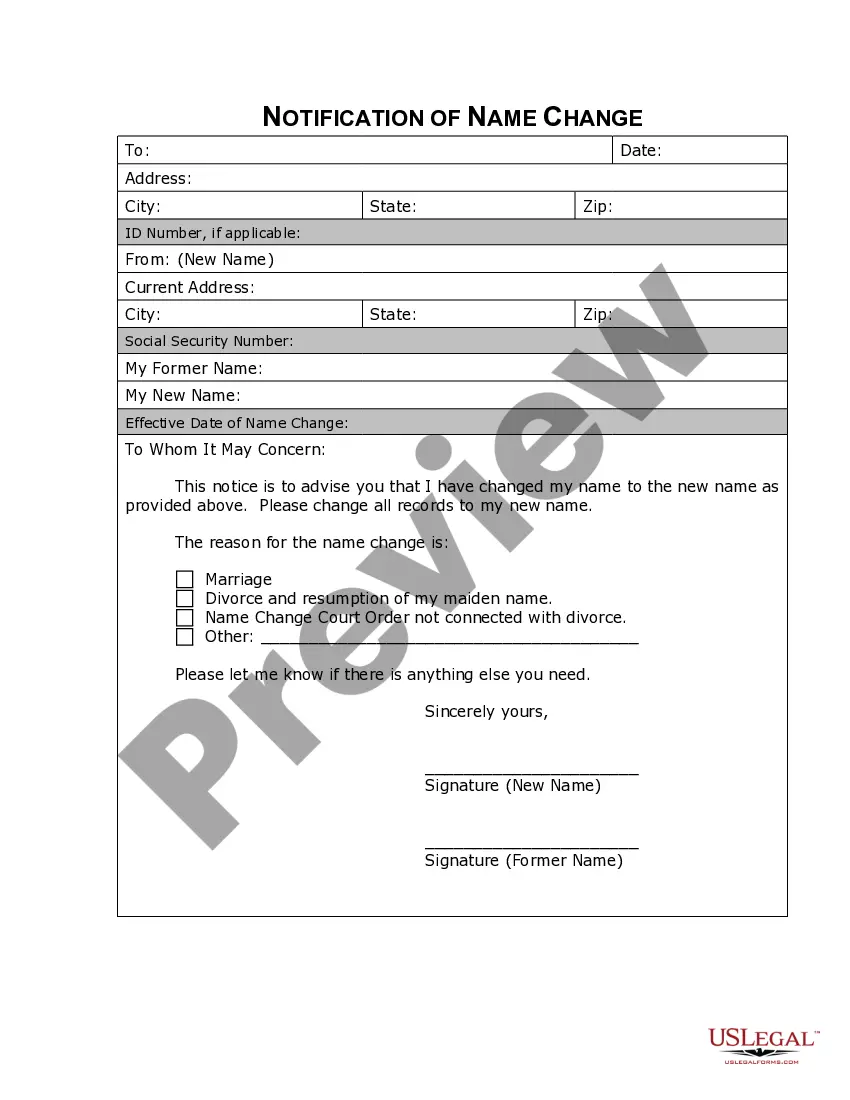
License Agreement with attachments between Site-Based Media, Inc., and On Site Media, Inc.
About this form
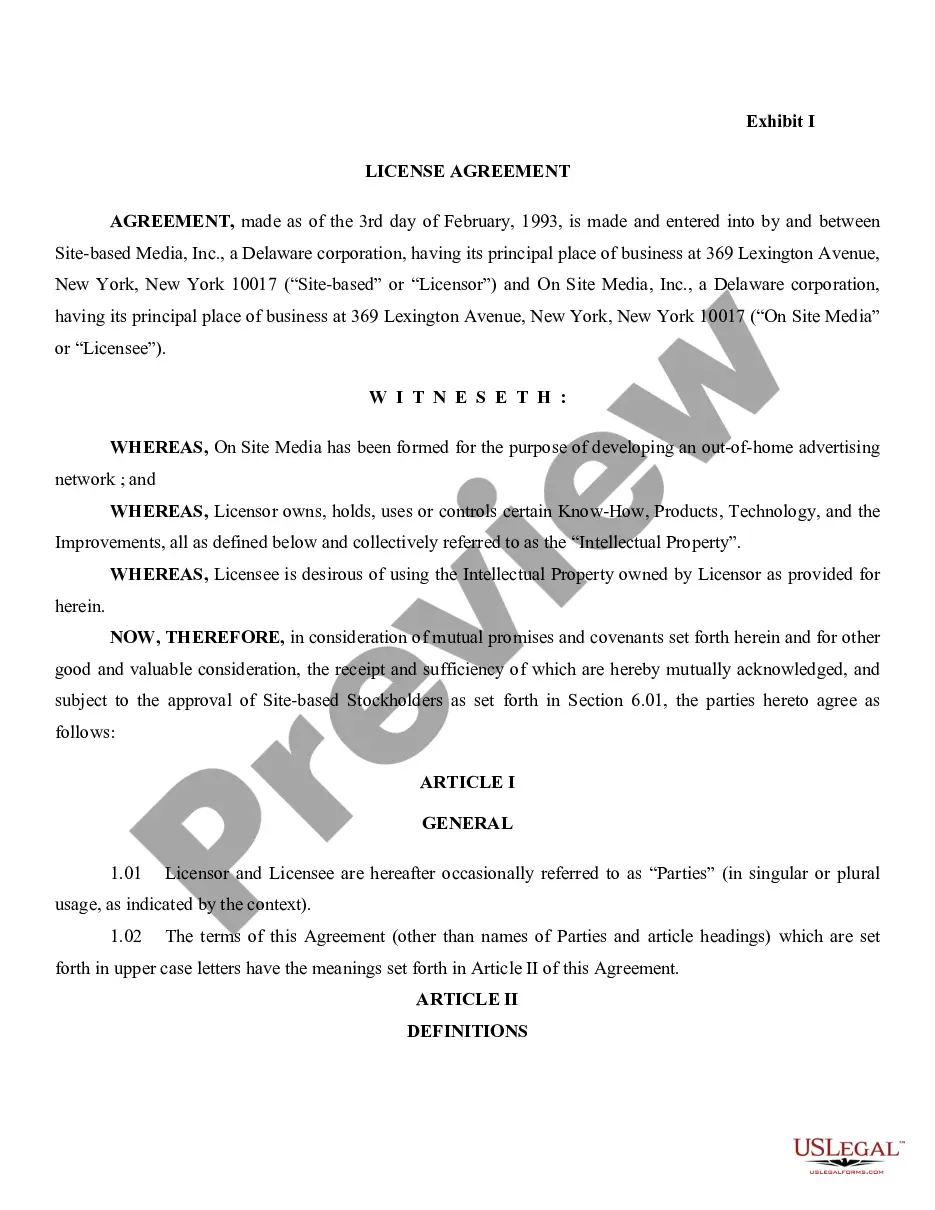
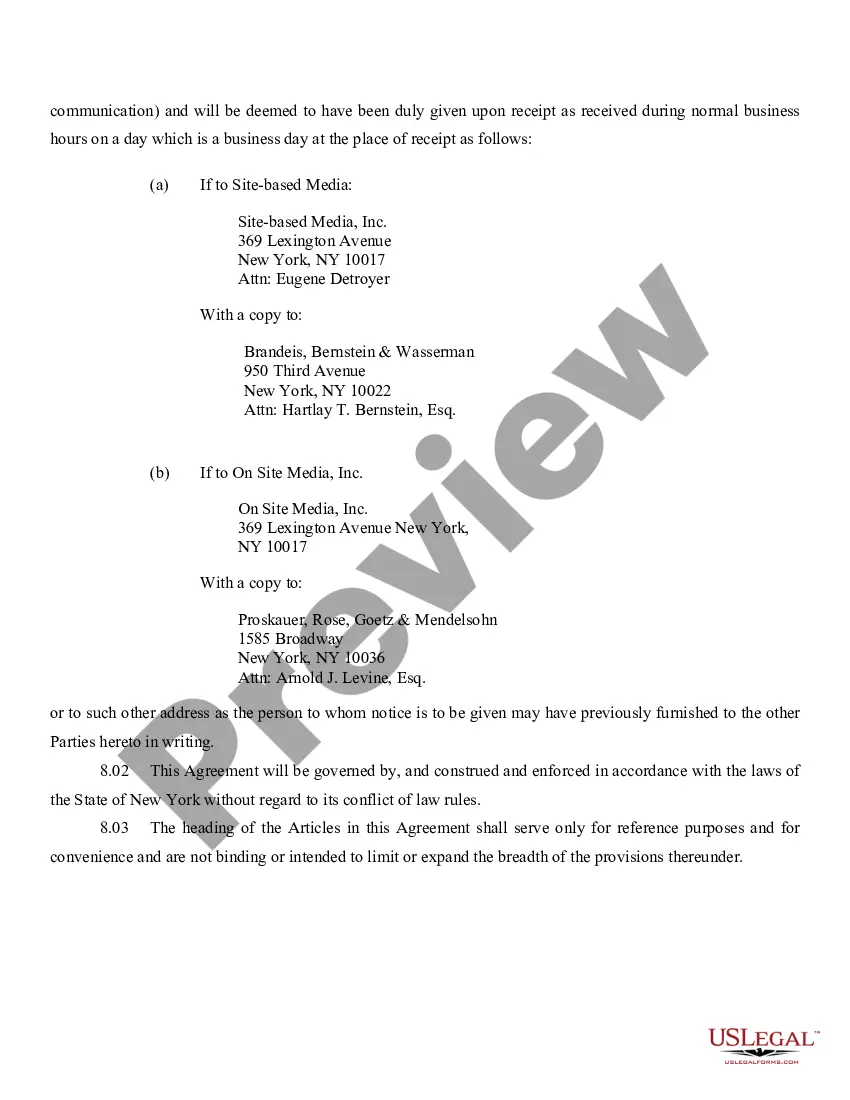
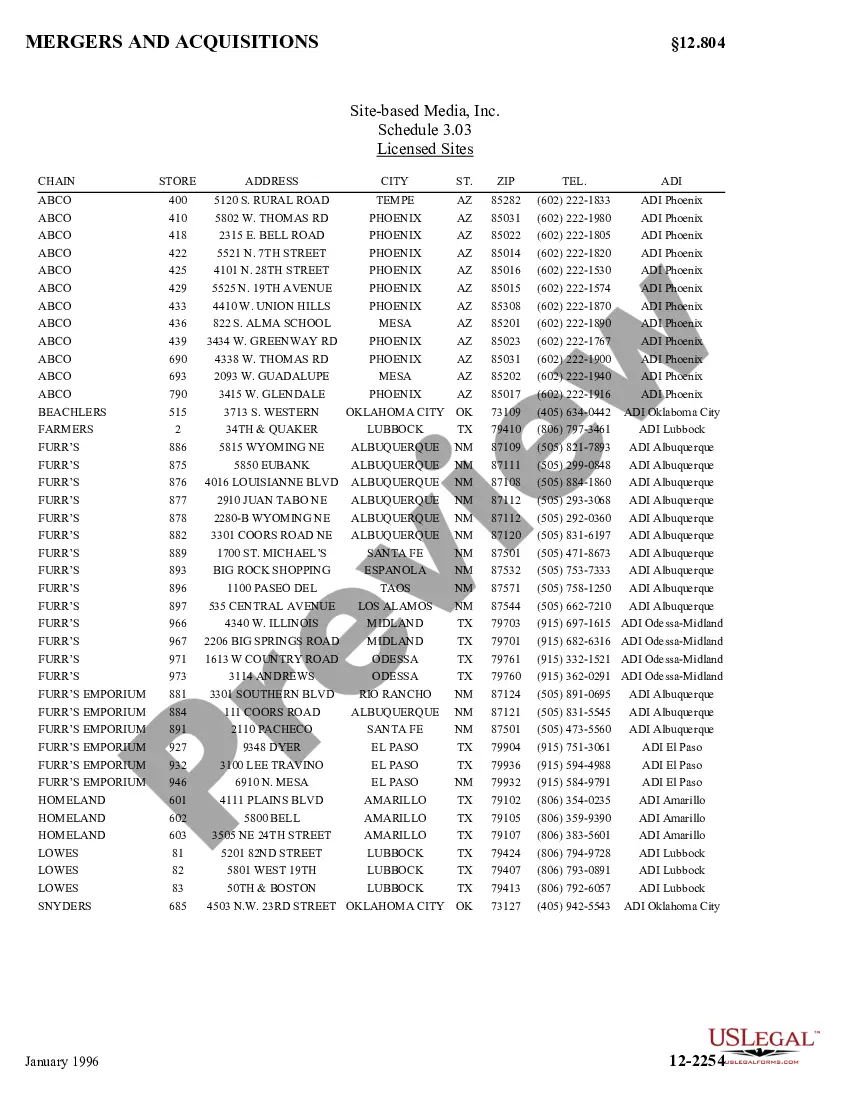
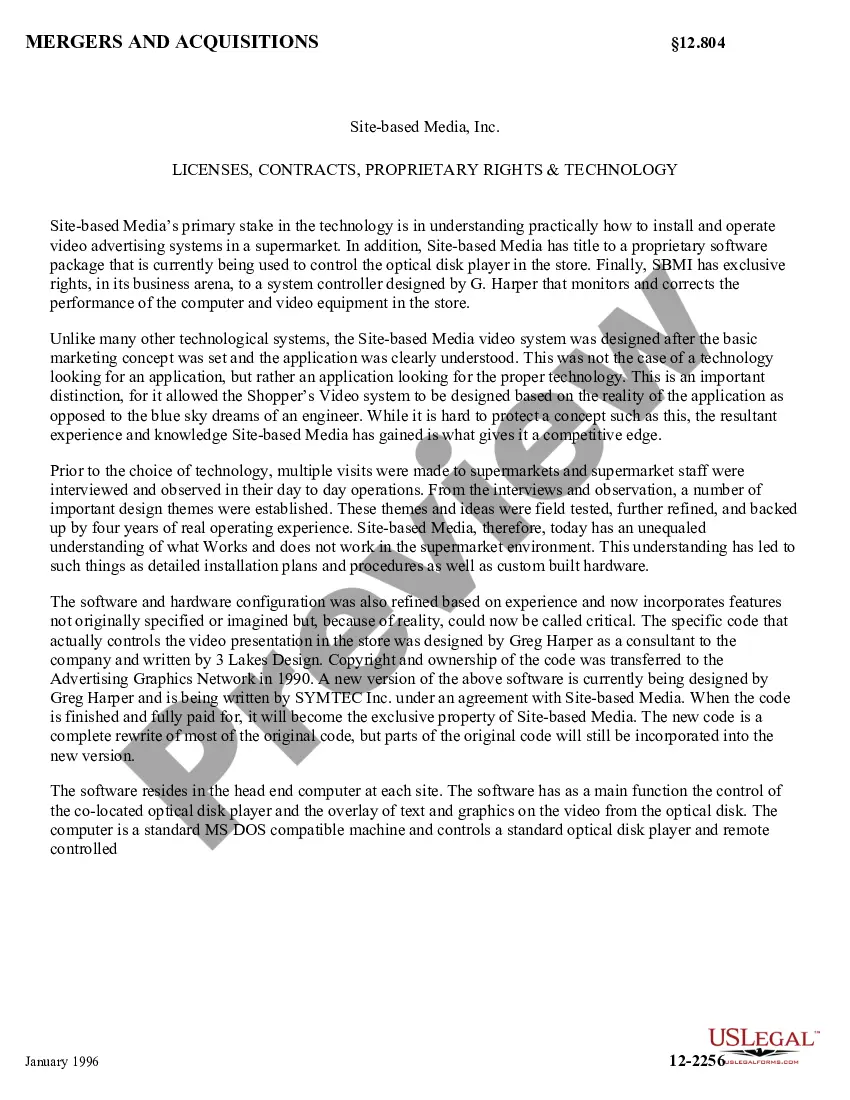
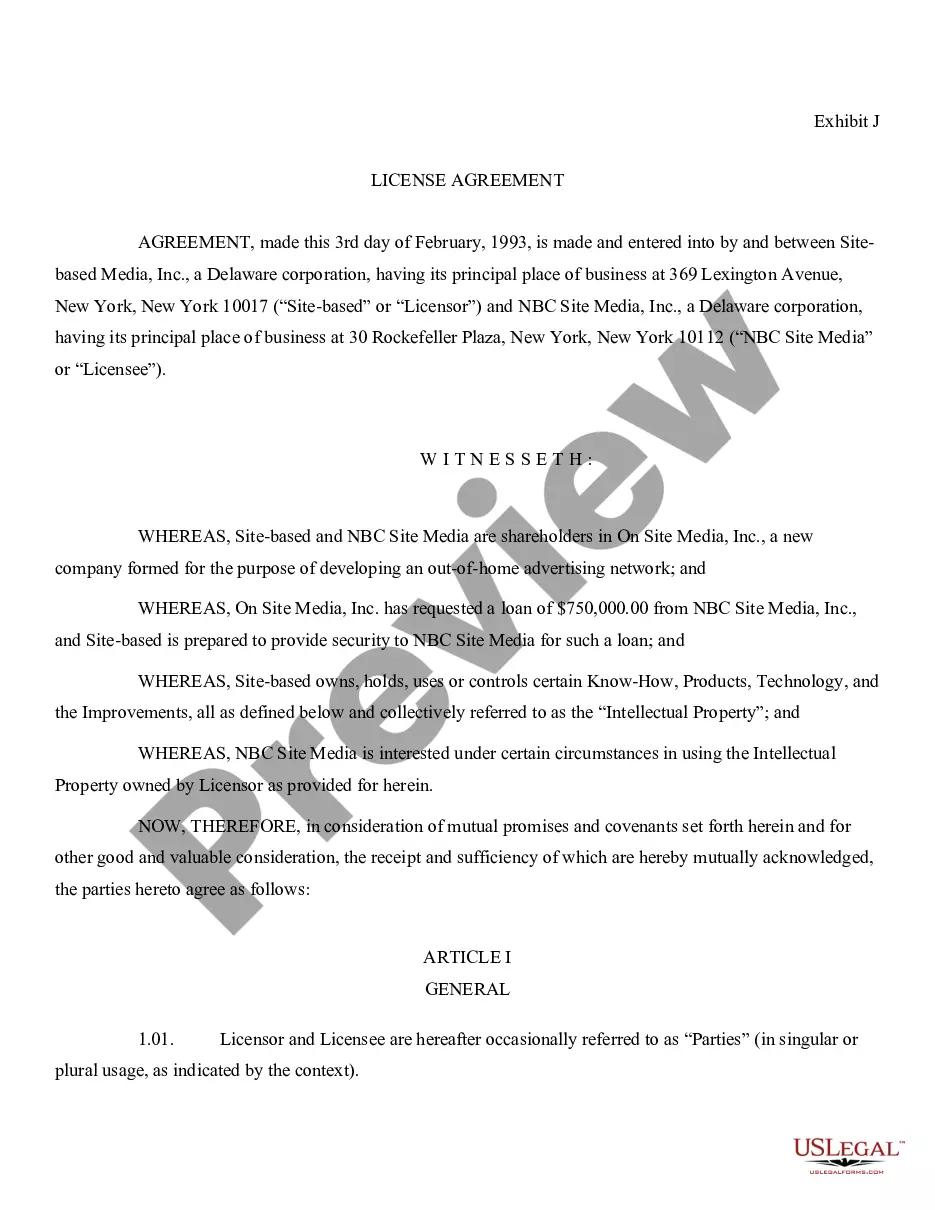
This License Agreement is a legal document between Site-Based Media, Inc. and On Site Media, Inc. It outlines the terms under which On Site Media is granted rights to utilize certain intellectual property and technologies owned by Site-Based Media for the purpose of developing an out-of-home advertising network. This form is designed specifically for licensing agreements, distinguishing it from other contracts by its focus on the usage of intellectual property in advertising contexts.
What’s included in this form
- Identification of the parties involved: Site-Based Media, Inc. and On Site Media, Inc.
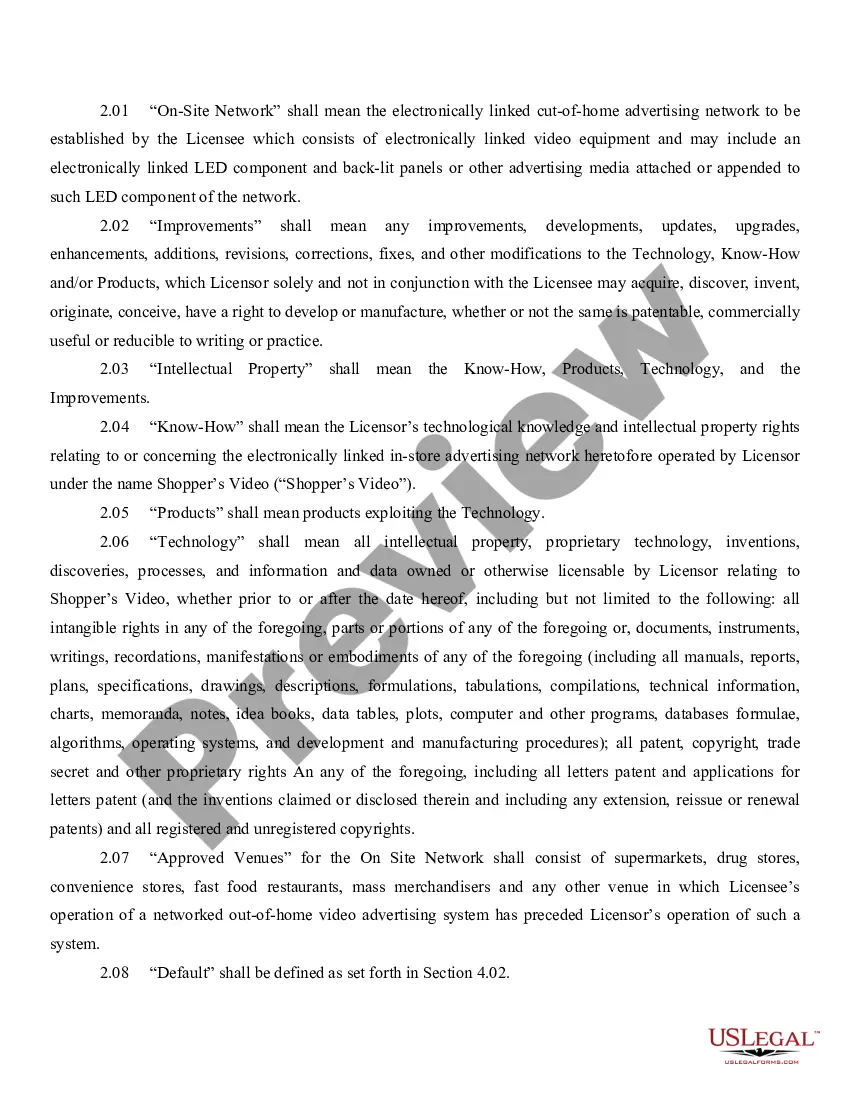
- Definition of key terms, including "Intellectual Property," "Technology," "Know-How," and "Improvements."
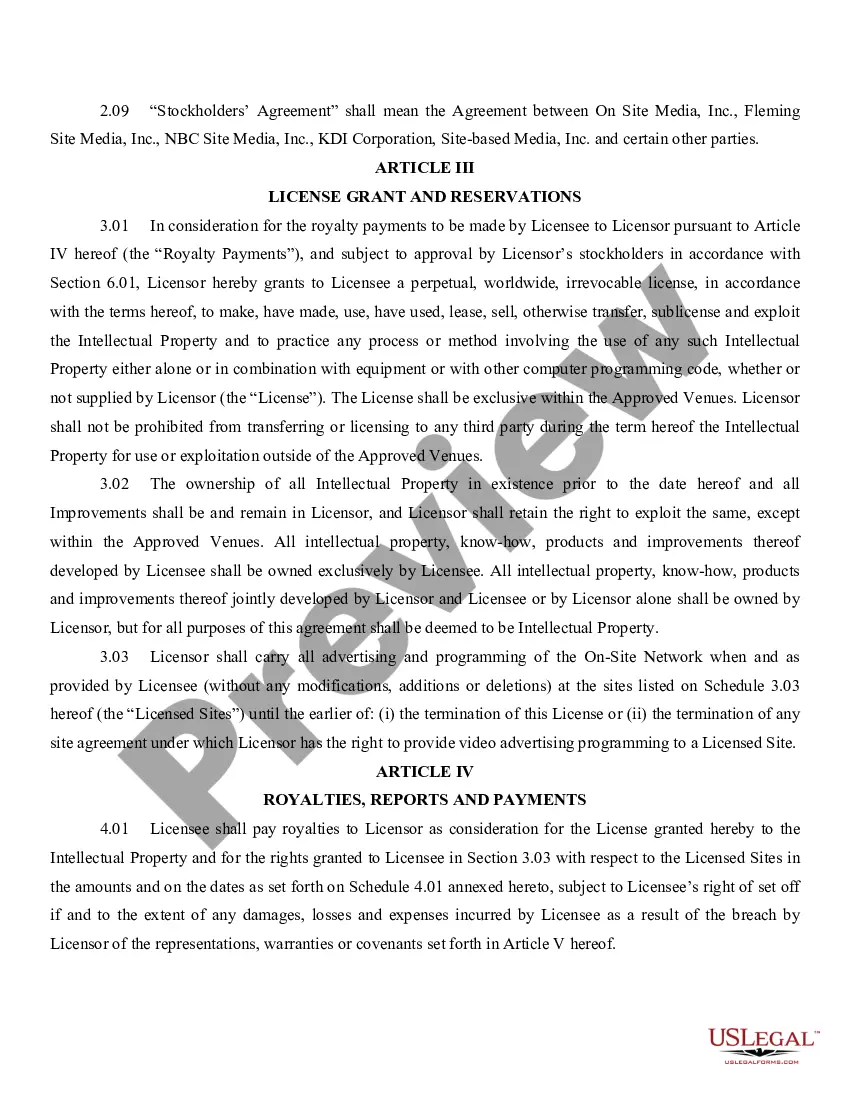
- Licensing terms outlining the grant of rights and the nature of the license (exclusive, worldwide, perpetual).
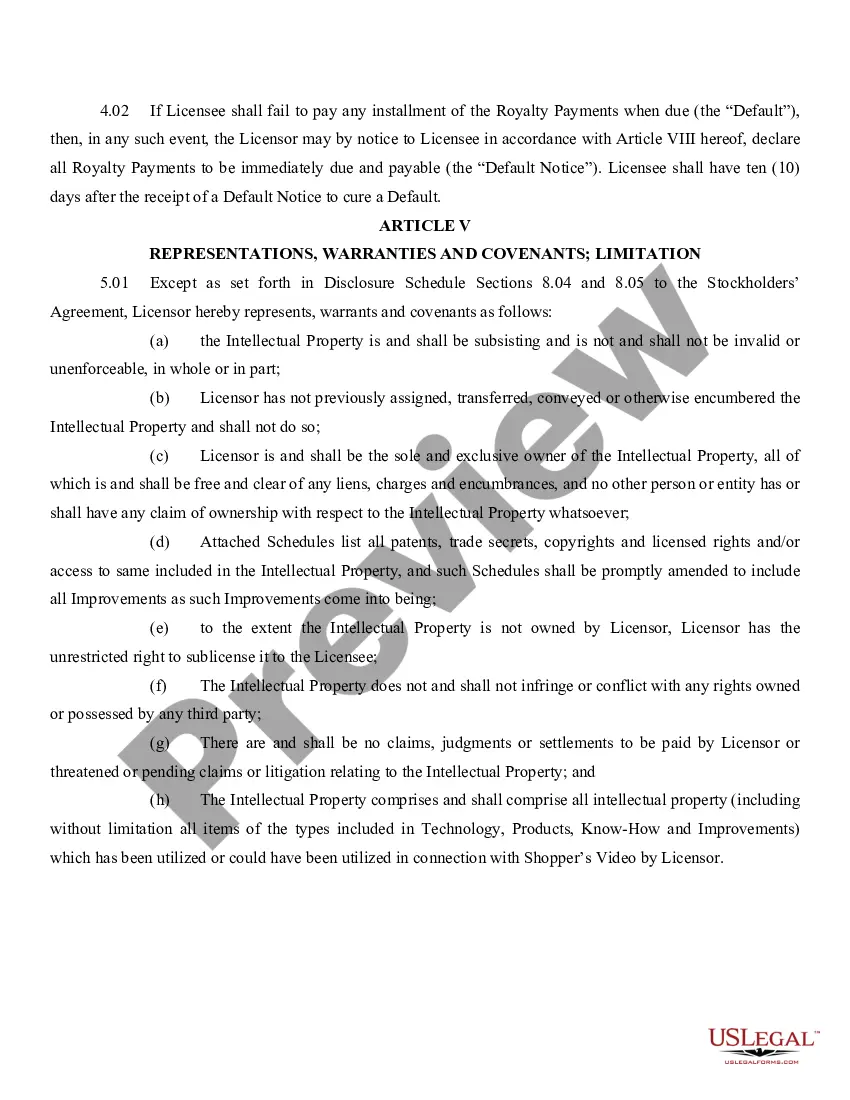
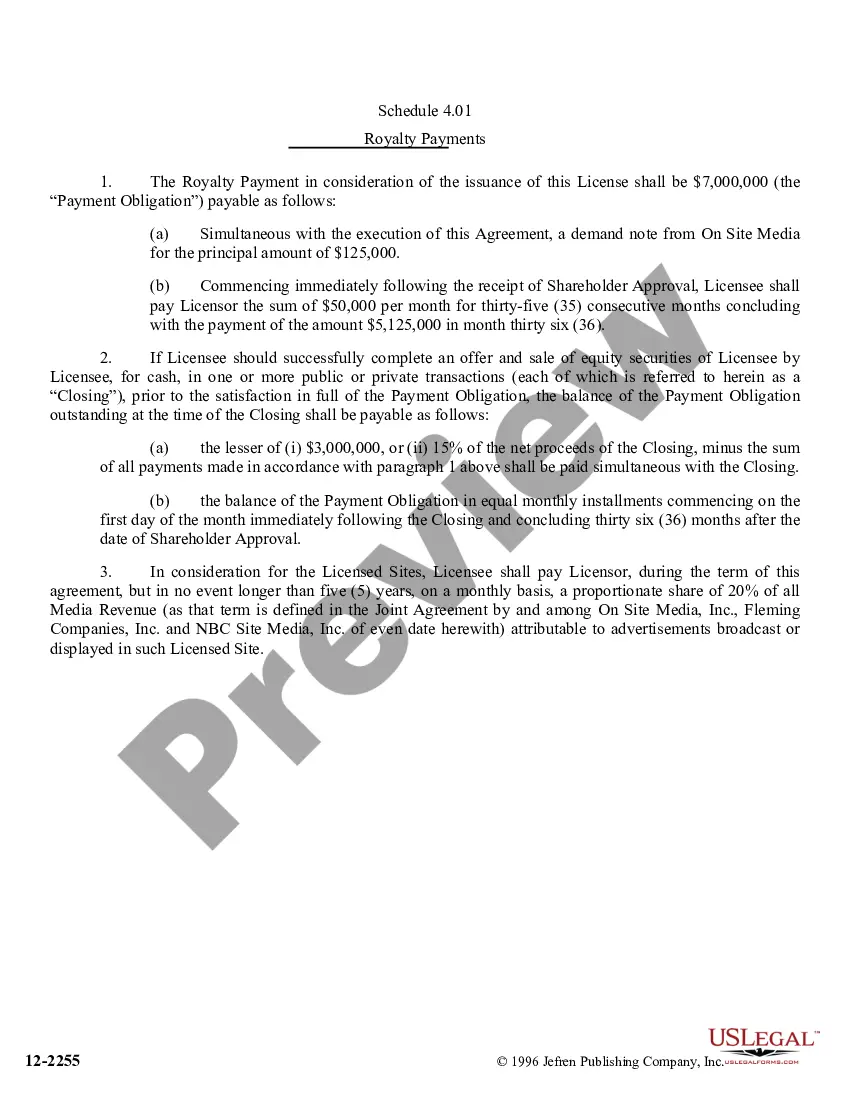
- Royalty payment structure and payment deadlines to compensate Site-Based Media for the licensed rights.
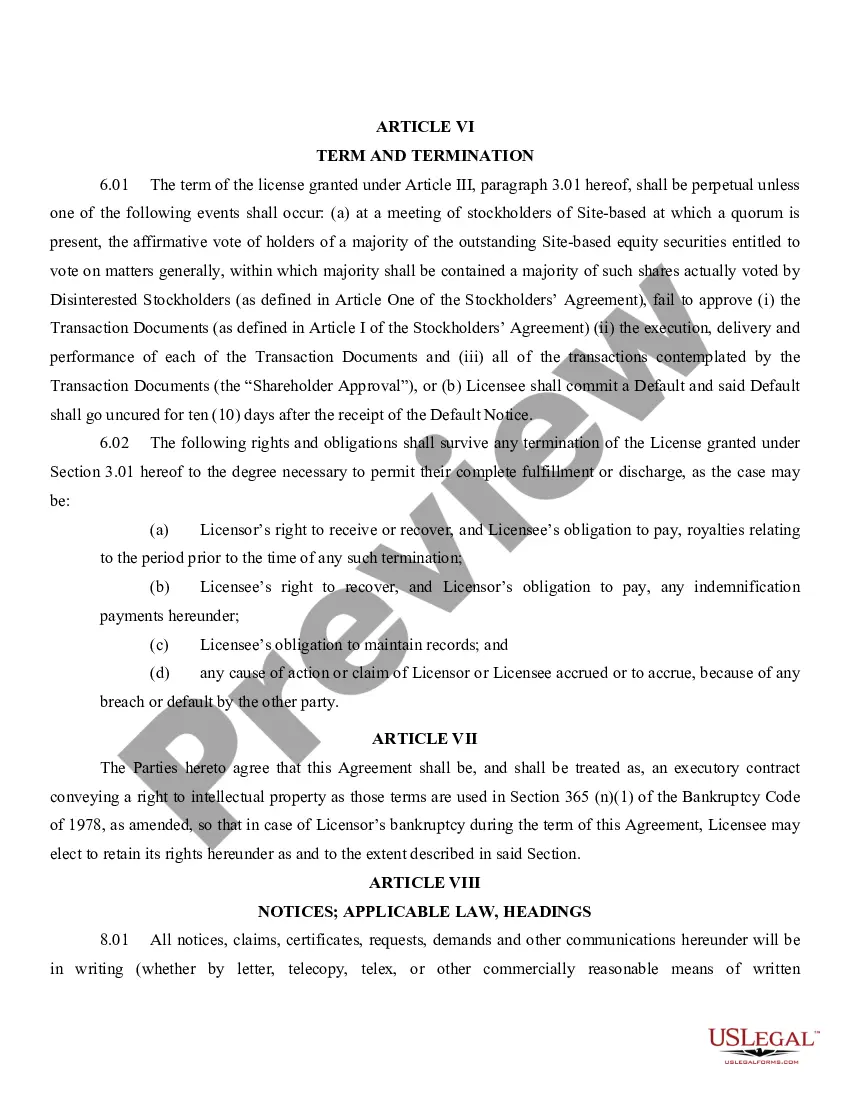
- Conditions for termination of the agreement and rights that survive termination.

Common use cases
This License Agreement should be used when one company desires to obtain rights to use another company's proprietary technology or intellectual property, specifically in the context of developing advertising networks. It is appropriate for businesses entering into partnerships that involve proprietary technologies related to advertising media.
Who should use this form
- Businesses looking to formalize a licensing arrangement for proprietary technology in advertising.
- Companies that own intellectual property and wish to license it to other parties for specific uses.
- Entities seeking to clearly define the terms of use, payment, and responsibilities in a licensing scenario.
Completing this form step by step
- Identify and enter the full legal names and addresses of both parties (Site-Based Media, Inc. and On Site Media, Inc.).
- Clearly define the key terms, including all intellectual property covered by the agreement.
- Specify the terms of the license, including duration, exclusivity, and geographical scope.
- Detail the royalty payment structure, including the amounts and payment schedule.
- Include the conditions for termination and the responsibilities of each party upon termination.
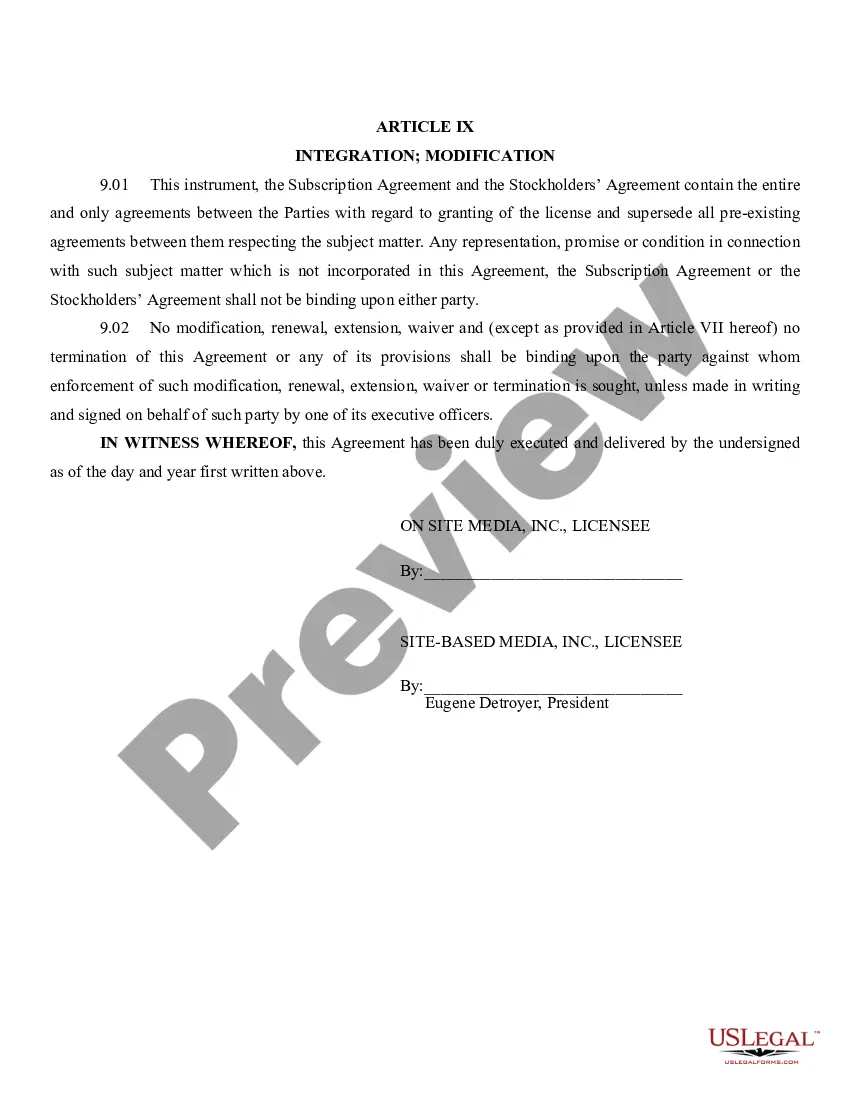
- Ensure that both parties sign the agreement to validate it.
Notarization guidance
This form does not typically require notarization to be legally valid. However, some jurisdictions or document types may still require it. US Legal Forms provides secure online notarization powered by Notarize, available 24/7 for added convenience.
Get your form ready online
Our built-in tools help you complete, sign, share, and store your documents in one place.
Make edits, fill in missing information, and update formatting in US Legal Forms—just like you would in MS Word.
Download a copy, print it, send it by email, or mail it via USPS—whatever works best for your next step.
Sign and collect signatures with our SignNow integration. Send to multiple recipients, set reminders, and more. Go Premium to unlock E-Sign.
If this form requires notarization, complete it online through a secure video call—no need to meet a notary in person or wait for an appointment.
We protect your documents and personal data by following strict security and privacy standards.

Make edits, fill in missing information, and update formatting in US Legal Forms—just like you would in MS Word.

Download a copy, print it, send it by email, or mail it via USPS—whatever works best for your next step.

Sign and collect signatures with our SignNow integration. Send to multiple recipients, set reminders, and more. Go Premium to unlock E-Sign.

If this form requires notarization, complete it online through a secure video call—no need to meet a notary in person or wait for an appointment.

We protect your documents and personal data by following strict security and privacy standards.
Typical mistakes to avoid
- Failing to define all key terms clearly, leading to ambiguity in the agreement.
- Neglecting to specify payment terms or payment schedules.
- Omitting provisions for termination of the agreement and survival of certain rights.
- Not ensuring that both parties sign the agreement, rendering it unenforceable.
Advantages of online completion
- Convenient access to a professionally drafted legal document tailored for licensing needs.
- Easy editability to customize terms specific to the agreement between the parties.
- Reliable format that adheres to legal standards, minimizing the risk of errors.
Looking for another form?
Form popularity
FAQ
Exclusive or non-exclusive. In an exclusive license, the intellectual property holder is licensing the work only to one person, for that particular use/territory. Territory. Use. Attribution. Derivative works. Confidentiality. Time frame. Termination.
Media Licenses means any license, permit, certificate, ordinance, approval or other authorization, or any renewal or extension thereof, from the FCC that is necessary for the broadcast or other operations of the Company and its Subsidiaries.
The 3 P's of collegiate licensing are protection, promotion, and profit.
What is a Licensing Agreement? A licensing agreement is a contract between two parties (the licensor and licensee) in which the licensor grants the licensee the right to use the brand name, trademark, patented technology, or ability to produce and sell goods owned by the licensor.
A Music License Agreement protects both parties when you settle in advance on whether to pay royalties as a percentage of revenue, for a set amount for each use, or under some other arrangement.
An example of a licensing agreement is a contract between the copyright holders of software and another company, allowing the latter to use the computer software for their daily business operations.
A license agreement is a business contract between two parties. The licensor (the seller of the license) owns the asset being licensed and the licensee (the buyer) pays for the right to use the license. The licensee pays royalties to the owner in exchange for the right to sell the product or use the technology.
In music, licensing refers to the officially permitted commercial uses of a piece of music (either a recording, a composition or both). A licensing deal ensures all copyright owners are entitled to accurate and fair compensation for the use and exploitation of their music.