Letter to Stockholders by General Physics Corp.
Understanding this form
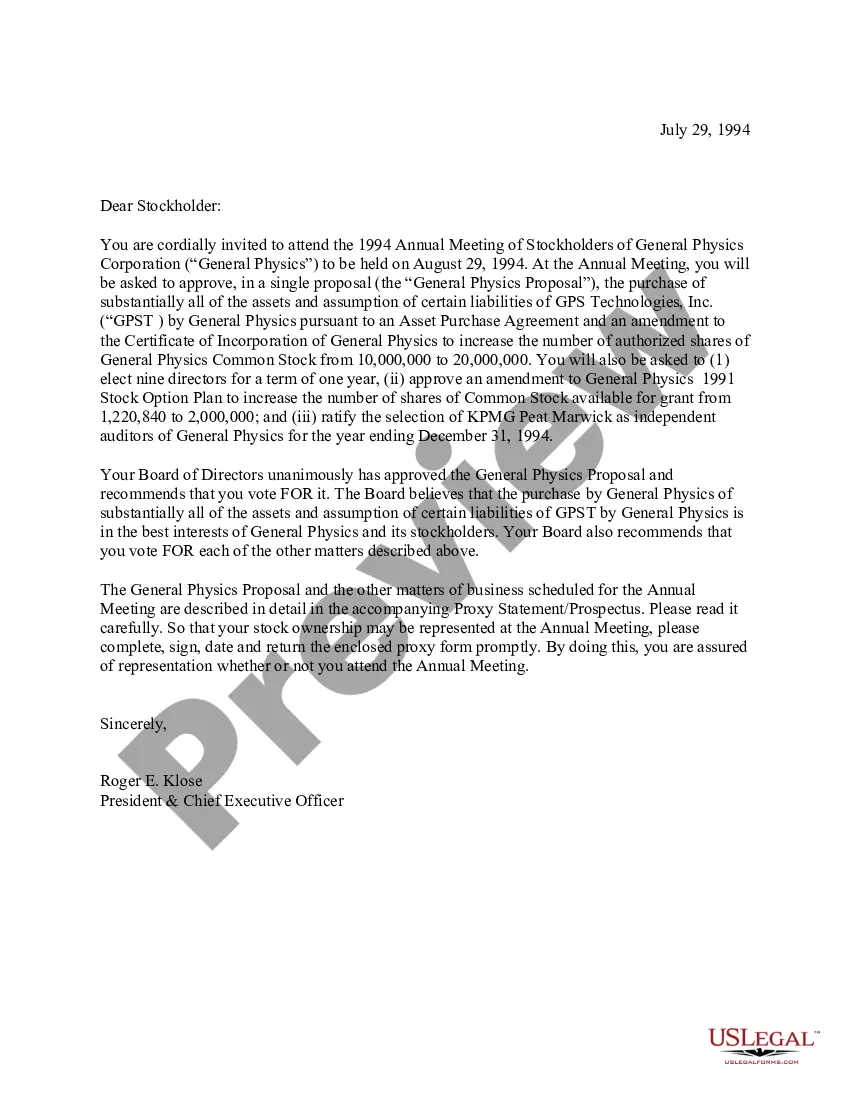
The Letter to Stockholders by General Physics Corp. serves as a formal communication to stockholders regarding important proposals that will be voted on during an annual meeting. This letter provides essential details regarding the acquisition of assets from another company, the election of directors, and proposed amendments to stock option plans. Unlike similar letters, this document is specifically tailored to present an official stance from the Board of Directors and recommendations for stockholder voting.
Key components of this form
- Introduction and invitation to the annual stockholder meeting.
- Details of the General Physics Proposal, including asset purchase and assumption of liabilities.
- Election of nine directors for a term of one year.
- Amendment to the 1991 Stock Option Plan for increasing available shares.
- Ratification of KPMG Peat Marwick as independent auditors.
- Instructions regarding the completion and return of the proxy form.
Situations where this form applies
This form is utilized during the preparation for an annual stockholder meeting. It is essential when a corporation needs to inform its stockholders of significant proposals that require approval, such as the acquisition of another company, board elections, and amendments to existing stock plans.
Who can use this document
- Corporate boards looking to inform stockholders about meeting agendas.
- Stockholders needing to understand proposals and vote accordingly.
- Corporate secretaries responsible for preparing formal communications to stockholders.
Instructions for completing this form
- Review the details of the proposals outlined in the document.
- Prepare the proxy form included with the letter, providing your vote on each matter.
- Sign and date the proxy form to validate your voting intent.
- Return the completed proxy form by mail or other designated methods as instructed.
- Consider attending the annual meeting for discussion and further involvement.
Notarization guidance
This form does not typically require notarization to be legally valid. However, some jurisdictions or document types may still require it. US Legal Forms provides secure online notarization powered by Notarize, available 24/7 for added convenience.
Get your form ready online
Our built-in tools help you complete, sign, share, and store your documents in one place.
Make edits, fill in missing information, and update formatting in US Legal Forms—just like you would in MS Word.
Download a copy, print it, send it by email, or mail it via USPS—whatever works best for your next step.
Sign and collect signatures with our SignNow integration. Send to multiple recipients, set reminders, and more. Go Premium to unlock E-Sign.
If this form requires notarization, complete it online through a secure video call—no need to meet a notary in person or wait for an appointment.
We protect your documents and personal data by following strict security and privacy standards.

Make edits, fill in missing information, and update formatting in US Legal Forms—just like you would in MS Word.

Download a copy, print it, send it by email, or mail it via USPS—whatever works best for your next step.

Sign and collect signatures with our SignNow integration. Send to multiple recipients, set reminders, and more. Go Premium to unlock E-Sign.

If this form requires notarization, complete it online through a secure video call—no need to meet a notary in person or wait for an appointment.

We protect your documents and personal data by following strict security and privacy standards.
Avoid these common issues
- Failing to sign or date the proxy form.
- Not reviewing all proposals before submitting your vote.
- Missing the deadline for returning the proxy form.
Why use this form online
- Easy access to download and print the form as needed.
- Convenient to complete and submit without the need for in-person meetings.
- Provides a clear format to ensure all necessary information is included.
Looking for another form?
Form popularity
FAQ
A shareholder, also referred to as a stockholder, is a person, company, or institution that owns at least one share of a company's stock, which is known as equity. Because shareholders are essentially owners in a company, they reap the benefits of a business' success.
Shareholders pay tax on their income in two ways: They pay tax on dividends they receive based on their stock ownership. Dividends can be taxed as ordinary income or as capital gains, depending on the type of dividend. Ordinary dividends are paid out of earnings and profits and are taxed as ordinary income.
A shareholder, also referred to as a stockholder, is a person, company, or institution that owns at least one share of a company's stock, which is known as equity. Because shareholders are essentially owners in a company, they reap the benefits of a business' success.
How Many Shares of Stock are Required? A corporation can't be a corporation without at least one share of stock. So you must have at least one shareholder, and one share of stock. You can have (authorize) as many shares of stock as you want, however, this may increase your filing fees in some cases.
In the Philippines, you can become a shareholder by purchasing stock directly from a company, acquiring shares in a company from other stockholders or buying them directly from the stock market.
Becoming a shareholder with any one public company means buying that company's stock through a brokerage firm. Becoming a shareholder in a private corporation involves contacting that company directly with an offer to invest.
At an annual general meeting (AGM), directors of the company present the company's financial performance and shareholders vote on the issues at hand. Shareholders who do not attend the meeting in person may usually vote by proxy, which can be done online or by mail.
It is far more common for dividends to be paid quarterly or annually, but some stocks and other types of investments pay dividends monthly to their shareholders. Only about 50 public companies pay dividends monthly out of some 3,000 that pay dividends on a regular basis.
Common shareholders are granted six rights: voting power, ownership, the right to transfer ownership, dividends, the right to inspect corporate documents, and the right to sue for wrongful acts.