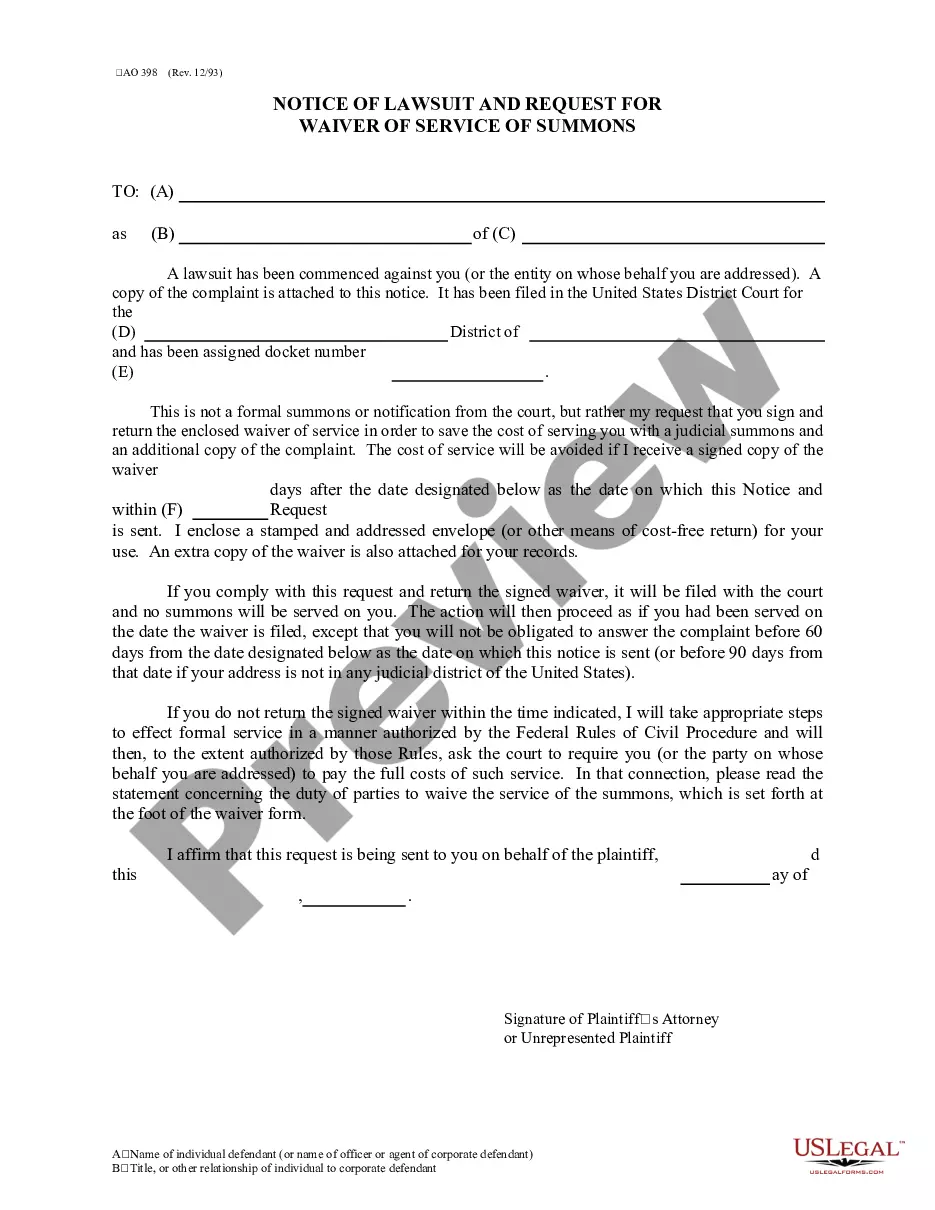
AO-398 Notice of Lawsuit - Request for Waiver - Federal District Court Official Form
Overview of this form
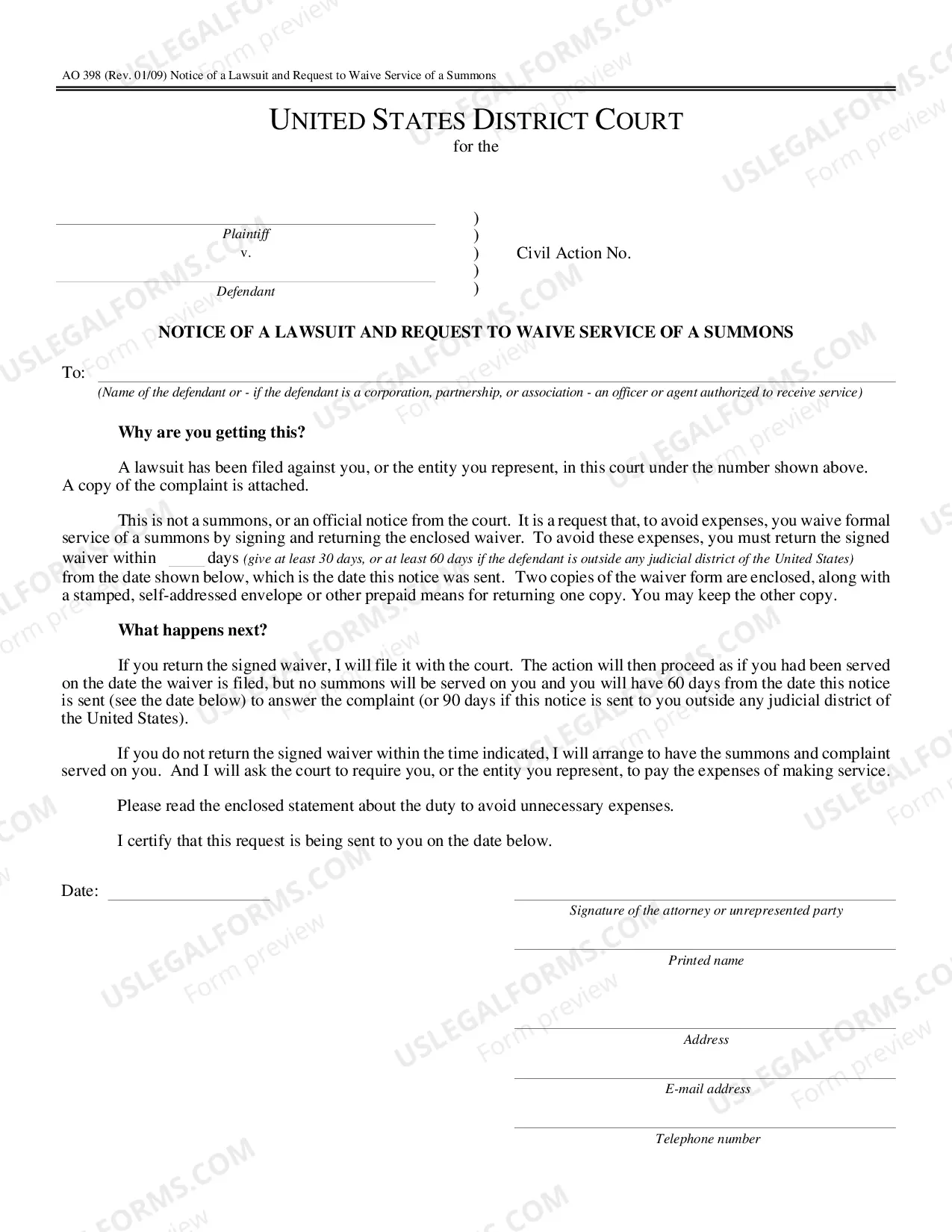
The AO-398 Notice of Lawsuit - Request for Waiver is an official form used in Federal District Court cases. This form allows a defendant to waive formal service of a summons, which can simplify the pretrial process. By accepting this waiver, the defendants can effectively acknowledge that they have received notice of the lawsuit without the need for a formal summons. This process helps expedite court proceedings and can ultimately save costs for both parties involved.
Key components of this form
- Defendant's acknowledgment of the notice of lawsuit.
- Request for waiver of formal service of summons.
- Details regarding the timeline for response after waiver submission.
- Consequences of not returning the signed waiver.
- Statement regarding the duty of parties to waive service.

Situations where this form applies
This form is used when a plaintiff intends to notify a defendant of a lawsuit without issuing a formal summons. It is particularly useful for cases where the defendant is expected to cooperate, allowing for a more streamlined legal process. By using this form, the plaintiff can reduce costs associated with formal service and encourage timely responses from the defendant.
Who this form is for
- Plaintiffs initiating a lawsuit in Federal District Court.
- Defendants who have been notified of a lawsuit and wish to waive formal service.
- Legal professionals preparing documentation for a federal case.
How to prepare this document
- Fill in the defendant's name and address to formally identify the recipient of the notice.
- Include the case number and court information as assigned by the Federal District Court.
- Sign and date the waiver request to confirm the defendant's acceptance.
- Clearly note the date this notice is being sent.
- Review the statement regarding the duty to waive service and any associated consequences.
Does this form need to be notarized?
This form usually doesn’t need to be notarized. However, local laws or specific transactions may require it. Our online notarization service, powered by Notarize, lets you complete it remotely through a secure video session, available 24/7.
Get your form ready online
Our built-in tools help you complete, sign, share, and store your documents in one place.
Make edits, fill in missing information, and update formatting in US Legal Forms—just like you would in MS Word.
Download a copy, print it, send it by email, or mail it via USPS—whatever works best for your next step.
Sign and collect signatures with our SignNow integration. Send to multiple recipients, set reminders, and more. Go Premium to unlock E-Sign.
If this form requires notarization, complete it online through a secure video call—no need to meet a notary in person or wait for an appointment.
We protect your documents and personal data by following strict security and privacy standards.

Make edits, fill in missing information, and update formatting in US Legal Forms—just like you would in MS Word.

Download a copy, print it, send it by email, or mail it via USPS—whatever works best for your next step.

Sign and collect signatures with our SignNow integration. Send to multiple recipients, set reminders, and more. Go Premium to unlock E-Sign.

If this form requires notarization, complete it online through a secure video call—no need to meet a notary in person or wait for an appointment.

We protect your documents and personal data by following strict security and privacy standards.
Common mistakes
- Failing to fill in the correct case number or court information.
- Not providing accurate contact information for the defendant.
- Neglecting to sign and date the notice before submitting it to the court.
Why complete this form online
- Convenience of downloading and completing the form at your convenience.
- Editability allows for easy corrections before finalizing the document.
- Reliable format in Word, PDF, and WordPerfect for compatibility with various systems.
What to keep in mind
- The AO-398 Notice of Lawsuit is essential for streamlining the service process in federal lawsuits.
- Parties should carefully consider the implications of waiving formal service.
- Completeness and timely return of the form are crucial to avoid additional costs.
- This form provides a user-friendly option for both plaintiffs and defendants to navigate legal proceedings more efficiently.
Looking for another form?
Form popularity
FAQ
For the waiver to be effective, the defendant or the defendant's counsel must sign the waiver of service and return it to the plaintiff within the time allowed and the plaintiff must file the executed waiver with the court within 120 days after the action was commenced (FRCP 4(d)(4) and 4(m)).
A waiver of service or summons means that a party voluntarily enters a lawsuit without requiring the opposing party to serve them with a summons and petition.Most people do not want to be served by a sheriff's deputy or special process server and so elect to sign a waiver of service.
You do not file anything with the federal court. relating to your initial disclosures. Sign the disclosures, include a certificate of service on the disclosures and keep a copy for your files as evidence that you served the disclosures should...
The Clerk will endorse the Complaint, the Cover Sheet and the Summons, and give them back to you with something called a Civil Lawsuit Notice. This tells the date and time of your first Court hearing, and which Department (courthouse and courtroom) and Judge your case is assigned to.
To begin a lawsuit in Federal Court, you must file a paper with the Court called a complaint. A complaint is a legal document that tells the judge and defendant(s) how and why you believe the defendants violated the law in a way that injured you and what you want the Court to do about it.
Unless service is waived, proof of service must be made to the court. Except for service by a United States marshal or deputy marshal, proof must be by the server's affidavit.
P.; colloquially FRCP) govern civil procedure in United States district courts. The FRCP are promulgated by the United States Supreme Court pursuant to the Rules Enabling Act, and then the United States Congress has seven months to veto the rules promulgated or they become part of the FRCP.
If your case is based on a violation of state law and not federal law, you can only sue in federal court if you and your opponents are citizens of different states and the amount in controversy exceeds $75,000. For example, a lawsuit based on a car accident usually involves state law.