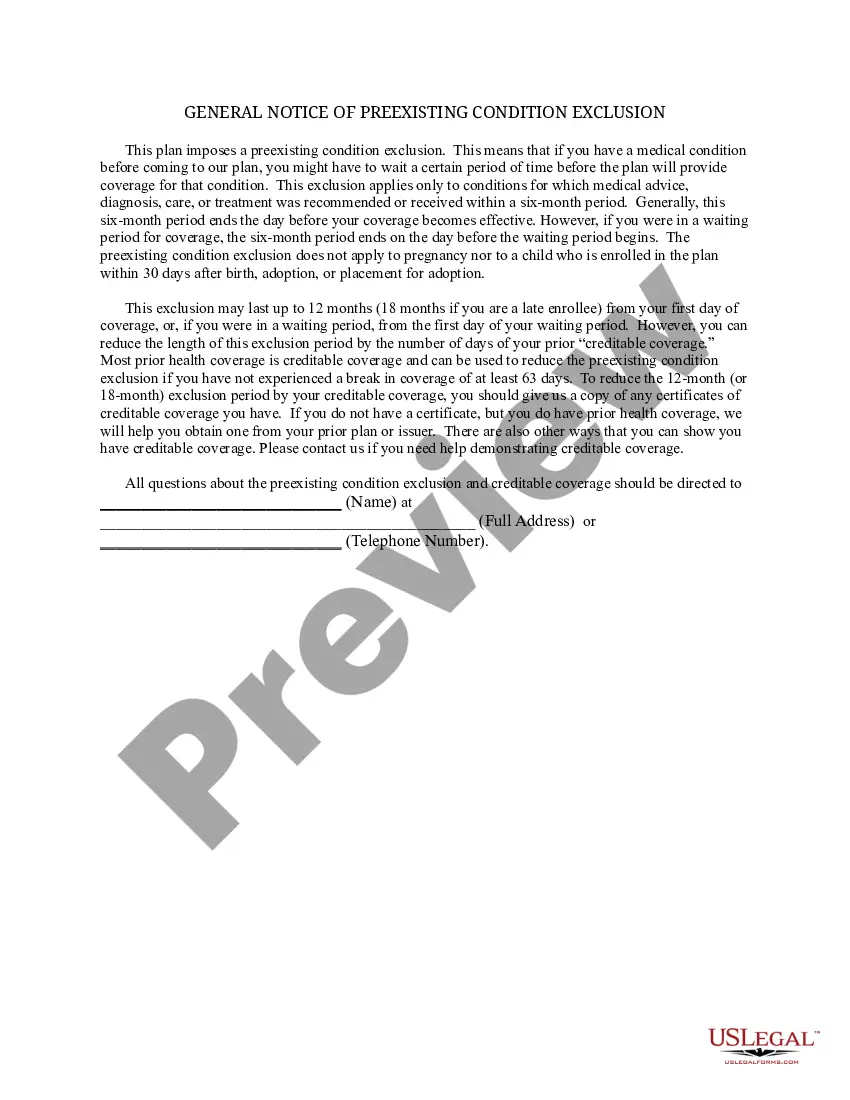
General Notice of Preexisting Condition Exclusion
Understanding this form
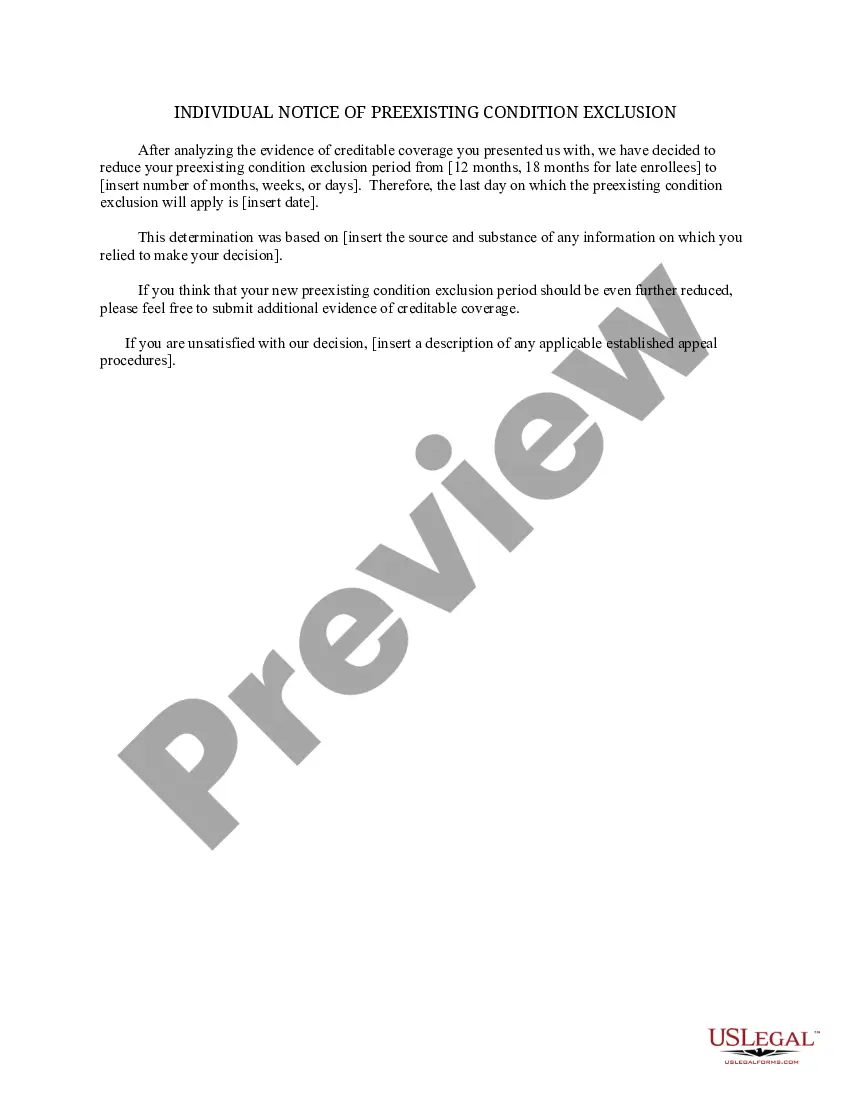
The General Notice of Preexisting Condition Exclusion is a document that notifies individuals of any exclusions regarding preexisting medical conditions under a group health plan. This form is crucial for understanding the limitations of coverage for health issues that existed before enrollment in the insurance plan, differentiating it from other health plan documents that may not specifically address preexisting conditions.
Key parts of this document
- Definition of preexisting condition exclusions and how they apply to your health coverage.
- Coverage waiting periods for existing medical conditions.
- Information on how prior health insurance coverage can reduce the exclusion duration.
- Specific scenarios where the exclusion does not apply, such as pregnancy.
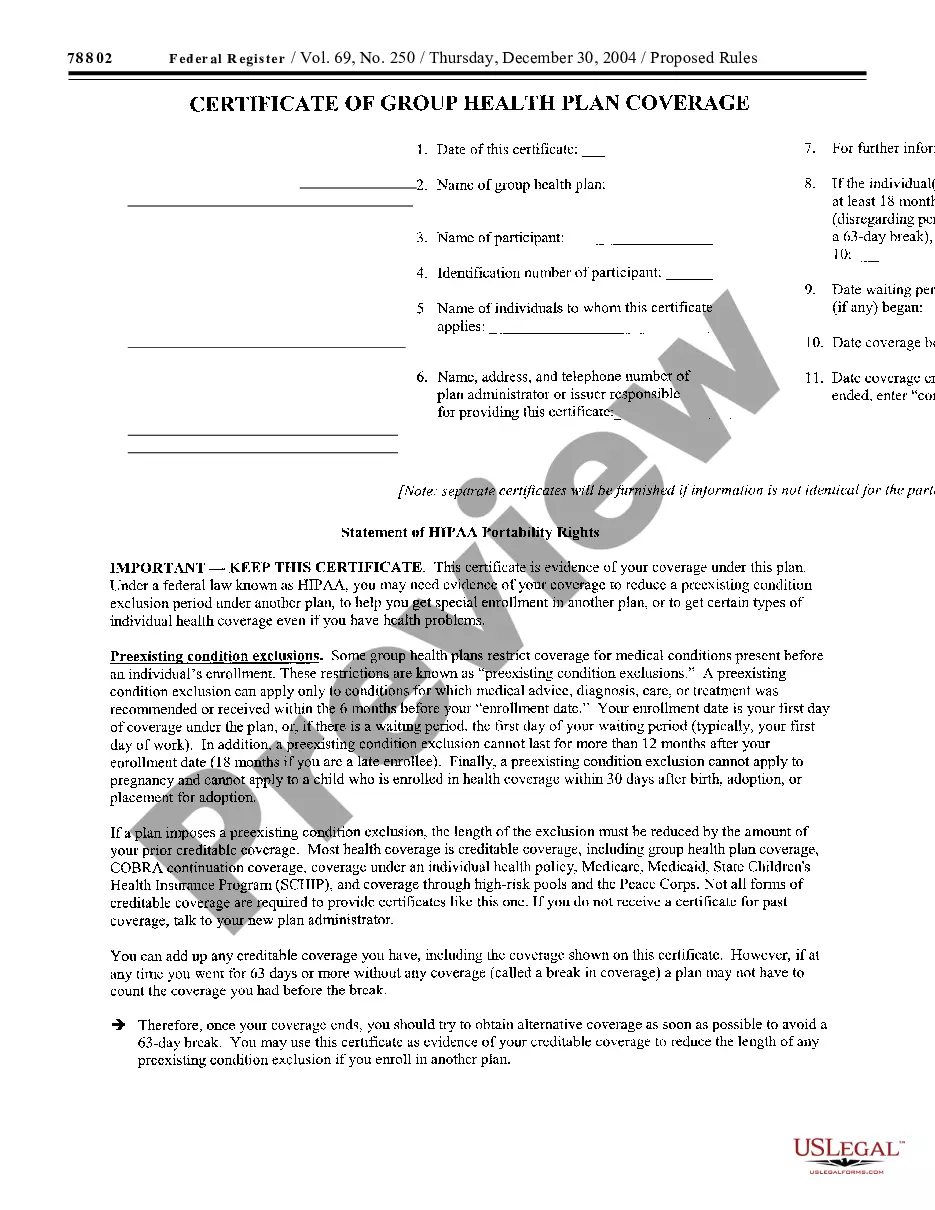
- Details on how to demonstrate prior coverage, including using certificates of creditable coverage.
- Contact information for inquiries regarding preexisting condition exclusions.
Situations where this form applies
This form should be used when you enroll in a health insurance plan and need to understand the implications of preexisting condition exclusions. It is particularly important if you have a history of medical issues that may affect your eligibility for coverage. Use this form to clarify any uncertainties regarding your coverage at the beginning of your health plan enrollment.
Intended users of this form
- Individuals enrolling in a group health plan for the first time.
- New employees receiving health coverage through an employer.
- Individuals with preexisting medical conditions who need clarity on their coverage options.
- Families adding members to a health policy, particularly infants or newly adopted children.
Instructions for completing this form
- Read the entire notice carefully to understand your rights and obligations concerning preexisting conditions.
- Identify any medical conditions that existed prior to your coverage and note them for discussion with your health plan provider.
- Gather any certificates of creditable coverage from previous health plans to potentially reduce your waiting period.
- Enter your contact information in the specified fields to ensure your inquiries are addressed.
- Keep a copy of this form for your records after completion and submission.
Does this document require notarization?
This form does not typically require notarization to be legally valid. However, some jurisdictions or document types may still require it. US Legal Forms provides secure online notarization powered by Notarize, available 24/7 for added convenience.
Get your form ready online
Our built-in tools help you complete, sign, share, and store your documents in one place.
Make edits, fill in missing information, and update formatting in US Legal Forms—just like you would in MS Word.
Download a copy, print it, send it by email, or mail it via USPS—whatever works best for your next step.
Sign and collect signatures with our SignNow integration. Send to multiple recipients, set reminders, and more. Go Premium to unlock E-Sign.
If this form requires notarization, complete it online through a secure video call—no need to meet a notary in person or wait for an appointment.
We protect your documents and personal data by following strict security and privacy standards.

Make edits, fill in missing information, and update formatting in US Legal Forms—just like you would in MS Word.

Download a copy, print it, send it by email, or mail it via USPS—whatever works best for your next step.

Sign and collect signatures with our SignNow integration. Send to multiple recipients, set reminders, and more. Go Premium to unlock E-Sign.

If this form requires notarization, complete it online through a secure video call—no need to meet a notary in person or wait for an appointment.

We protect your documents and personal data by following strict security and privacy standards.
Common mistakes
- Failing to disclose all preexisting conditions, which may lead to unexpected denial of coverage.
- Not providing certificates of creditable coverage that could shorten the exclusion period.
- Misunderstanding the waiting period, thinking coverage starts immediately.
Advantages of online completion
- Quick access to the form ensures timely submission with health plan enrollment.
- Editability allows you to fill in the required information at your convenience.
- Reliable legal framework designed by licensed attorneys, ensuring compliance with current laws.
Summary of main points
- The General Notice of Preexisting Condition Exclusion outlines coverage limitations for preexisting conditions.
- Prior health coverage can potentially reduce the exclusion period outlined in the notice.
- Understanding this form is crucial for informed health care decisions upon enrollment.
Looking for another form?

Form popularity
FAQ
The time period during which an individual policy won't pay for care relating to a pre-existing condition. Under an individual policy, conditions may be excluded permanently (known as an "exclusionary rider").
Employer-sponsored coverage is the best bet for people with pre-existing conditions. Don't have access to that kind of coverage? Consider buying a plan through the health insurance marketplace set up by the Affordable Care Act. All marketplace or exchange plans have to cover pre-existing conditions.
Under current law, health insurance companies can't refuse to cover you or charge you more just because you have a pre-existing condition that is, a health problem you had before the date that new health coverage starts.
Under current law, health insurance companies can't refuse to cover you or charge you more just because you have a pre-existing condition that is, a health problem you had before the date that new health coverage starts.
A pre-existing condition is a health condition that existed prior to applying for health or life insurance. Conditions include illnesses like diabetes, cancer, and heart disease. Under the Affordable Care Act, health insurance companies can't refuse coverage or charge more for pre-existing conditions.
Insurers then use your permission to snoop through old records to look for anything that they might be able to use against you. If you have a pre-existing condition, they'll try to deny your claim on the grounds that you were already injured and their insured had nothing to do with it.
Yes. Under the Affordable Care Act, health insurance companies can't refuse to cover you or charge you more just because you have a pre-existing condition that is, a health problem you had before the date that new health coverage starts.
Yes. Under the Affordable Care Act, health insurance companies can't refuse to cover you or charge you more just because you have a pre-existing condition that is, a health problem you had before the date that new health coverage starts.They don't have to cover pre-existing conditions.
A pre-existing condition is typically one for which you have received treatment or diagnosis before you enrolled in a new health plan.The ACA made it illegal for health insurance companies to deny you medical coverage or raise rates due to a pre-existing condition.