Checklist - Documents to Bring to Your Attorney
What this document covers
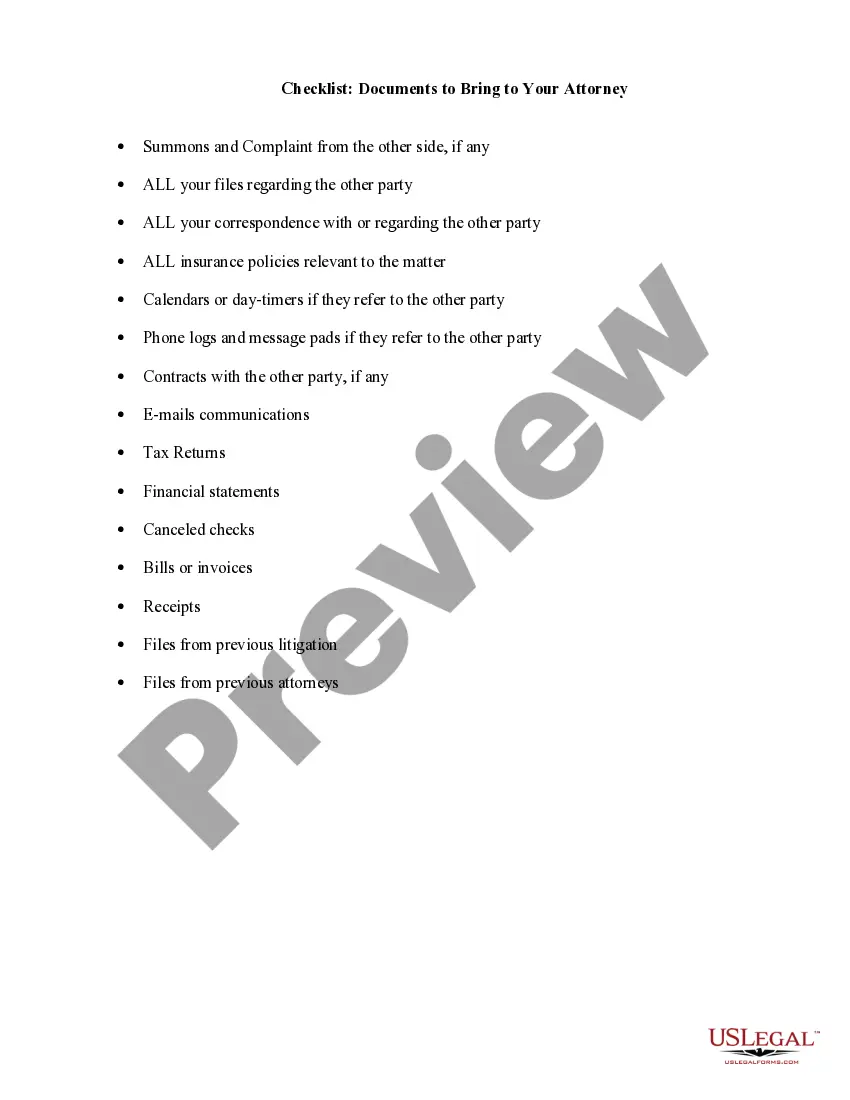
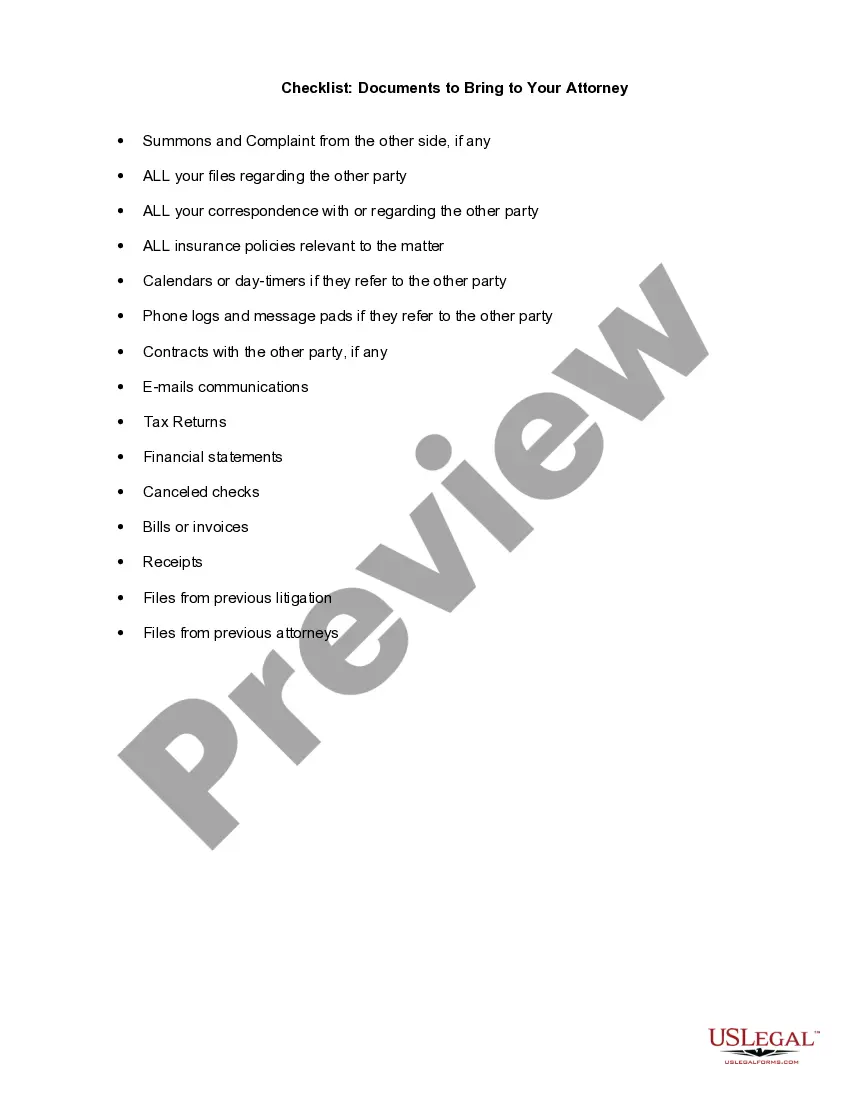
The Checklist - Documents to Bring to Your Attorney is a useful tool designed to help clients prepare for their meetings with legal professionals. This checklist ensures that you gather all necessary documentation, making the consultation process more efficient. Unlike other forms that simply list information, this checklist focuses specifically on the critical documents that can impact your case or legal advice.
What’s included in this form
- Summons and complaint from the other party, if applicable.
- Relevant files and correspondence related to the other party.
- Insurance policies tied to the dispute.
- Calendars or planners documenting interactions with the other party.
- Phone logs and notes regarding communications.
- Contracts with the other party, if any.
- Emails related to the matter.
- Tax returns and financial statements.
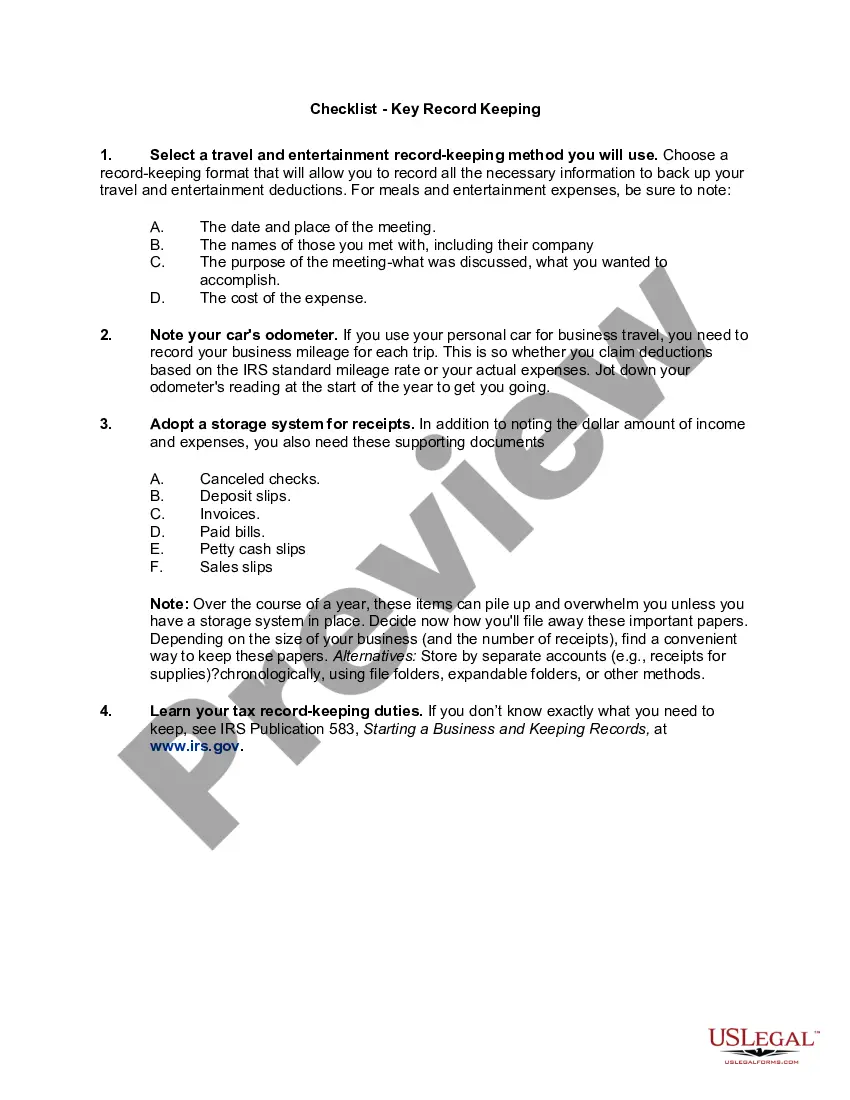
- Canceled checks, bills, and invoices that pertain to the case.
- Files from previous litigations or attorneys.
When to use this form
This checklist is essential when you suspect potential legal issues with creditors or debtors. It is particularly useful in scenarios involving late payments, disputes over amounts owed, or any communications that could indicate legal actions. By preparing these documents, you can facilitate a productive meeting with your attorney and clarify your position regarding the issue at hand.
Intended users of this form
- Individuals involved in disputes with creditors or debtors.
- Clients seeking to consult with an attorney on financial matters.
- Those planning to take legal action based on document evidence.
- Anyone wanting to ensure all relevant information is presented effectively to their legal representative.
Instructions for completing this form
- Gather all relevant documents mentioned in the checklist.
- Organize your files in order of importance or relevance to your case.
- Make copies of all documents for your attorney and keep originals for your records.
- Label each document clearly to facilitate easy reference during discussions.
- Review the checklist before your appointment to ensure you are prepared.
Notarization guidance
Notarization is generally not required for this form. However, certain states or situations might demand it. You can complete notarization online through US Legal Forms, powered by Notarize, using a verified video call available anytime.
Get your form ready online
Our built-in tools help you complete, sign, share, and store your documents in one place.
Make edits, fill in missing information, and update formatting in US Legal Forms—just like you would in MS Word.
Download a copy, print it, send it by email, or mail it via USPS—whatever works best for your next step.
Sign and collect signatures with our SignNow integration. Send to multiple recipients, set reminders, and more. Go Premium to unlock E-Sign.
If this form requires notarization, complete it online through a secure video call—no need to meet a notary in person or wait for an appointment.
We protect your documents and personal data by following strict security and privacy standards.

Make edits, fill in missing information, and update formatting in US Legal Forms—just like you would in MS Word.

Download a copy, print it, send it by email, or mail it via USPS—whatever works best for your next step.

Sign and collect signatures with our SignNow integration. Send to multiple recipients, set reminders, and more. Go Premium to unlock E-Sign.

If this form requires notarization, complete it online through a secure video call—no need to meet a notary in person or wait for an appointment.

We protect your documents and personal data by following strict security and privacy standards.
Typical mistakes to avoid
- Forgetting to include crucial correspondence with the other party.
- Not organizing documents, which can lead to confusion during meetings.
- Failing to confirm which documents are relevant to your specific case.
- Neglecting to review all gathered documents before the meeting.
Benefits of completing this form online
- Immediate access to a comprehensive checklist tailored for preparing for legal consultations.
- Easy customization to meet specific needs and cases.
- Printable format for convenience and organization.
- Peace of mind knowing you are adequately prepared for your attorney visit.
What to keep in mind
- This form assists in preparing for meetings with attorneys by ensuring all relevant documents are collected.
- It is useful for individuals facing creditor or debtor disputes.
- No notarization is generally needed for this checklist.
- Proper organization of documents can lead to a more effective legal consultation.
Looking for another form?
Form popularity
FAQ
Someone close to you has just received a terminal illness diagnosis. The doctor is telling them that they have a short time to live and that they should get their affairs in order.
The 4 legal documents every adult should have A will. Also known as: a last will and testament.A living will. Also known as: an advance directive.Durable health care power of attorney. It appoints: a health care proxy.Durable financial power of attorney. It appoints: an attorney-in-fact or agent.
Here's how to write a legal document in 10 simple steps: Plan Out the Document Before You Begin.Write with Clear and Concise Language.Ensure the Correct Use of Grammar.Be as Accurate as Possible.Make Information Accessible.Ensure All Necessary Information Is Included.Always Use an Active Voice.
What Do Legal Documents Include? Identification of the parties. Rights of parties. Duties of parties. Cost of offer. Payment terms. Choice of law clause. Disclaimers. Dispute resolution clause.
The 4 legal documents every adult should have A will. Also known as: a last will and testament.A living will. Also known as: an advance directive.Durable health care power of attorney. It appoints: a health care proxy.Durable financial power of attorney. It appoints: an attorney-in-fact or agent.
For a contract to be valid and recognized by the common law, it must include certain elements? offer, acceptance, consideration, intention to create legal relations, authority and capacity, and certainty. Without these elements, a contract is not legally binding and may not be enforced by the courts.
You'll want to start with a standard page size (8.5 x 11 inches) with 1-inch margins. Keep the font simple, such as Times New Roman, and avoid the use of color. Remember to break up text with headers and paragraphs for readability.
Checklist for getting your affairs in order Plan for your estate and finances.Plan for your future health care.Put your important papers and copies of legal documents in one place.Tell someone you know and trust or a lawyer where to find your important papers.