Jury Instruction - Sale Of Firearm To Convicted Felon
Understanding this form
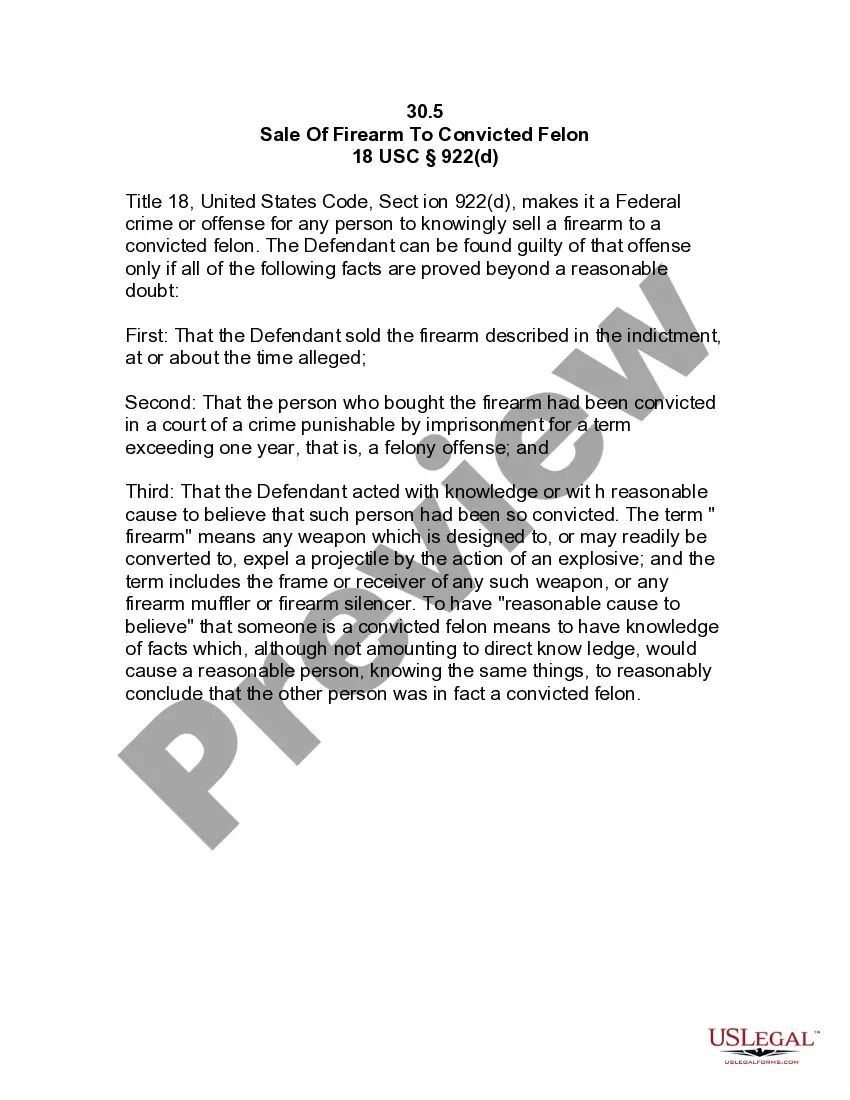
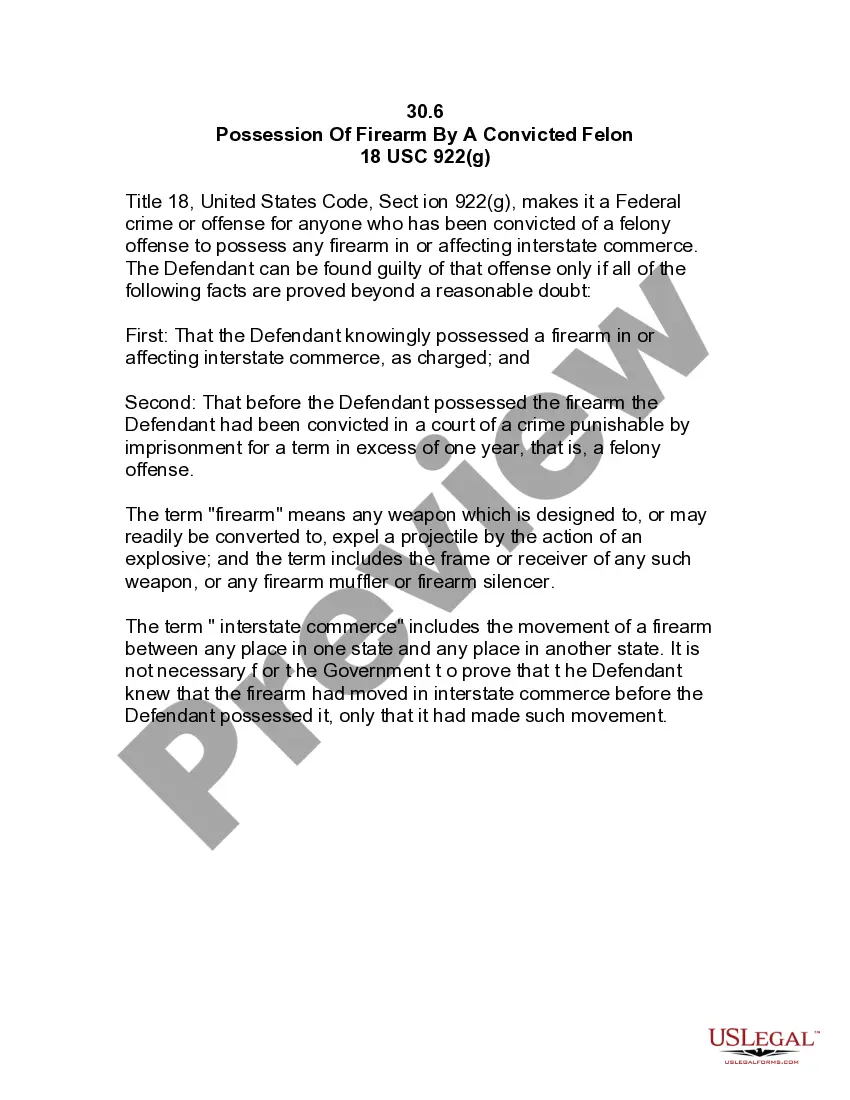
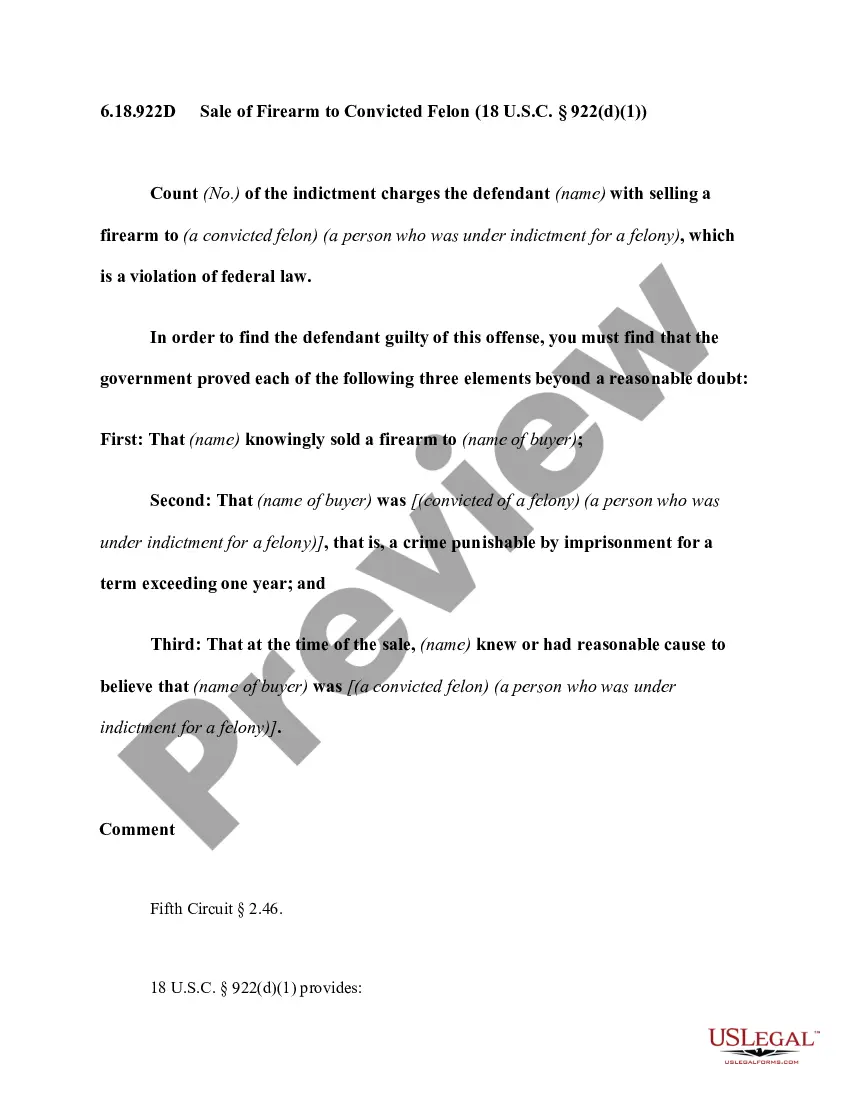
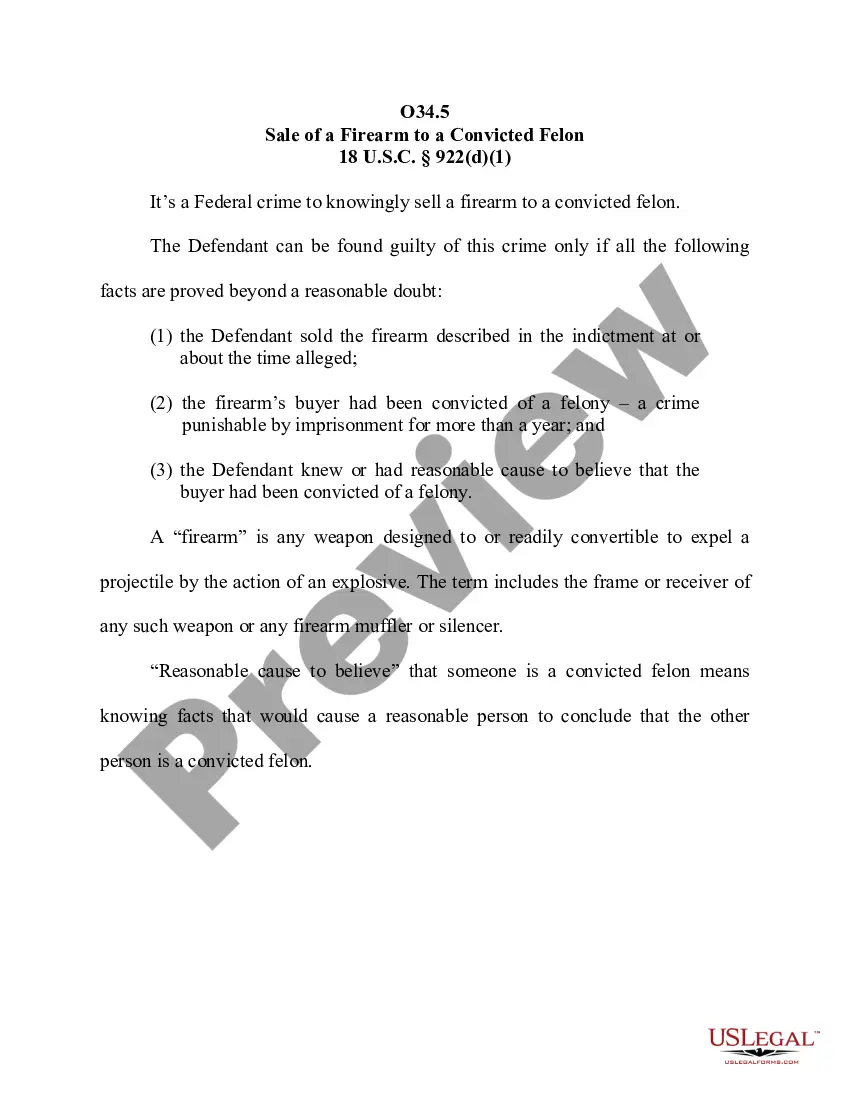
This form provides sample jury instructions related to the sale of firearms to convicted felons, guided by federal law under 18 USC 922(d). It is designed to assist juries in understanding the legal standards necessary to determine guilt in such cases. These instructions are adaptable to fit specific legal scenarios and ensure clarity in application, setting them apart from other jury instruction forms.
Main sections of this form
- Detailed definition of a firearm as per federal law.
- Criteria for establishing the guilt of the defendant through evidence.
- Clarification of the term "convicted felon" and its legal implications.
- Guidelines on what constitutes "reasonable cause" to believe a buyer is a convicted felon.
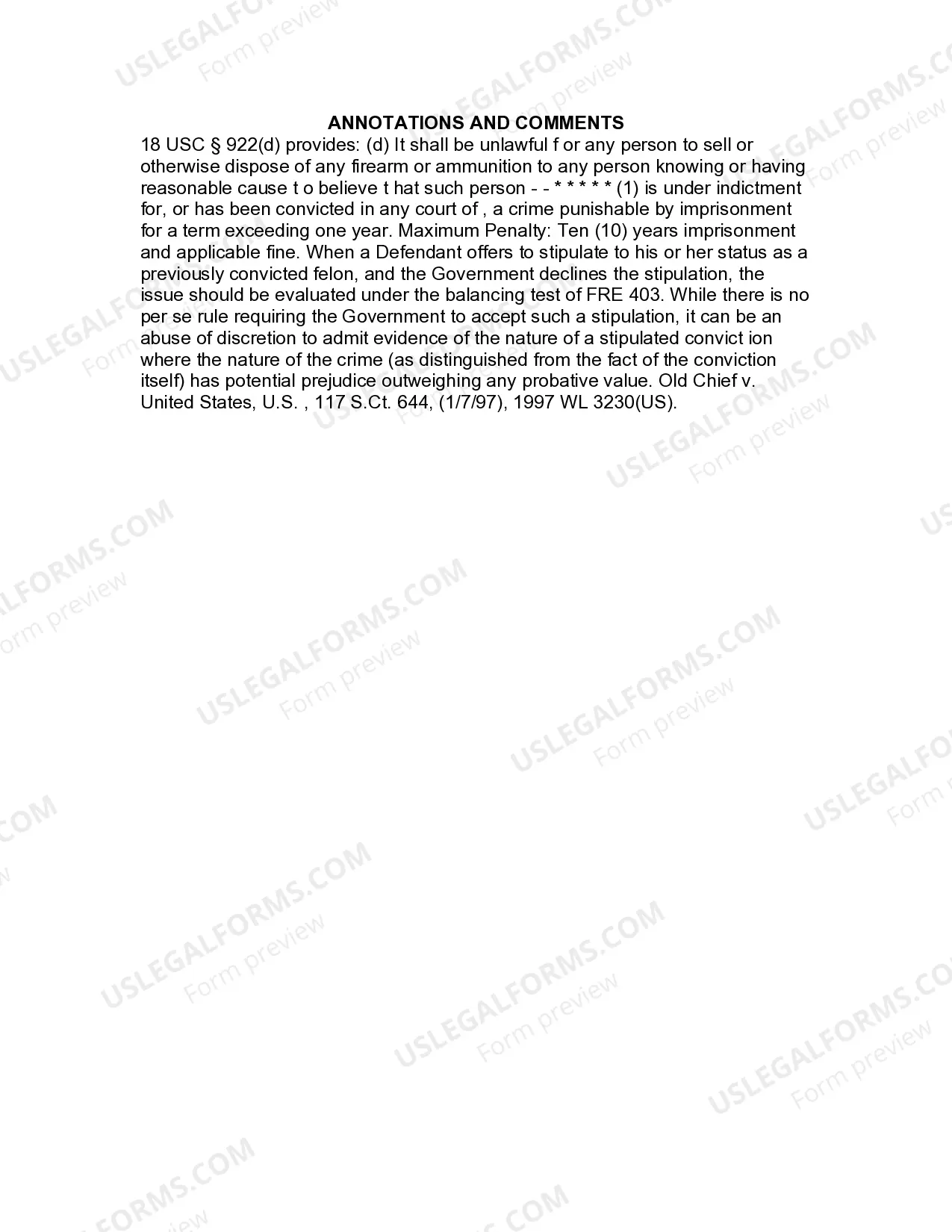
- Penalties associated with selling firearms to convicted felons, including potential imprisonment and fines.
Situations where this form applies
This form is essential in criminal trials involving charges against individuals accused of illegally selling firearms to convicted felons. It helps jurors understand their deliberations, ensuring they can fairly evaluate the evidence presented. Use this form in cases where there is a need for clarity on the legal definitions and standards required for conviction under federal law.
Who can use this document
- Legal professionals involved in criminal defense or prosecution.
- Judges presiding over trials that include firearm-related charges.
- Jurors needing guidance on specific legal standards in a trial.
How to complete this form
- Identify the specific charges related to the firearm sale.
- Define the characteristics of the firearm as per federal law.
- Gather evidence that establishes the defendant's knowledge of the buyer's criminal history.
- Clarify the felon's status and ensure it meets the legal definition of a convicted felon.
- Include any applicable penalty information to guide jurors appropriately.
Notarization guidance
This form usually doesn’t need to be notarized. However, local laws or specific transactions may require it. Our online notarization service, powered by Notarize, lets you complete it remotely through a secure video session, available 24/7.
Get your form ready online
Our built-in tools help you complete, sign, share, and store your documents in one place.
Make edits, fill in missing information, and update formatting in US Legal Forms—just like you would in MS Word.
Download a copy, print it, send it by email, or mail it via USPS—whatever works best for your next step.
Sign and collect signatures with our SignNow integration. Send to multiple recipients, set reminders, and more. Go Premium to unlock E-Sign.
If this form requires notarization, complete it online through a secure video call—no need to meet a notary in person or wait for an appointment.
We protect your documents and personal data by following strict security and privacy standards.

Make edits, fill in missing information, and update formatting in US Legal Forms—just like you would in MS Word.

Download a copy, print it, send it by email, or mail it via USPS—whatever works best for your next step.

Sign and collect signatures with our SignNow integration. Send to multiple recipients, set reminders, and more. Go Premium to unlock E-Sign.

If this form requires notarization, complete it online through a secure video call—no need to meet a notary in person or wait for an appointment.

We protect your documents and personal data by following strict security and privacy standards.
Avoid these common issues
- Failing to clearly establish the knowledge element required for conviction.
- Misunderstanding what qualifies as a firearm under federal definitions.
- Not providing sufficient evidence regarding the buyer's prior felony conviction.
Why use this form online
- Instant access to comprehensive jury instructions tailored to federal law.
- Ease of customization to meet specific trial needs.
- Convenient downloadable format for immediate use in court proceedings.
Legal use & context
- This form is used to outline the legal standards for selling firearms to convicted felons.
- It serves to educate juries thoroughly, ensuring accurate verdicts based on legal definitions.
- Understanding the implications of this form helps prevent wrongful convictions due to misunderstandings of the law.
Looking for another form?


Form popularity
FAQ
Schedule D is required when a taxpayer reports capital gains or losses from investments or the result of a business venture or partnership. The calculations from Schedule D are combined with individual tax return form 1040, where it will affect the adjusted gross income amount.
Short You do not really need to mail Form 8949, but you do need to mail your supporting statements, such as your brokerage statements (Form 1099B) and Form 8453.Most people send their 1099-B forms received form their brokers as these usually contain all the information for the transactions.
Any year that you have to report a capital asset transaction, you'll need to prepare Form 8949 before filling out Schedule D unless an exception applies. Form 8949 requires the details of each capital asset transaction.
IRS Form 8949 is used to report capital gains and losses from investments for tax purposes. The form segregates short-term capital gains and losses from long-term ones. Filing this form also requires a Schedule D and a Form 1099-B, which is provided by brokerages to taxpayers.
File Form 8949 with the Schedule D for the return you are filing. This includes Schedule D of Forms 1040, 1040-SR, 1041, 1065, 8865, 1120, 1120-S, 1120-C, 1120-F, 1120-FSC, 1120-H, 1120-IC-DISC, 1120-L, 1120-ND, 1120-PC, 1120-POL, 1120-REIT, 1120-RIC, and 1120-SF; and certain Forms 990-T.
Any year that you have to report a capital asset transaction, you'll need to prepare Form 8949 before filling out Schedule D unless an exception applies. Form 8949 requires the details of each capital asset transaction.
Form 8453 is required to be filled out and mailed to the IRS when one or more of the forms below are included in an e-filed return.Form 5713, International Boycott Report. Form 8858, Foreign Disregarded Entities Information Return.
You'll need it to report short- and long-term capital gains to the IRS. Schedule D of Form 1040 is used to report most capital gain (or loss) transactions. But before you can enter your net gain or loss on Schedule D, you have to complete Form 8949.
Schedule D is used to report income or losses from capital assets. Assets owned by you are considered capital assets. These include your home, car, boat, furniture, and stocks, to name a few.
Use Form 8949 to reconcile amounts that were reported to you and the IRS on Form 1099-B or 1099-S (or substitute statement) with the amounts you report on your return. The subtotals from this form will then be carried over to Schedule D (Form 1040), where gain or loss will be calculated in aggregate.