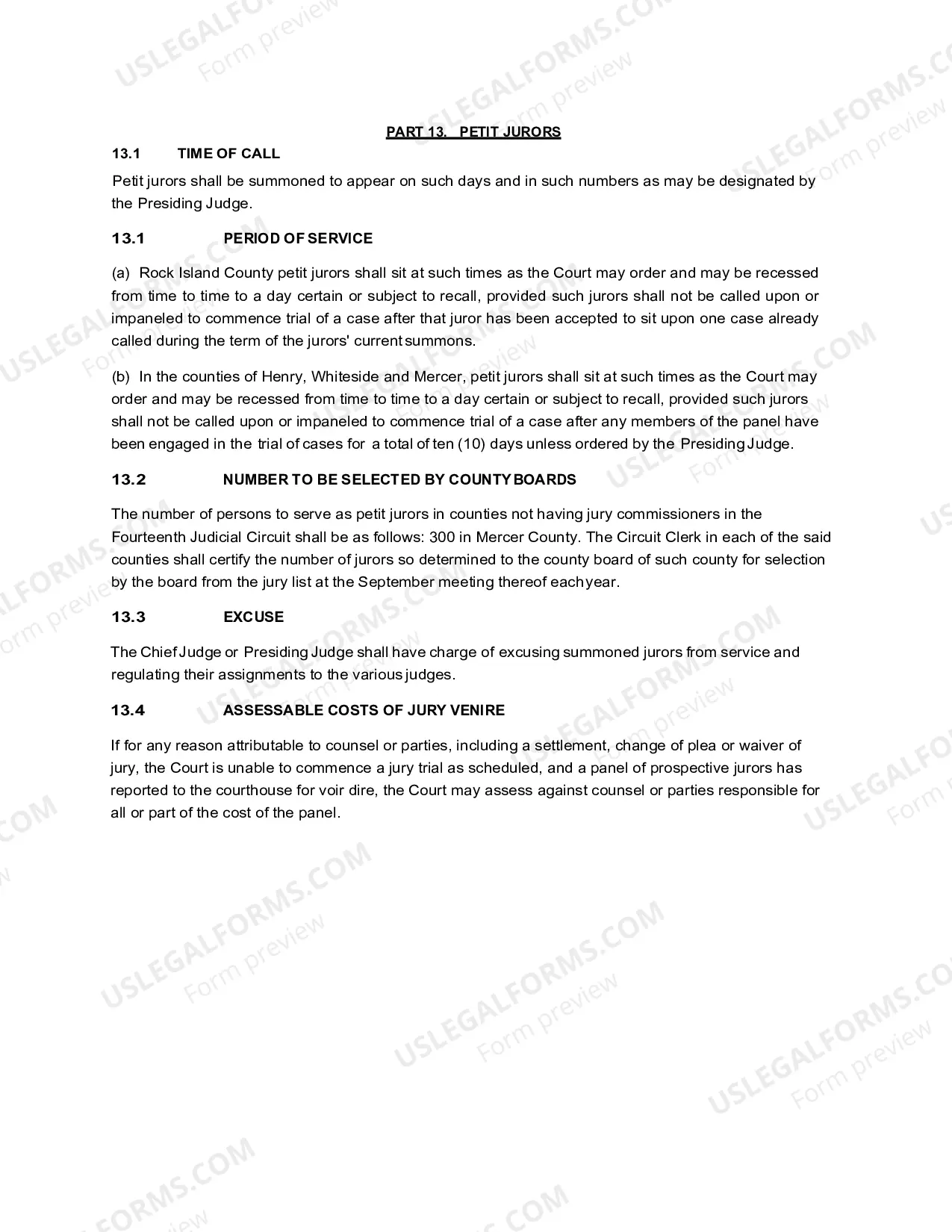
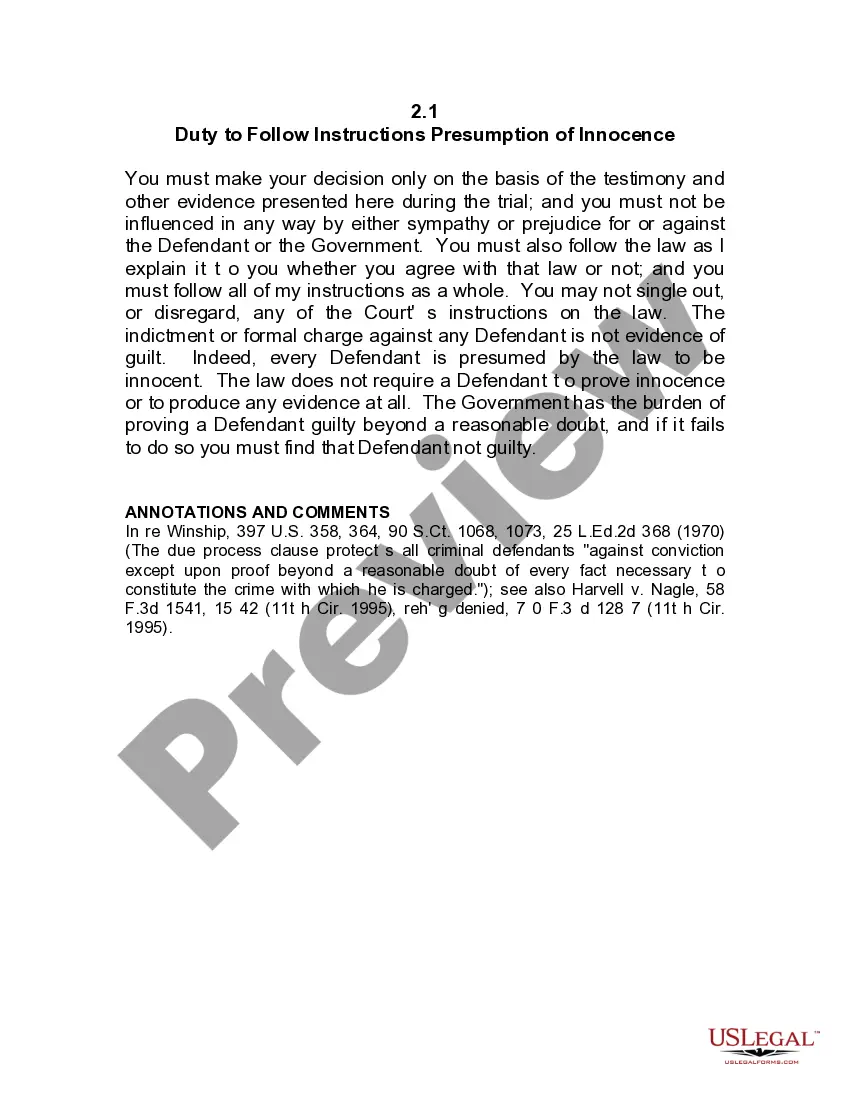
Jury Instruction - Duty to Follow Instructions, etc.
What this document covers
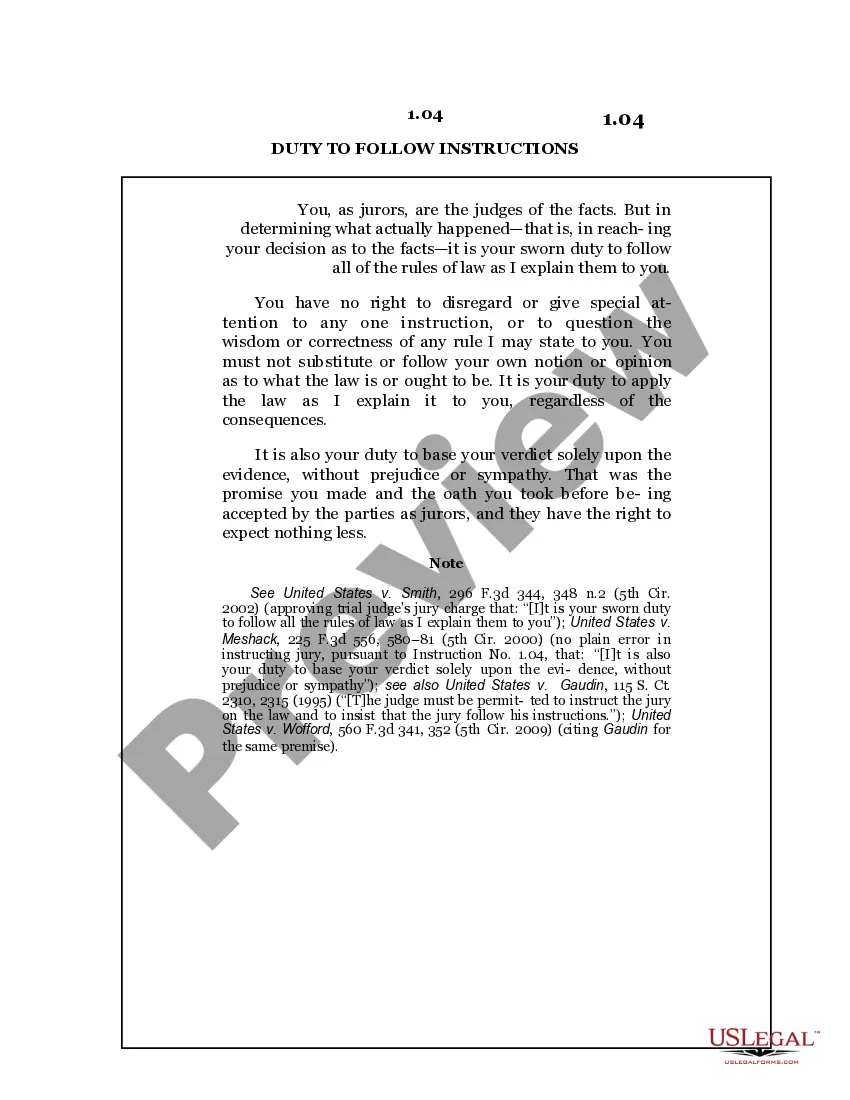
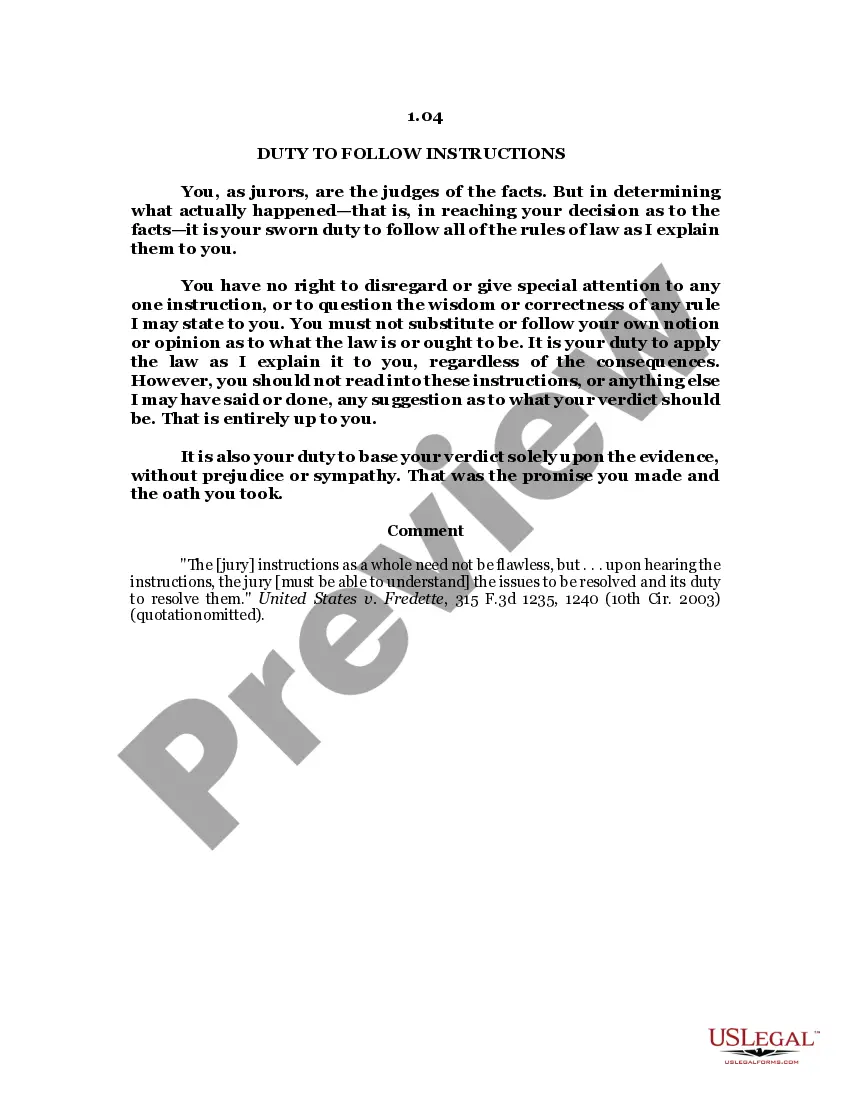
This form is a sample jury instruction titled "Duty to Follow Instructions." It provides guidelines that jurors must adhere to when evaluating the evidence presented during a trial. This instruction emphasizes the presumption of innocence and establishes the standard that a defendant is not guilty unless proven otherwise beyond a reasonable doubt. This form is crucial in ensuring jurors understand their responsibilities in the decision-making process and how to apply the law impartially.
Main sections of this form
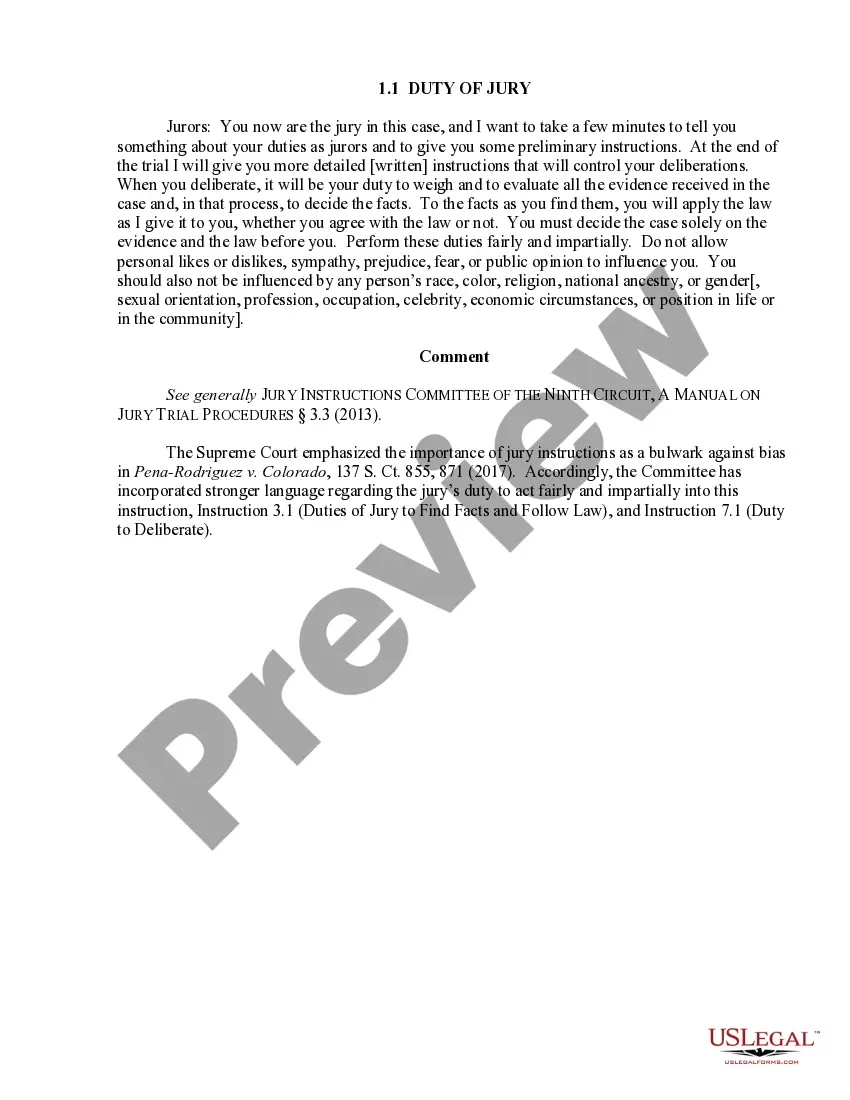
- Duty to Follow Instructions: Jurors must follow the law as explained, even if they disagree with it.
- Presumption of Innocence: A defendant is presumed innocent until proven guilty beyond a reasonable doubt.
- Evaluation of Evidence: Jurors should base their decisions solely on trial evidence, free from sympathy or prejudice.
- Legal Standards: The burden of proof lies with the government to demonstrate guilt.
Common use cases
This form should be used in criminal trials to instruct jurors on their duties. It is applicable whenever a jury is empaneled and must navigate complex legal standards regarding evidence and the presumption of innocence. This instruction ensures that jurors understand their critical role in the justice system, particularly when deliberating the guilt or innocence of a defendant.
Who can use this document
- Judges who need to provide juries with clear legal instructions in criminal cases.
- Legal professionals, such as attorneys and paralegals, involved in jury trials.
- Court administrators ensuring compliance with judicial procedures and standards.
How to prepare this document
- Review the full instructions and ensure they align with local laws and requirements.
- Customize any sections of the instructions to fit the specific case at hand.
- Present the completed jury instructions to the court during trial proceedings.
- Provide jurors with a clear explanation of their duties based on these instructions.
- Ensure jurors understand the importance of following the law impartially.
Notarization requirements for this form
In most cases, this form does not require notarization. However, some jurisdictions or signing circumstances might. US Legal Forms offers online notarization powered by Notarize, accessible 24/7 for a quick, remote process.
Get your form ready online
Our built-in tools help you complete, sign, share, and store your documents in one place.
Make edits, fill in missing information, and update formatting in US Legal Forms—just like you would in MS Word.
Download a copy, print it, send it by email, or mail it via USPS—whatever works best for your next step.
Sign and collect signatures with our SignNow integration. Send to multiple recipients, set reminders, and more. Go Premium to unlock E-Sign.
If this form requires notarization, complete it online through a secure video call—no need to meet a notary in person or wait for an appointment.
We protect your documents and personal data by following strict security and privacy standards.

Make edits, fill in missing information, and update formatting in US Legal Forms—just like you would in MS Word.

Download a copy, print it, send it by email, or mail it via USPS—whatever works best for your next step.

Sign and collect signatures with our SignNow integration. Send to multiple recipients, set reminders, and more. Go Premium to unlock E-Sign.

If this form requires notarization, complete it online through a secure video call—no need to meet a notary in person or wait for an appointment.

We protect your documents and personal data by following strict security and privacy standards.
Mistakes to watch out for
- Failing to modify the instructions to reflect the specific charges or facts of the case.
- Overly complicating the language, making it difficult for jurors to understand their duties.
- Neglecting to emphasize the presumption of innocence adequately.
- Ignoring local jurisdictional requirements for jury instructions.
Benefits of using this form online
- Convenience: Downloadable format allows for easy access and use in court.
- Editability: Users can tailor the instructions to suit specific case needs.
- Reliability: Form templates are drafted by licensed attorneys, ensuring accuracy and legal compliance.
Legal use & context
- This form is designed to provide formal legal guidance to jurors during a trial.
- It serves to uphold fair trial standards and ensure juror impartiality.
- Instructions must follow the prescribed legal framework to be valid and enforceable in court.
Looking for another form?
Form popularity
FAQ
Jury. a group of citizens who will decide the issues or questions of facts at trial.
They will review the evidence and arguments made by both sides, and frame the legal principles on which the jury has to make its decision. These remarks from the judge are known as jury directions. Jury directions have become more and more frequent as the criminal process has developed over the generations.
Jury lists are compiled from voter registrations and driver license or ID renewals. From those lists, summonses are mailed. A panel of jurors is then assigned to a courtroom.
Jury instructions, directions to the jury, or judge's charge are legal rules that jurors should follow when deciding a case.
Jury Instructions. instructions that are given by the trial judge that specifically state what the defendant can be found guilty of and what the prosecution or plaintiff has to prove in order for a guilty verdict.
These are civil or criminal jury instructions approved by a state court, bench committee, or bar association. They are commonly used by courts in the relevant jurisdiction, as they ease the process of drafting fair jury instructions and theoretically do not have errors.
The jury listens to the evidence during a trial, decides what facts the evidence has established, and draws inferences from those facts to form the basis for their decision. The jury decides whether a defendant is "guilty" or "not guilty" in criminal cases, and "liable" or "not liable" in civil cases.