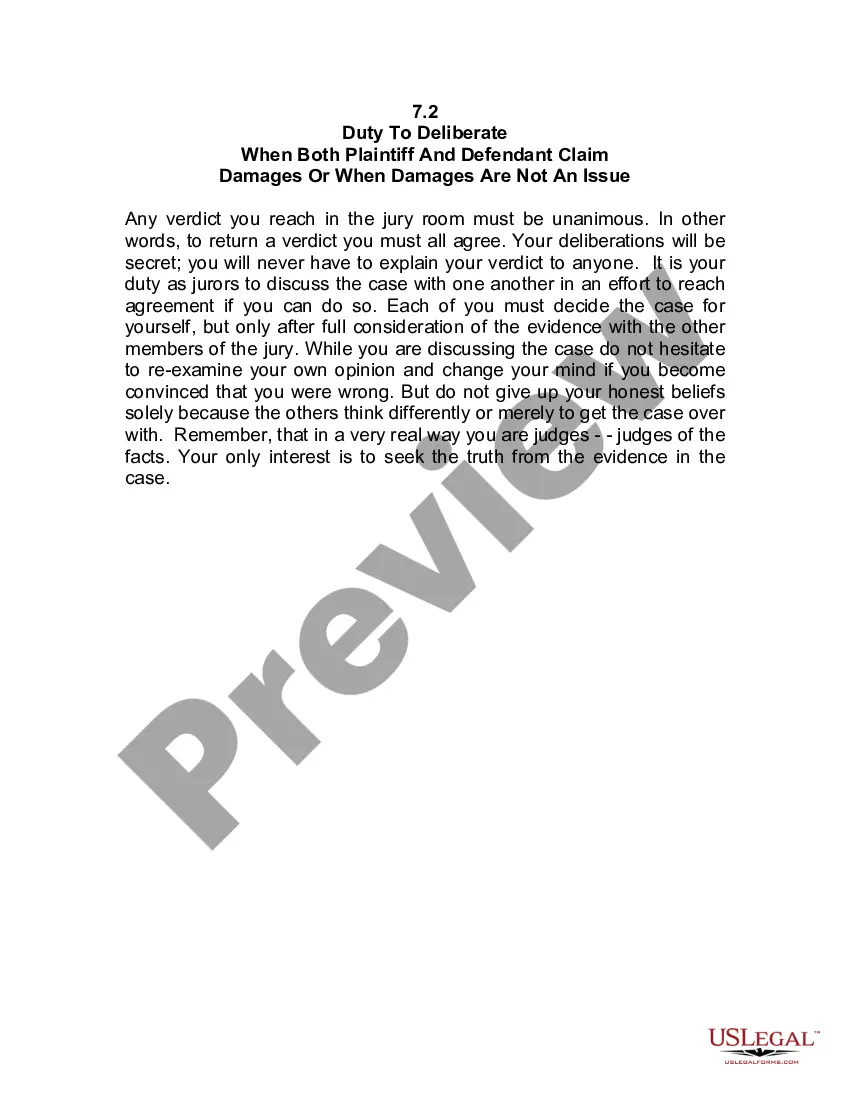
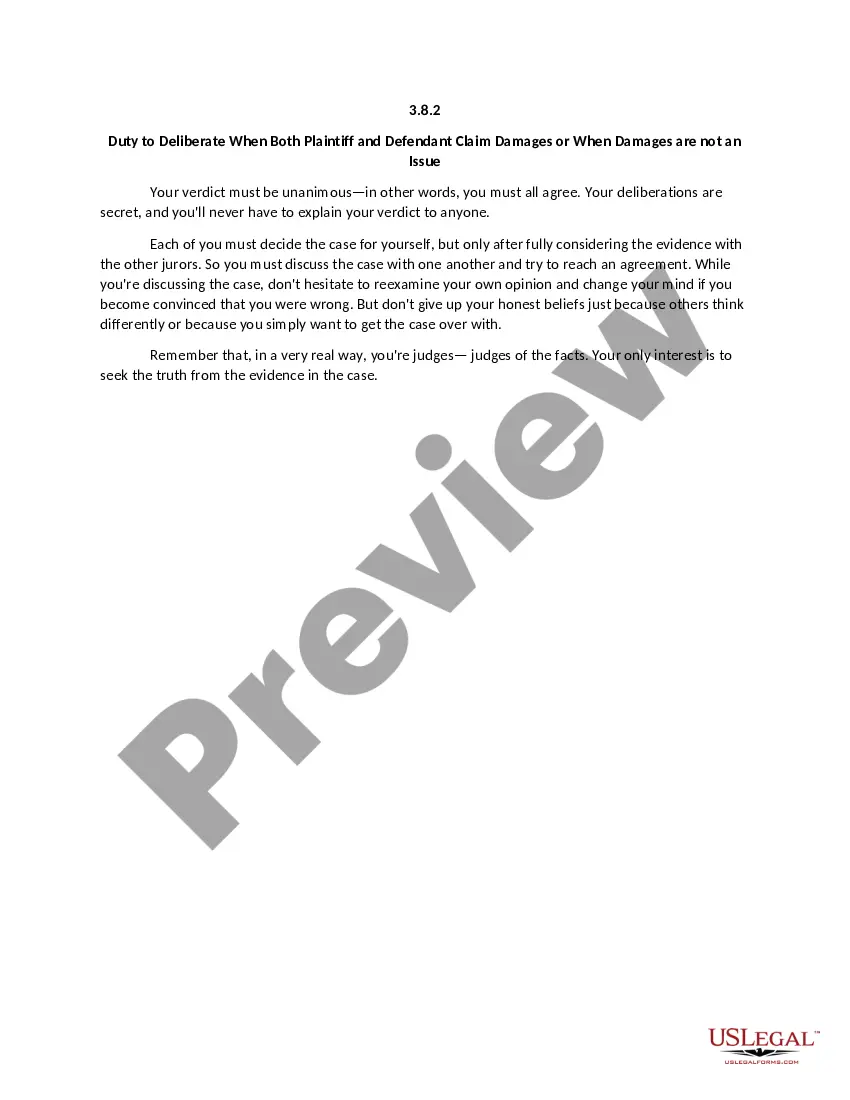
Jury Instruction - 7.2 Duty To Deliberate When Both Plaintiff and Defendant Claim Damages or When Damages Are Not an Issue
What is this form?
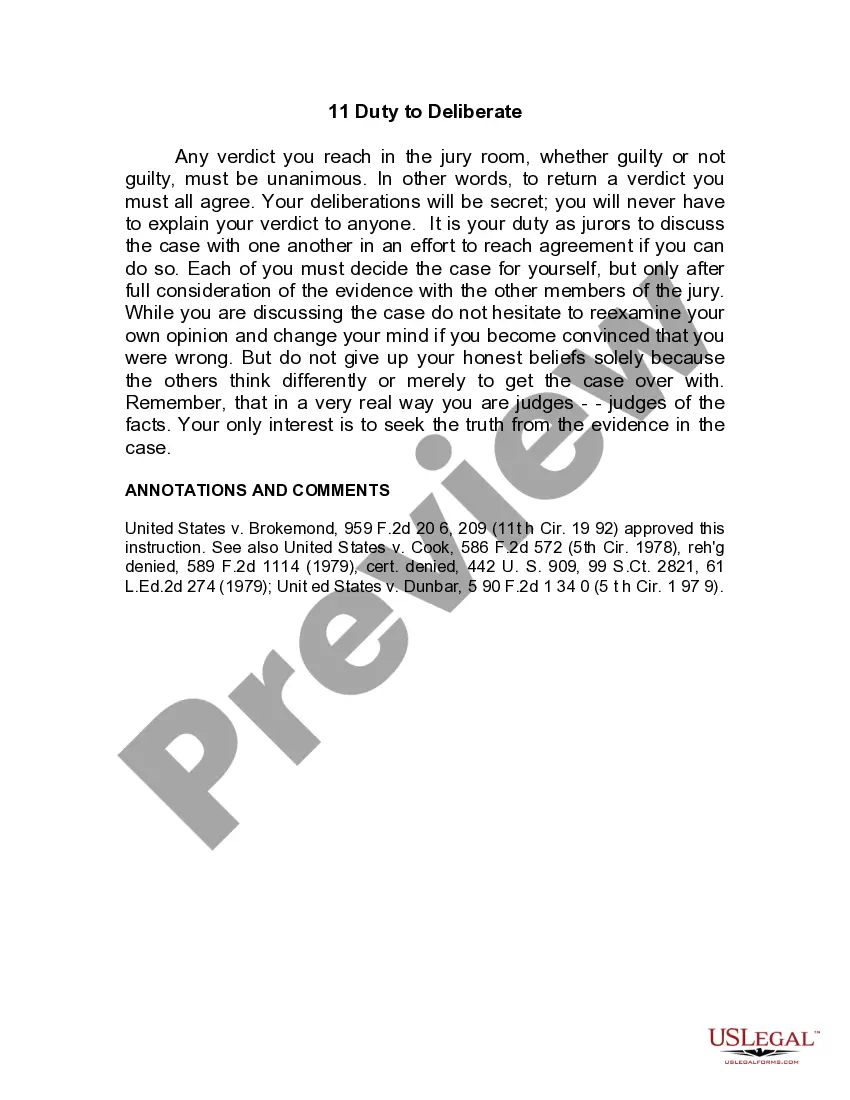
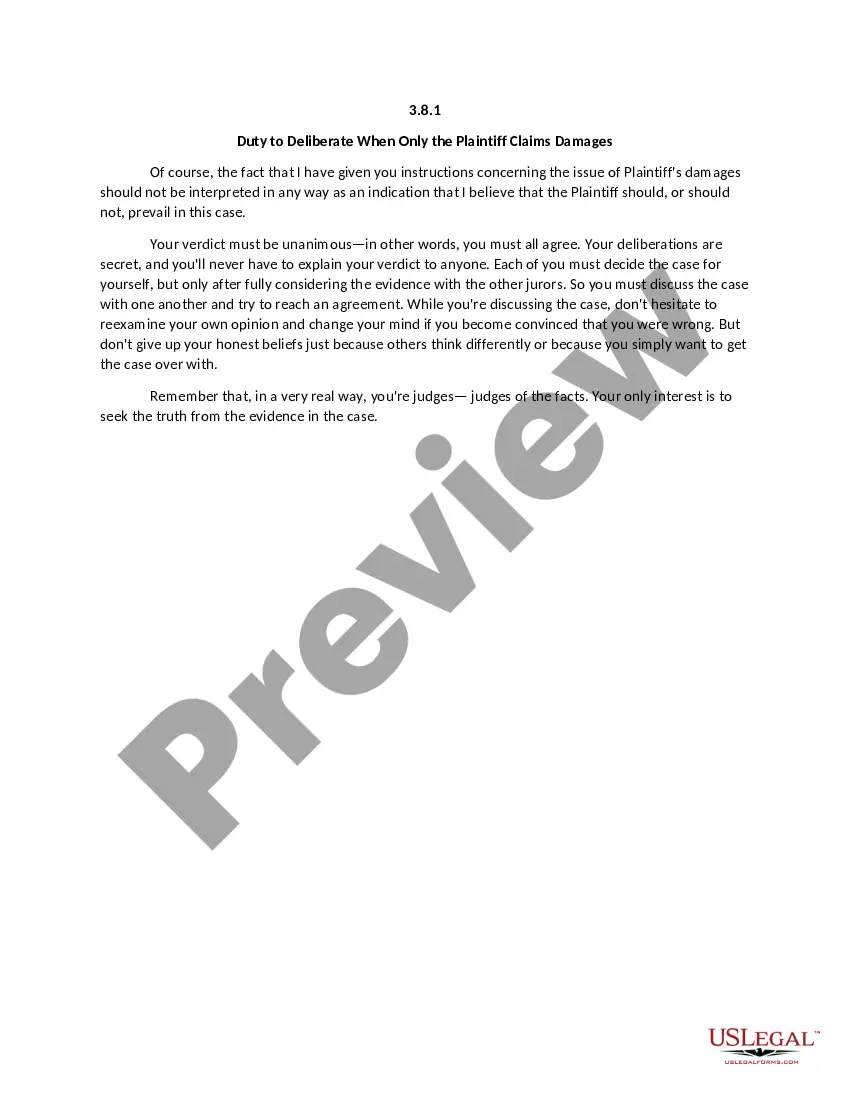
The Jury Instruction - Duty to Deliberate is a legal document that provides guidance to jurors on their responsibilities during deliberations, particularly when both the plaintiff and defendant claim damages or when damages are not an issue. This instruction aims to help jurors understand the importance of reaching a unanimous verdict while considering the evidence presented. Unlike other jury instructions, this form specifically addresses scenarios involving claims from both parties, ensuring that jurors are well-informed about their duty to deliberate effectively.
Form components explained
- Instructions on achieving a unanimous verdict.
- Emphasis on the secrecy of deliberations.
- Encouragement for jurors to discuss and reconsider their opinions.
- Clarification of each juror's duty to seek the truth based on evidence.
Common use cases
This jury instruction is utilized during court trials when jurors need clarification on their role in deliberating cases where both parties assert claims for damages or when the issue of damages is not central to the case. It is essential for guiding jurors on how to approach their decision-making process effectively and fairly.
Who needs this form
- Judges presiding over civil or criminal trials.
- Attorneys preparing jury instructions for their cases.
- Jurors who need clear guidance on their deliberation duties.
How to prepare this document
- Identify the case details including the names of the plaintiff and defendant.
- Adapt the jury instruction text to fit the specifics of the case.
- Ensure that all jurors understand the requirement for a unanimous verdict.
- Distribute the finalized jury instructions to the jurors before deliberations begin.
Is notarization required?
This form does not typically require notarization to be legally valid. However, some jurisdictions or document types may still require it. US Legal Forms provides secure online notarization powered by Notarize, available 24/7 for added convenience.
Get your form ready online
Our built-in tools help you complete, sign, share, and store your documents in one place.
Make edits, fill in missing information, and update formatting in US Legal Forms—just like you would in MS Word.
Download a copy, print it, send it by email, or mail it via USPS—whatever works best for your next step.
Sign and collect signatures with our SignNow integration. Send to multiple recipients, set reminders, and more. Go Premium to unlock E-Sign.
If this form requires notarization, complete it online through a secure video call—no need to meet a notary in person or wait for an appointment.
We protect your documents and personal data by following strict security and privacy standards.

Make edits, fill in missing information, and update formatting in US Legal Forms—just like you would in MS Word.

Download a copy, print it, send it by email, or mail it via USPS—whatever works best for your next step.

Sign and collect signatures with our SignNow integration. Send to multiple recipients, set reminders, and more. Go Premium to unlock E-Sign.

If this form requires notarization, complete it online through a secure video call—no need to meet a notary in person or wait for an appointment.

We protect your documents and personal data by following strict security and privacy standards.
Avoid these common issues
- Failing to clarify the difference between civil and criminal cases in the instructions.
- Not emphasizing the importance of unanimous agreement among jurors.
- Providing instructions that are too vague or not tailored to the case specifics.
Benefits of using this form online
- Easy access to professionally drafted jury instructions.
- Editable formats allow customization to fit specific cases.
- Convenient downloading ensures quick distribution to jurors.
Legal use & context
- This form provides legal guidance to jurors, ensuring their understanding of the deliberation process.
- Jurors must adhere to the instructions to promote fair and just verdicts in cases.
- Failure to follow the jury instructions could result in legal challenges to the trial outcome.
Key takeaways
- The form provides essential jury instructions for cases with claims from both parties.
- Jurors must reach a unanimous decision based on discussion and evidence evaluation.
- Jurors should feel free to reconsider their views during deliberations.
Looking for another form?
Form popularity
FAQ
JNOV is the practice in American courts whereby the presiding judge in a civil jury trial may overrule the decision of a jury and reverse or amend their verdict.If the judge grants a motion to set aside judgment after the jury convicts, however, the action may be reversed on appeal by the prosecution.
To overturn a guilty verdict, the judge must look at all evidence presented most favorable to the prosecution. The judge can only grant judgment to overturn the verdict if the evidence clearly fails to establish guilt.A judge will never interfere with a jury's decision and process unless there is a legitimate reason.
No. The judge can follow the same law but judge the case differently and change a ruling. When you write your motion, though, it is best if you explain clearly why you think the judge should change the ruling.
Verdict: The official decision or finding of the jury which is reported to the court.
Instructions to the Jury The judge instructs the jury about the relevant laws that should guide its deliberations. (In some jurisdictions, the court may instruct the jury at any time after the close of evidence. This sometimes occurs before closing arguments.) The judge reads the instructions to the jury.
A jury instruction is a guideline given by the judge to the jury about the law they will have to apply to the facts they have found to be true. The purpose of the instructions is to help the jury arrive at a verdict that follows the law of that jurisdiction.
When there is no jury ("bench trial"), the judge makes rulings on both questions of law and of fact. In most continental European jurisdictions, judges have more power in a trial and the role and powers of a jury are often restricted.
The High Court found that a trial judge is able to direct a jury to return a verdict of not guilty where a verdict of guilty would be 'unsafe or unsatisfactory. 'So, all in all, courts can intervene to either direct the outcome of a case or overturn a verdict of guilty but these situations are rare.
Jury instructions, directions to the jury, or judge's charge are legal rules that jurors should follow when deciding a case.