Jury Instruction - 7.1 Duty To Deliberate When Only The Plaintiff Claims Damages
Understanding this form
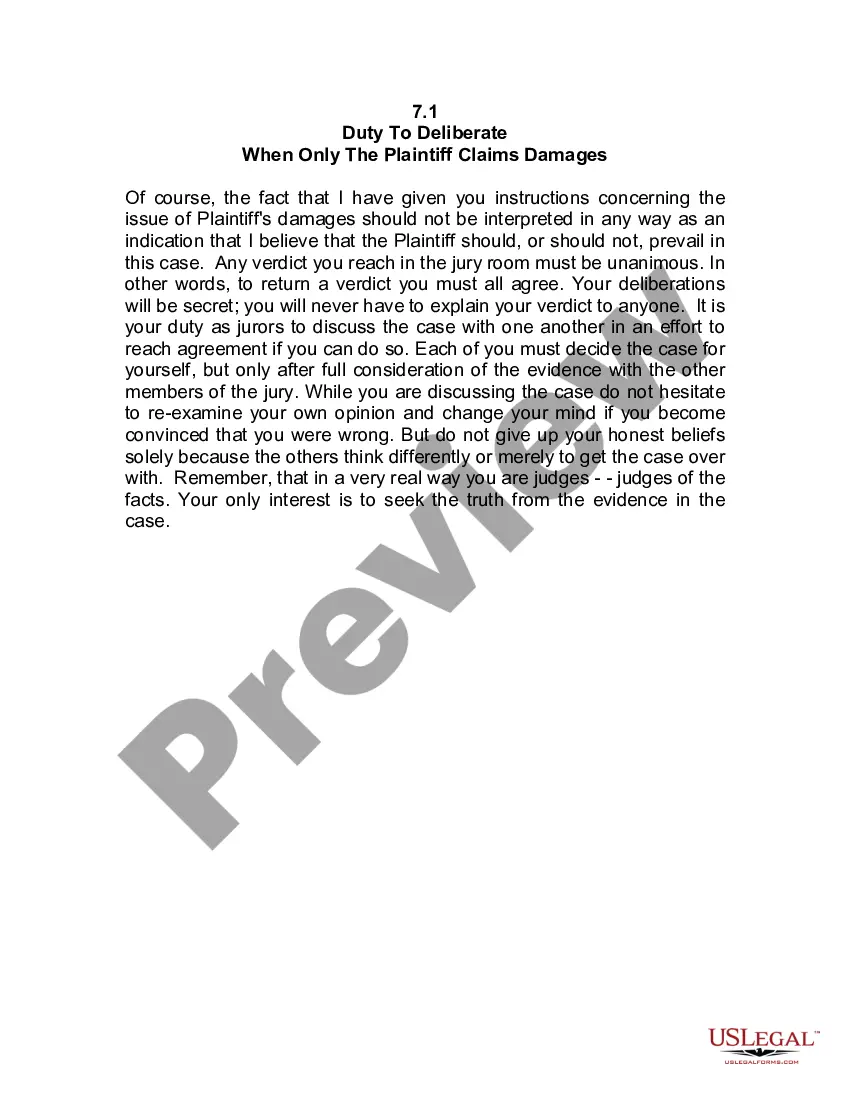
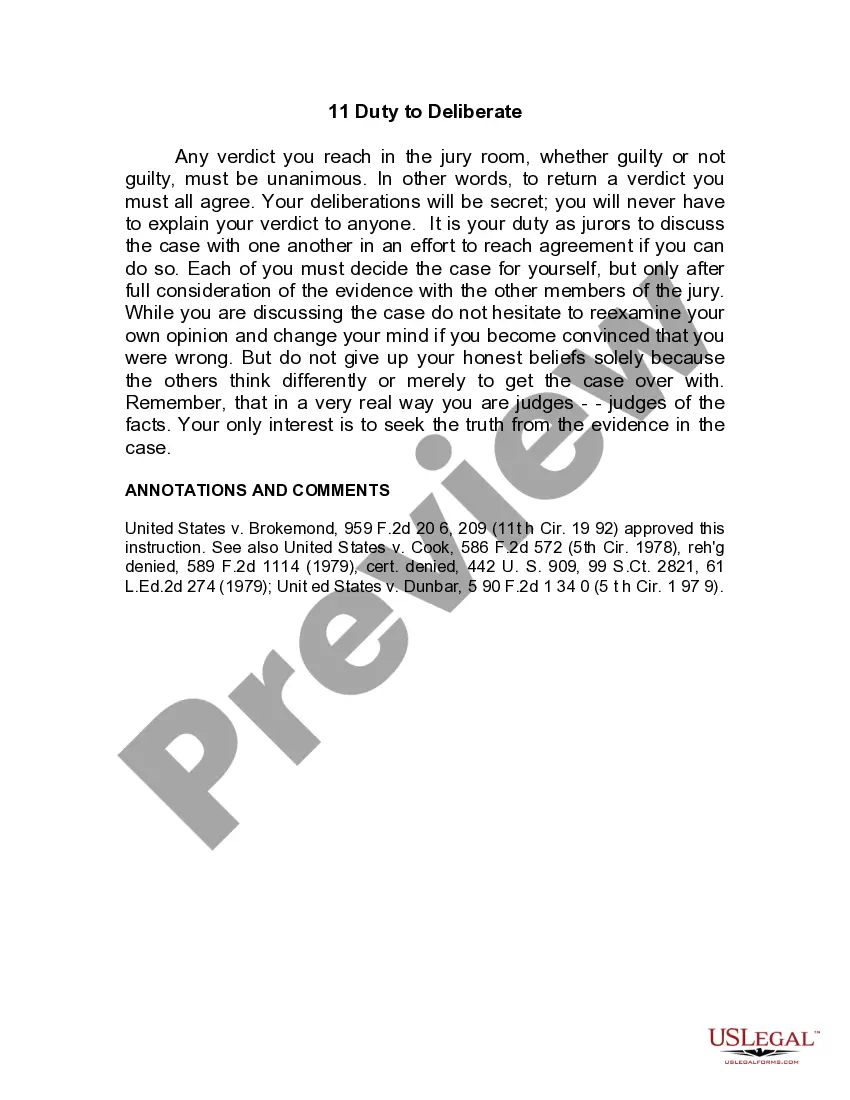
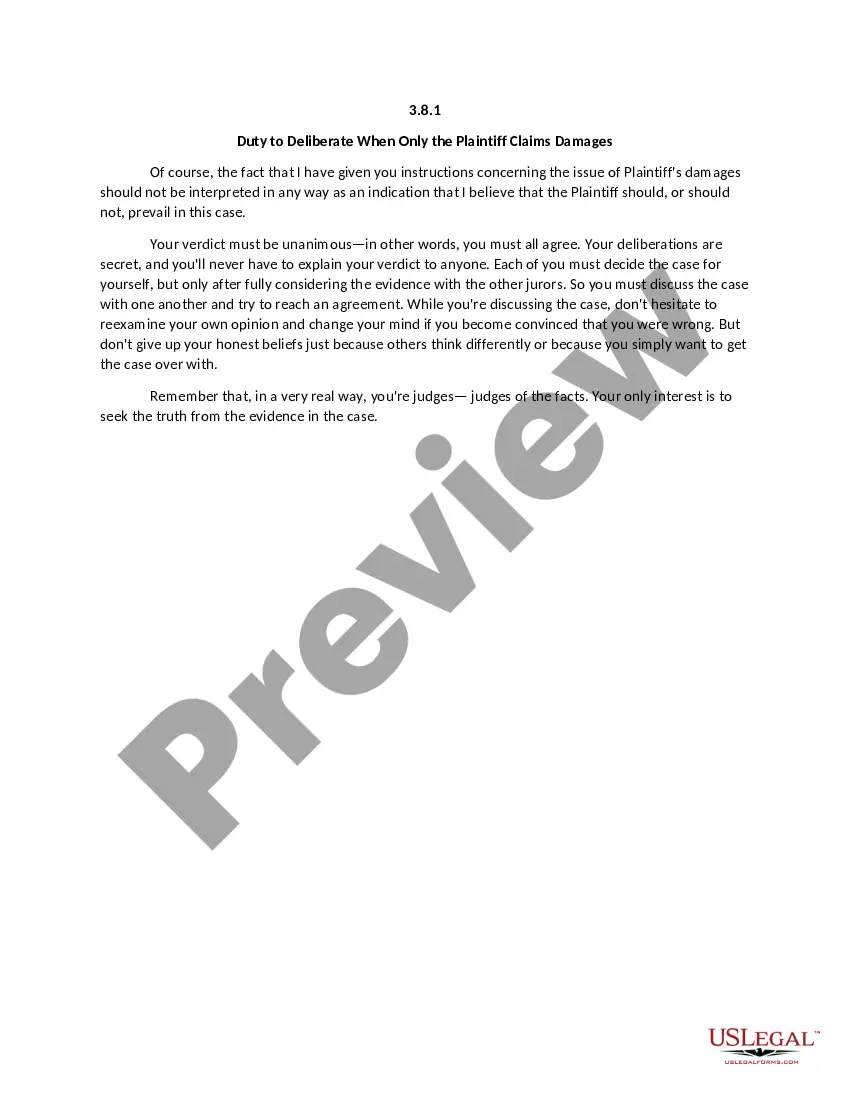
The Jury Instruction - Duty To Deliberate When Only The Plaintiff Claims Damages is a legal document designed to guide jurors on their responsibilities during deliberation in cases where the plaintiff is the only party claiming damages. This form provides a clear framework for jurors to understand that their verdict must be unanimous and emphasizes their role in seeking the truth based on the evidence presented, distinguishing it from other jury instructions by focusing specifically on cases with single plaintiff damage claims.
Key parts of this document
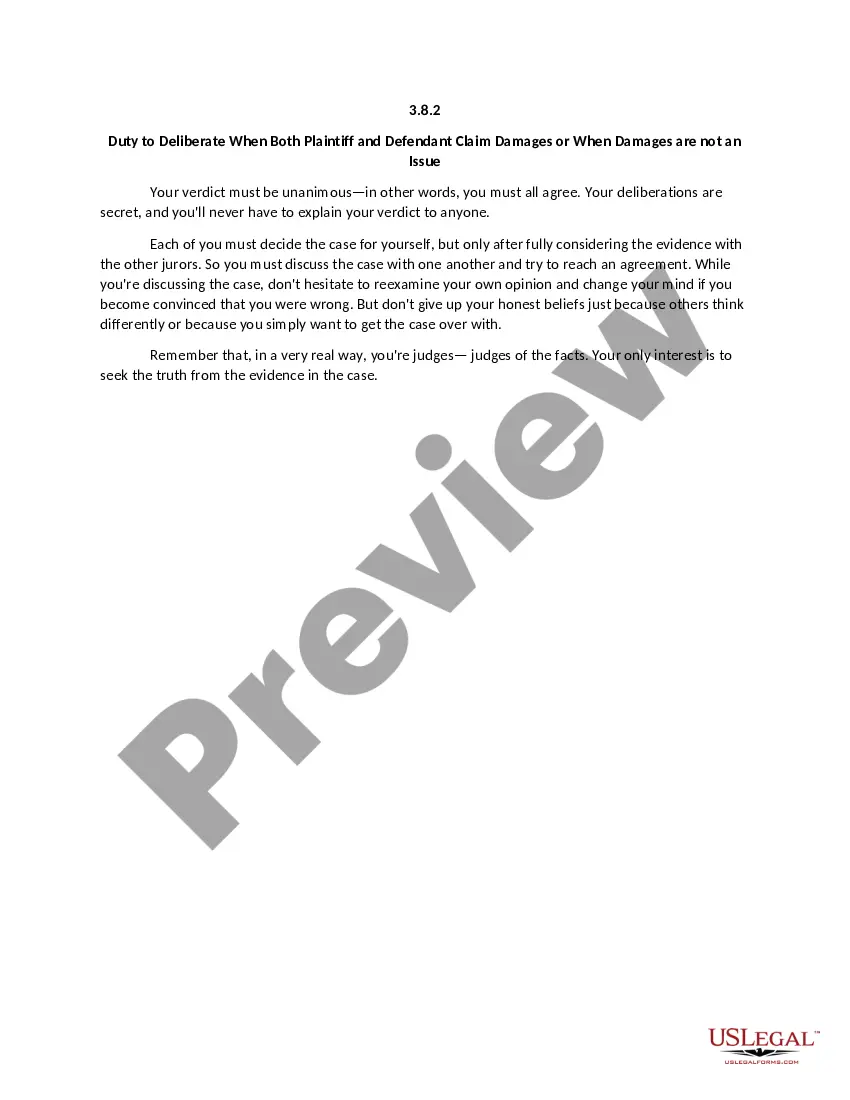
- Instructions on the importance of unanimous verdicts among jurors.
- Emphasis on jurors' duty to deliberate and discuss the case fully.
- Guidance on maintaining confidentiality during deliberations.
- Encouragement to reevaluate personal opinions based on evidence.
- Reminders about the jurors' role as judges of the facts in the case.
When to use this form
This Jury Instruction should be used during trials where the plaintiff is only claiming damages. This form is applicable in both civil and some criminal cases, providing jurors with the necessary guidance to understand the implications of their decisions regarding the plaintiff's claims and the evidence presented in the trial.
Who should use this form
- Judges presiding over trials involving damage claims by a single plaintiff.
- Attorneys preparing jury instructions for case presentations.
- Legal professionals seeking a standard format for jury instructions.
How to prepare this document
- Review the evidence presented in the case.
- Familiarize jurors with the requirement for a unanimous verdict.
- Encourage discussion among jurors to ensure comprehensive deliberation.
- Remind jurors of the confidentiality of their discussions.
- Instruct jurors to reassess their opinions as necessary during deliberation.
Notarization requirements for this form
This form does not typically require notarization unless specified by local law. It is important to verify specific state requirements before use.
Get your form ready online
Our built-in tools help you complete, sign, share, and store your documents in one place.
Make edits, fill in missing information, and update formatting in US Legal Forms—just like you would in MS Word.
Download a copy, print it, send it by email, or mail it via USPS—whatever works best for your next step.
Sign and collect signatures with our SignNow integration. Send to multiple recipients, set reminders, and more. Go Premium to unlock E-Sign.
If this form requires notarization, complete it online through a secure video call—no need to meet a notary in person or wait for an appointment.
We protect your documents and personal data by following strict security and privacy standards.

Make edits, fill in missing information, and update formatting in US Legal Forms—just like you would in MS Word.

Download a copy, print it, send it by email, or mail it via USPS—whatever works best for your next step.

Sign and collect signatures with our SignNow integration. Send to multiple recipients, set reminders, and more. Go Premium to unlock E-Sign.

If this form requires notarization, complete it online through a secure video call—no need to meet a notary in person or wait for an appointment.

We protect your documents and personal data by following strict security and privacy standards.
Common mistakes to avoid
- Failing to emphasize the need for a unanimous verdict, leading to confusion.
- Neglecting to encourage jurors to reconsider their initial opinions.
- Providing inadequate information about the importance of confidentiality in deliberations.
Advantages of online completion
- Convenient access to professionally drafted instructions.
- Adaptability to fit various trial environments and case specifics.
- Time-saving with easily downloadable format for quick use during trials.
Legal use & context
- This form serves as a guideline for jury deliberation in legal cases.
- It helps in maintaining the integrity of the jury's decision-making process.
- Juror accountability and clarity about their roles are reinforced through this instruction.
Quick recap
- The jury instruction emphasizes exclusive duty to deliberate when only the plaintiff claims damages.
- Jurors must reach a unanimous verdict and discuss all evidence comprehensively.
- Confidentiality during deliberations is paramount for an unbiased decision.
Looking for another form?
Form popularity
FAQ
Court cases that involve disputes between people or businesses over money or some injury to personal rights are called civil cases. A civil case usually begins when one person or business (called the "plaintiff") claims to have been harmed by the actions of another person or business (called the "defendant").
Court cases that involve disputes between people or businesses over money or some injury to personal rights are called civil cases. Ask the court for "damages," meaning money to pay the plaintiff for any harm suffered.
Even if you do not have the money to pay the debt, always go to court when you are told to go. A creditor or debt collector can win a lawsuit against you even if you are penniless. The lawsuit is not based on whether you can payit is based on whether you owe the specific debt amount to that particular plaintiff.
Four of the most important types of civil law deal with 1) contracts, 2) property, 3) family relations, and 4) civil wrongs causing physical injury or injury to property (tort). C. Contract law involves a contract, or a set of enforceable voluntary promises.
"Civil" cases are the cases in which private citizens (or companies) sue each other in court.General civil cases, usually involving suing someone for money in disputes over things like contracts, damage to property, or someone getting hurt. Family law cases such as divorce, child support, child custody, and adoptions.
Examples are murder, assault, theft,and drunken driving. Civil law deals with behavior that constitutes an injury to an individual or other private party, such as a corporation. Examples are defamation (including libel and slander), breach of contract, negligence resulting in injury or death, and property damage.
Contract Disputes. Contract disputes occur when one or more parties who signed a contract cannot or will not fulfill their obligations. Property Disputes. Torts. Class Action Cases. Complaints Against the City.
Unlike criminal cases, civil court cases do not carry jail time and other legal penalties. In other cases, aside from civil fines, the judge or court can revoke permits or licenses of the offenders when found out guilty.