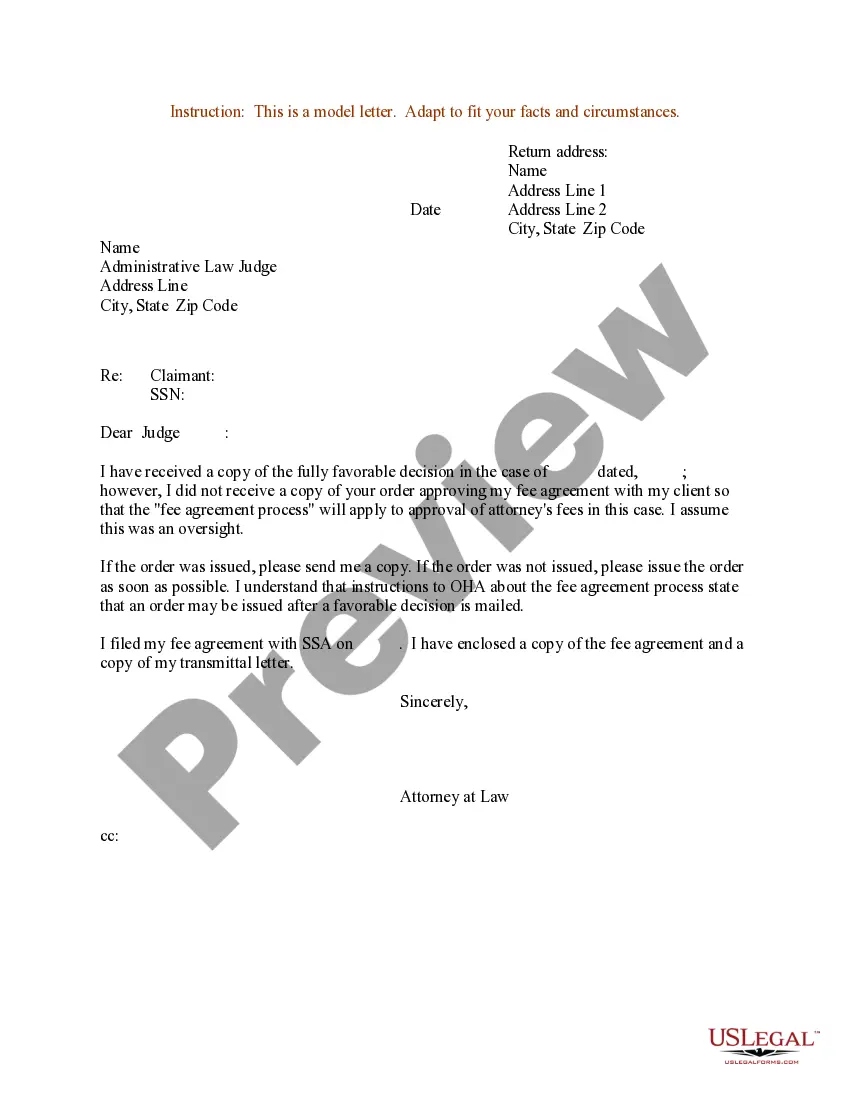
Sample Letter for Letter to Judge Seeking Approval of Attorney's Fees
Understanding this form
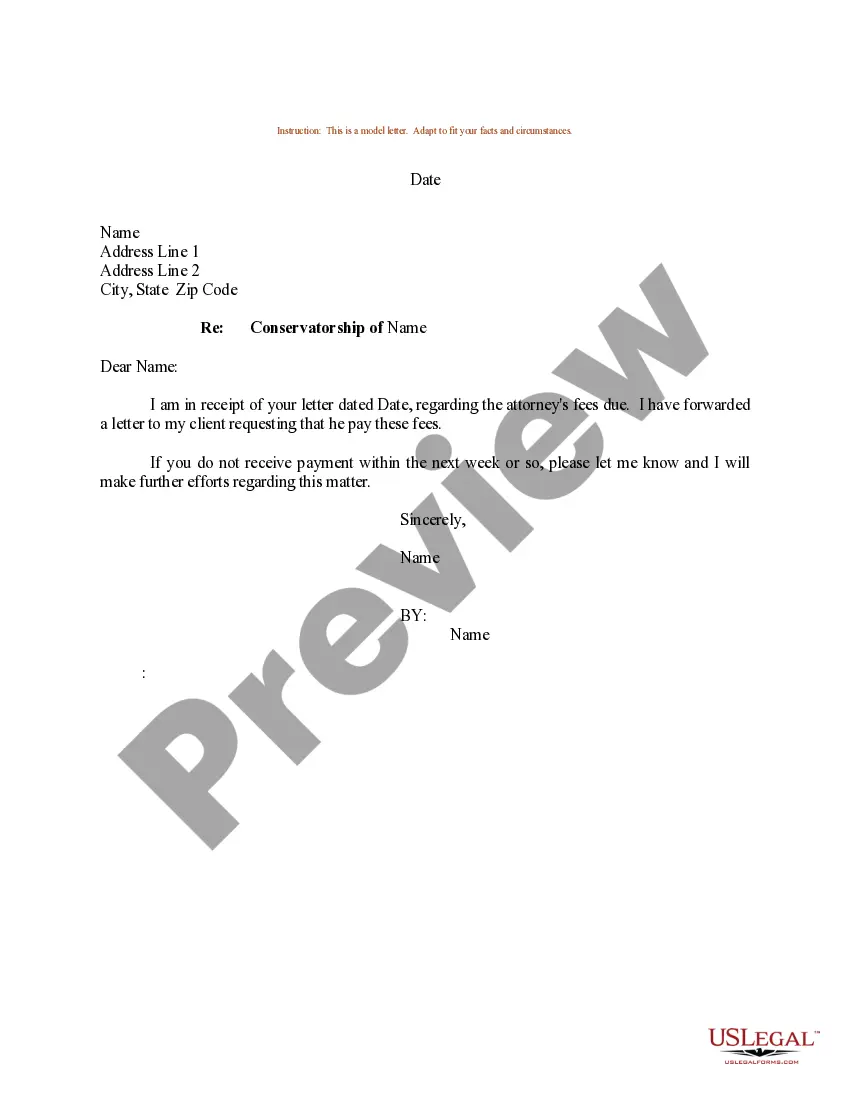
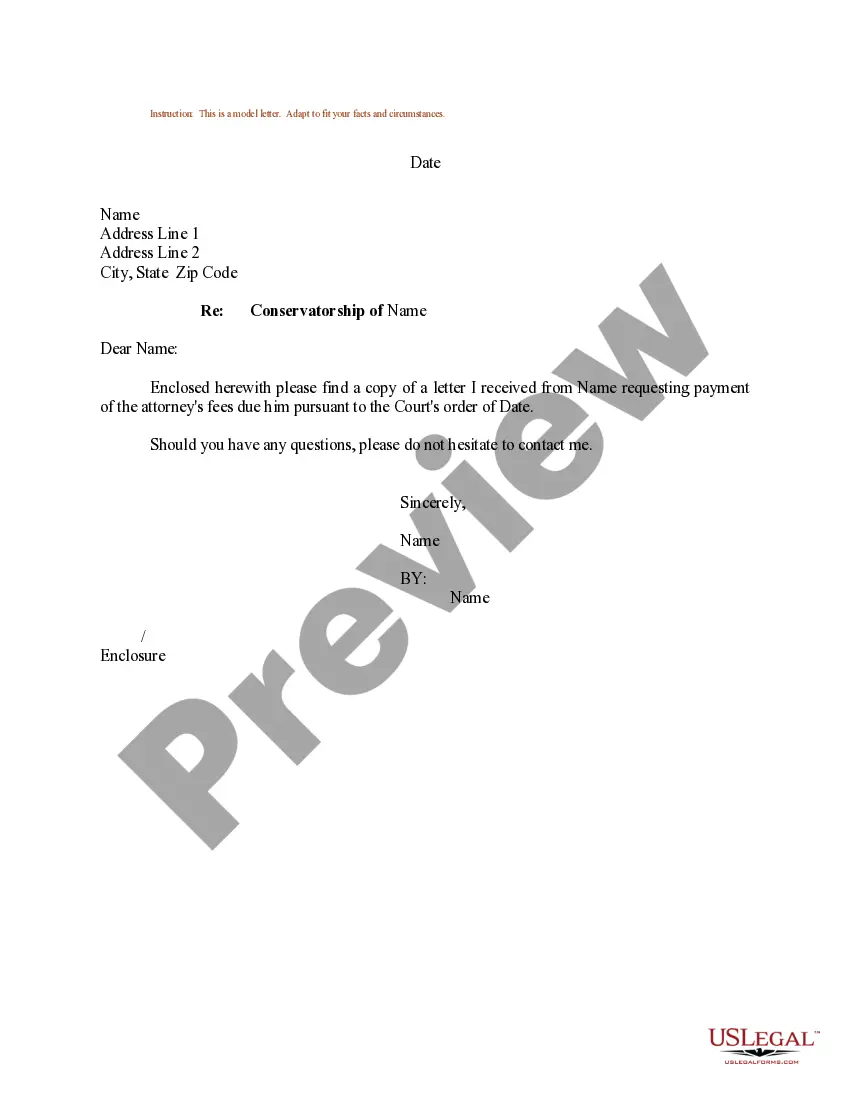
The Sample Letter for Letter to Judge Seeking Approval of Attorney's Fees is a template designed to aid individuals in formally requesting a judge's approval for attorney's fees incurred during legal proceedings. This letter can streamline the process of obtaining necessary judicial approval, differentiating it from generic correspondence by its specific legal intent and formal structure.
Key components of this form
- Return address: The sender's name and contact details.
- Date: The date the letter is composed.
- Judge's address: The name and address of the administrative law judge.
- Request for order: A clear request for a courtesy copy of the judge's order.
- Understanding of fee agreement process: An acknowledgment of the fee approval process as dictated by relevant guidelines.
When to use this form
This letter is needed when a party involved in a legal case seeks official approval from a judge for attorney's fees. It may be used after receiving a favorable decision from the court when you need to formalize the request for fee approval as part of your legal process.
Who this form is for
- Individuals who have hired an attorney and require court approval for the fees.
- Lawyers seeking to formalize their fee agreements with the court.
- Parties involved in administrative legal procedures.
Instructions for completing this form
- Identify the sender's details: Fill in your name and address at the top.
- Enter the date: Write the date on which you are sending the letter.
- Specify the judge's information: Include the name and address of the judge receiving the letter.
- State your request: Clearly articulate your request for the approval of attorney's fees.
- Review and sign: Double-check the letter for accuracy and sign it before sending.
Notarization requirements for this form
This form does not typically require notarization unless specified by local law. Ensure you follow any specific requirements set by your jurisdiction.
Get your form ready online
Our built-in tools help you complete, sign, share, and store your documents in one place.
Make edits, fill in missing information, and update formatting in US Legal Forms—just like you would in MS Word.
Download a copy, print it, send it by email, or mail it via USPS—whatever works best for your next step.
Sign and collect signatures with our SignNow integration. Send to multiple recipients, set reminders, and more. Go Premium to unlock E-Sign.
If this form requires notarization, complete it online through a secure video call—no need to meet a notary in person or wait for an appointment.
We protect your documents and personal data by following strict security and privacy standards.

Make edits, fill in missing information, and update formatting in US Legal Forms—just like you would in MS Word.

Download a copy, print it, send it by email, or mail it via USPS—whatever works best for your next step.

Sign and collect signatures with our SignNow integration. Send to multiple recipients, set reminders, and more. Go Premium to unlock E-Sign.

If this form requires notarization, complete it online through a secure video call—no need to meet a notary in person or wait for an appointment.

We protect your documents and personal data by following strict security and privacy standards.
Mistakes to watch out for
- Failing to include complete and accurate addresses.
- Not stating the specific request clearly.
- Ignoring court deadlines for submission.
- Omitting the necessary acknowledgment of the fee agreement process.
Benefits of completing this form online
- Convenience: Download the form directly from your device.
- Editability: Customize the template easily to fit your needs.
- Reliability: Use a form drafted by licensed attorneys for legal accuracy.
Looking for another form?








Form popularity
FAQ
A demand letter, or letter of demand (of payment), is a letter stating a legal claim (usually drafted by a lawyer) which makes a demand for restitution or performance of some obligation, owing to the recipients' alleged breach of contract, or for a legal wrong.
Type your letter. Concisely review the main facts. Be polite. Write with your goal in mind. Ask for exactly what you want. Set a deadline. End the letter by stating you will promptly pursue legal remedies if the other party does not meet your demand. Make and keep copies.
Use "Re:" (an abbreviation for "regarding" or "with reference to"), followed by a brief identifying phrase. Begin with a salutation. Write "Dear Judge (last name)," to start the message of your letter. Note that you should use "the Honorable" when referring to the judge, but use "Judge" addressing him or her directly.
The most common route is that, after your demand letter has been sent, the insurance company will reject your settlement amount and come back with a different value. Once that has been sent, you and your attorney will either accept or refuse the amount.
You can't write to the judge. You can hire your own attorney to make your case to the court.
However, when a person is awaiting trial, writing a letter to the judge will not help. At best, the letter will go unread by the judge, and will be of no help. In a worst-case scenario, the letter will end up being used by the prosecution as evidence against that person.
Demand letters are often the precursor to filing a lawsuit. But they can also be an effective tool in resolving disputes before going to court.Having your attorney draft a demand letter can be a wise move because it gives the recipient a chance to rectify the situation without facing a lawsuit.
Once you've written your demand letter and sent it on to the insurance company, the response time may vary. Typically, you can expect an answer within a few weeks. However, sometimes this process can take as long as a few months.
Evaluate the letter. The first step after receiving a letter is to carefully read it and evaluate its merits. Determine its intent. People send demand letters for all sorts of reasons. Calculate the claims. Is a lawyer needed? Respond within allotted time frame.