Release regarding Martial Arts Training
Overview of this form
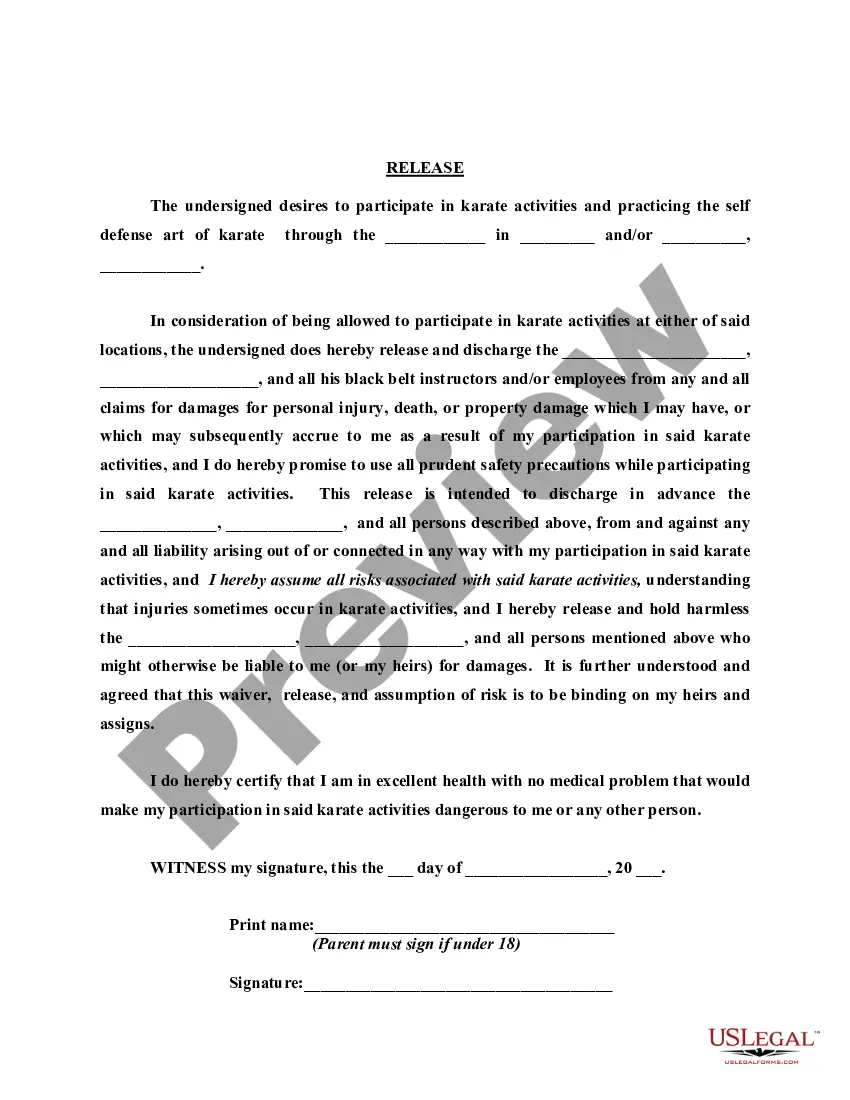
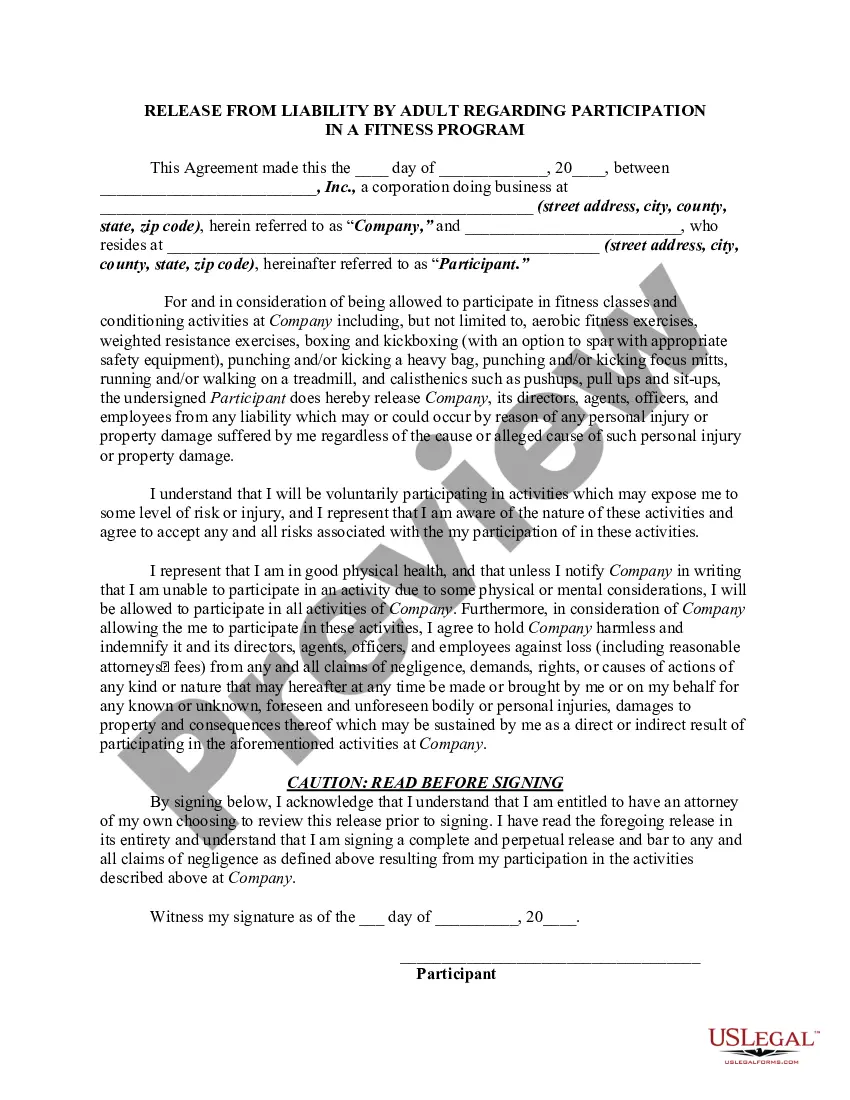
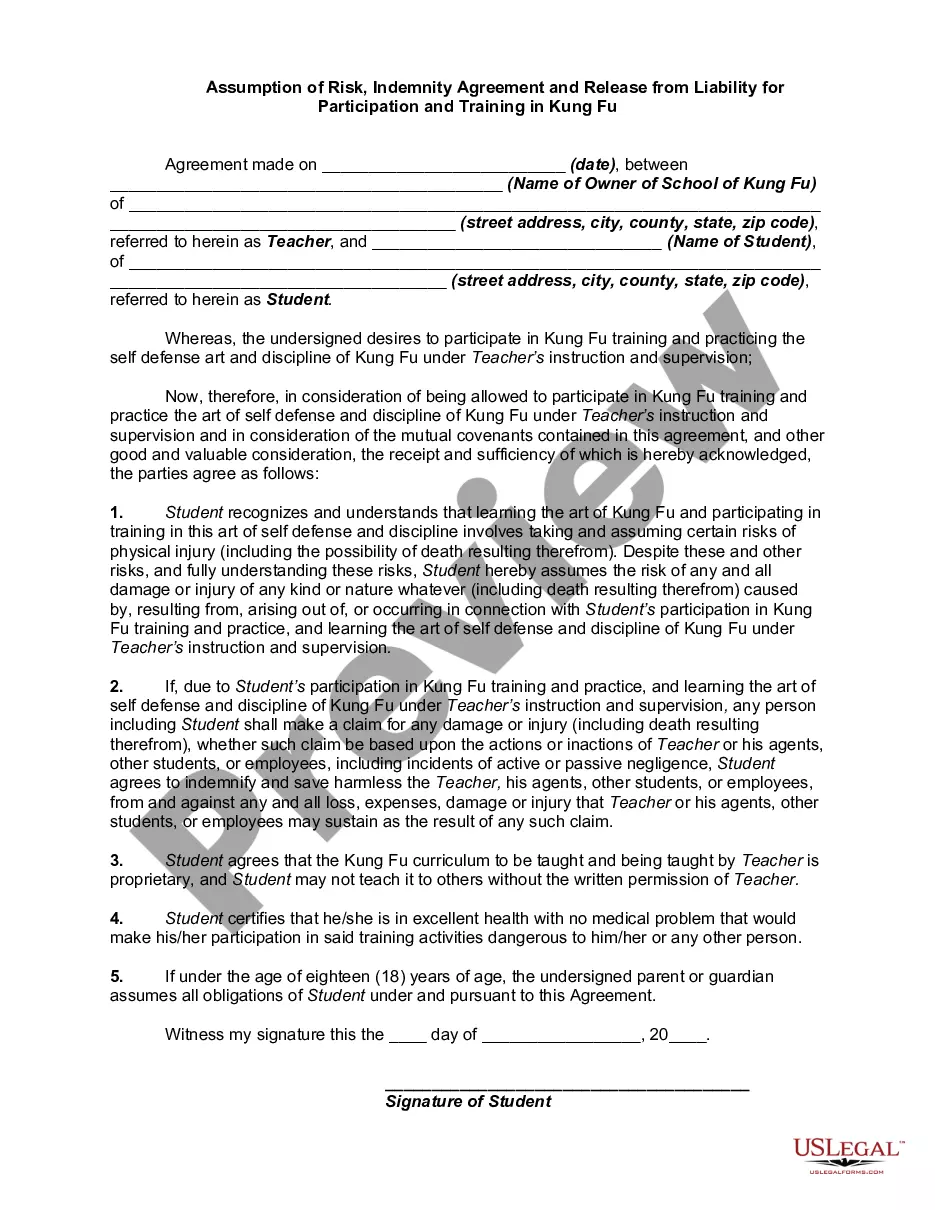
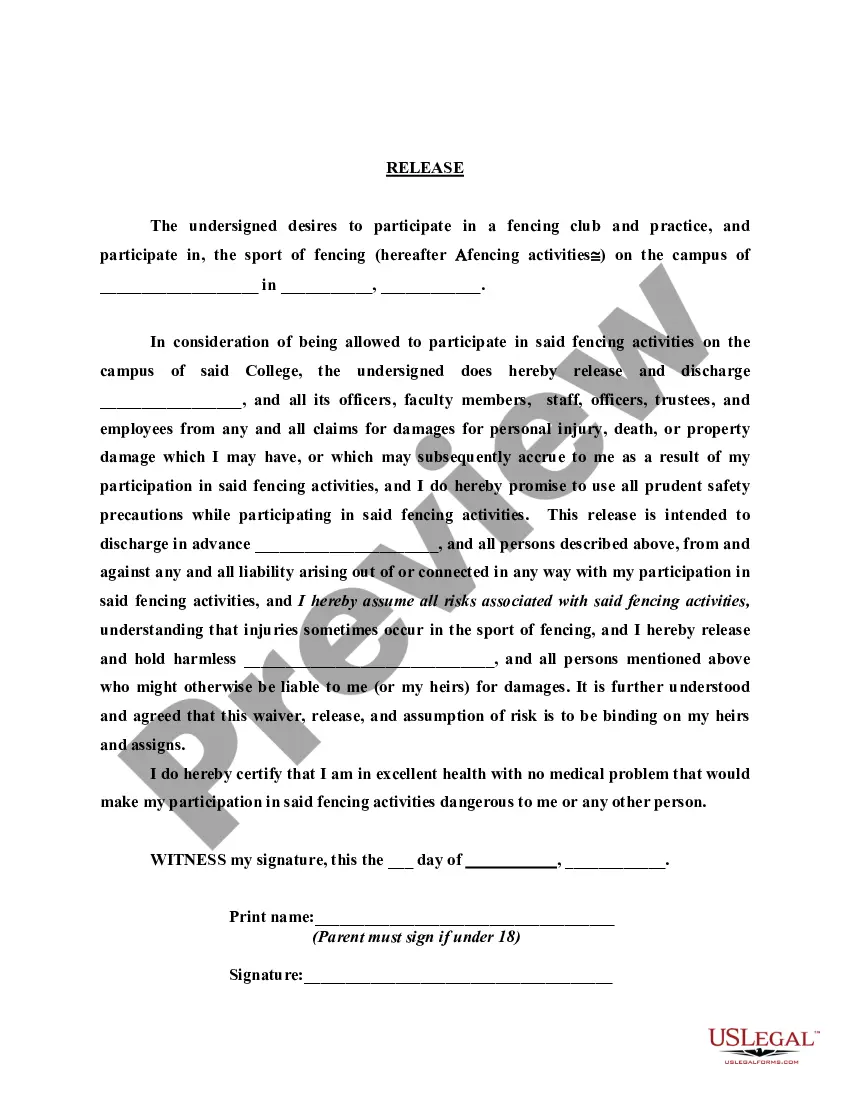
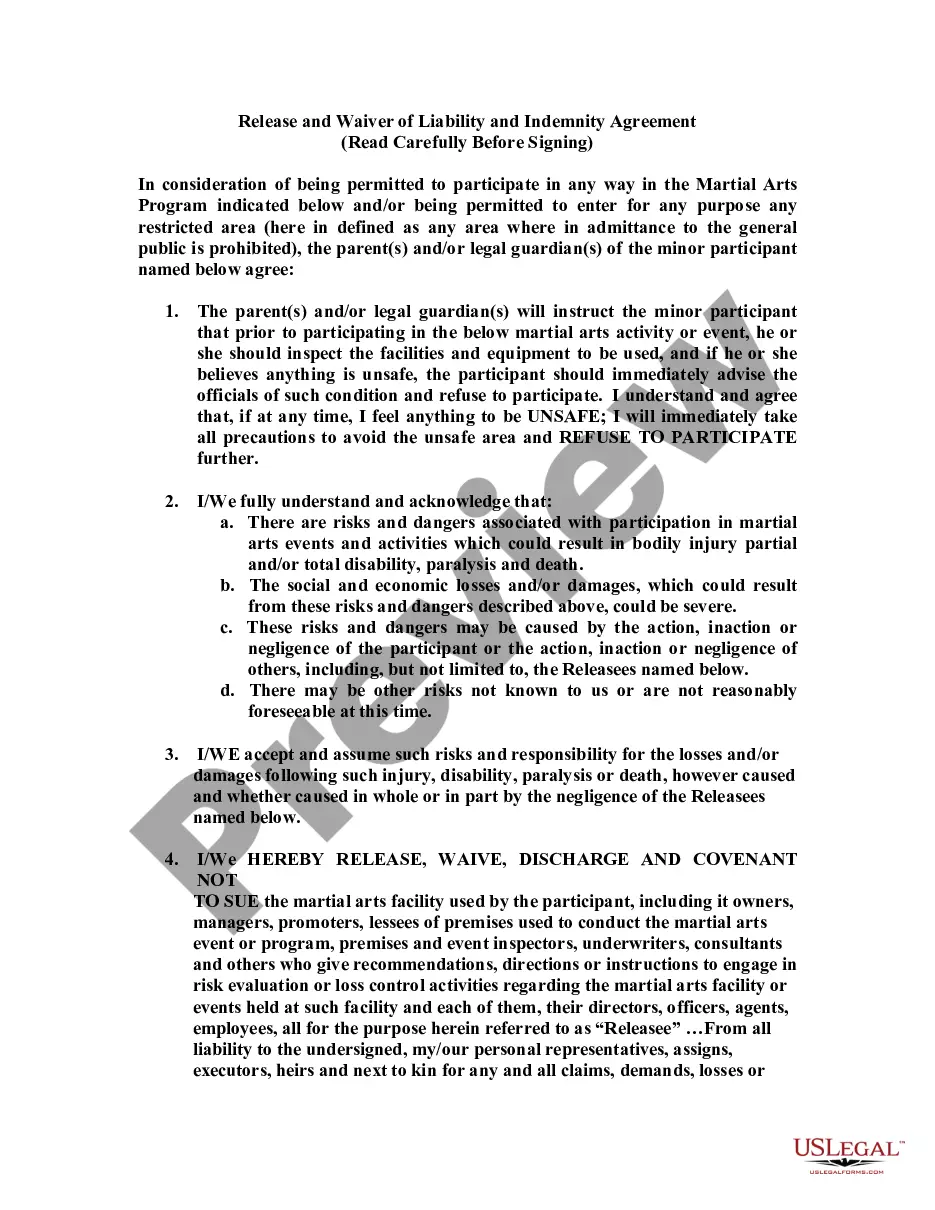
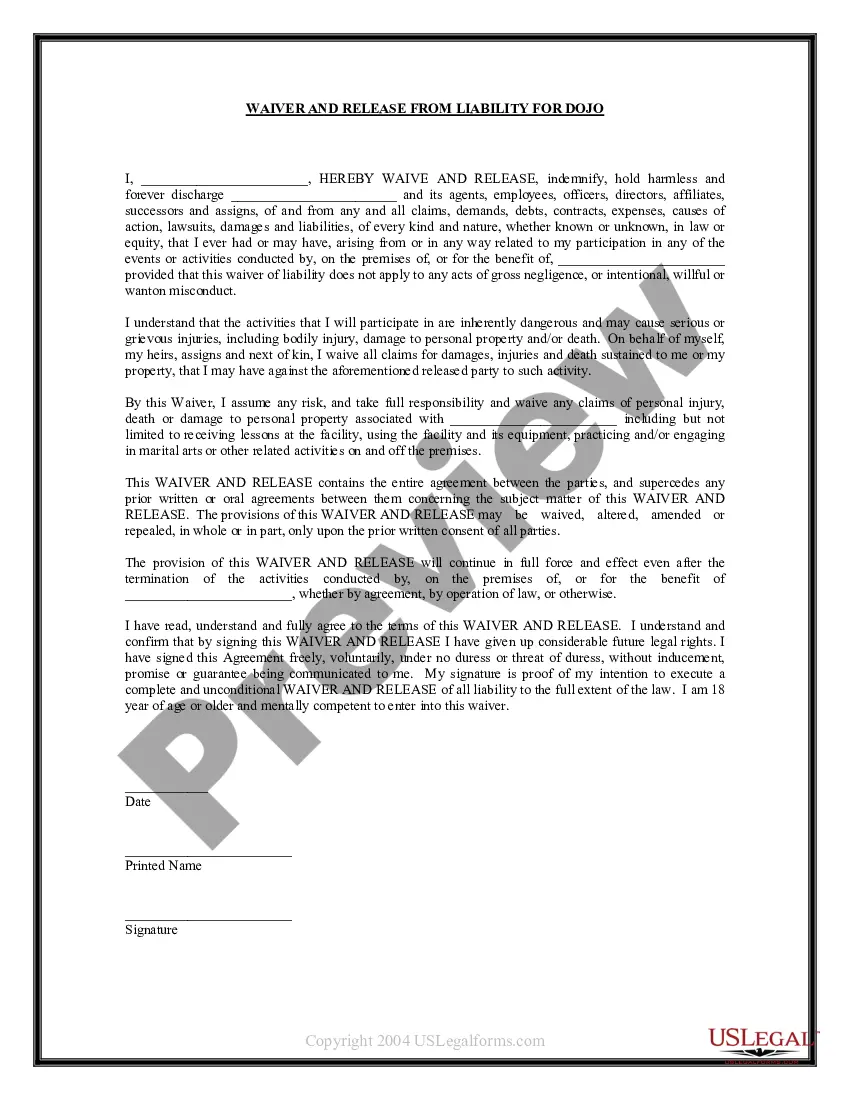
The Release Regarding Martial Arts Training form is a legal document that protects martial arts instructors and facilities by requiring participants to acknowledge and accept the risks associated with training. By signing this release, participants confirm their voluntary participation and agree not to hold the instructors or establishment liable for any injuries that may occur. This form specifically caters to those engaging in karate activities and is essential for protecting all parties involved.
What’s included in this form
- Release of liability clause stating that the participant cannot sue for injuries sustained during activities.
- Informed consent acknowledgment where the participant accepts all inherent risks of martial arts training.
- Health certification confirming the participant's fitness for karate activities.
- Parental or guardian signature requirement for participants under the age of 18.
- Signature and date fields for the participant and any required witnesses.
When to use this document
This form should be used when individuals wish to participate in karate training or other martial arts activities that involve physical risk. It is particularly important for gyms, studios, and instructors who require explicit acknowledgment of risks and liability before allowing students to engage in training. This form is beneficial for both the participant and the facility to ensure clarity and protection in case of accidental injuries.
Who can use this document
- Individuals participating in martial arts training, including adults and minors.
- Parents or guardians of minor participants engaging in karate activities.
- Martial arts instructors and training facilities looking to mitigate liability risk.
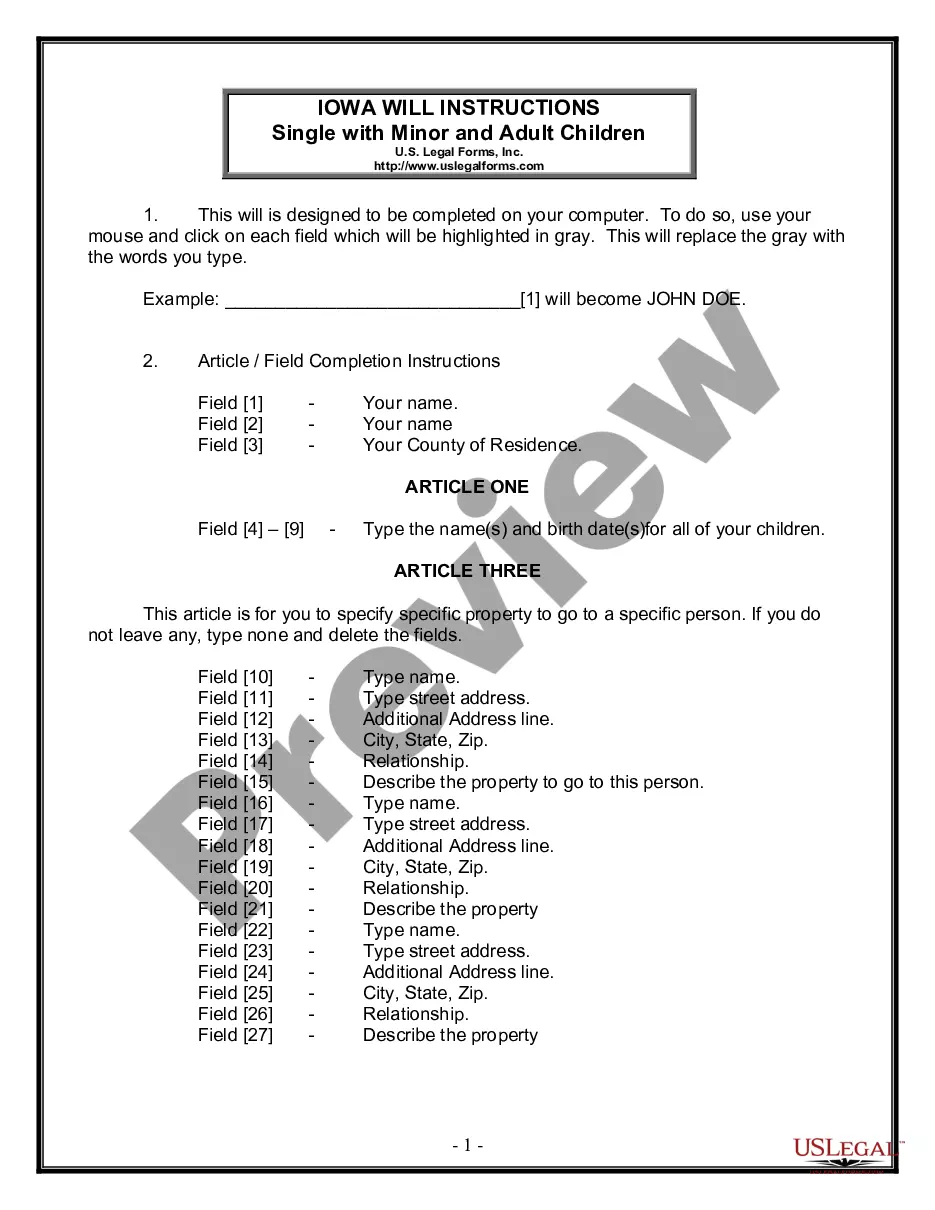
How to prepare this document
- Enter the name of the martial arts facility and the specific locations where activities will occur.
- Provide personal information, including the participant's name and date of signature.
- Read and understand the liability clauses before signing, ensuring you acknowledge the risks involved.
- If the participant is under 18, ensure a parent or guardian fills out and signs the consent section.
- Sign and date the document in the designated areas.
Notarization guidance
Notarization is not commonly needed for this form. However, certain documents or local rules may make it necessary. Our notarization service, powered by Notarize, allows you to finalize it securely online anytime, day or night.
Get your form ready online
Our built-in tools help you complete, sign, share, and store your documents in one place.
Make edits, fill in missing information, and update formatting in US Legal Forms—just like you would in MS Word.
Download a copy, print it, send it by email, or mail it via USPS—whatever works best for your next step.
Sign and collect signatures with our SignNow integration. Send to multiple recipients, set reminders, and more. Go Premium to unlock E-Sign.
If this form requires notarization, complete it online through a secure video call—no need to meet a notary in person or wait for an appointment.
We protect your documents and personal data by following strict security and privacy standards.

Make edits, fill in missing information, and update formatting in US Legal Forms—just like you would in MS Word.

Download a copy, print it, send it by email, or mail it via USPS—whatever works best for your next step.

Sign and collect signatures with our SignNow integration. Send to multiple recipients, set reminders, and more. Go Premium to unlock E-Sign.

If this form requires notarization, complete it online through a secure video call—no need to meet a notary in person or wait for an appointment.

We protect your documents and personal data by following strict security and privacy standards.
Mistakes to watch out for
- Failing to read the entire form, which may lead to misunderstandings of liabilities.
- Not obtaining a signature from a parent or guardian for minors.
- Using an outdated version of the form that may not comply with current legal standards.
Benefits of using this form online
- Convenience of downloading and completing the form at your own pace.
- Editable fields allow for quick customization to fit specific martial arts programs.
- Reliable access to forms created by licensed attorneys to ensure legal enforceability.
Legal use & context
- The release helps protect martial arts instructors and facilities from liability for injuries incurred during training.
- This form is based on the principle of informed consent, where participants acknowledge the risks of martial arts.
- Participants are encouraged to have a clear understanding of the terms before signing to ensure enforceability.
What to keep in mind
- The release form is crucial for managing liability in martial arts training.
- Completing the form accurately helps safeguard both participants and instructors.
- Always check state-specific requirements to ensure compliance.
Looking for another form?
Form popularity
FAQ
Brazilian Jiu Jitsu. Eskrima. Bacom. Vale Tudo. Ninjutsu. Rough and Tumble. LINE. Krav Maga. First developed for the Israeli Defence Force, Krav Maga is the world's most effective and dangerous form of combat and is known as a non-sport form of martial arts.
On a collision course: Krav Maga. (Almost) nothing is off limits: Mixed Martial Arts. Raw but effective: Keysi. Individual self-defense in the style of Bruce Lee: Jeet Kune Do. Instinct rather than deliberation: Wing Chun.
Grandmaster (or Grand Master) and Master are titles used to describe or address some senior or experienced martial artists. Typically these titles are honorific in nature, meaning that they do not infer rank, but rather distinguish the individual as very highly revered in their school, system, or style.
For starters, fighters generally train four hours a day, five days a week, when preparing for a bout. There's no way you could humanly do more, says Jackson.
Praying Mantis Kung Fu is as deadly as it is legendary and can be observed in countless Kung Fu movies.
Krav Maga. Getty There is no spiritual journey, no harmony to be achieved in Krav Maga. This fighting form was designed with one thing in mind: disarming, disabling and destroying your enemies. The unofficial slogan of the style, according to the New York Times, is "Hurt them real bad and then get away."
Sensei, pronounced sen-say, is in its most basic sense a covers-all Japanese word for a teacher.It also includes instructors such as dance instructors and training instructors at a karate dojo, or martial arts school.
So, what is a martial arts instructor called? Sensei (sen-sey) is Japanese for a Karate instructor.
Criminal Charges for Using Martial Arts. You are criminally liable when you wrongfully and willfully use your skills to repel an attack that is non-existent, minimal, or not imminent. A person who is held criminally liable for excessive and disproportionate use of force may be arrested and charged with criminal assault