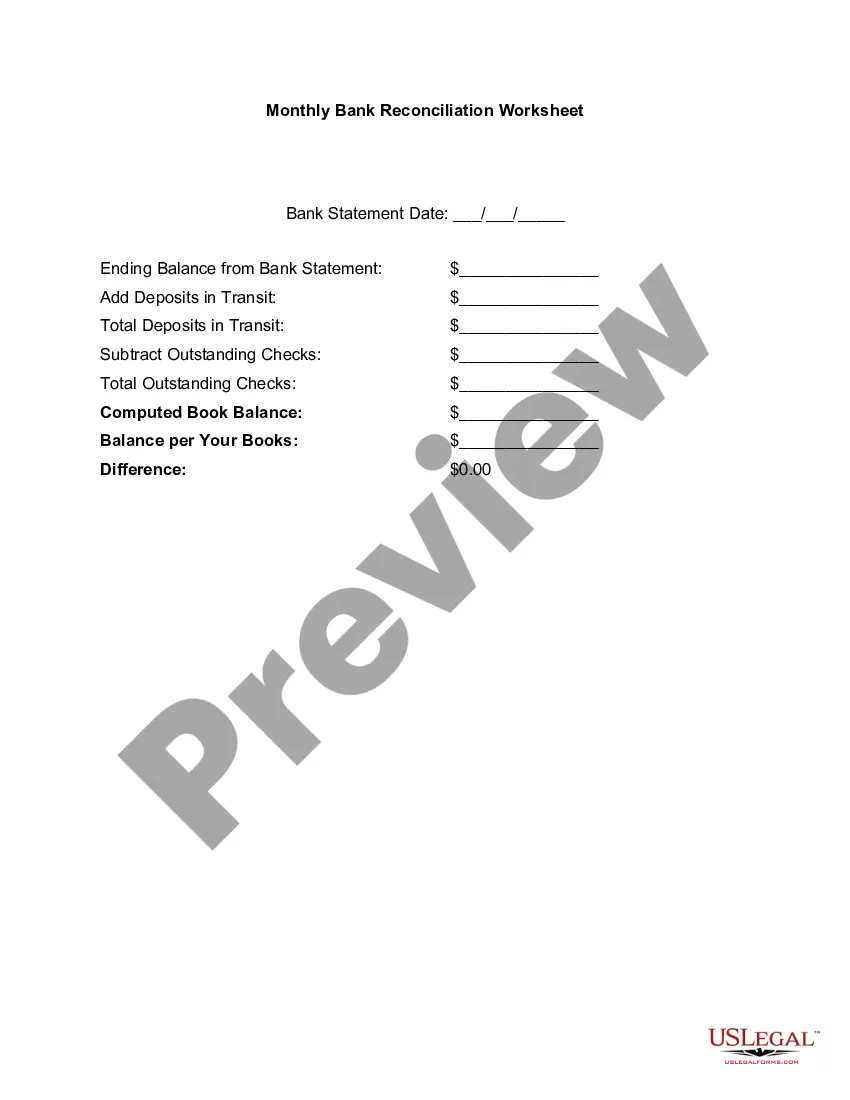
Monthly Bank Reconciliation Worksheet
About this form
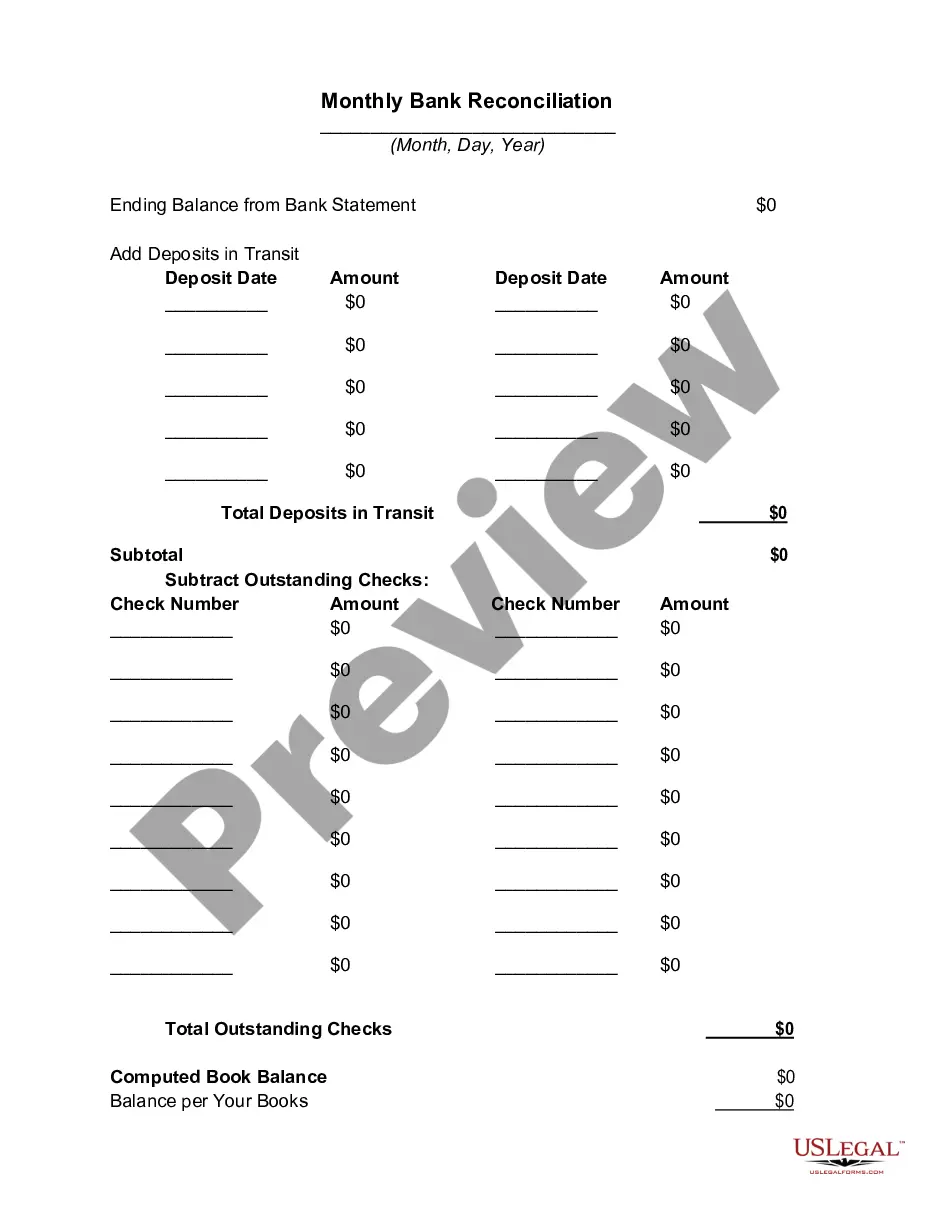
The Monthly Bank Reconciliation Worksheet is a financial document used to match your bank statement balance to your own records. This form helps identify discrepancies between your bank and book balances, ensuring accuracy in your financial reporting. Unlike similar forms, this worksheet is specifically designed for monthly reconciliations, providing a structured template to simplify the process.
Key parts of this document
- Bank statement date: Capture the date of your bank statement.
- Ending balance from bank statement: Enter the bank's reported ending balance.
- Add deposits in transit: List any deposits you have made that are not yet reflected in your bank statement.
- Subtract outstanding checks: Record checks you have issued that have not yet cleared the bank.
- Computed book balance: Calculate your book balance after adjustments.
- Balance per your books: Input the balance according to your own records.
- Difference: Identify any discrepancies that result from these calculations.
Situations where this form applies
This form is useful for business owners and individuals who regularly manage finances through bank accounts. You should consider using the Monthly Bank Reconciliation Worksheet when you receive your bank statement each month, particularly if you notice differences between your records and the statement. It is essential for maintaining accurate financial information and preventing fraud or accounting errors.
Who needs this form
- Small business owners who need to reconcile bank statements for accounting purposes.
- Individuals managing personal finances and wanting to ensure accuracy in their banking records.
- Accountants or bookkeepers tasked with preparing monthly financial reports.
- Anyone who has a bank account and wants to track discrepancies effectively.
Instructions for completing this form
- Identify the bank statement date and record it at the top of the worksheet.
- Enter the ending balance found on your bank statement.
- List any deposits in transit that you have made but are not reflected in the bank statement.
- Subtract outstanding checks that have been issued but not yet cleared.
- Calculate your computed book balance based on the entries made.
- Compare your computed book balance to the balance per your books to identify any difference.
Is notarization required?
In most cases, this form does not require notarization. However, some jurisdictions or signing circumstances might. US Legal Forms offers online notarization powered by Notarize, accessible 24/7 for a quick, remote process.
Get your form ready online
Our built-in tools help you complete, sign, share, and store your documents in one place.
Make edits, fill in missing information, and update formatting in US Legal Forms—just like you would in MS Word.
Download a copy, print it, send it by email, or mail it via USPS—whatever works best for your next step.
Sign and collect signatures with our SignNow integration. Send to multiple recipients, set reminders, and more. Go Premium to unlock E-Sign.
If this form requires notarization, complete it online through a secure video call—no need to meet a notary in person or wait for an appointment.
We protect your documents and personal data by following strict security and privacy standards.

Make edits, fill in missing information, and update formatting in US Legal Forms—just like you would in MS Word.

Download a copy, print it, send it by email, or mail it via USPS—whatever works best for your next step.

Sign and collect signatures with our SignNow integration. Send to multiple recipients, set reminders, and more. Go Premium to unlock E-Sign.

If this form requires notarization, complete it online through a secure video call—no need to meet a notary in person or wait for an appointment.

We protect your documents and personal data by following strict security and privacy standards.
Avoid these common issues
- Not including all deposits in transit or outstanding checks, leading to incorrect balances.
- Forgetting to update the worksheet after reconciling, thus maintaining outdated records.
- Misrecording amounts, whether adding or subtracting, which skews the final balance.
Why use this form online
- Convenience of downloading and saving the form for monthly use without the need for physical copies.
- Editability allows users to adjust figures easily as new deposits and checks occur.
- Reliable template to streamline the reconciliation process, reducing time spent on manual calculations.
What to keep in mind
- The Monthly Bank Reconciliation Worksheet is essential for maintaining accurate financial records.
- It helps identify discrepancies between your records and those of the bank.
- Using this form can simplify financial management for both individuals and businesses alike.
Looking for another form?
Form popularity
FAQ
Bank Statement - the bank's accounting of your transactions. Reconciliation Worksheet - how you identify the missing transactions between the two.
COMPARE THE DEPOSITS. Match the deposits in the business records with those in the bank statement. ADJUST THE BANK STATEMENTS. Adjust the balance on the bank statements to the corrected balance. ADJUST THE CASH ACCOUNT. COMPARE THE BALANCES.
Agree the Adjusted Book Balance noted on the reconciliation to the Balance Sheet. Review cancelled check images for unusual endorsements or signatures. Scan cleared checks on the reconciliation to ensure they appear as expected. Also look for potential duplicates.
COMPARE THE DEPOSITS. Match the deposits in the business records with those in the bank statement. ADJUST THE BANK STATEMENTS. Adjust the balance on the bank statements to the corrected balance. ADJUST THE CASH ACCOUNT. COMPARE THE BALANCES.
Access bank records. Access software. Update uncleared checks. Update deposits in transit. Enter new expenses. Enter bank balance. Review reconciliation. Continue investigation.
Get bank records. You need a list of transactions from the bank. Get business records. Open your ledger of income and outgoings. Find your starting point. Run through bank deposits. Check the income on your books. Run through bank withdrawals. Check the expenses on your books. End balance.