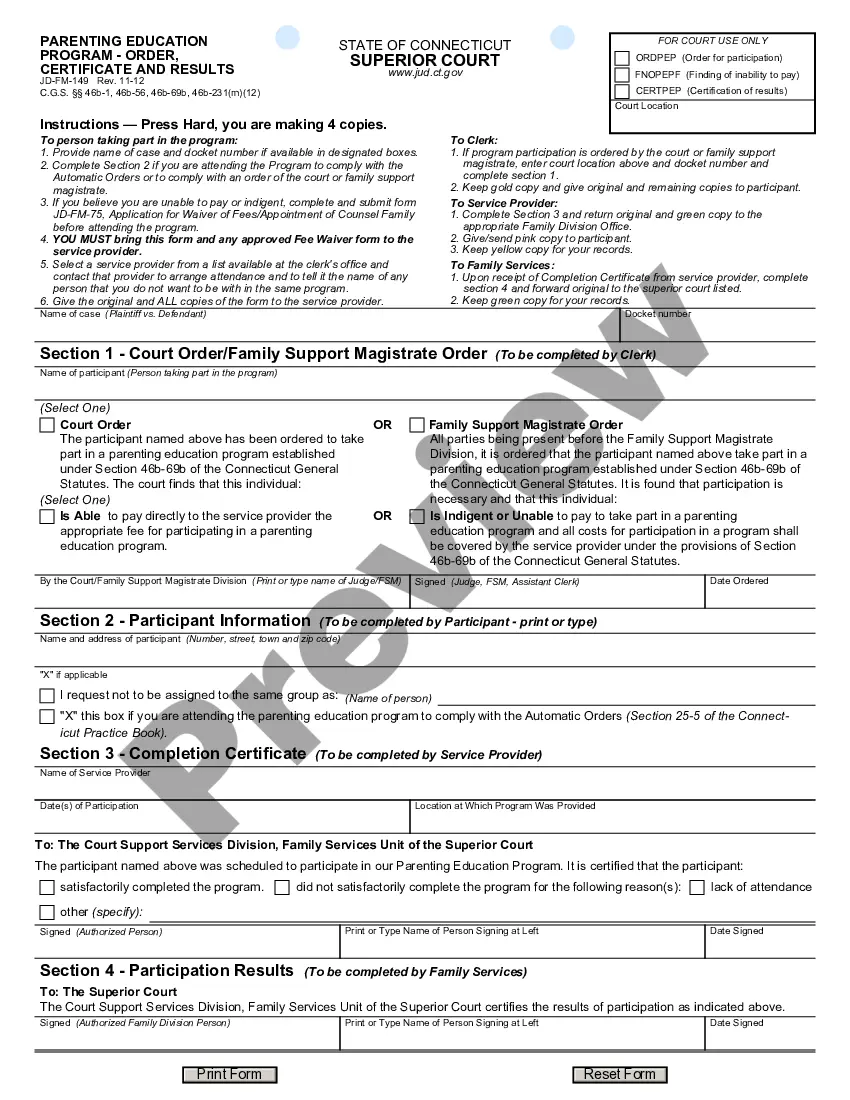
Complaint by a Baseball Game Spectator Struck by Bat Thrown by Player
What this document covers
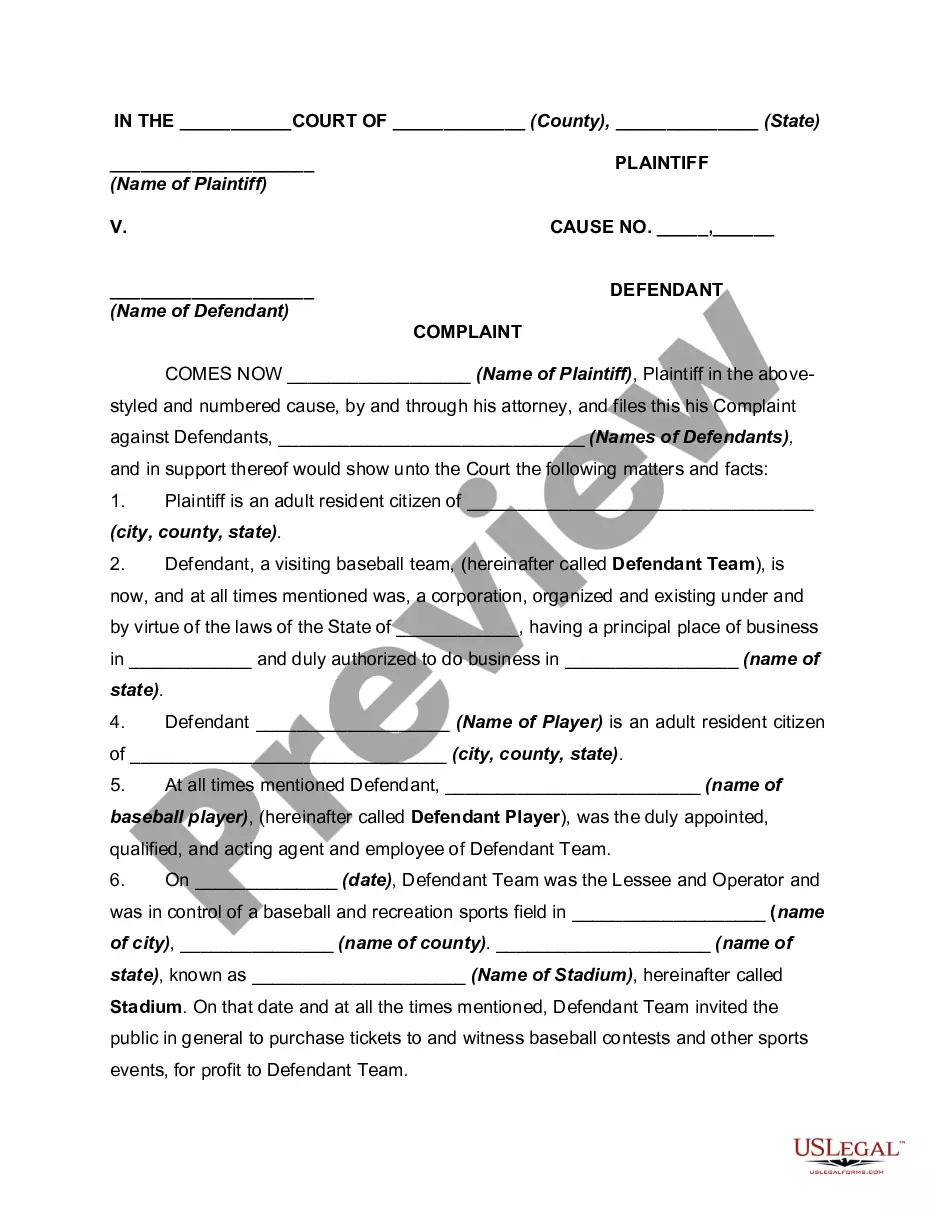
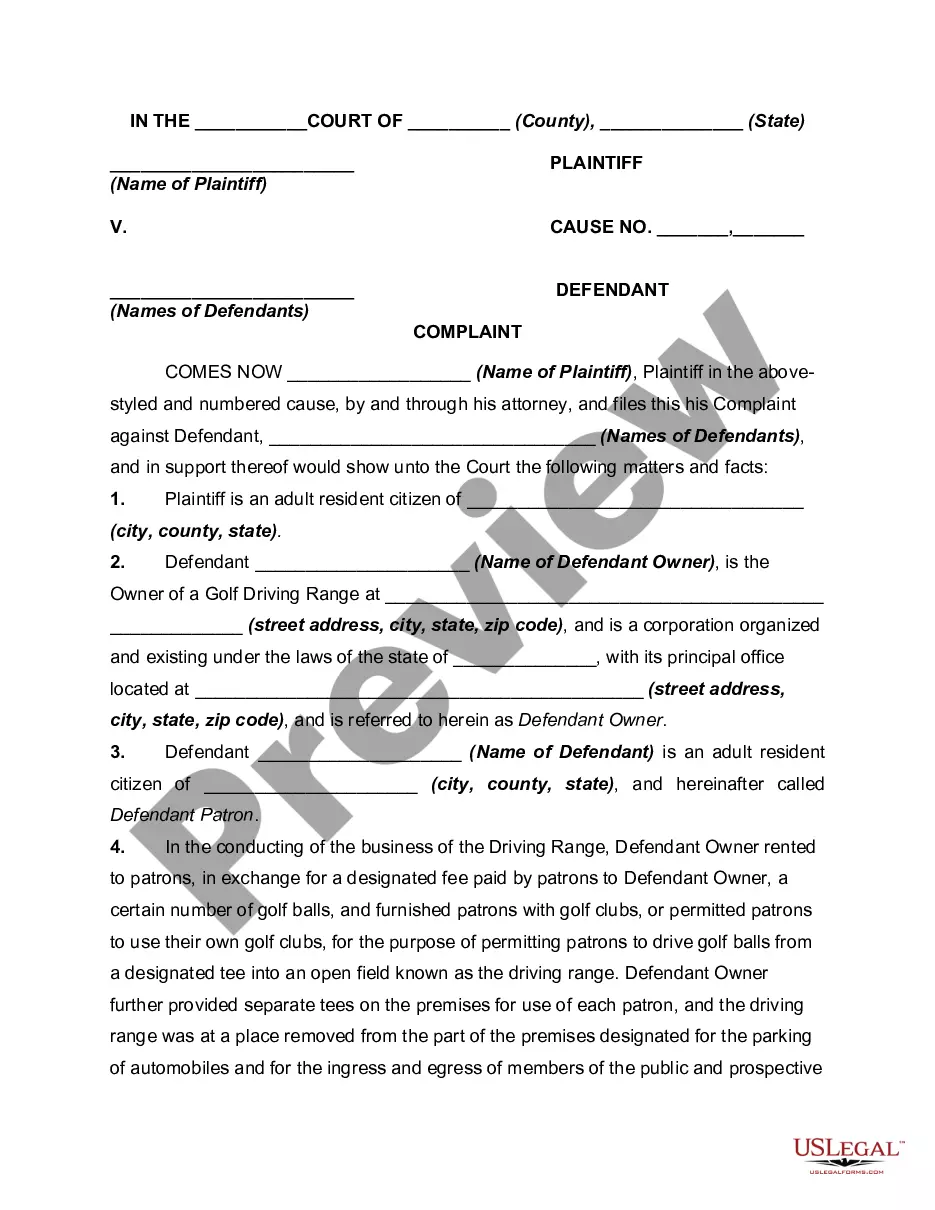
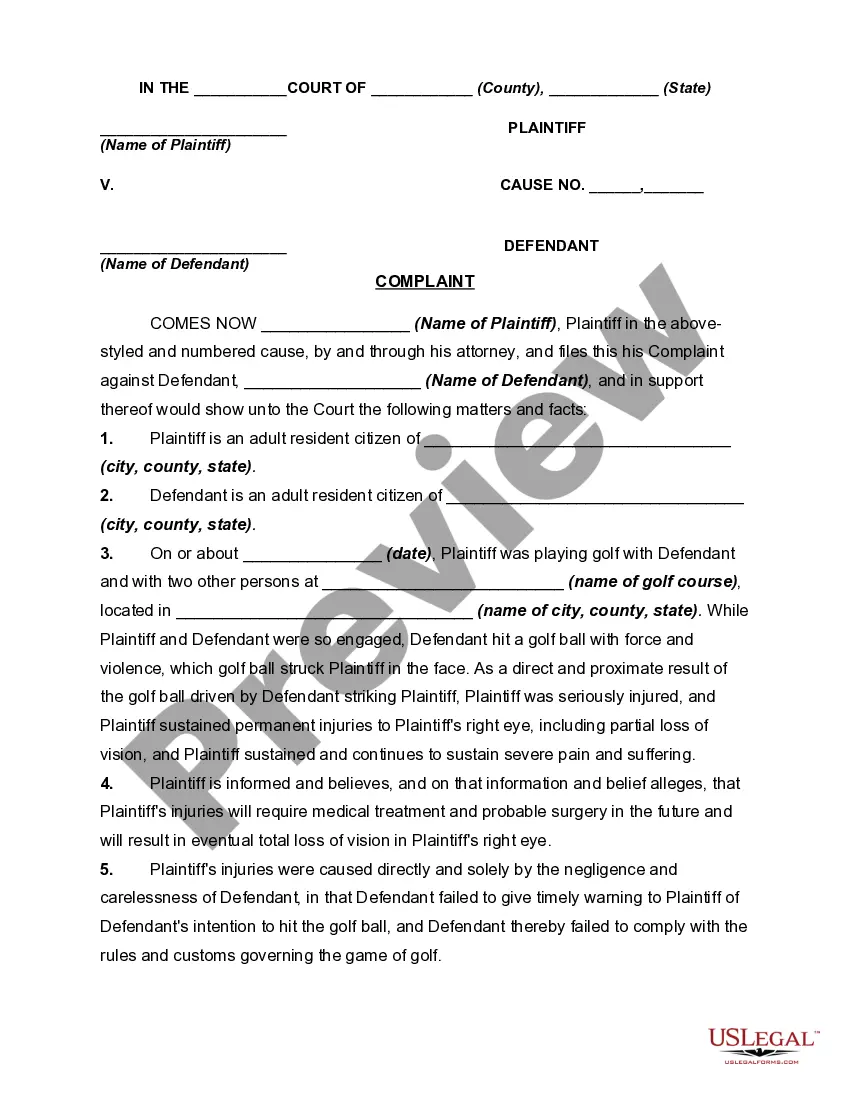
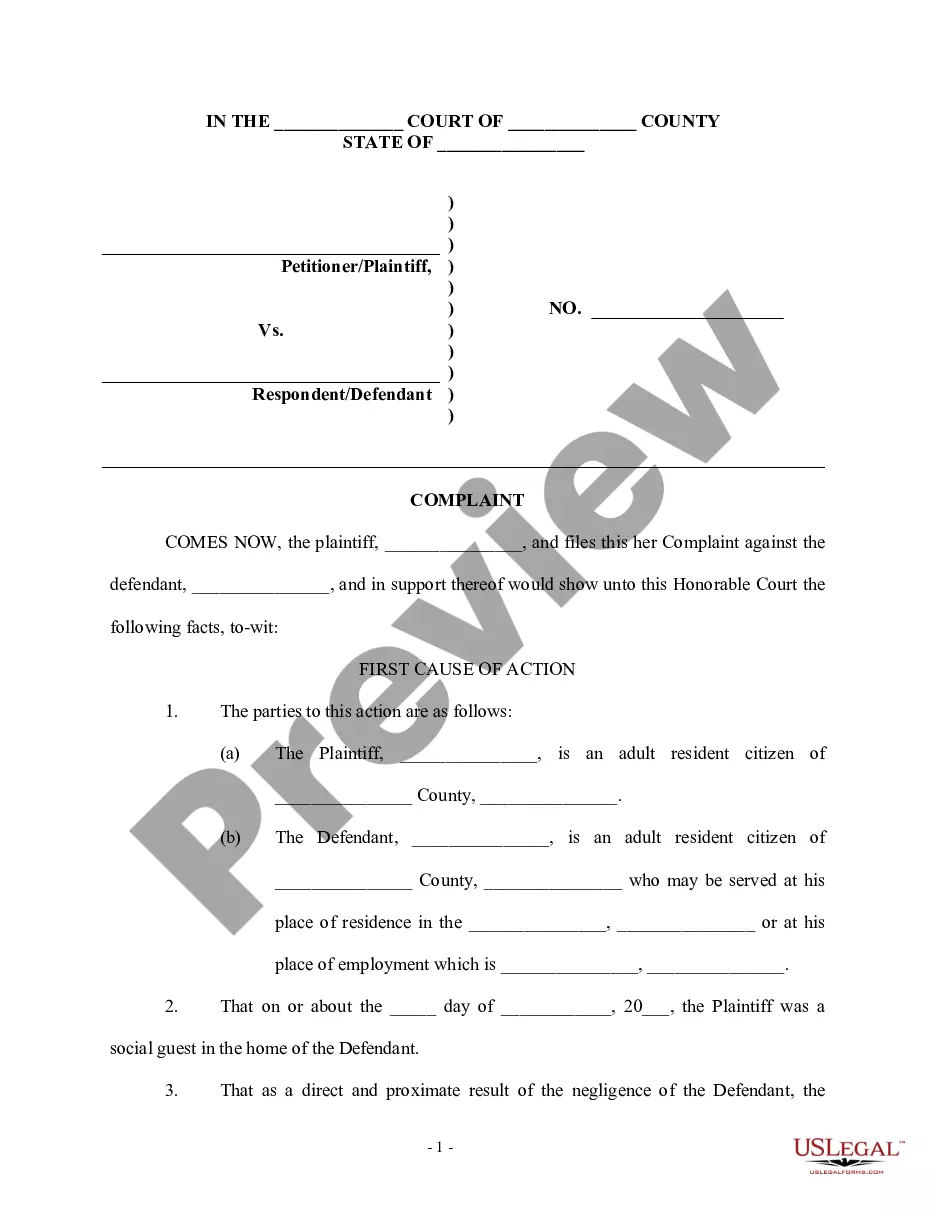
This form, known as the Complaint by a Baseball Game Spectator Struck by Bat Thrown by Player, is used to initiate legal action when a spectator is injured by a bat thrown during a baseball game. It outlines the plaintiff's claims against the defendants, typically the players, teams, and venue operators, based on negligence principles. This form is distinct from other personal injury complaints as it addresses specific circumstances arising in the context of sports venues and events.
Key parts of this document
- Title of the case and parties involved (plaintiff and defendants).
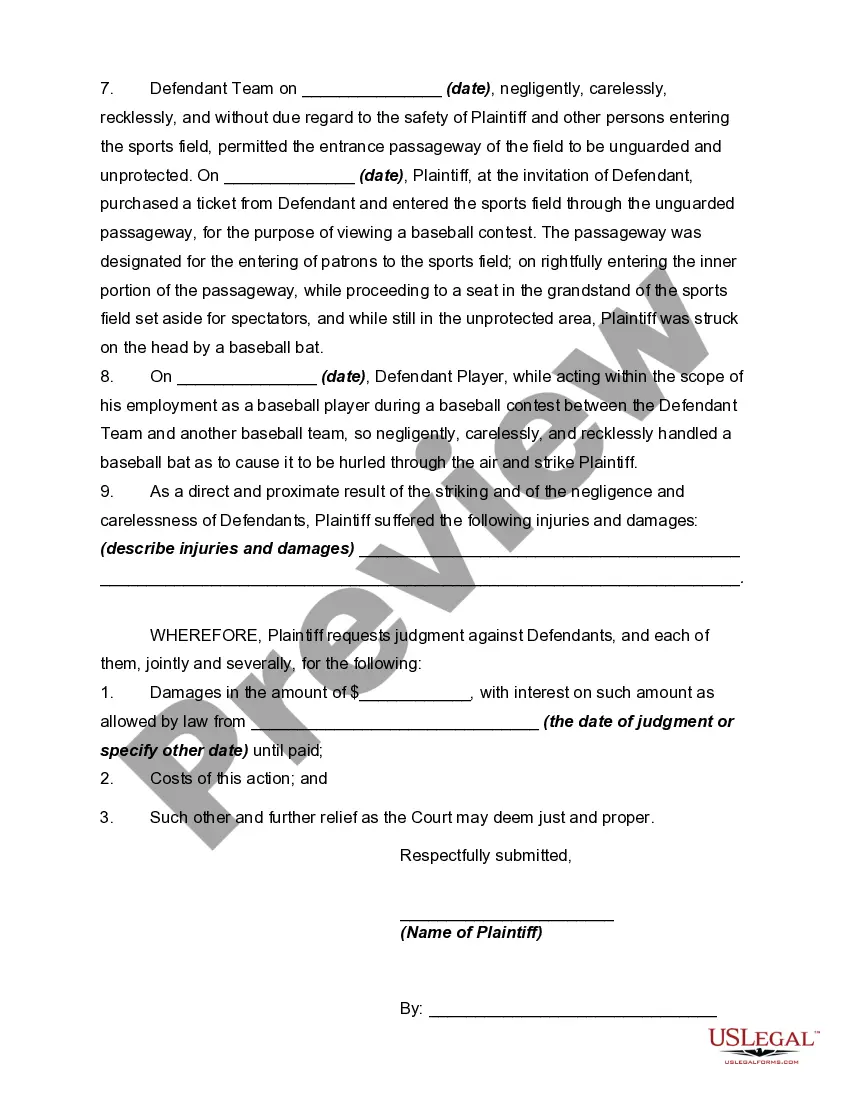
- Detailed allegations regarding the nature of the incident.
- Statements proving the defendants' duty of care and their breach.
- Specific facts surrounding the injury and resulting damages.
- Request for damages and other legal relief.
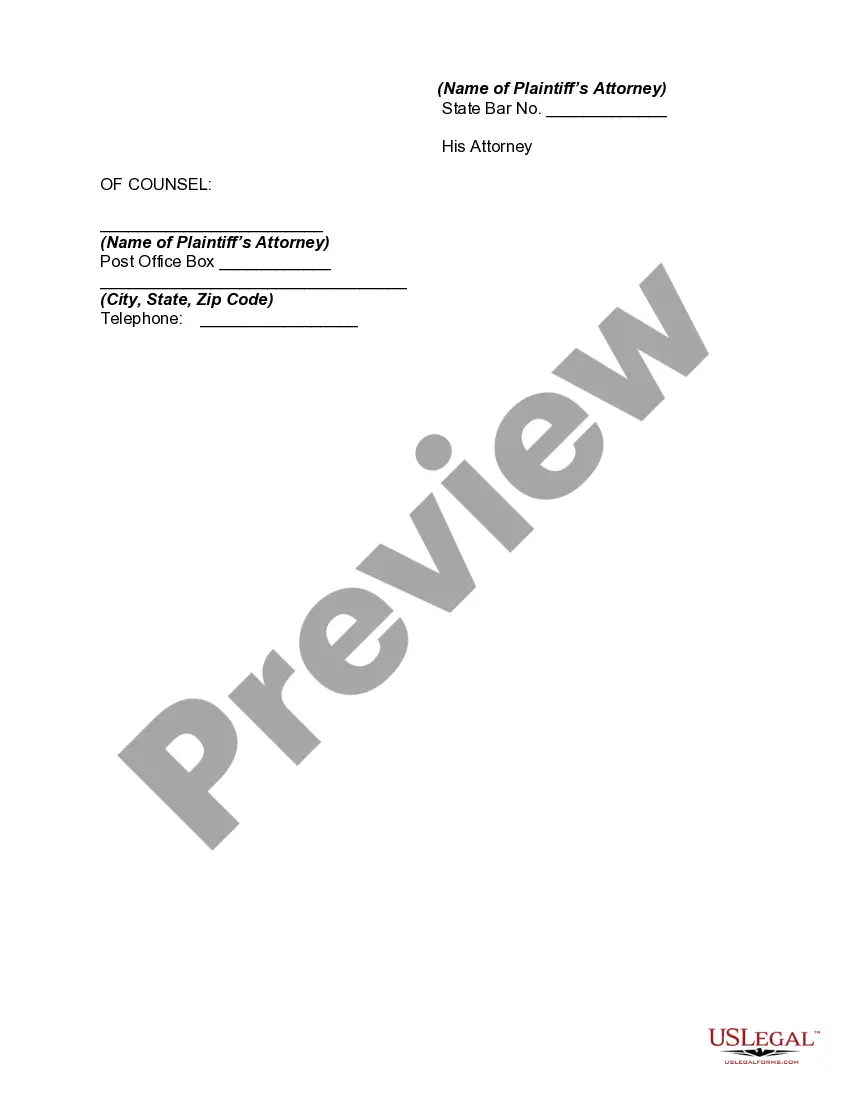
- Signatures of the plaintiff and their attorney.
When to use this form
This form should be used when a spectator at a baseball game suffers injury due to negligence, such as being struck by a bat thrown by a player. It is relevant in situations where the venue operators did not maintain a safe environment, or when actions by players or other spectators contribute to the injury. Common scenarios include injuries caused by errant throws, falls caused by unsafe seating, or obstacles in pathways.
Who can use this document
This form is intended for:
- Individual spectators injured at a baseball game.
- Parents or guardians on behalf of minors injured at a sporting event.
- Legal representatives filing on behalf of injured clients.
Instructions for completing this form
- Identify the parties involved, including the plaintiff and defendants, and clearly state their details.
- Provide specific information about the event leading to the injury, including dates and locations.
- Describe the nature of the negligence or unsafe condition that caused the injury.
- Detail the injuries sustained and any damages incurred as a result.
- Sign the document, ensuring all required signatures from the plaintiff and their attorney are present.
Notarization guidance
This form does not typically require notarization unless specified by local law. It is advised to check any jurisdiction-specific requirements to confirm if notarization is necessary.
Get your form ready online
Our built-in tools help you complete, sign, share, and store your documents in one place.
Make edits, fill in missing information, and update formatting in US Legal Forms—just like you would in MS Word.
Download a copy, print it, send it by email, or mail it via USPS—whatever works best for your next step.
Sign and collect signatures with our SignNow integration. Send to multiple recipients, set reminders, and more. Go Premium to unlock E-Sign.
If this form requires notarization, complete it online through a secure video call—no need to meet a notary in person or wait for an appointment.
We protect your documents and personal data by following strict security and privacy standards.

Make edits, fill in missing information, and update formatting in US Legal Forms—just like you would in MS Word.

Download a copy, print it, send it by email, or mail it via USPS—whatever works best for your next step.

Sign and collect signatures with our SignNow integration. Send to multiple recipients, set reminders, and more. Go Premium to unlock E-Sign.

If this form requires notarization, complete it online through a secure video call—no need to meet a notary in person or wait for an appointment.

We protect your documents and personal data by following strict security and privacy standards.
Common mistakes to avoid
- Failing to provide complete and accurate details about the incident.
- Not clearly establishing the duty of care owed by the defendants.
- Omitting critical facts regarding the injuries suffered and their impact.
- Neglecting to include proper signatures and dates on the form.
Benefits of using this form online
- Instant access to a ready-to-use legal document tailored for your needs.
- Edit and customize the form easily to ensure it accurately reflects your situation.
- Secure and reliable process for preparing legal documents without the need for in-person consultations.
Legal use & context
- The form establishes a basis for a negligence claim when spectators are injured at sporting events.
- It is essential to demonstrate duty of care and breach to support your case legally.
- Understanding local laws regarding sporting events can influence the outcome of your case.
Summary of main points
- The form is designed for spectators injured at baseball games due to negligence.
- Accurate completion is crucial for pursuing a successful lawsuit.
- Consulting legal advice can enhance the effectiveness of your complaint.
Looking for another form?

Form popularity
FAQ
Is a 14 a good ACT score? A score of 14 is definitely low. It places you in the bottom 13th percentile nationally out of the 2 million test takers of the ACT entrance exam. The score indicates you've done a very poor job answering the questions on the English, Math, Reading and Science sections of the test.
A score of 24 means you've scored better than about 74% of students. A 28 means you've scored better than 88% of students, and a 30 means you've scored better than 93% of them! Anything 35 or above is in the 99th percentilea truly phenomenal score.
Students who earned an ACT Composite score of 12 in 7th grade scored at the national mean (an ACT Composite score of 211), on average, in grade 11 or 12. For 7th grade scores of 20 or higher, median scores for grades 11/12 are 30 or higher.
Is a 17 a good ACT score? A score of 17 is pretty low. It places you in the bottom 31st percentile nationally out of the 2 million test takers of the ACT entrance exam. The score indicates you've done a well below average job answering the questions on the English, Math, Reading and Science sections of the test.
Nationally, What's a Bad ACT Score? If you look at the ACT percentiles, any composite score below 20 (the 50th percentile) is below average. (For more on how the ACT is scored and how the composite is calculated, see our guide.) In other words, to be above average nationally, you need at least a 21 ACT composite score.
Both ACT and SAT scores are used for college admissions decisions and awarding merit-based scholarships. Most colleges do not prefer one test over the other. Neither the SAT or ACT is harder than the other. Different students tend to do better on one test over the other.
With a 12 ACT score, you're already strongly competitive for these schools. You're very likely to get admitted if you apply. If you improve your ACT score, your Safety Schools will get better and better.
Students who earned an ACT Composite score of 12 in 7th grade scored at the national mean (an ACT Composite score of 211), on average, in grade 11 or 12. For 7th grade scores of 20 or higher, median scores for grades 11/12 are 30 or higher.
Composite ACT score which is 20 or below 20 is known to be below average in terms of National average.So, nationally stating, 17 ACT scores may be considered as bad ACT scores. This indicates that you got to score more than 17 as an ACT score if you don't want it to be considered below average.
Even if you don't think you're eligible for scholarships, it doesn't hurt to check2026and double-check. With a GPA of 3.0 and a 24 ACT score (remember, the average is 21), you could still get up to $7,000 a year at Oklahoma State University. Get that score even higherabove 30and you can get up to $12,500 a year.