Assignment of Intellectual Property Rights
What is this form?
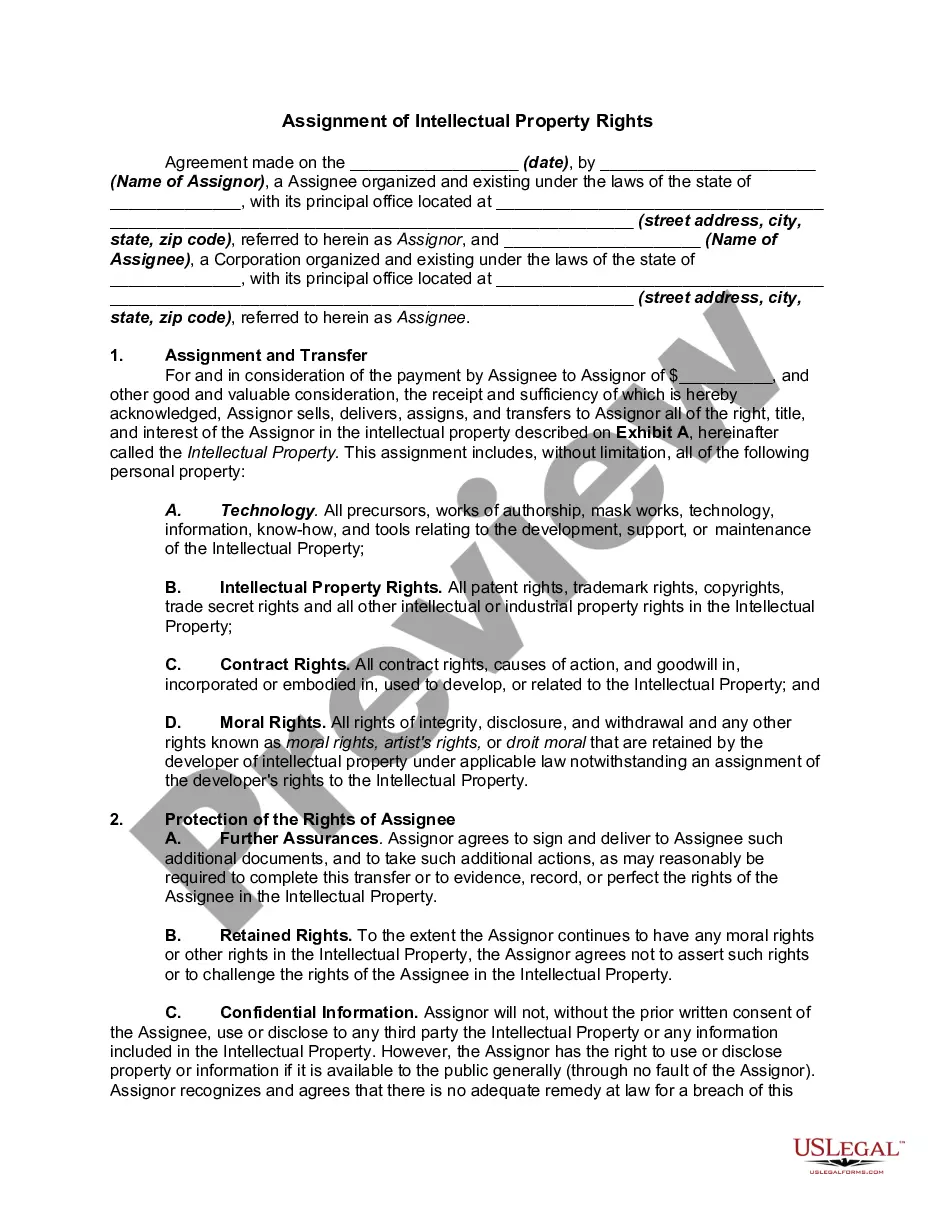
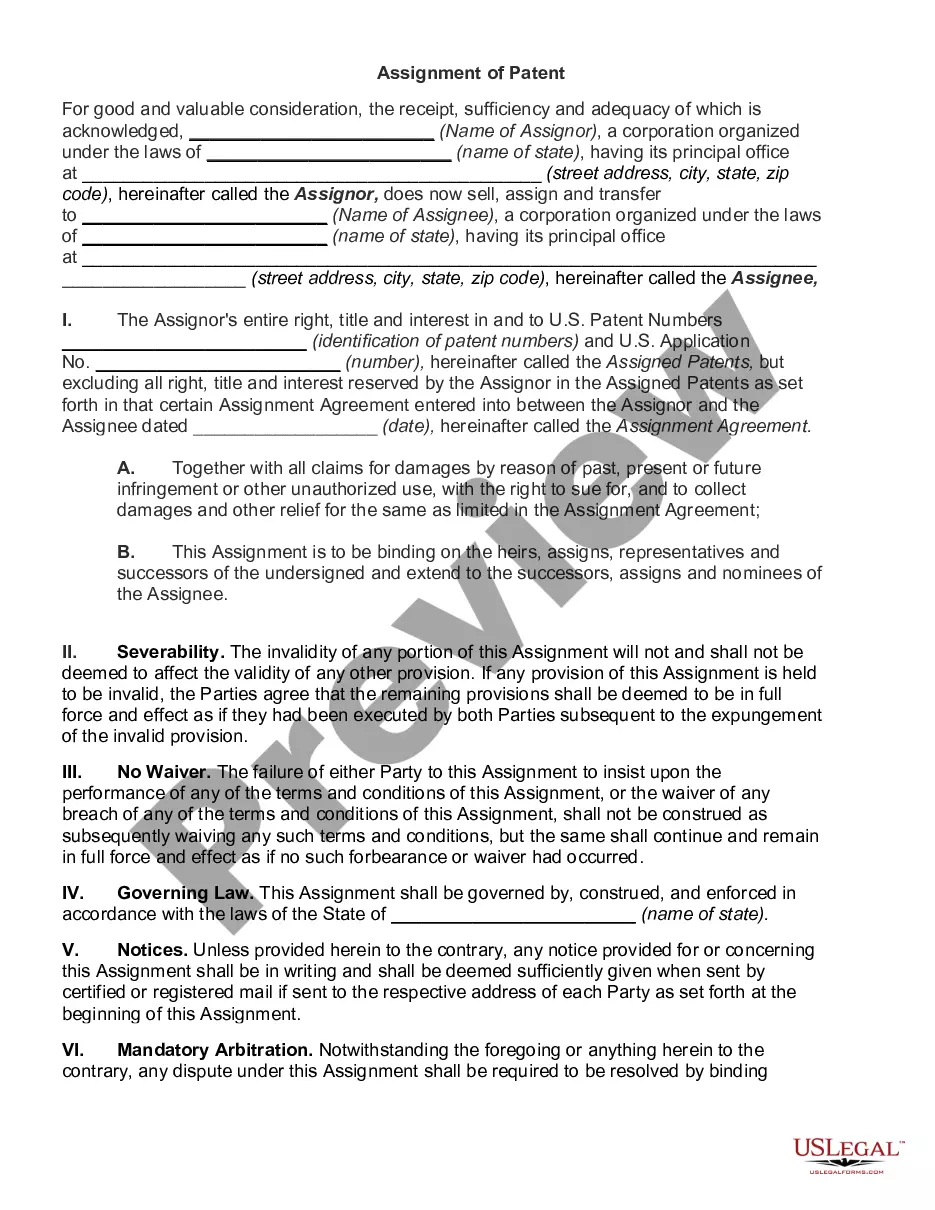
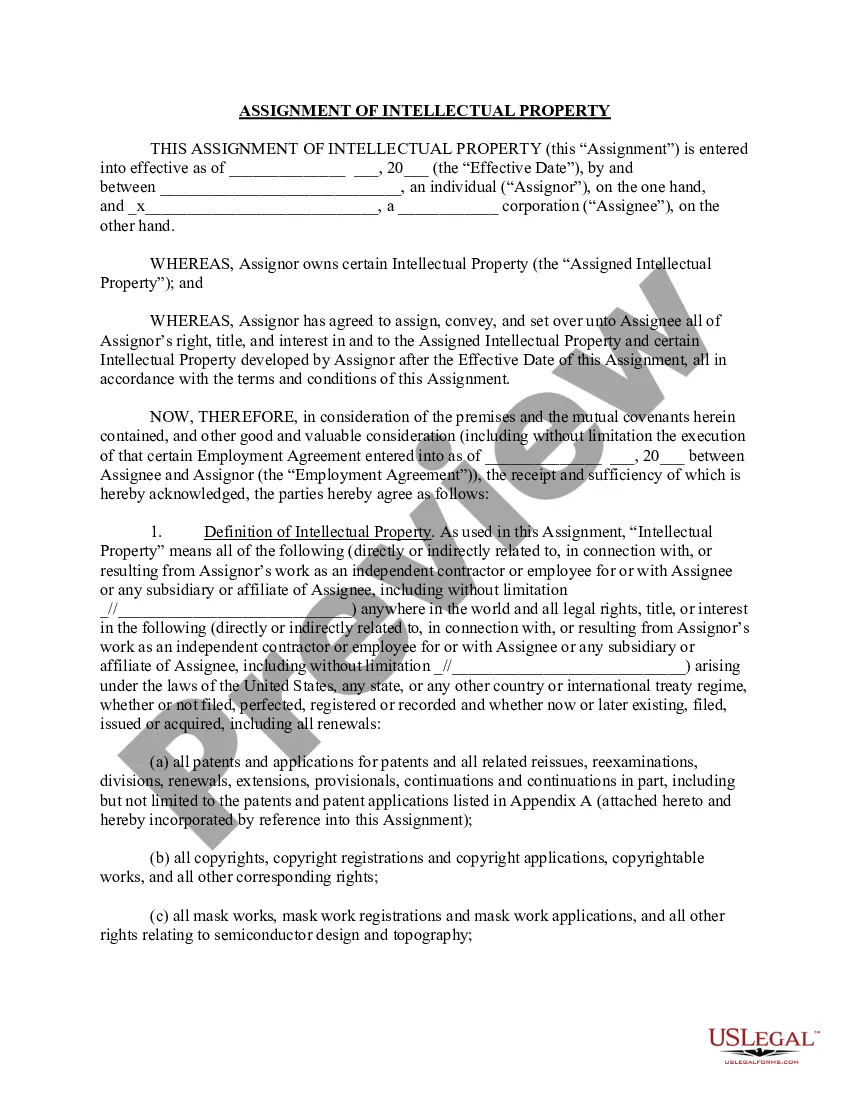
The Assignment of Intellectual Property Rights is a legal document that transfers ownership of intellectual property from one party (the Assignor) to another (the Assignee). This form is essential for ensuring that the rights to inventions, trademarks, copyrights, and other intellectual property are legally assigned and recognized. By completing this form, parties establish clear ownership and protect their rights according to federal and state laws related to intellectual property.
What’s included in this form
- Identification of the Assignor and Assignee, including their legal structure and principal office addresses.
- Details of the intellectual property being assigned, defined in Exhibit A.
- Assignment and transfer of rights, including technology, intellectual property rights, contract rights, and moral rights.
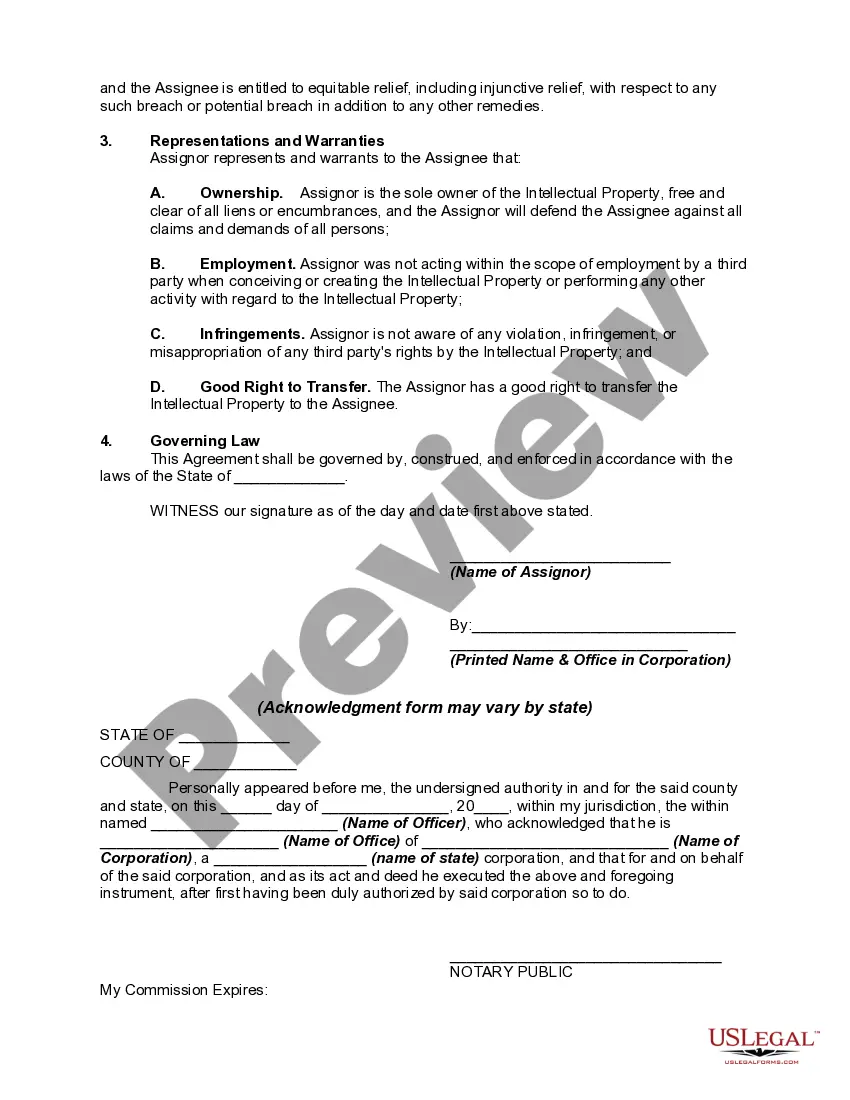
- Representations and warranties made by the Assignor regarding ownership and rights.
- Governing law for the agreement, specifying the state jurisdiction.



Common use cases
This form should be used when an individual or business wishes to transfer ownership of intellectual property rights to another party. Common scenarios include startups assigning patent rights to investors, authors transferring copyright of their works to publishers, or companies selling trademarks to other businesses. Utilizing this form ensures that all parties are legally protected and that the rights associated with the intellectual property are clearly defined and enforceable.
Who can use this document
- Inventors or creators looking to sell or transfer their intellectual property rights.
- Businesses needing to formalize the transfer of intellectual property to partners or investors.
- Contractors or freelancers who have developed intellectual property under a contract.
- Organizations engaged in mergers or acquisitions where intellectual property is involved.
Steps to complete this form
- Identify the parties: Enter the names and addresses of the Assignor and Assignee.
- Specify the property: Clearly describe the intellectual property being assigned in Exhibit A.
- Enter the compensation: Indicate the payment or consideration for the transfer.
- Complete the representations: The Assignor must affirm ownership and other warranties.
- Sign and date the document: Ensure both parties sign the assignment to make it legally binding.
Is notarization required?
This form must be notarized to be legally valid. US Legal Forms provides secure online notarization powered by Notarize, allowing you to complete the process through a verified video call.
Get your form ready online
Our built-in tools help you complete, sign, share, and store your documents in one place.
Make edits, fill in missing information, and update formatting in US Legal Forms—just like you would in MS Word.
Download a copy, print it, send it by email, or mail it via USPS—whatever works best for your next step.
Sign and collect signatures with our SignNow integration. Send to multiple recipients, set reminders, and more. Go Premium to unlock E-Sign.
If this form requires notarization, complete it online through a secure video call—no need to meet a notary in person or wait for an appointment.
We protect your documents and personal data by following strict security and privacy standards.

Make edits, fill in missing information, and update formatting in US Legal Forms—just like you would in MS Word.

Download a copy, print it, send it by email, or mail it via USPS—whatever works best for your next step.

Sign and collect signatures with our SignNow integration. Send to multiple recipients, set reminders, and more. Go Premium to unlock E-Sign.

If this form requires notarization, complete it online through a secure video call—no need to meet a notary in person or wait for an appointment.

We protect your documents and personal data by following strict security and privacy standards.
Typical mistakes to avoid
- Failing to clearly define the intellectual property being transferred.
- Not including necessary signatures, which can invalidate the agreement.
- Omitting representations and warranties that could lead to legal disputes.
Why complete this form online
- Convenience: Easily complete the form from any location with an internet connection.
- Editability: Customize the document as needed for specific circumstances.
- Reliability: Utilize legal forms drafted by attorneys to ensure compliance with laws.
Legal use & context
- This form is legally enforceable in courts once completed correctly.
- It protects the rights of both the Assignor and Assignee concerning the intellectual property.
- Proof of ownership and assignment may be critical in potential legal disputes.
Summary of main points
- The Assignment of Intellectual Property Rights helps transfer rights legally and clearly.
- Parties involved must ensure all details are correctly filled to avoid disputes.
- Consult local laws to ensure compliance and understand the necessity of notarization.
Looking for another form?
Form popularity
FAQ
Intellectual property rights are legal rights that provide creators protection for original works, inventions, or the appearance of products, artistic works, scientific developments, and so on. There are four types of intellectual property rights (IP): patents, trademarks, copyrights, and trade secrets.
Intellectual property (IP) refers to the ownership of an idea or design by the person who came up with it. It is a term used in property law. It gives a person certain exclusive rights to a distinct type of creative design, meaning that nobody else can copy or reuse that creation without the owner's permission.
Trade Secrets. Trade secrets refer to specific, private information that is important to a business because it gives the business a competitive advantage in its marketplace. Patents. Copyrights. Trademarks.
Recordation of the assignment provides legal notice to the public of the assignment.For a patent to issue to an assignee, the assignment must have been recorded or filed for recordation in accordance with 37 CFR 3.11. See 37 CFR 3.81(a).
The assignment of intellectual property (IP) refers to the process by which ownership of work product created for a company by an employee or consultant is transferred to the entity.
Intellectual property (IP) refers to creations of the mind, such as inventions; literary and artistic works; designs; and symbols, names and images used in commerce.
All forms of intellectual property -- copyrights, trademarks, trade secrets and patents can be transferred in two ways: the property can be temporarily transferred under a license; or the property can be permanently transferred by way of an assignment.
Intellectual property (IP) is ideas, information and knowledge. In the University context IP can be viewed as the results and outcomes of research 'intellectual' because it is creative output and 'property' because it is viewed as a tradable commodity.
Use EPAS to create and submit a Patent Assignment Recordation Coversheet by completing on-line web forms and attaching the supporting legal documentation as black and white TIFF or PDF for submission via the internet. You may email questions about filing electronic patent assignments to EPAS@uspto.gov .