Covenant Not to Sue by Parents Regarding a Claim of Their Minor Child
Overview of this form
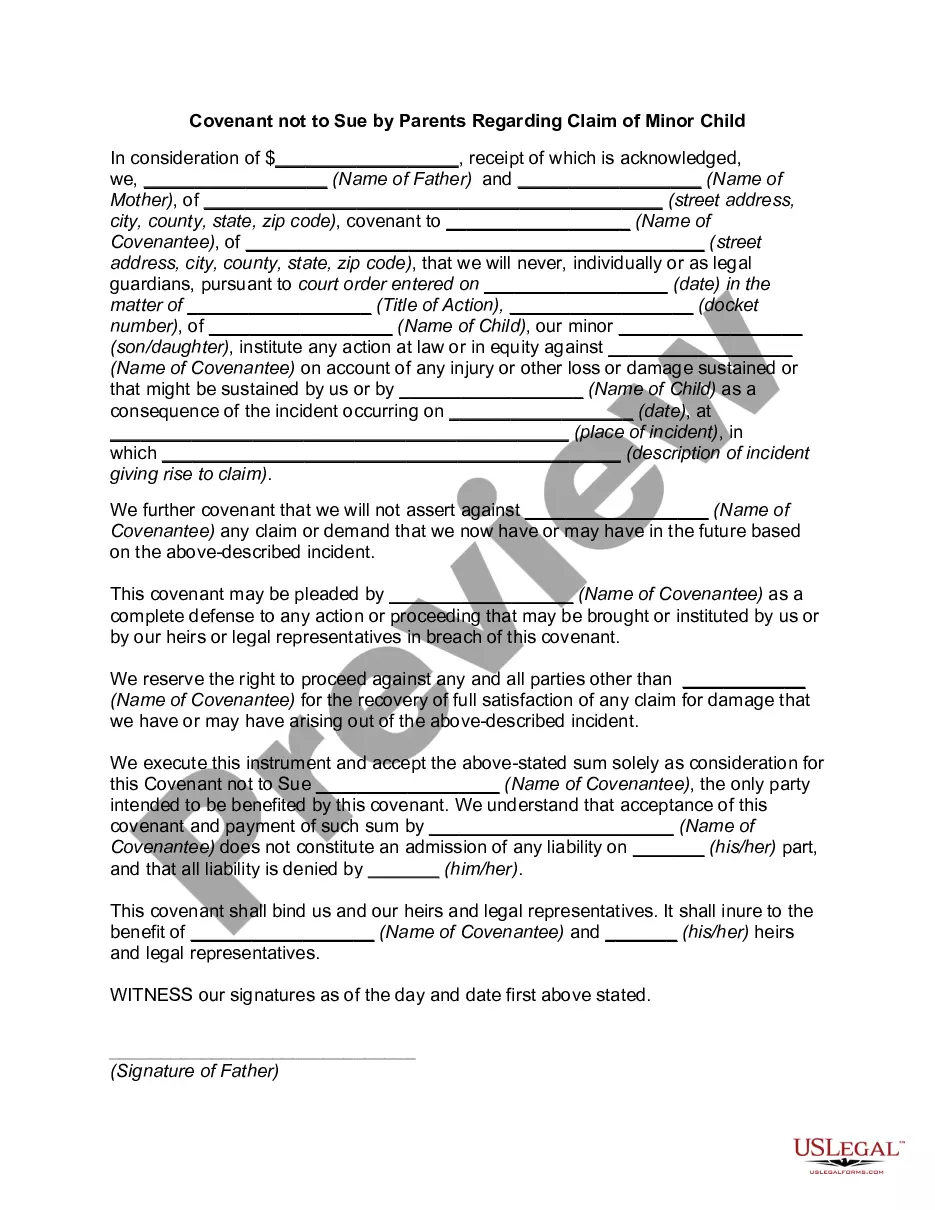
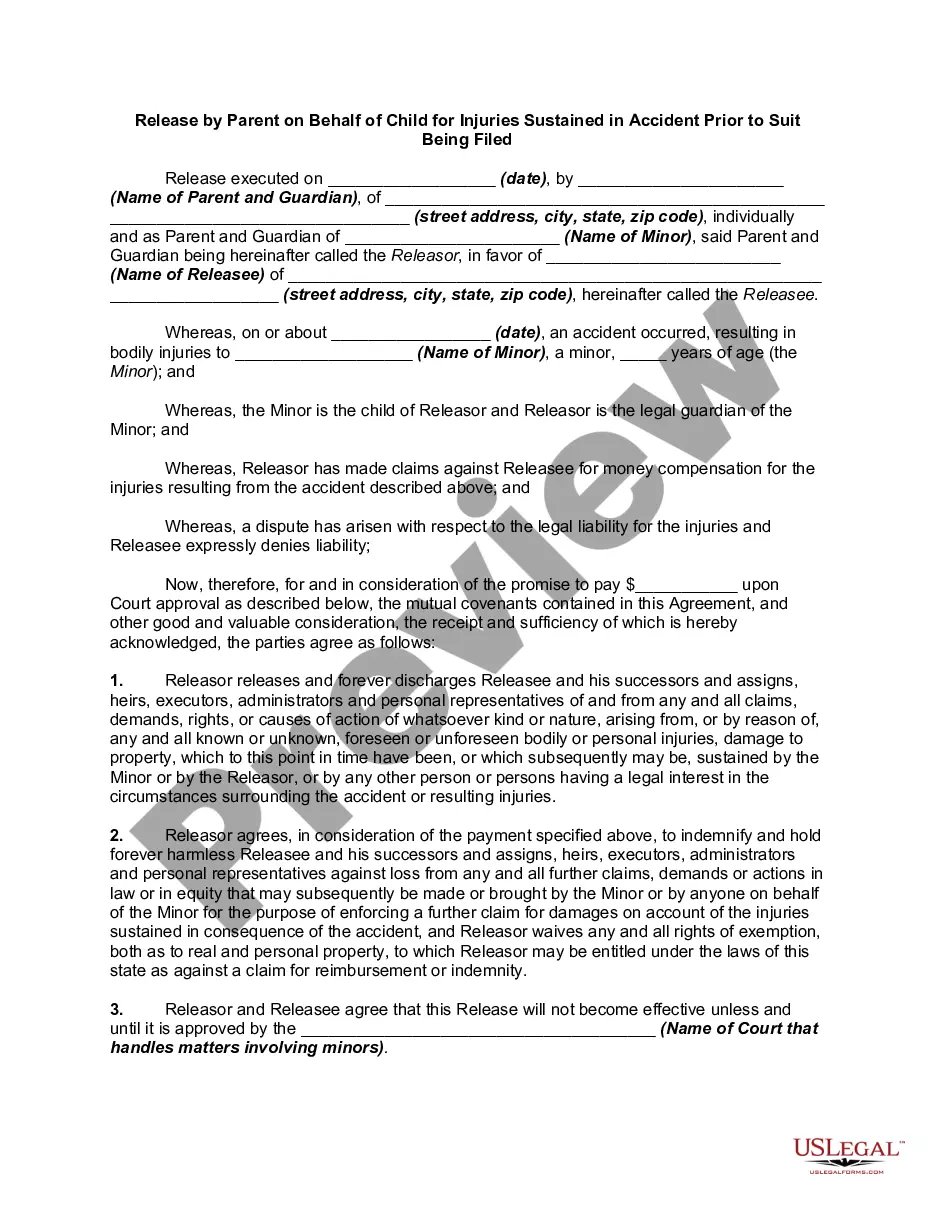
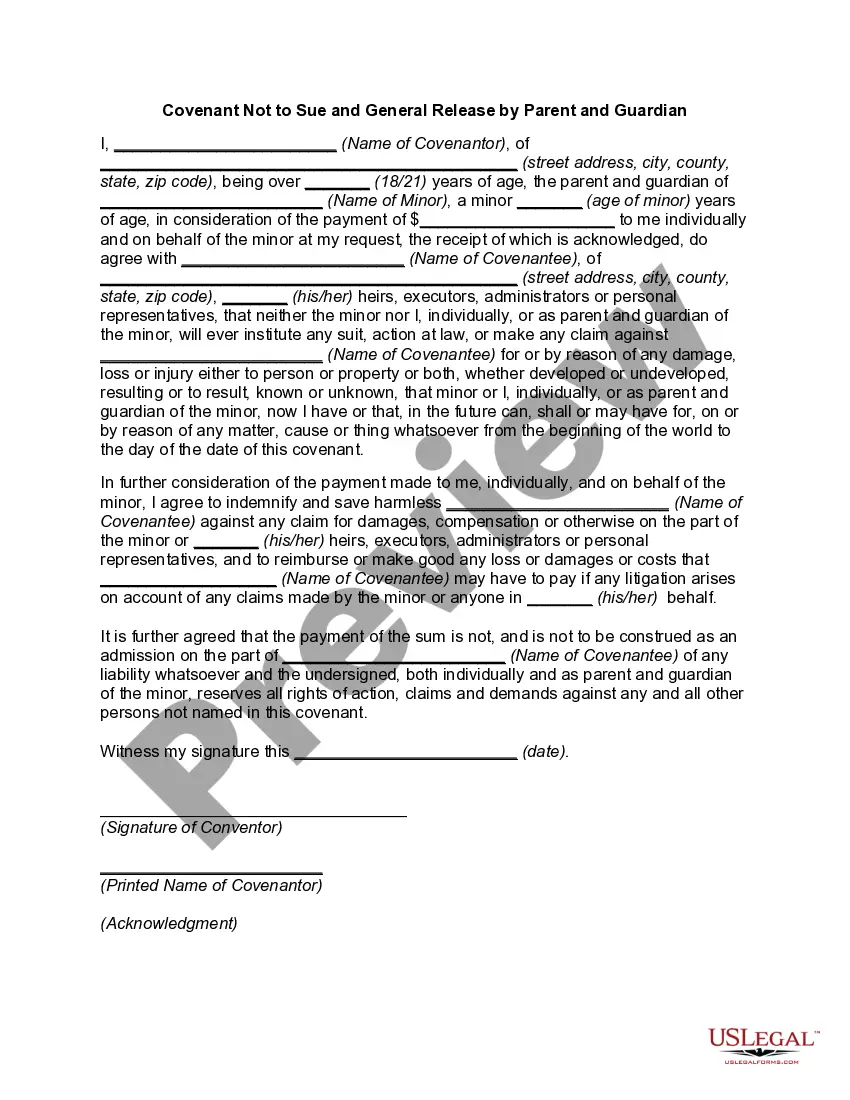
A Covenant Not to Sue by Parents Regarding a Claim of Their Minor Child is a legal agreement in which parents agree not to initiate a lawsuit against a specified party for injuries or damages sustained by their minor child. Unlike a release, this covenant does not relinquish a claim but prevents the parents from pursuing legal action against the designated individual or entity. This form ensures clarity about the parents' intention not to enforce certain legal rights while retaining the option to pursue claims against other parties involved.
Form components explained
- Parties involved: Names and addresses of the parents and the covenantee.
- Date of the court order that gives the parents legal standing.
- Description of the incident that led to the claim.
- Statement of the parents' agreement not to sue regarding the incident.
- Clause allowing the covenantee to use this covenant as a defense in court.
- Signature lines for both parents and sections for judicial approval, if necessary.

Common use cases
This form should be used when parents of a minor child have a claim for damages related to an incident, such as an injury or accident, and wish to agree that they will not sue a particular party for that claim. It is particularly useful in settlements or negotiations where the parents receive compensation in exchange for relinquishing their right to sue the specified individual or entity. Additionally, situations involving claims against joint tortfeasors or multiple responsible parties may necessitate using this form to clarify the intentions of the parties involved.
Who can use this document
- Parents or legal guardians of minor children who have sustained injuries.
- Individuals involved in settlement negotiations regarding claims to prevent litigation.
- Parties looking to limit potential future claims regarding incidents involving their minor children.
- Attorneys preparing documentation for lawsuits involving minors.
How to prepare this document
- Identify the parties: Fill in the names and addresses of both parents and the covenantee.
- Enter the court order date: Specify the date when the court order was issued that pertains to the minor child.
- Detail the incident: Provide a comprehensive description of the incident leading to the claim.
- Review the agreement: Ensure that both parents understand their commitment not to initiate legal action as outlined in the form.
- Sign and date: Both parents must sign and date the document to make it legally binding.
Does this form need to be notarized?
This form does not typically require notarization unless specified by local law. However, having it notarized may provide an additional layer of legal validation, making it more secure in court proceedings.
Get your form ready online
Our built-in tools help you complete, sign, share, and store your documents in one place.
Make edits, fill in missing information, and update formatting in US Legal Forms—just like you would in MS Word.
Download a copy, print it, send it by email, or mail it via USPS—whatever works best for your next step.
Sign and collect signatures with our SignNow integration. Send to multiple recipients, set reminders, and more. Go Premium to unlock E-Sign.
If this form requires notarization, complete it online through a secure video call—no need to meet a notary in person or wait for an appointment.
We protect your documents and personal data by following strict security and privacy standards.

Make edits, fill in missing information, and update formatting in US Legal Forms—just like you would in MS Word.

Download a copy, print it, send it by email, or mail it via USPS—whatever works best for your next step.

Sign and collect signatures with our SignNow integration. Send to multiple recipients, set reminders, and more. Go Premium to unlock E-Sign.

If this form requires notarization, complete it online through a secure video call—no need to meet a notary in person or wait for an appointment.

We protect your documents and personal data by following strict security and privacy standards.
Typical mistakes to avoid
- Not providing complete names and addresses of all parties involved.
- Failing to accurately describe the incident that gives rise to the claim.
- Not including the date of the court order, which could lead to confusion about the agreement.
- Forgetting to sign the document, resulting in it being unenforceable.
Benefits of completing this form online
- Convenience: Download and complete the form from home, saving time.
- Editability: Make necessary changes and ensure the document fits your specific situation.
- Reliability: Access professionally drafted legal templates designed by licensed attorneys.
Legal use & context
The Covenant Not to Sue is designed to provide clarity regarding the intentions of the parties involved and to protect the covenantee from future claims related to the described incident. It is important to ensure all parties understand what rights are being waived and that the form complies with local statutes to maintain enforceability.
What to keep in mind
- This form allows parents to agree not to sue a specific party regarding claims for injuries sustained by their minor child.
- Understanding the difference between a covenant not to sue and a release is crucial for the effectiveness of this legal tool.
- Completing the form accurately and ensuring all parties sign helps preserve its legal standing.
Looking for another form?
Form popularity
FAQ
Can a minor child sign a liability waiver in California? Yes, as long as a parent or legal guardian also signs. In California, a parent can also sign a liability waiver on his or her child's behalf. This makes California different from many other states.
Waiver of Parental permission is permitted under 45 CFR 46.408(c) when it is not a reasonable requirement to protect subjects. This waiver is usually but not always limited to minimal risk research, such as surveys, interviews or focus groups.
5. Can a minor child sign a liability waiver in California? Yes, as long as a parent or legal guardian also signs. In California, a parent can also sign a liability waiver on his or her child's behalf.
Minor Waiver. RELEASE OF LIABILITY, WAIVER OF CLAIMS, ASSUMPTION OF RISKS AND INDEMNTIY AGREEMENT BY SIGNING THIS DOCUMENT YOU WILL WAIVE CERTAIN LEGAL RIGHTS, INCLUDING THE RIGHT TO SUE.
Can a minor child sign a liability waiver in California? Yes, as long as a parent or legal guardian also signs. In California, a parent can also sign a liability waiver on his or her child's behalf. This makes California different from many other states.
In many cases, the waiver is not enforceable.If you've been injured due to negligent actions, you can sue even if you signed a waiver. Winning a lawsuit concerning negligence is not uncommon. Many celebrities have sued for negligence even though they signed documents stating they understood the risks.
Essentially, a waiver removes a real or potential liability for the other party in the agreement. For example, in a settlement between two parties, one party might, by means of a waiver, relinquish its right to pursue any further legal action once the settlement is finalized.
The Waiver must be clearly worded and unambiguous in its intent to relieve any and all legal liability, even liability for negligence. The Waiver should be prominent and not hidden in the fine print of a long contract. The Waiver must be signed by the person who it is being used against.