Complaint to Recover Overtime Compensation or Wages in State Court under Section 16(b) of Fair Labor Standards Act
Overview of this form
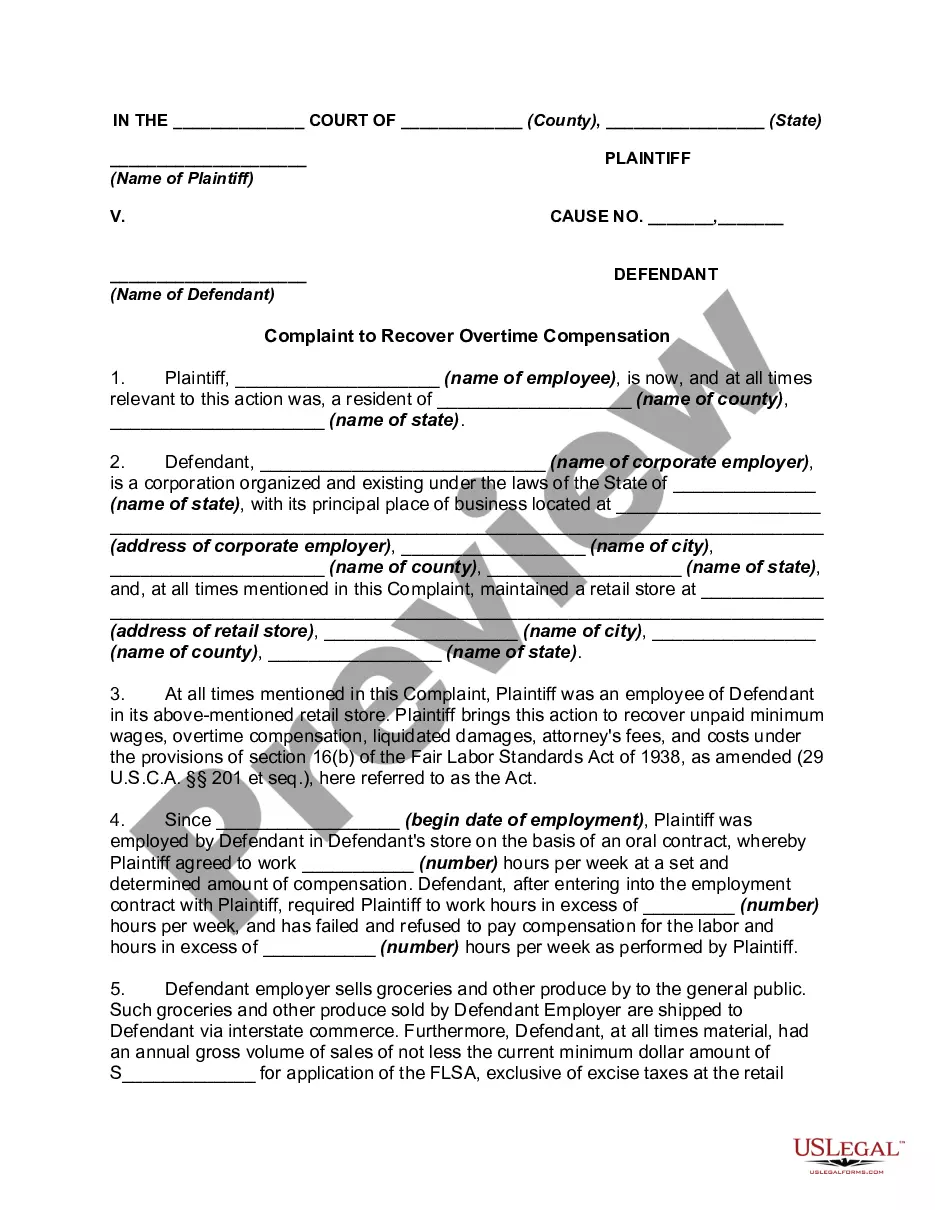
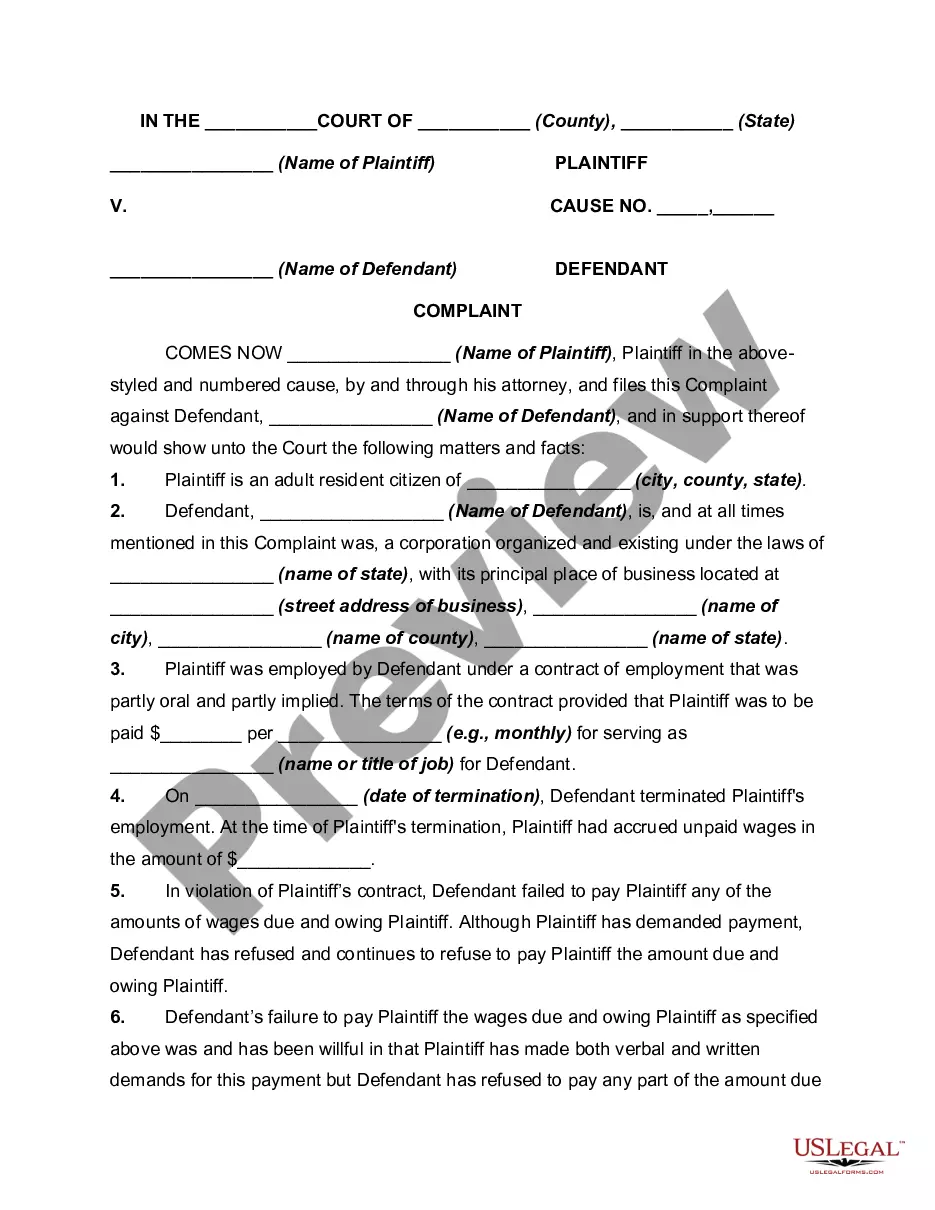
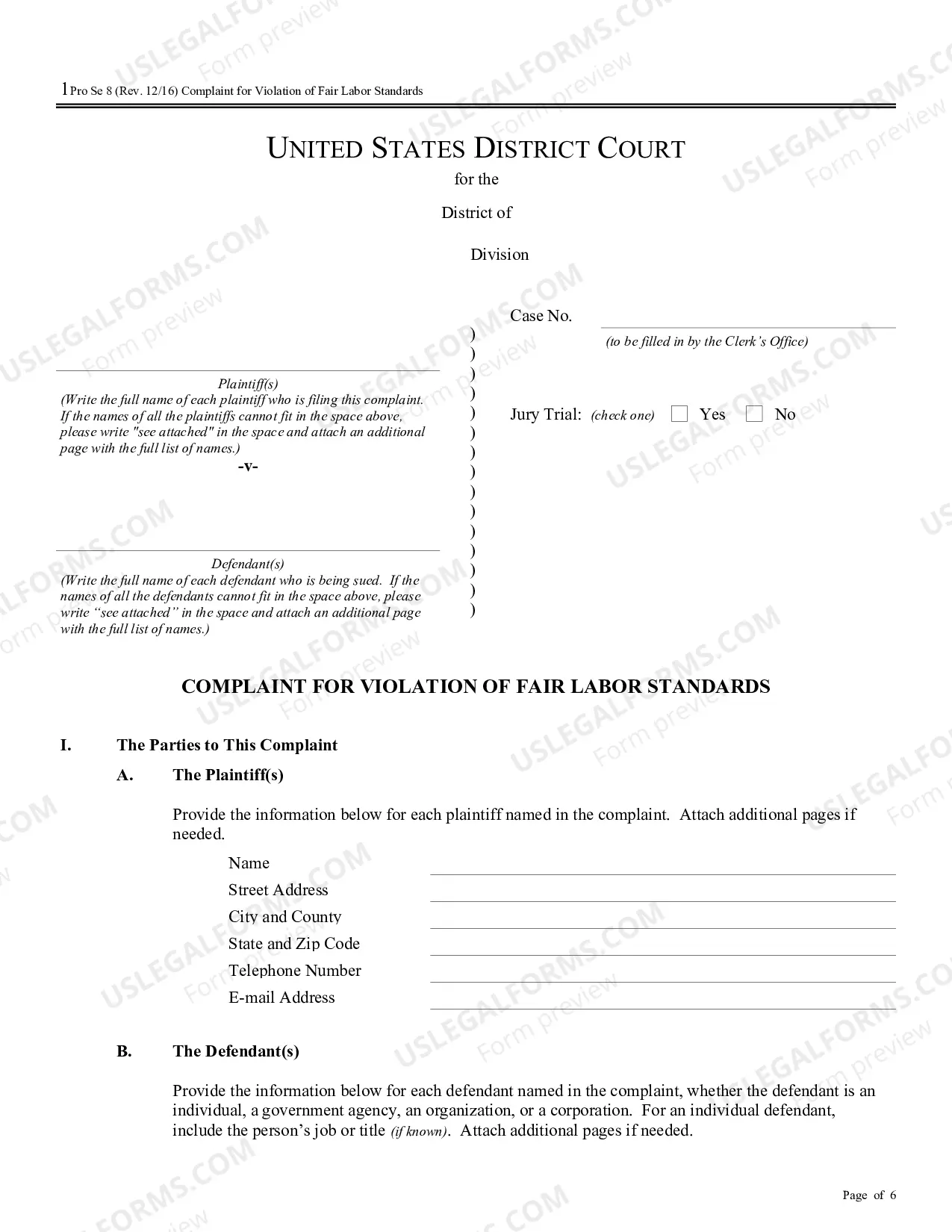
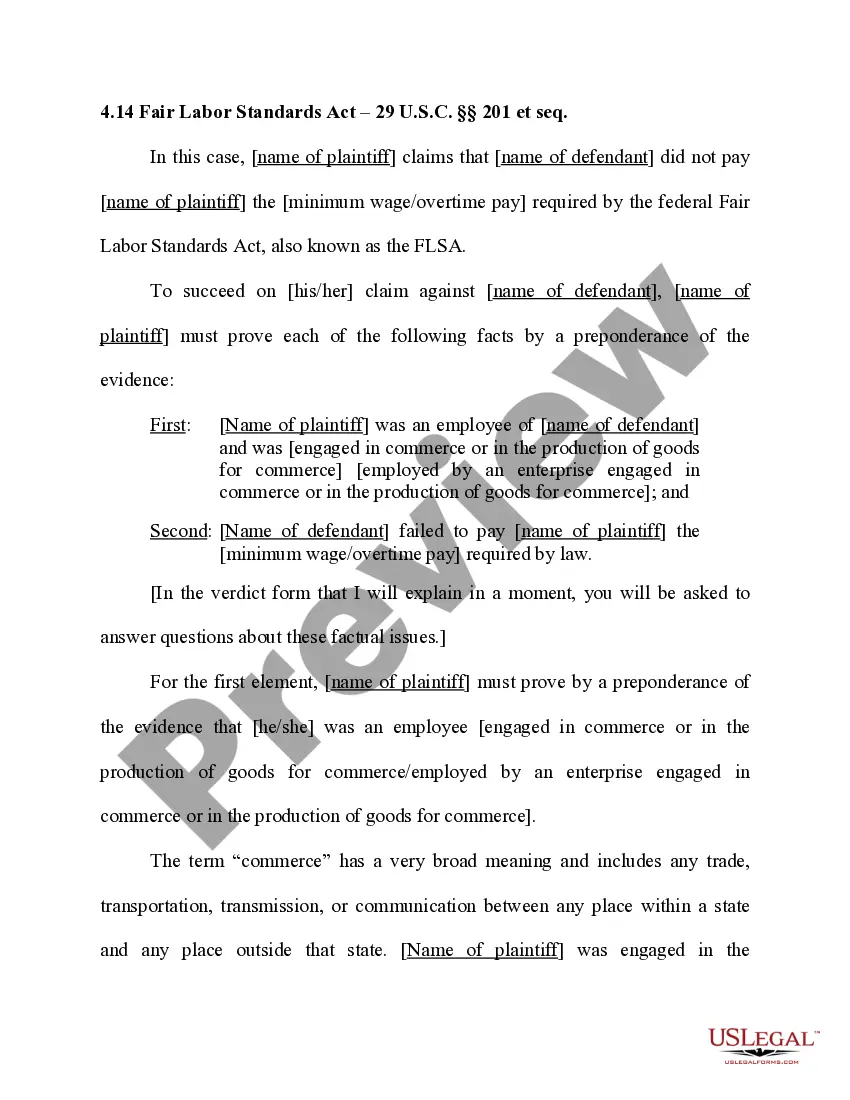
The Complaint to Recover Overtime Compensation or Wages is a legal document enabling employees to request unpaid wages and overtime from their employers under Section 16(b) of the Fair Labor Standards Act (FLSA). This form is essential for individuals seeking to recover compensation owed due to violations of overtime pay laws. Unlike other wage-related complaints, this form specifically addresses claims under federal law related to failure to pay overtime compensation.
Key components of this form
- Identification of the Plaintiff (employee) and Defendant (employer).
- Details surrounding the employment relationship and contract terms.
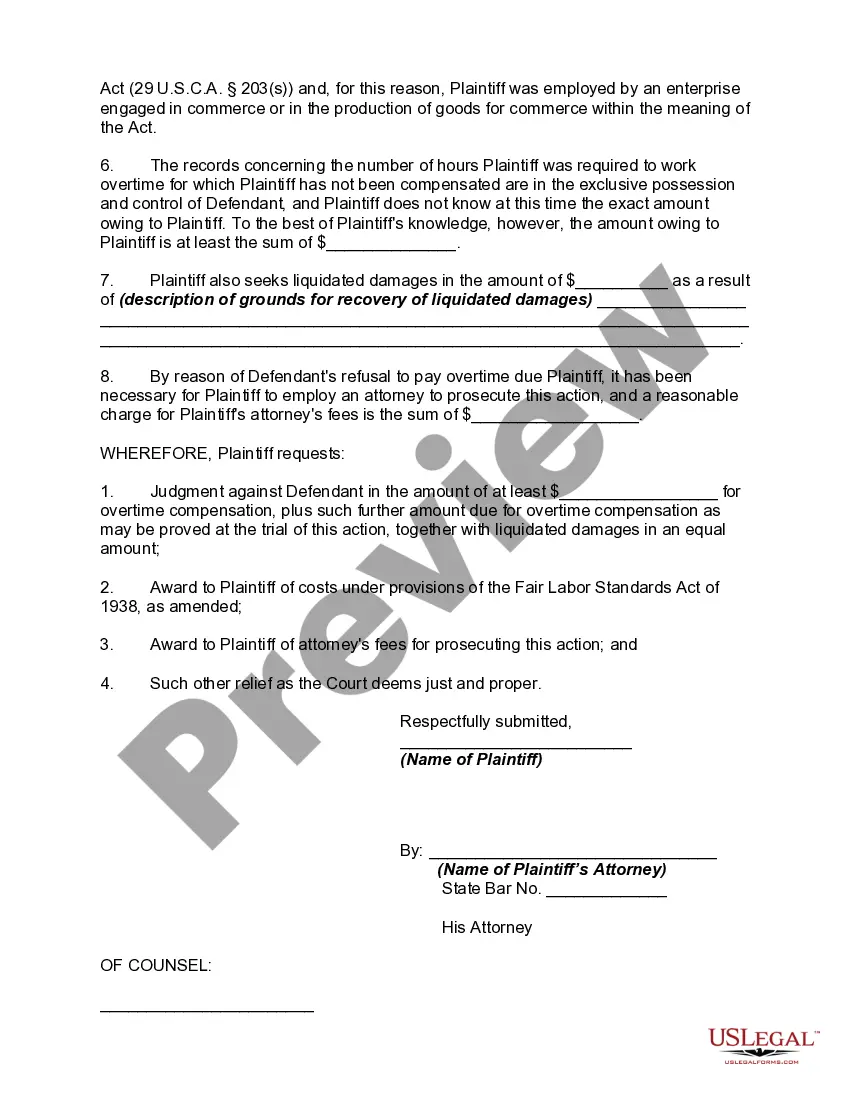
- Specific allegations of unpaid wages and overtime hours worked.
- Request for liquidated damages and attorney fees.
- Final prayer for relief, specifying the damages sought.
When to use this form
This form should be used when an employee believes they have not been compensated for overtime work as required by the FLSA. Specific scenarios include when an employee regularly works more than 40 hours per week and does not receive the legally required overtime pay, or when there is a dispute regarding unpaid wages due after rendering services to an employer in excess of agreed working hours.
Who can use this document
- Nonexempt employees who believe they have not been paid proper overtime wages.
- Individuals looking to recover unpaid wages from their employer.
- Employees who have been terminated or retaliated against for asserting their rights under the FLSA.
- Workers in industries covered by the FLSA, such as retail, hospitality, and service sectors.
Instructions for completing this form
- Provide the names and addresses of both the Plaintiff and Defendant clearly and accurately.
- Detail the employment relationship, including start date and agreed compensation.
- State the number of hours worked beyond the regular schedule without payment.
- Indicate the unpaid wages owed and any claims for liquidated damages.
- Ensure to sign the form and include attorney information, if applicable.
Is notarization required?
Notarization is not commonly needed for this form. However, certain documents or local rules may make it necessary. Our notarization service, powered by Notarize, allows you to finalize it securely online anytime, day or night.
Get your form ready online
Our built-in tools help you complete, sign, share, and store your documents in one place.
Make edits, fill in missing information, and update formatting in US Legal Forms—just like you would in MS Word.
Download a copy, print it, send it by email, or mail it via USPS—whatever works best for your next step.
Sign and collect signatures with our SignNow integration. Send to multiple recipients, set reminders, and more. Go Premium to unlock E-Sign.
If this form requires notarization, complete it online through a secure video call—no need to meet a notary in person or wait for an appointment.
We protect your documents and personal data by following strict security and privacy standards.

Make edits, fill in missing information, and update formatting in US Legal Forms—just like you would in MS Word.

Download a copy, print it, send it by email, or mail it via USPS—whatever works best for your next step.

Sign and collect signatures with our SignNow integration. Send to multiple recipients, set reminders, and more. Go Premium to unlock E-Sign.

If this form requires notarization, complete it online through a secure video call—no need to meet a notary in person or wait for an appointment.

We protect your documents and personal data by following strict security and privacy standards.
Common mistakes to avoid
- Failing to accurately detail the overtime hours worked.
- Not including all relevant employer details or a complete address.
- Neglecting to provide necessary documentation to support claims.
- Overlooking state-specific laws that may impact the claim process.
Why complete this form online
- Convenience of downloading the form from any location at any time.
- Editability allows you to customize the form to fit your needs specifically.
- Access to reliable templates drafted by licensed attorneys, ensuring compliance with legal standards.
Legal use & context
- This form is a means to enforce rights under the Fair Labor Standards Act regarding unpaid wages.
- Filing this complaint initiates legal proceedings and can lead to a court judgment in favor of the Plaintiff.
- Employers are prohibited from retaliating against employees for filing such complaints.
Looking for another form?

Form popularity
FAQ
Section 7(r) of the Fair Labor Standards Act Break Time for Nursing Mothers Provision. Effective March 23, 2010, the Patient Protection and Affordable Care Act amended the FLSA to require employers to provide a nursing mother reasonable break time to express breast milk after the birth of her child.
The FLSA applies only to employers whose annual sales total $500,000 or more or who are engaged in interstate commerce. You might think that this would restrict the FLSA to covering only employees in large companies, but, in reality, the law covers nearly all workplaces.
The Fair Labor Standards Act (FLSA) establishes minimum wage, overtime pay, recordkeeping, and youth employment standards affecting employees in the private sector and in Federal, State, and local governments.There is no limit on the number of hours employees 16 years or older may work in any workweek.
Employers Who Are Covered The FLSA applies only to employers whose annual sales total $500,000 or more or who are engaged in interstate commerce. You might think that this would restrict the FLSA to covering only employees in large companies, but, in reality, the law covers nearly all workplaces.
The most sweeping federal law that restricts the employment and abuse of child workers is the Fair Labor Standards Act (FLSA).FLSA restricts the hours that youth under 16 years of age can work and lists hazardous occupations too dangerous for young workers to perform.
The Fair Labor Standards Act (FLSA) of 1938 prohibits the employment of oppressive child labor in the United States, which the act defineswith some exceptionsas the employment of youth under the age of 16 in any occupation or the employment of youth under 18 years old in hazardous occupations.
The Fair Labor Standards Act (FLSA) has made two distinctions between a company or organization's employees: exempt and non-exempt. Non-exempt employees must record their hours worked each workweek and must be paid overtime wages in an amount of 1.5 times their regular rate of pay for all hours over 40 in a workweek.
Since California's wage and hour laws stronger than federal laws, it will most likely prevail. Under FLSA, overtime must be paid at 1.5 times the employee's hourly rate for working more than 40 hours during a workweek.
An exempt employee is not paid overtime wages for hours worked over 40 in a workweek. To be considered exempt from FLSA, an employee must be paid on a salary basis, and must have exempt job duties.