Affidavit By Finder of Lost Property
Understanding this form
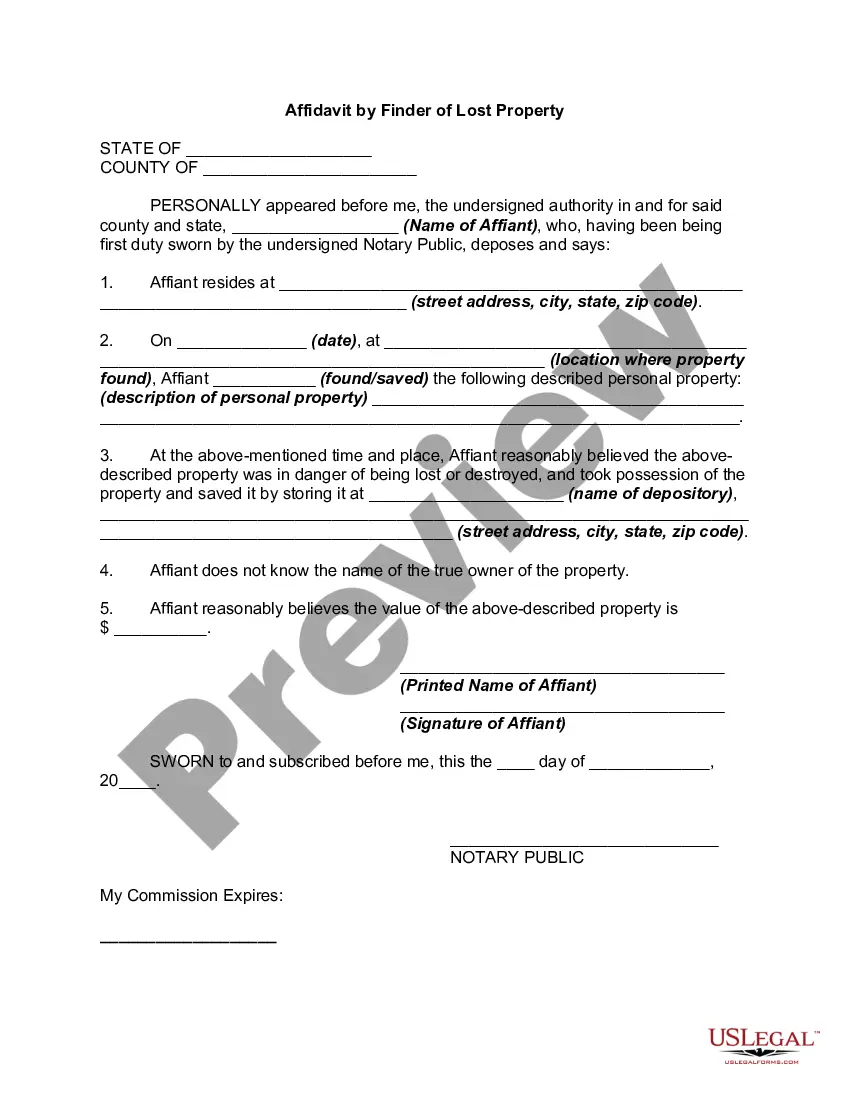
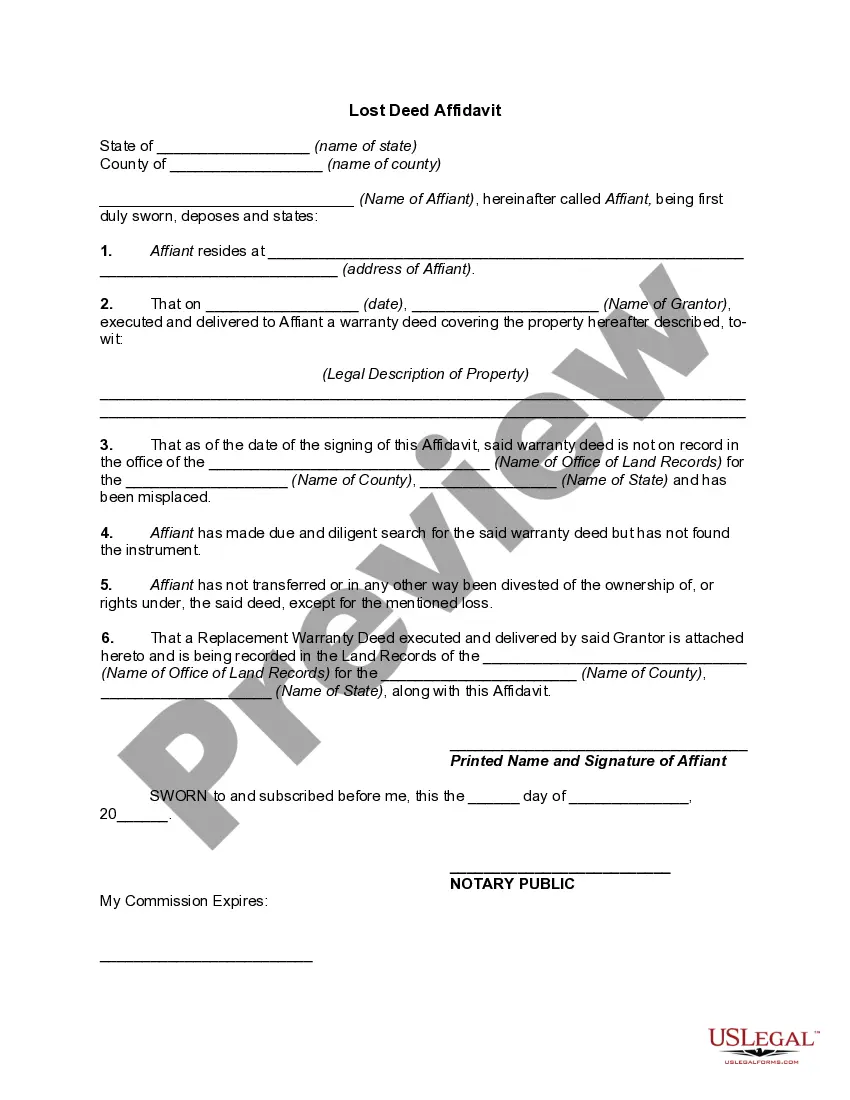
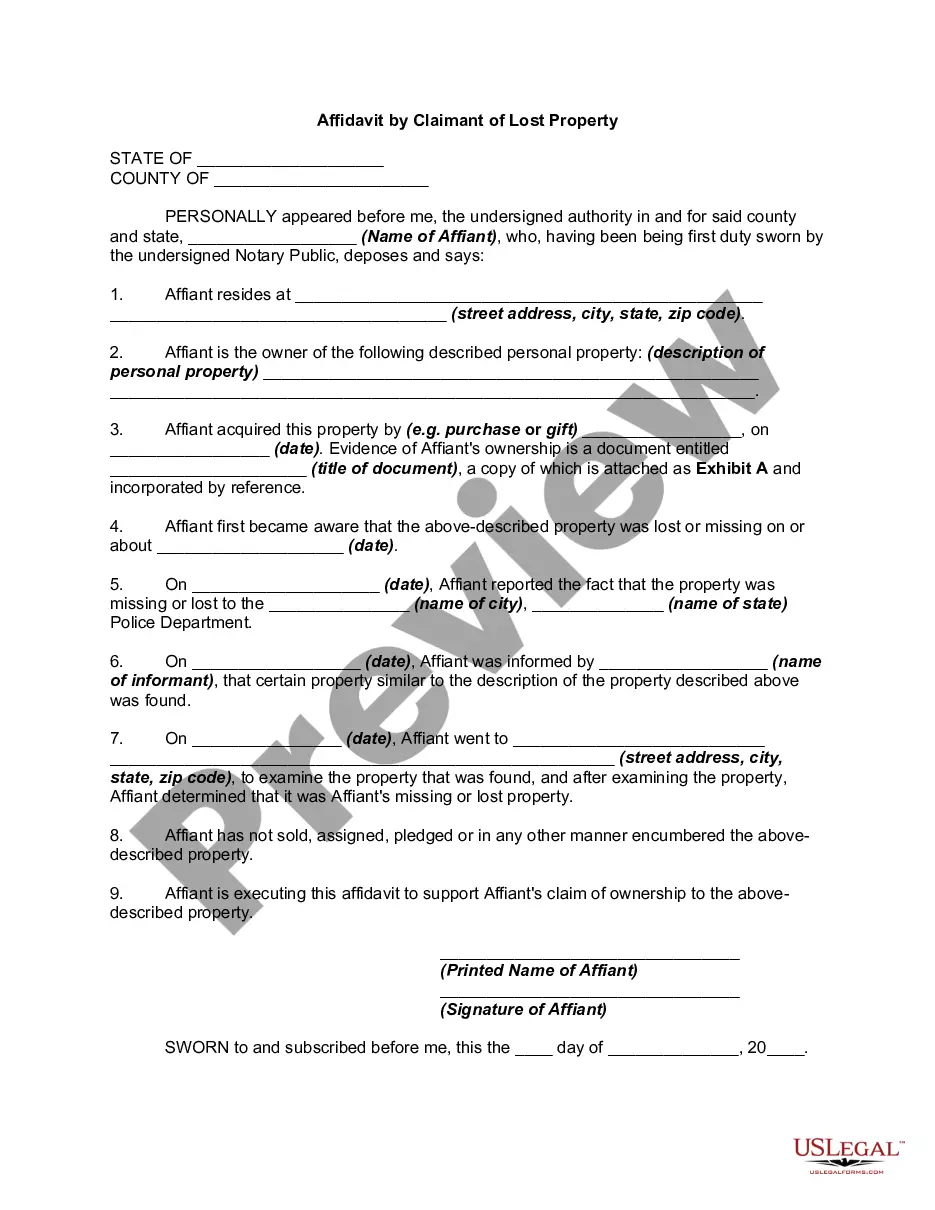
The Affidavit by Finder of Lost Property is a legal document used to declare that a person has found property that its owner has misplaced. This form serves to assert the finder's possession of the property until the true owner is located. Unlike other forms, this affidavit emphasizes the finder's temporary possession and outlines the steps needed to notify the rightful owner in accordance with state laws.
Key components of this form
- Affiant's name and address
- Date and location where the property was found
- Description of the lost property
- Details on where the property is being stored
- Affiant's belief about the property's value
- Signature of the affiant and notarization section
When to use this document
This form should be used when an individual finds property that is not theirs and wants to formally document the discovery. It may be necessary in situations where the finder intends to hold the property for a specific period before taking further actions, such as attempting to contact the owner or reporting the find to authorities.
Who this form is for
- Individuals who have found lost personal property
- Finders who wish to document their possession for legal purposes
- People complying with state laws regarding lost property
How to complete this form
- Provide the affiant's full name and address at the top of the form.
- Enter the date and specific location where the property was found.
- Describe the property in detail, including any identifying features.
- Indicate where the property has been stored for safekeeping.
- State the affiantâs belief about the value of the property.
- Sign the document in front of a notary public for verification.
Notarization guidance
Yes, this form must be notarized to be legally valid. US Legal Forms offers integrated online notarization services available 24/7, allowing you to complete the notarization via secure video call without the need to travel.
Get your form ready online
Our built-in tools help you complete, sign, share, and store your documents in one place.
Make edits, fill in missing information, and update formatting in US Legal Forms—just like you would in MS Word.
Download a copy, print it, send it by email, or mail it via USPS—whatever works best for your next step.
Sign and collect signatures with our SignNow integration. Send to multiple recipients, set reminders, and more. Go Premium to unlock E-Sign.
If this form requires notarization, complete it online through a secure video call—no need to meet a notary in person or wait for an appointment.
We protect your documents and personal data by following strict security and privacy standards.

Make edits, fill in missing information, and update formatting in US Legal Forms—just like you would in MS Word.

Download a copy, print it, send it by email, or mail it via USPS—whatever works best for your next step.

Sign and collect signatures with our SignNow integration. Send to multiple recipients, set reminders, and more. Go Premium to unlock E-Sign.

If this form requires notarization, complete it online through a secure video call—no need to meet a notary in person or wait for an appointment.

We protect your documents and personal data by following strict security and privacy standards.
Common mistakes to avoid
- Failing to provide a detailed description of the found property.
- Not completing the form before the property is stored.
- Neglecting to have the form notarized if required by state law.
Advantages of online completion
- Convenient access to legal forms that can be downloaded at any time.
- The ability to edit and customize the form to meet specific needs.
- Reliability from templates drafted by licensed attorneys.
Legal use & context
- This affidavit creates a formal record of the finderâs claim over the lost property.
- The legal standing of the finder is typically temporary and subject to local laws regarding lost property.
- It is advisable to take further steps to locate the true owner, such as notifying local authorities or making public announcements.
Summary of main points
- The Affidavit By Finder of Lost Property is essential for anyone who finds lost items and wishes to protect their legal rights.
- Details including the discovery location, description of the property, and storage information must be accurately completed.
- Notarization is typically necessary for this form to ensure its validity.
Looking for another form?



Form popularity
FAQ
The usual police practice is that the finder can have the goods back and keep them if they are not claimed within six weeks. However, the police may want more time if there are special circumstances and they want to investigate.
Full name of the deponent and their signature. Statement indicating whether the affidavit has been sworn or not. Date and place where the affidavit is being signed. Designation and full name of the Notary or Magistrate (person attesting the affidavit)
What do the law and the police really say about lost property in the United Kingdom?Officially, the police are no longer taking responsibility for the handing-in and recording of missing valuables. However, businesses must still ensure that they take 'reasonable' steps when something is found on their property.
Regulations state that items must be kept for a period of at least 3 months. TfL are often viewed as a benchmark for this. Their full lost property policy can be found here. Lost Keys.
Unclaimed property is eventually deemed abandoned property where the apparent owner has not claimed the property. Depending on the category of property, the recovery must be within as little as one year and as long as fifteen years (See the Regulations to this Act).
The finder does not automatically acquire title under the generally assumed law of finders-keepers. California's lost property law requires a finder of lost property to return the property to its owner, if known, or hand it over to the police if the owner is not known.
I am _____ and my name _______, appearing on the enclosed ID proof, is single name.Both names denote one and the same person. I solemnly state that the contents of this affidavit are true to the best of my knowledge and belief and that it conceals nothing and that no part of it is false.
In the sentence, the person writing the statement must state that he or she is stating that the information is accurate. (Example: I, Jane Doe, solemnly swear that the contents of this document are true and correct, and that I agree to abide by the terms in this affidavit.)
In a nutshell, an affidavit is a sworn statement that is in writing. Affidavits are usually used in a court or in negotiations. They are common in family law cases and bankruptcy cases. They are also used in civil and criminal cases, though not as often as family or bankruptcy law cases.