Letter to Alleged Patent Infringer
Understanding this form
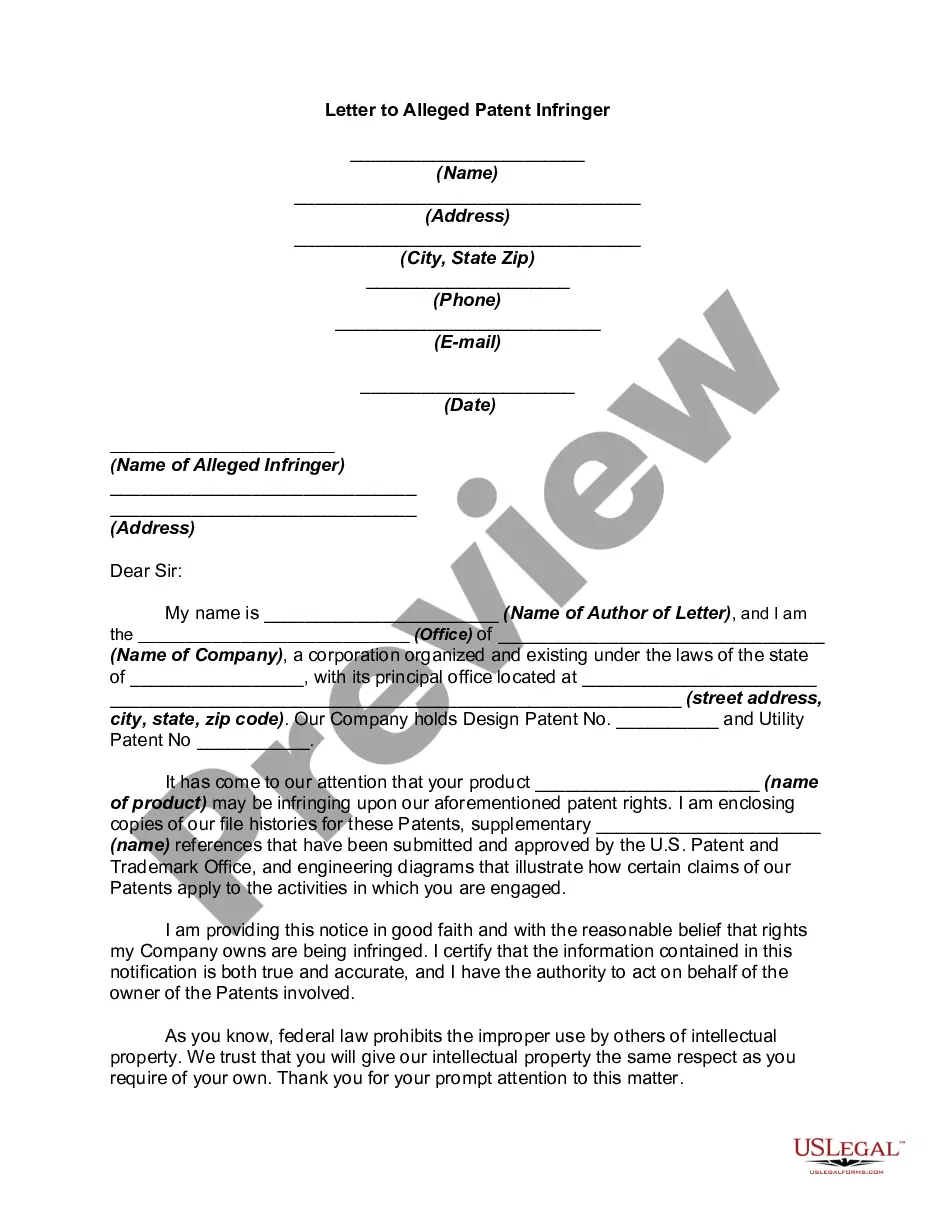
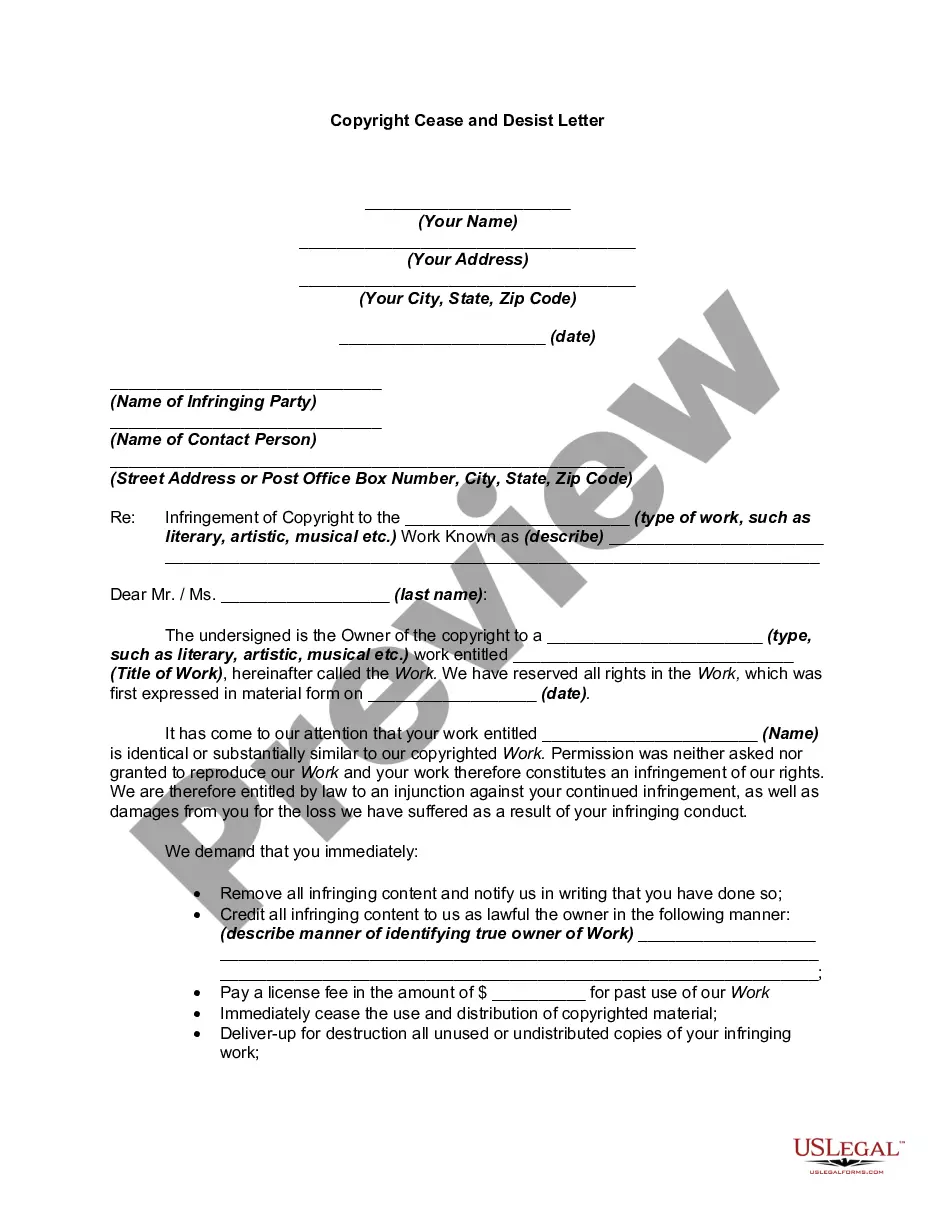
The Letter to Alleged Patent Infringer is a crucial legal document that allows a patent holder to formally notify a suspected infringer of their patent rights. This letter serves as a communication tool aimed at initiating a dialogue regarding licensing agreements or cessation of infringing activities. Unlike similar forms, this letter specifically addresses issues related to patent infringement, ensuring that the rights of the patent holder are clearly articulated and protected.
Key parts of this document
- Sender's information: includes name, address, phone number, and email.
- Date of the letter: indicates when the notice is issued.
- Alleged infringer's information: provides the name and address of the suspected infringer.
- Details of the patent: specifies the patent numbers that the sender holds.
- Description of infringed product: identifies the product that may be infringing on the patent rights.
- Certification of information: confirms the accuracy of the claims made in the letter.

When to use this form
This form is useful when a patent holder suspects that another party is infringing on their patent rights by making, selling, or distributing products without permission. It is typically used as a preliminary step before pursuing legal action or negotiating licensing terms, making it an essential tool for protecting intellectual property rights.
Who needs this form
- Individuals or businesses holding a valid patent.
- Patent attorneys acting on behalf of their clients.
- Corporations seeking to assert their patent rights against suspected infringers.
Instructions for completing this form
- Identify the parties involved: Fill out the senderâs information and the alleged infringerâs details.
- Enter the date on which the letter is issued.
- Specify the patent numbers that are believed to be infringed.
- Describe the alleged infringing product clearly.
- Sign the letter and include the sender's printed name and office title.
Does this form need to be notarized?
This form usually doesn’t need to be notarized. However, local laws or specific transactions may require it. Our online notarization service, powered by Notarize, lets you complete it remotely through a secure video session, available 24/7.
Get your form ready online
Our built-in tools help you complete, sign, share, and store your documents in one place.
Make edits, fill in missing information, and update formatting in US Legal Forms—just like you would in MS Word.
Download a copy, print it, send it by email, or mail it via USPS—whatever works best for your next step.
Sign and collect signatures with our SignNow integration. Send to multiple recipients, set reminders, and more. Go Premium to unlock E-Sign.
If this form requires notarization, complete it online through a secure video call—no need to meet a notary in person or wait for an appointment.
We protect your documents and personal data by following strict security and privacy standards.

Make edits, fill in missing information, and update formatting in US Legal Forms—just like you would in MS Word.

Download a copy, print it, send it by email, or mail it via USPS—whatever works best for your next step.

Sign and collect signatures with our SignNow integration. Send to multiple recipients, set reminders, and more. Go Premium to unlock E-Sign.

If this form requires notarization, complete it online through a secure video call—no need to meet a notary in person or wait for an appointment.

We protect your documents and personal data by following strict security and privacy standards.
Avoid these common issues
- Failing to include all relevant patent numbers in the letter.
- Not providing clear descriptions of the infringed products.
- Omitting contact information, making it difficult for the alleged infringer to respond.
Benefits of using this form online
- Convenience of downloading and customizing the letter to fit specific needs.
- Access to templates drafted by licensed attorneys, ensuring legality.
- Easy editability to accommodate different patent situations.
Legal use & context
- This letter serves as a formal notice and can be used to establish a record of communication with the alleged infringer.
- Failure to send a notice may impact the ability to claim damages in case of further legal action.
- The contents of this letter can be critical in subsequent patent litigation, establishing good faith communication.
Summary of main points
- The Letter to Alleged Patent Infringer is a vital tool for patent holders addressing infringement issues.
- Completing the letter accurately can help avoid potential legal disputes.
- This form serves as a formal notification that can lead to resolution or further action.
Looking for another form?

Form popularity
FAQ
Limitations Period Under U.S. Patent Act In other words, patent holders must file their infringement lawsuit within six years of the date of the alleged infringement in order to recover damages.
Patent Claim is Invalid: Another way to defend against patent infringement is to argue that the patent claim, which is allegedly being infringed, is invalid because it does not satisfy any of the five patentability requirements discussed above: patentable subject matter, utility, novelty, non-obviousness, and
To file your lawsuit, you must pay a $400 federal court filing fee. Once you've paid the fees, the clerk will assign your lawsuit to a judge and issue a unique case number which will be used to identify your case on all subsequent documents filed with the court.
If someone uses your invention without your permission, you are entitled to stop their use of the invention by seeking a legal injunction in Federal court. In addition, you are entitled to collect damages for any unlicensed use of your invention.
To prove direct infringement, the patent holder must prove that the defendant made, used, sold, offered for sale or imported the claimed invention. Direct infringement may occur literally, meaning that a claim of the patent, when compared to the accused device or process, is an exact match.
To win, a plaintiff must not only prove that the patent was infringed, but also overcome any defenses that the alleged infringer might have.
Violation of a patent owner's rights with respect to some invention. Unless permitted by the patent owner, one commits patent infringement by making, using, offering to sell, or selling something that contains every element of a patented claim or its equivalent while the patent is in effect.
To analyze infringement, you must check each independent claim in the patent and see if each claim feature is found in your product. If an independent claim is not infringed, then logically a dependent claim cannot be infringed.