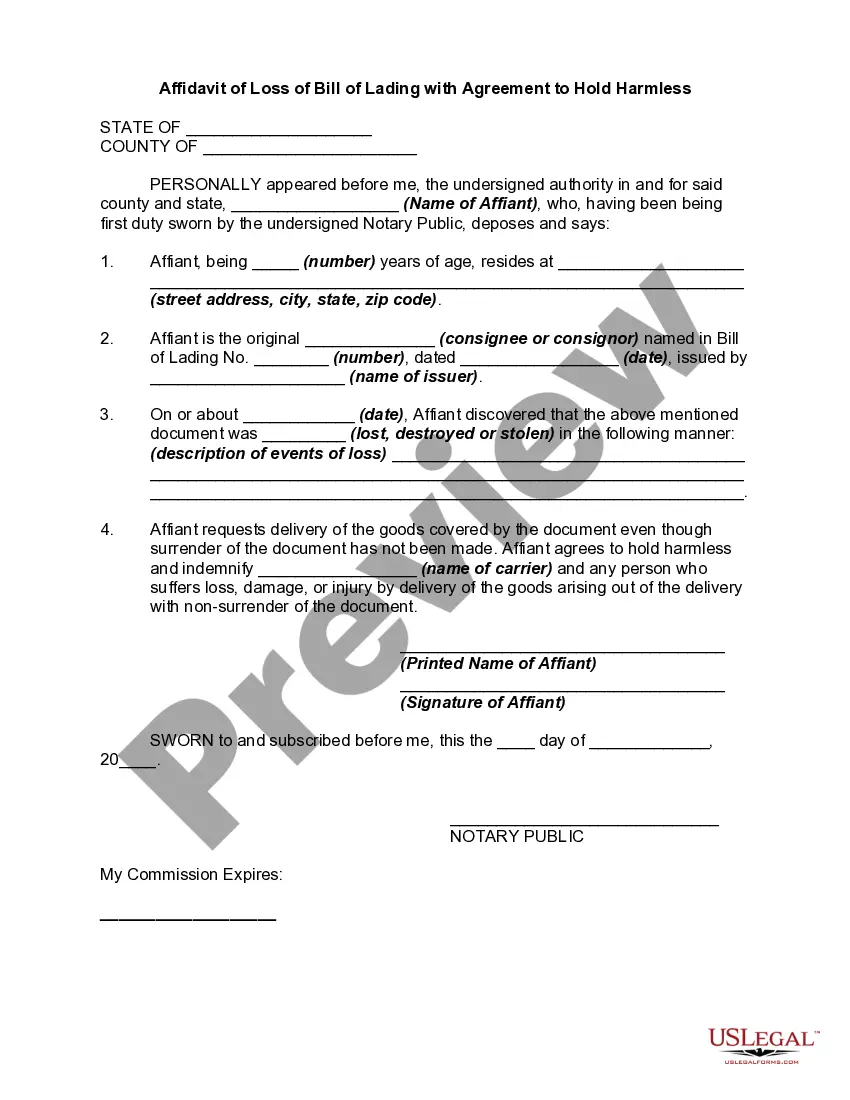
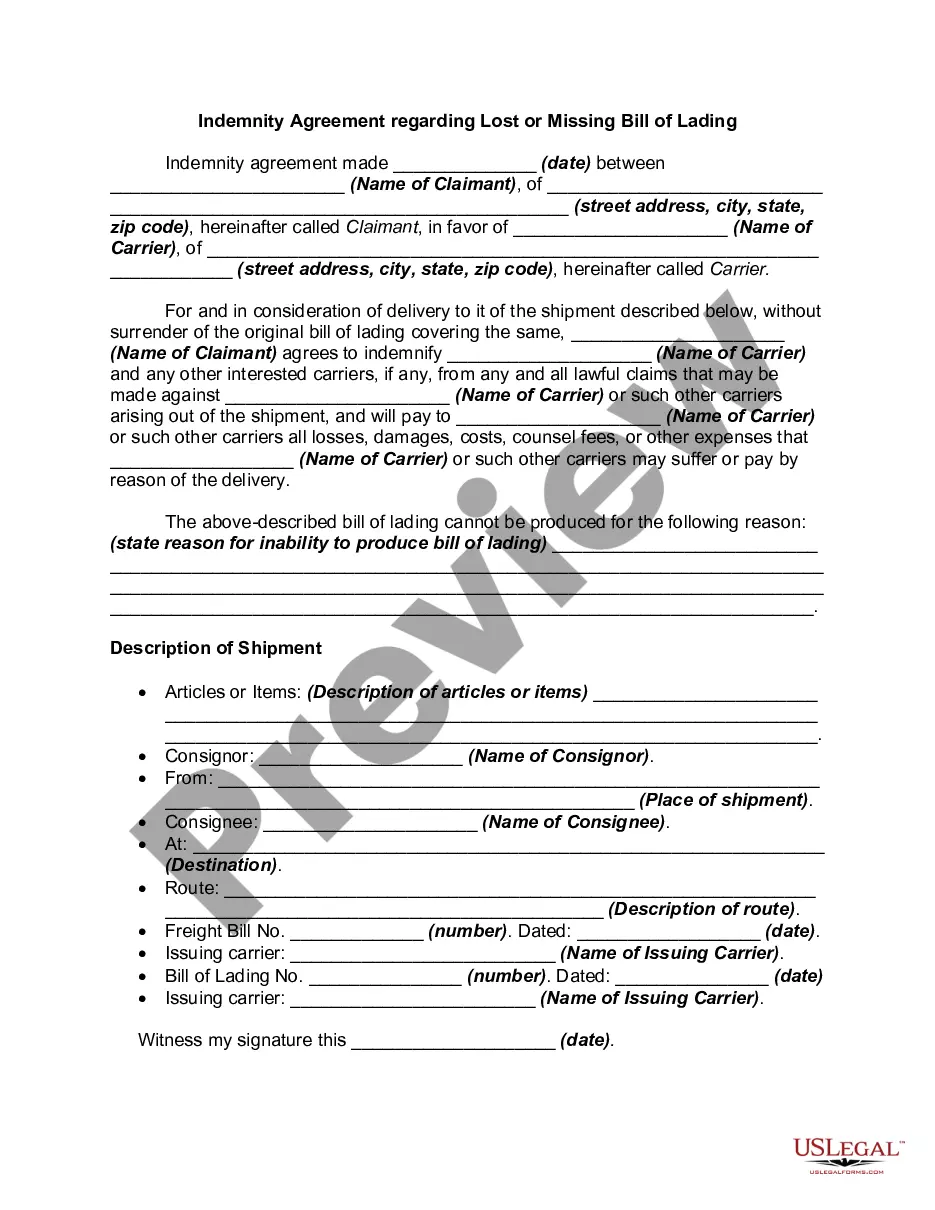
Affidavit of Loss of Bill of Lading with Agreement to Hold Harmless
What is this form?
The Affidavit of Loss of Bill of Lading with Agreement to Hold Harmless is a legal document used to declare the loss of a specific bill of lading due to theft, destruction, or other circumstances. This affidavit serves to provide evidence of the loss and to request the delivery of goods listed in the lost bill without surrendering the original document. Unlike similar affidavits, this form includes an agreement to hold the carrier harmless in the event of any resulting claims or losses.
Form components explained
- Affiant's personal details, including age and address.
- Identification of the affiant as the consignor or consignee of the lost bill of lading.
- Description of the circumstances surrounding the loss of the document.
- Request for goods delivery without the original bill's surrender.
- Agreement to indemnify the carrier and any affected parties.
- Notarization section for legal validation.
Common use cases
This form should be used when an individual or business has lost a bill of lading and needs to request the shipment of goods without the original documentation. Common scenarios include theft during transit, accidental destruction, or misplacement of the document. It ensures that the parties involved mitigate risks and clearly delineate responsibilities regarding the lost document.
Who should use this form
Individuals or entities involved in the shipping or receiving of goods who are the original consignor or consignee should utilize this form. This includes:
- Businesses transporting goods.
- Importers and exporters.
- Individuals who have misplaced their bill of lading.
- Any party seeking to claim ownership over goods without the original document.
Steps to complete this form
- Identify the parties involved by filling in the affiant's name, address, and age.
- Specify the role of the affiant as either consignee or consignor and provide the corresponding bill of lading number.
- Describe the circumstances of the loss, detailing how and when the document was lost.
- Request delivery of the goods while agreeing to hold the carrier harmless.
- Sign the affidavit in the presence of a notary public to validate the document.
Is notarization required?
This form must be notarized to be legally valid. US Legal Forms provides secure online notarization powered by Notarize, allowing you to complete the process through a verified video call.
Get your form ready online
Our built-in tools help you complete, sign, share, and store your documents in one place.
Make edits, fill in missing information, and update formatting in US Legal Forms—just like you would in MS Word.
Download a copy, print it, send it by email, or mail it via USPS—whatever works best for your next step.
Sign and collect signatures with our SignNow integration. Send to multiple recipients, set reminders, and more. Go Premium to unlock E-Sign.
If this form requires notarization, complete it online through a secure video call—no need to meet a notary in person or wait for an appointment.
We protect your documents and personal data by following strict security and privacy standards.

Make edits, fill in missing information, and update formatting in US Legal Forms—just like you would in MS Word.

Download a copy, print it, send it by email, or mail it via USPS—whatever works best for your next step.

Sign and collect signatures with our SignNow integration. Send to multiple recipients, set reminders, and more. Go Premium to unlock E-Sign.

If this form requires notarization, complete it online through a secure video call—no need to meet a notary in person or wait for an appointment.

We protect your documents and personal data by following strict security and privacy standards.
Mistakes to watch out for
- Failing to provide a detailed account of how the bill of lading was lost.
- Not including all necessary personal information of the affiant.
- Omitting the indemnity clause or not clearly stating the agreement to hold harmless.
- Neglecting to have the document notarized at the appropriate time.
Why complete this form online
- Convenience of downloading and completing the form at your own pace.
- Editability allows customization to fit specific circumstances.
- Access to professionally drafted forms ensures legal compliance.
- Immediate availability helps expedite the process of claiming goods.
Summary of main points
- The Affidavit of Loss of Bill of Lading serves to declare loss and facilitate the delivery of goods.
- Accurate information is crucial for the form's validity, including a thorough account of the loss.
- Notarization is required for legal effectiveness.
- This form is suitable for consignees and consignors involved in shipping transactions.
Looking for another form?





Form popularity
FAQ
Navigate to the website: www.studentloans.gov. Click "Log In." Enter your FSA ID and Password. Click "Complete Master Promissory Note." Select the appropriate loan type. Enter Your Personal Information.
The lender holds the promissory note while the loan is being repaid, then the note is marked as paid and returned to the borrower when the loan is satisfied. Promissory notes aren't the same as mortgages, but the two often go hand in hand when someone is buying a home.
Promissory notes are a valuable legal tool that any individual can use to legally bind another individual to an agreement for purchasing goods or borrowing money. A well-executed promissory note has the full effect of law behind it and is legally binding on both parties.
Search the county recorder's records. Promissory notes are typically recorded as public documents and accessible shortly after the closing. The trustee maintains the original deed until the loan is satisfied.
The buyer of the note becomes what is called a holder because they hold your note as the owner of it. A holder has a special right to collect from you right away if you don't pay. But only the holder of an original promissory note can collect from you. A promissory note can change many hands as it is bought and sold.
If you lose your closing papers or they get destroyed, you can obtain a copy of your mortgage note by searching the county's records or contacting the registry of deeds. It's also possible to obtain a copy from the company who services your loan (that is, the company you get billing statements from).
The lender can provide copies of the documents signed at closing. If the loan has changed hands, contact the most current servicer for a copy of your mortgage or deed of trust documents. A lender is required under the Federal Servicer Act to provide you copies of your loan documents if you submit a written request.
A promissory note, in simplest terms, is the acknowledgment of a debt.Even if a promissory note is lost, the legal obligation to repay the loan remains. The lender has a right to re-establish the note legally as long as it has not sold or transferred the note to another party.