Notice to Trespasser to Personal Property for Reimbursement for Damage due to Trespass
About this form
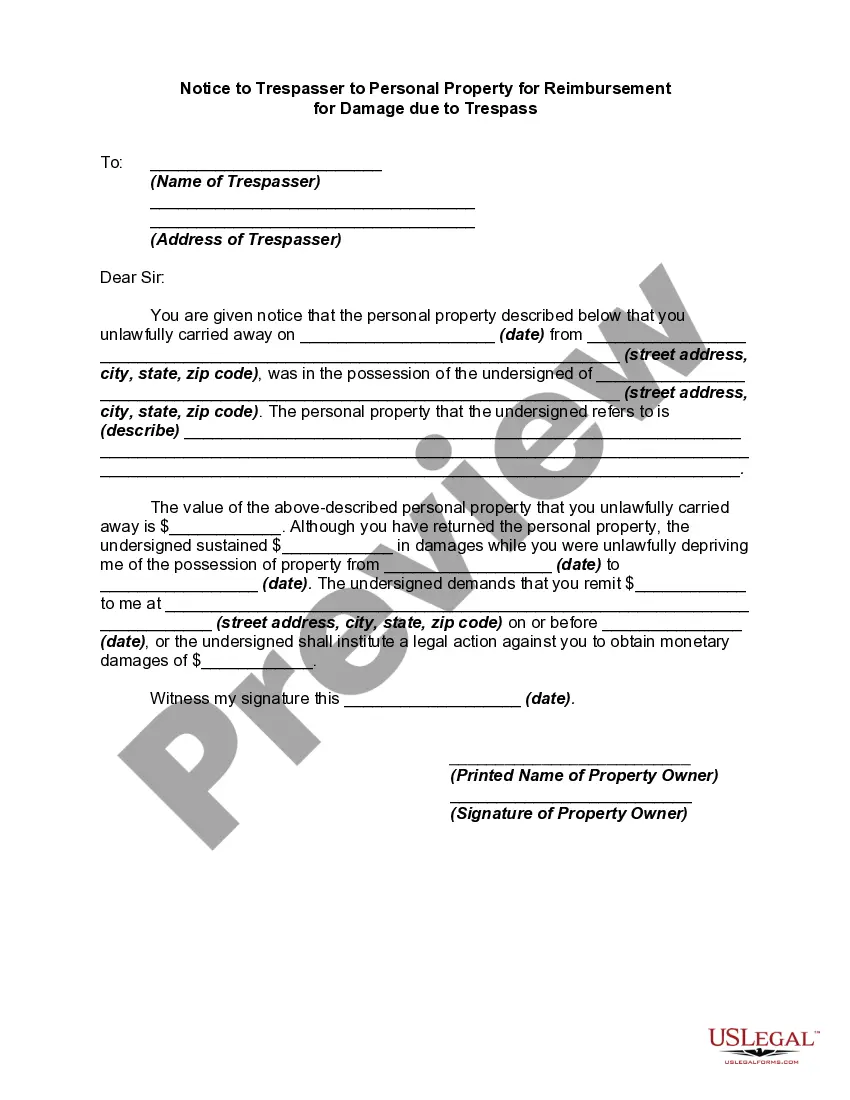
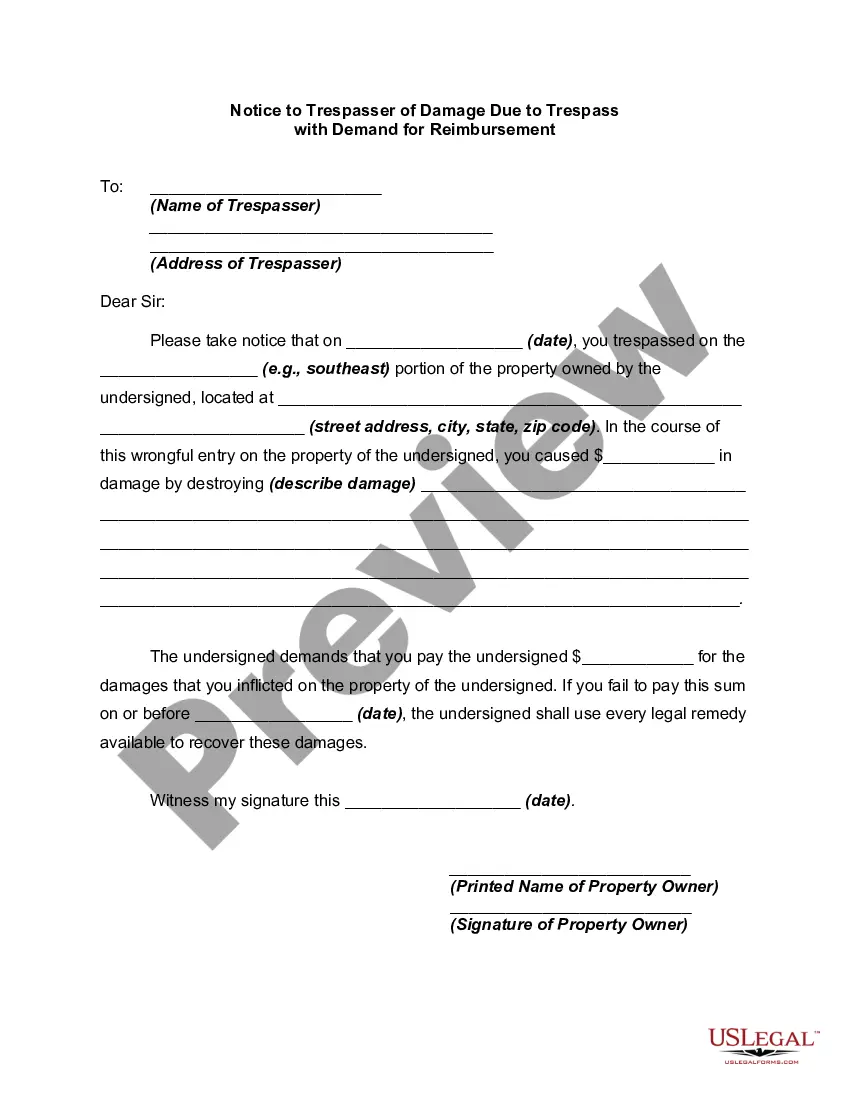
The Notice to Trespasser to Personal Property for Reimbursement for Damage due to Trespass is a legal document used to notify an individual that they have unlawfully interfered with or taken possession of personal property. The form serves as an official request for reimbursement for any damages incurred during the period of trespass. Unlike similar forms, this notice specifically addresses claims related to the unlawful removal or use of personal property, emphasizing the need for compensation due to related damages.
Key parts of this document
- Information about the trespasser, including name and address.
- Details of the property unlawfully taken or used.
- Description of damages incurred during the period of trespass.
- Value of the property involved and the requested reimbursement amount.
- Timeline for payment and potential legal action if not fulfilled.
When to use this document
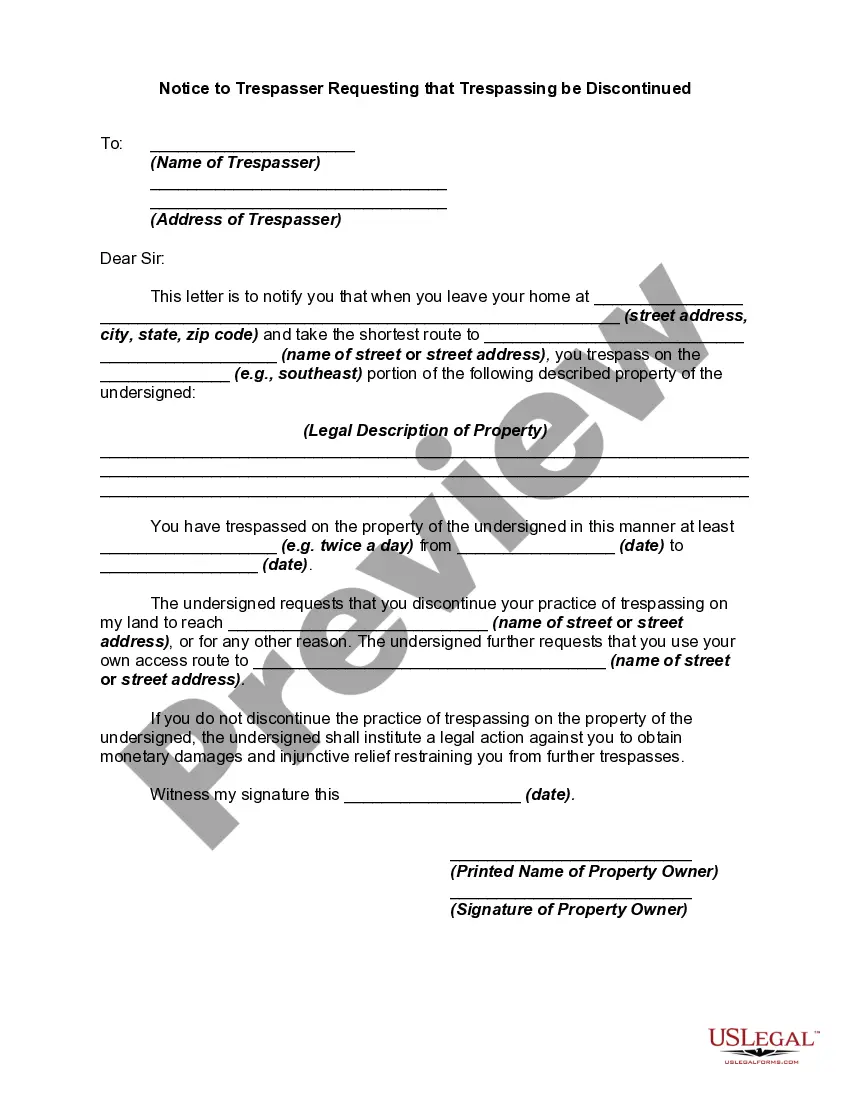
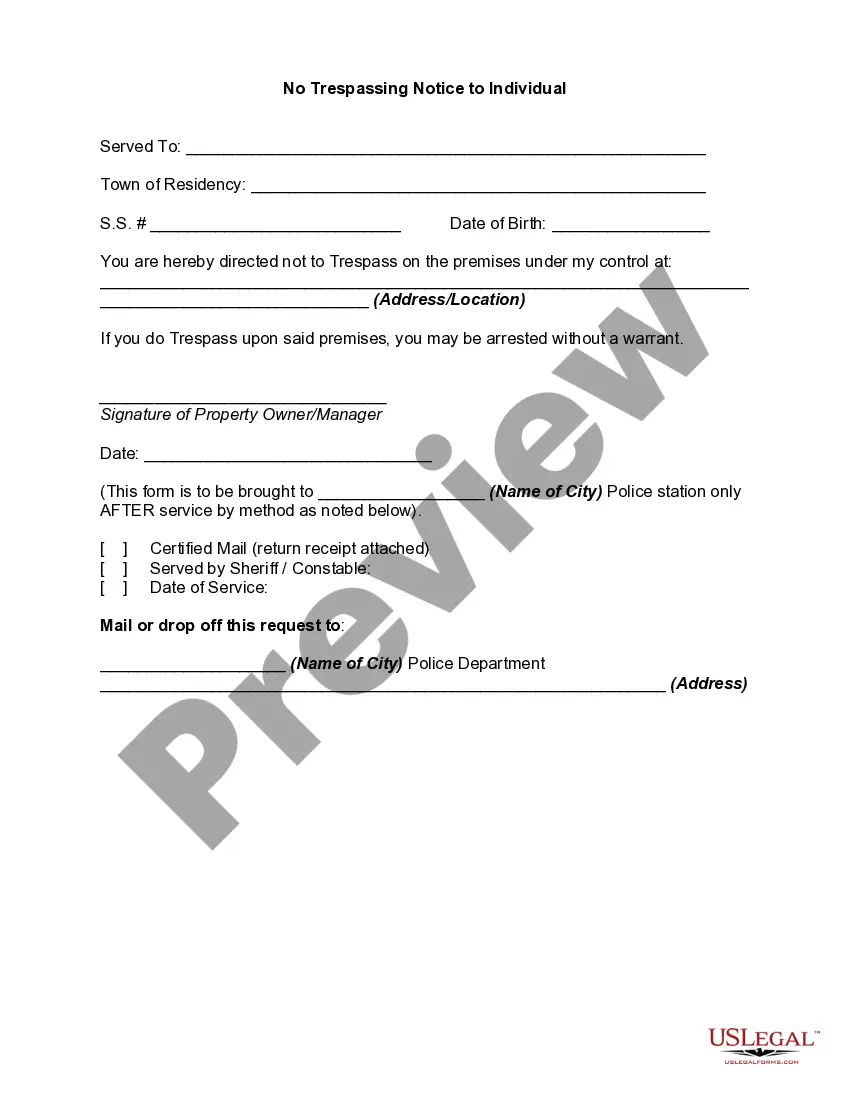
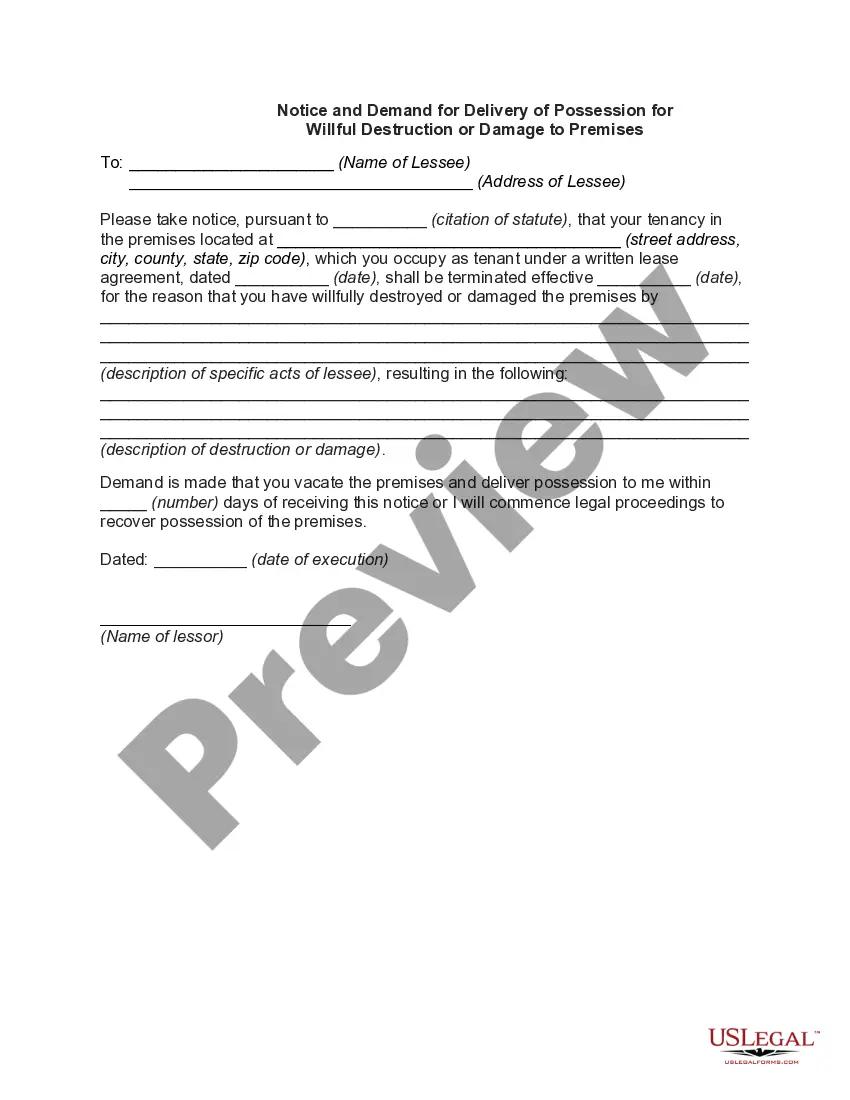
This form is necessary when your personal property has been unlawfully taken, damaged, or used by another person. Use this notice when you have attempted to resolve the situation informally but have been unsuccessful, and you need to formally demand reimbursement for alleged damages caused by the trespasser. It is recommended to send this notice before pursuing further legal action to recover your losses.
Who should use this form
- Property owners who have experienced trespass of their personal property.
- Individuals needing to document damage caused by another's unlawful actions.
- Those seeking financial reimbursement for losses due to trespass.
Completing this form step by step
- Identify the trespasser by filling in their name and address at the beginning of the form.
- Describe the personal property that was unlawfully taken or damaged, ensuring to include relevant details.
- Provide the dates when the property was taken and when it was returned, if applicable.
- Specify the value of the property and any additional damages suffered.
- Include your own name and address, along with the date, before signing the document.
Notarization guidance
This form does not typically require notarization unless specified by local law. However, having a notarized copy could strengthen your claim by providing added verification of your identity and the authenticity of your notice.
Get your form ready online
Our built-in tools help you complete, sign, share, and store your documents in one place.
Make edits, fill in missing information, and update formatting in US Legal Forms—just like you would in MS Word.
Download a copy, print it, send it by email, or mail it via USPS—whatever works best for your next step.
Sign and collect signatures with our SignNow integration. Send to multiple recipients, set reminders, and more. Go Premium to unlock E-Sign.
If this form requires notarization, complete it online through a secure video call—no need to meet a notary in person or wait for an appointment.
We protect your documents and personal data by following strict security and privacy standards.

Make edits, fill in missing information, and update formatting in US Legal Forms—just like you would in MS Word.

Download a copy, print it, send it by email, or mail it via USPS—whatever works best for your next step.

Sign and collect signatures with our SignNow integration. Send to multiple recipients, set reminders, and more. Go Premium to unlock E-Sign.

If this form requires notarization, complete it online through a secure video call—no need to meet a notary in person or wait for an appointment.

We protect your documents and personal data by following strict security and privacy standards.
Common mistakes
- Failing to provide accurate information regarding the trespasser's identity.
- Not clearly describing the personal property in question.
- Neglecting to state the correct value for reimbursement.
- Omitting deadlines for payment, which can weaken your claim.
Why complete this form online
- Immediate access to a legally sound document prepared by licensed attorneys.
- Convenience of downloading and completing the form at your own pace.
- Reduced risk of errors with a structured format guiding you through the necessary information.
Legal use & context
- This form serves as legal notice and can be used in court if reimbursement is sought.
- It may act as evidence of your attempt to resolve the dispute amicably.
- Understanding local laws regarding trespass and property rights is crucial for effective use of this form.
Summary of main points
- The form is essential for formally notifying a trespasser and seeking reimbursement.
- Accuracy and clarity in completing the form can significantly impact your case.
- Consulting state-specific regulations is important to ensure compliance.
Looking for another form?







Form popularity
FAQ
Generally speaking, your neighbour should not go onto your land without your permission. There are some situations where they may be able to access your land in order to complete repairs to their property, and their right to do this may be set out in the title deeds for the home.
Some circumstances do justify taking immediate action rather than calling the police. Some do not. In most instances, you can use non-deadly reasonable force to remove someone from your property.You have to give the person some reasonable amount of time to get off your property.
Politely ask the trespassers to leave as soon as you become aware of them. Contact the local police as they might be able to remove the trespassers without having to go through the courts process.
In order to prove a trespassing case against you, the prosecution will point out the presence of any barriers that should have notified you that property was off-limits. Barriers that may be used to secure and/or enclose property may include: Fences.
A trespasser can hold a dog owner liable for a dog bite injury, but only by proving that the owner was somehow negligent. Unlike many other dog bite victims, trespassers cannot use California's dog bite statute, which provides the strongest protections to dog bite victims.
Because trespass is a violation of someone's property rights, a property owner can sue a trespasser for money, even if the trespasser didn't cause any harm. (If the trespasser's presence didn't hurt anyone or damage property, though, the plaintiff will likely only be able to recover nominal damages.)
Generally speaking, if someone trespasses on your property and they get hurt, you will not be liable.You have been grossly negligent and/or expect that trespassers may enter your property. For instance, if you know about a serious property hazard and you take no steps to post a warning, you could be liable.
Trespass to land involves the "wrongful interference with one's possessory rights in real property." It is not necessary to prove that harm was suffered to bring a claim, and is instead actionable per se.
Because trespass is a violation of someone's property rights, a property owner can sue a trespasser for money, even if the trespasser didn't cause any harm. (If the trespasser's presence didn't hurt anyone or damage property, though, the plaintiff will likely only be able to recover nominal damages.)