Sample Letter for Unable to Dissect Animal due to Medical Reasons - Student to School
Overview of this form
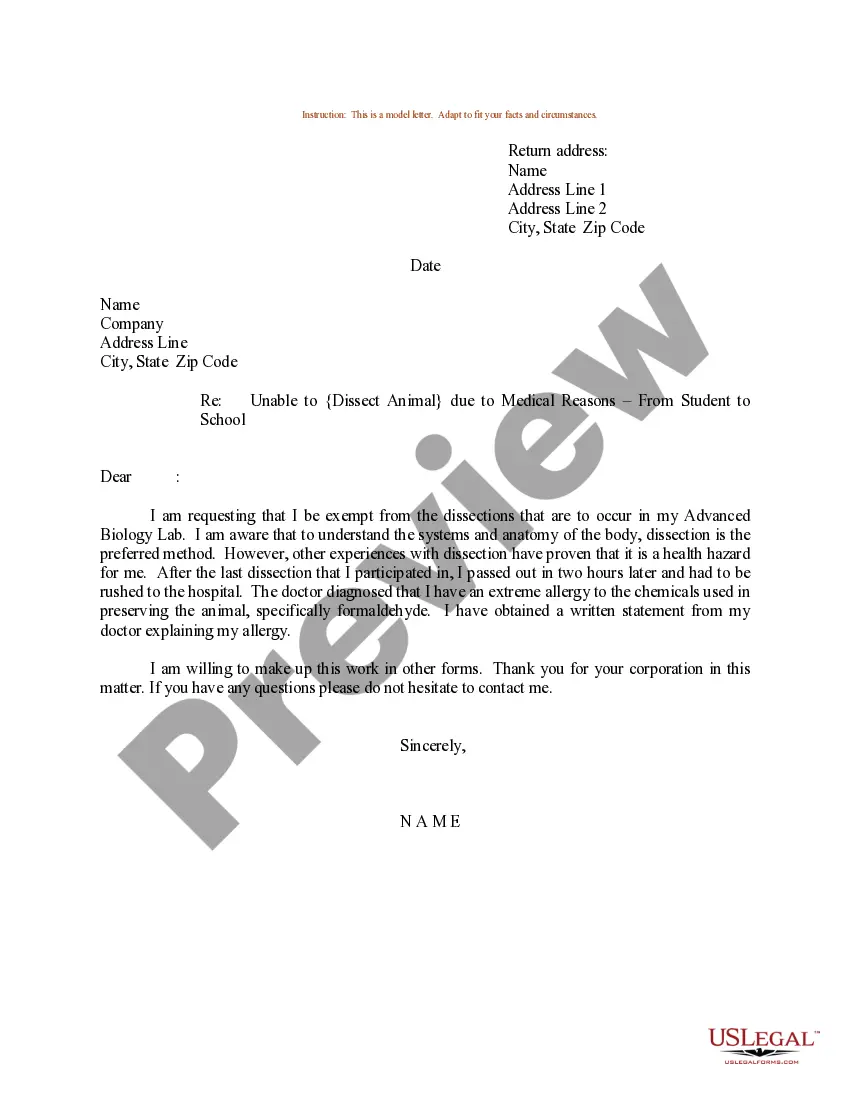
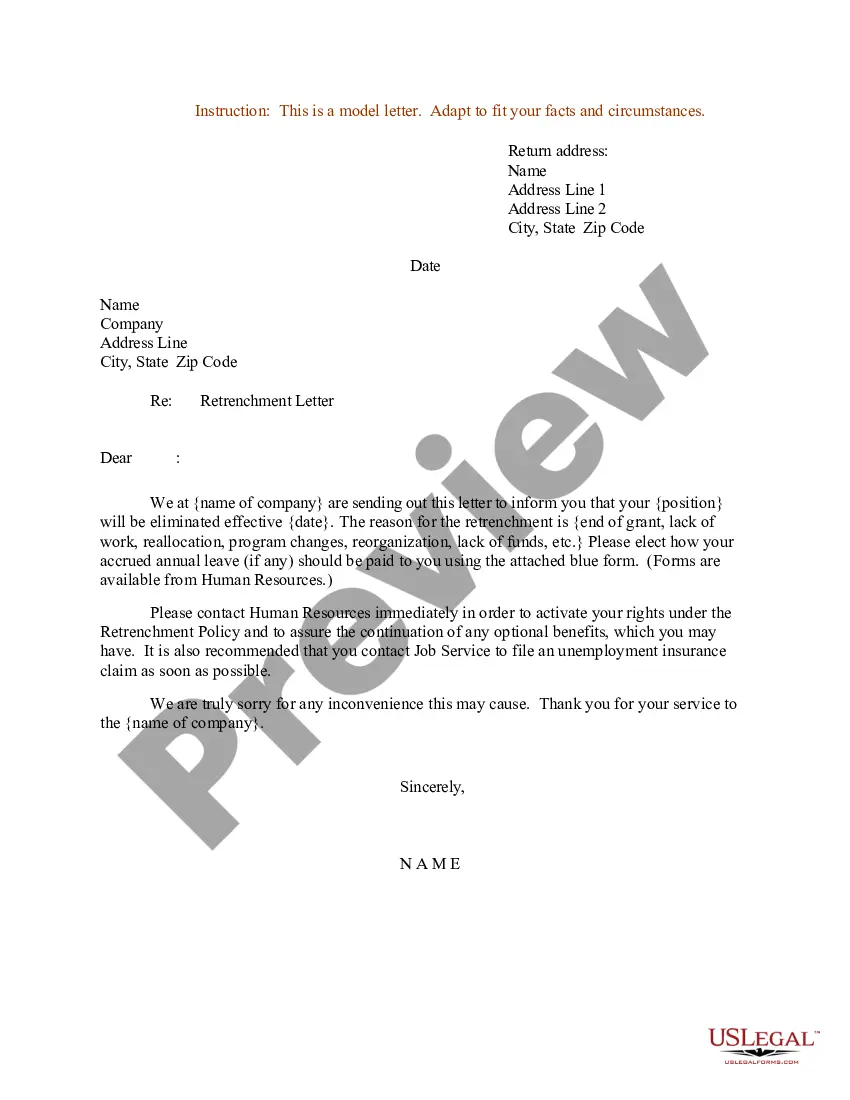
This form is a sample letter that allows students to formally communicate with their school regarding their inability to participate in animal dissection due to medical reasons. It outlines the student's willingness to complete alternative assignments while ensuring that their medical conditions are acknowledged. This letter serves as a specific means to address academic accommodations, which sets it apart from general request letters or notices.
Key parts of this document
- Return address: The student's name and contact information.
- Date: The date when the letter is written.
- Recipient address: School's name and address for proper delivery.
- Subject line: Clearly states the purpose of the letter regarding the dissection.
- Message body: Brief explanation of medical reasons and willingness to complete alternate tasks.
- Closing: A polite sign-off and signature area for the student.
Common use cases
This form is needed when a student has medical reasons preventing them from participating in animal dissection as part of a school project or course. It can be used in scenarios such as allergies, phobias, or other health concerns that may hinder the student's ability to engage in the activity. The letter ensures official communication to school authorities to seek alternative assignments or accommodations.
Who this form is for
- Students who are unable to participate in animal dissection due to medical reasons.
- Parents or guardians writing on behalf of a minor student.
- Educators looking to provide a template for students requesting accommodations.
Instructions for completing this form
- Identify the student: Enter the full name and contact information in the return address section.
- Enter the date: Fill in the date on which the letter is written.
- Provide recipient details: Include the school's name and address in the recipient address section.
- Explain your situation: Clearly state your medical reasons for not participating in the dissection within the message body.
- Offer alternatives: Express willingness to complete alternative assignments as needed.
- Sign off: Add your signature and print your name at the end of the letter.
Does this form need to be notarized?
In most cases, this form does not require notarization. However, some jurisdictions or signing circumstances might. US Legal Forms offers online notarization powered by Notarize, accessible 24/7 for a quick, remote process.
Get your form ready online
Our built-in tools help you complete, sign, share, and store your documents in one place.
Make edits, fill in missing information, and update formatting in US Legal Forms—just like you would in MS Word.
Download a copy, print it, send it by email, or mail it via USPS—whatever works best for your next step.
Sign and collect signatures with our SignNow integration. Send to multiple recipients, set reminders, and more. Go Premium to unlock E-Sign.
If this form requires notarization, complete it online through a secure video call—no need to meet a notary in person or wait for an appointment.
We protect your documents and personal data by following strict security and privacy standards.

Make edits, fill in missing information, and update formatting in US Legal Forms—just like you would in MS Word.

Download a copy, print it, send it by email, or mail it via USPS—whatever works best for your next step.

Sign and collect signatures with our SignNow integration. Send to multiple recipients, set reminders, and more. Go Premium to unlock E-Sign.

If this form requires notarization, complete it online through a secure video call—no need to meet a notary in person or wait for an appointment.

We protect your documents and personal data by following strict security and privacy standards.
Common mistakes to avoid
- Failing to include contact information for follow-up questions.
- Not specifying the medical reasons clearly, which may lead to misunderstandings.
- Forgetting to sign the letter before submission.
- Sending the letter to the wrong department or individual.
Benefits of using this form online
- Easy to customize: The form can be modified to suit individual circumstances quickly.
- Accessible: Downloadable and usable from any device, allowing convenience for busy students and parents.
- Legally sound: Ensures the letter is structured properly to fulfill educational requirements.
Quick recap
- This sample letter facilitates communication between students and schools regarding dissection exemptions.
- It is crucial to express willingness to fulfill alternative requirements.
- The form is adaptable for various jurisdictions and easily downloadable for convenience.
Looking for another form?






Form popularity
FAQ
Dissection is bad for the environment. Many of the animals harmed or killed for classroom use are caught in the wild, often in large numbers. Plus, the chemicals used to preserve animals are unhealthy (formaldehyde, for example, irritates the eyes, nose, and throat).
Dissection is bad for the environment. Many of the animals harmed or killed for classroom use are caught in the wild, often in large numbers. Plus, the chemicals used to preserve animals are unhealthy (formaldehyde, for example, irritates the eyes, nose, and throat).
Animal dissection is a productive and worthwhile use for dead animals. A large portion of dissected animals were already dead before being allocated for dissection. Having students dissect the animals allows for a learning opportunity instead of just wasting the animal.
More than 10 million animals are dissected in schools nationwide every year, according to reports PETA. It's a good time for us to move past dissection and in fact it's not even required of the education code, Kalra explains.The groups say there are better alternatives to killing animals for the use of dissection.
Yes, animal dissection should be banned:Animal dissection involves cutting open the body of an animal and not every student is comfortable doing it.Infection risks are higher - the animal body is full of bacteria and viruses which can be contaminated in students during animal dissection in school labs.
Dissection is also important because it: Helps students learn about the internal structures of animals. Helps students learn how the tissues and organs are interrelated. Gives students an appreciation of the complexity of organisms in a hands-on learning environment.
Yes, animal dissection should be banned:Animal dissection involves cutting open the body of an animal and not every student is comfortable doing it. For some students, animal dissection is distressing experience as they need to kill the animal and then studying its anatomy.
There are logistic and organizational barriers also; including the time constraints of modern medical curricula, lack of dissection trained personnel, scarcity of sufficient dead bodies available for dissection, student overloads, costly maintenance of dissection labs, health risks of prolonged formalin exposure and
In dissecting an animal, students see, touch, and explore the various organs in the body. Seeing these organs and understanding how they work within a single animal allows students to understand how these systems work within many other animals, including themselves.