Letter to Physician Requesting Medical Information Regarding Claim for Social Security Disability Benefits
Overview of this form
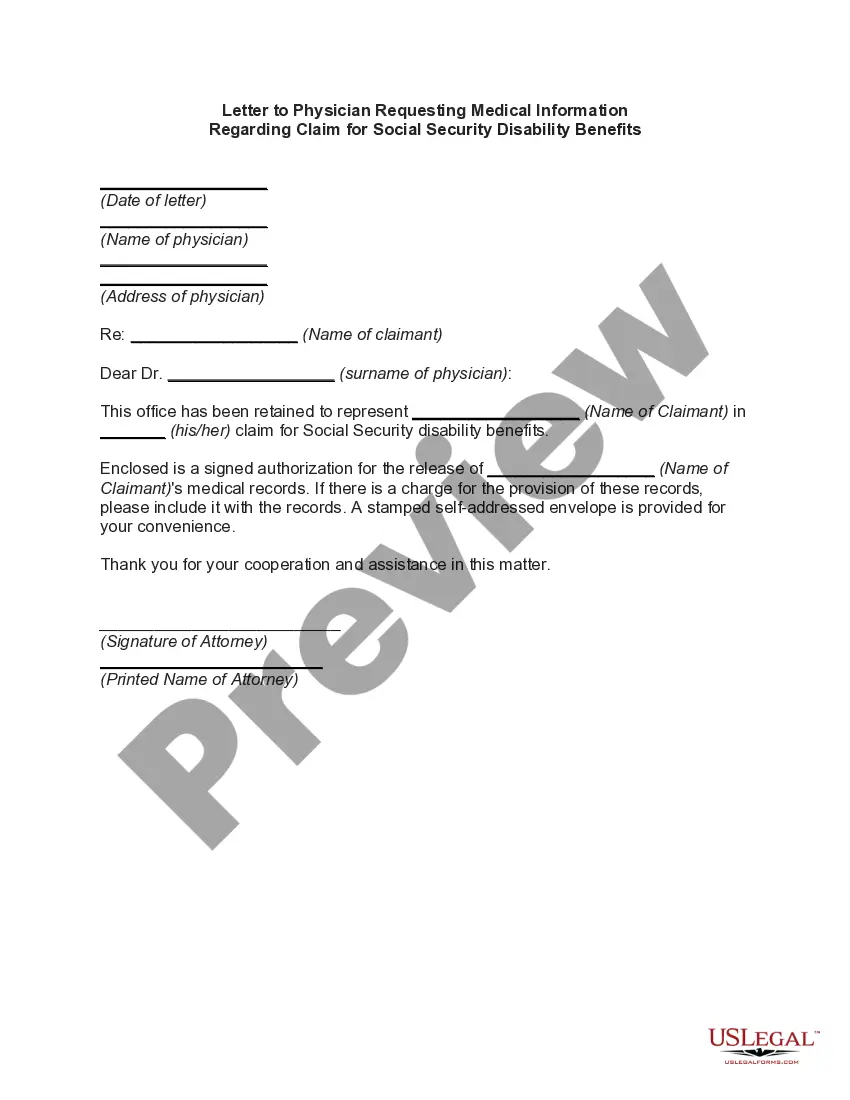
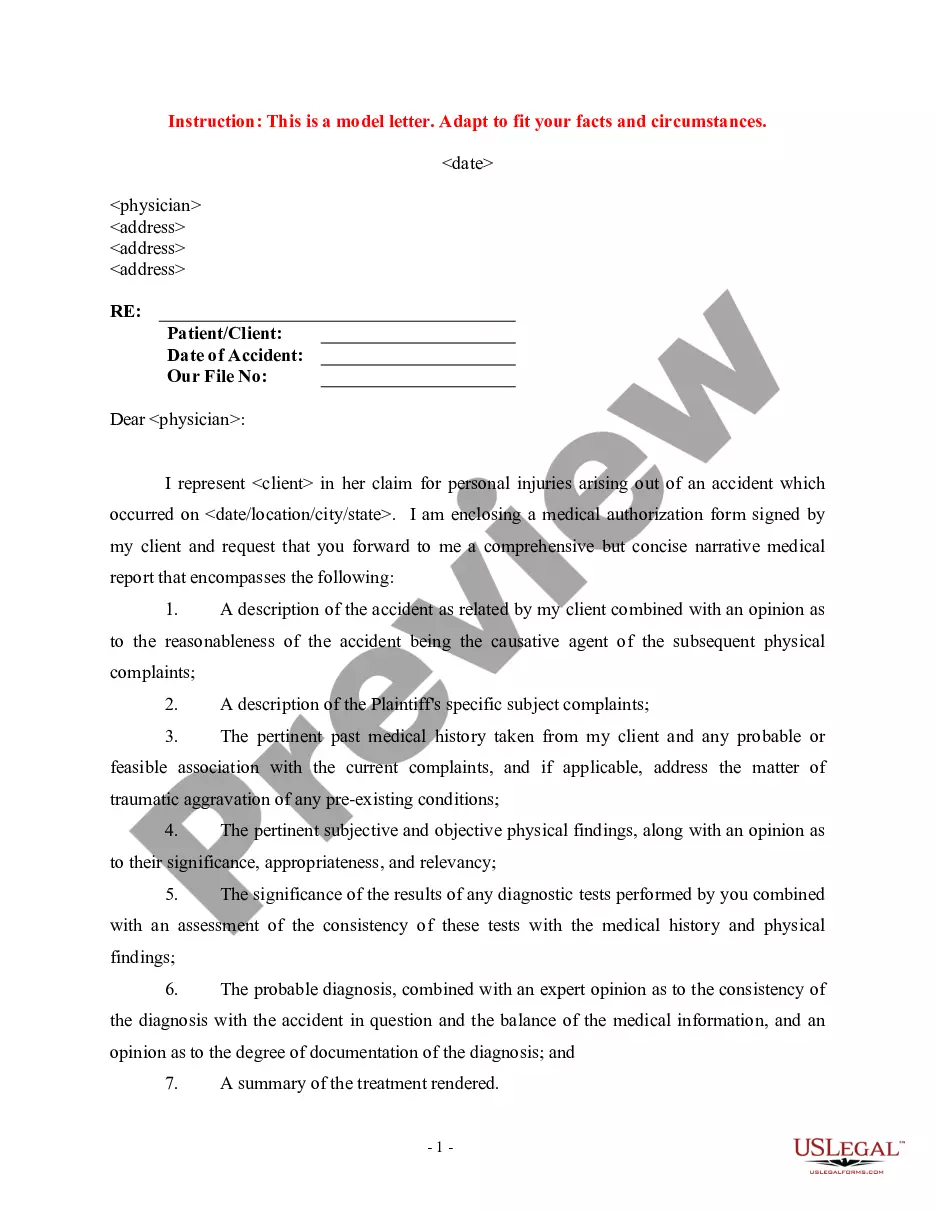
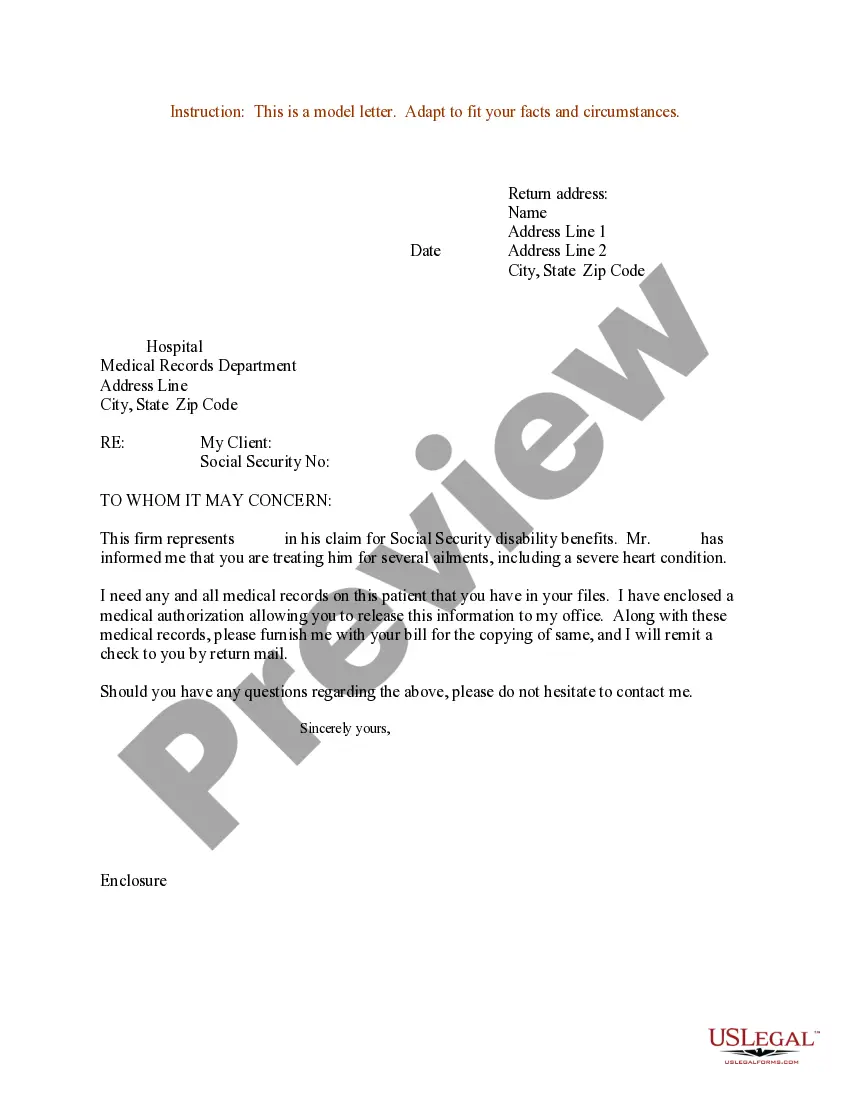
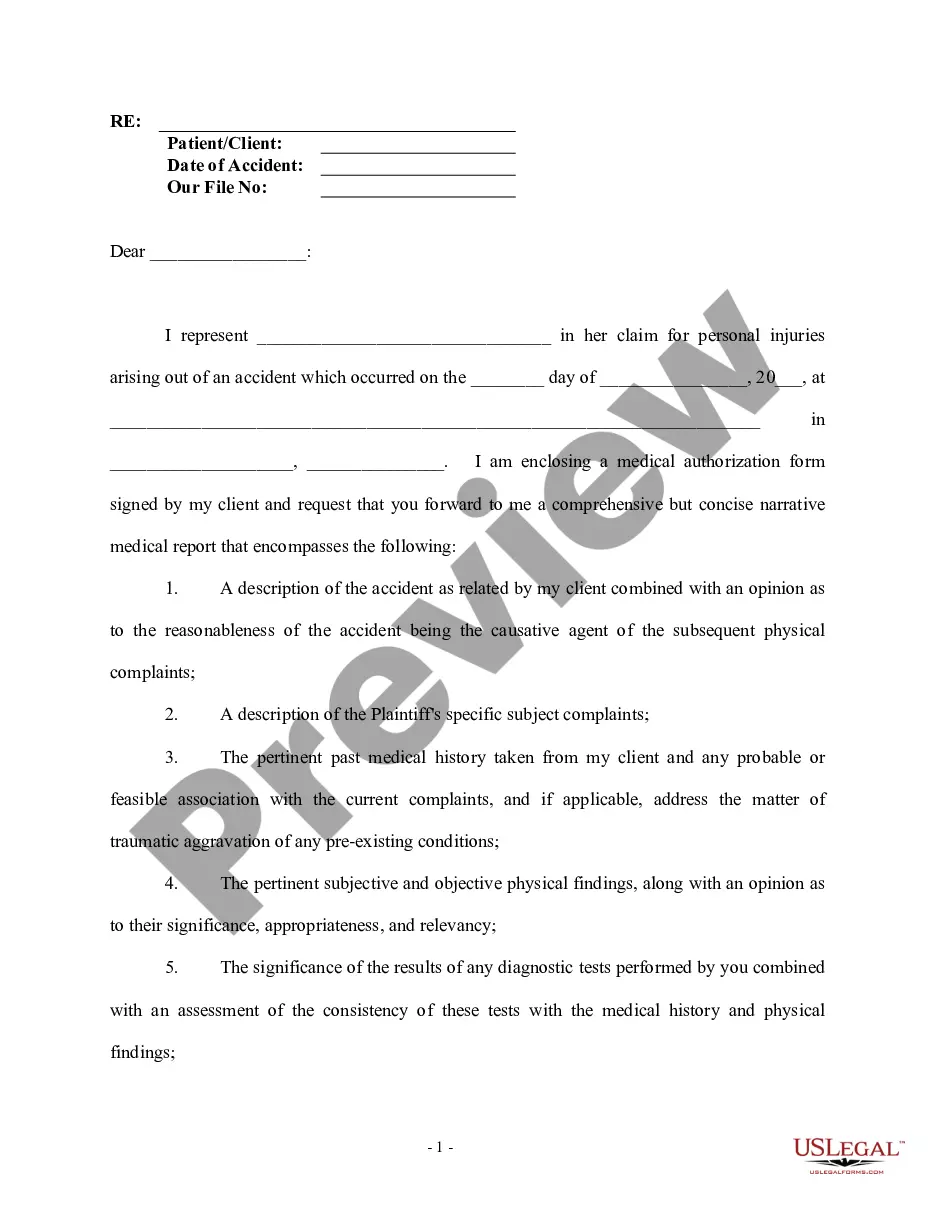
This Letter to Physician Requesting Medical Information Regarding Claim for Social Security Disability Benefits is a formal communication that facilitates the collection of essential medical records needed to support a disability claim. It differs from other requests in its specific focus on gathering medical information particularly relevant to Social Security disability benefits applications.
Key parts of this document
- Date of the letter
- Name and address of the physician
- Name of the claimant
- Confirmation of attorney representation
- Signed authorization for record release
- Instructions for any associated charges for records
When to use this document
This form is used when an attorney needs to request medical records from a physician for a client who is filing a claim for Social Security disability benefits. It is particularly necessary when the Social Security Administration requires detailed medical documentation to assess disability claims.
Intended users of this form
- Attorneys representing clients in Social Security disability claims
- Individuals who are in the process of applying for Social Security disability benefits
- Medical professionals who need formal requests for patient records
How to prepare this document
- Enter the date of the letter at the top.
- Provide the physician's name and complete address.
- Specify the name of the claimant in the designated section.
- Include your name as the attorney representing the claimant, along with any relevant identification.
- Attach the signed authorization to release the medical records.
- If applicable, note any fees associated with obtaining the medical records and include a self-addressed envelope.
Does this form need to be notarized?
This form does not typically require notarization to be legally valid. However, some jurisdictions or document types may still require it. US Legal Forms provides secure online notarization powered by Notarize, available 24/7 for added convenience.
Get your form ready online
Our built-in tools help you complete, sign, share, and store your documents in one place.
Make edits, fill in missing information, and update formatting in US Legal Forms—just like you would in MS Word.
Download a copy, print it, send it by email, or mail it via USPS—whatever works best for your next step.
Sign and collect signatures with our SignNow integration. Send to multiple recipients, set reminders, and more. Go Premium to unlock E-Sign.
If this form requires notarization, complete it online through a secure video call—no need to meet a notary in person or wait for an appointment.
We protect your documents and personal data by following strict security and privacy standards.

Make edits, fill in missing information, and update formatting in US Legal Forms—just like you would in MS Word.

Download a copy, print it, send it by email, or mail it via USPS—whatever works best for your next step.

Sign and collect signatures with our SignNow integration. Send to multiple recipients, set reminders, and more. Go Premium to unlock E-Sign.

If this form requires notarization, complete it online through a secure video call—no need to meet a notary in person or wait for an appointment.

We protect your documents and personal data by following strict security and privacy standards.
Avoid these common issues
- Failing to include the claimant's authorization for record release.
- Omitting the physician's complete contact information.
- Not specifying the nature of the claim clearly enough.
- Neglecting to request the inclusion of fees along with the records.
- Forgetting to sign the letter as the attorney.
Benefits of completing this form online
- Convenience of downloading and completing the form at your own pace.
- Editability to customize the form for specific cases and needs.
- Access to legally vetted content drafted by licensed attorneys.
- Speed of obtaining necessary paperwork without the need for physical visits.
What to keep in mind
- The form is essential for obtaining medical records needed for Social Security Disability claims.
- Ensures accurate and timely requests to physicians.
- Streamlines the process of gathering medical evidence to support a claimant's case.
Looking for another form?


Form popularity
FAQ
It is a formal request used to obtain essential medical records to support a Social Security disability claim. The form prompts the filer to include the letter date, the physician’s name and address, the claimant’s name, confirmation of attorney representation, a signed authorization for record release, and instructions about record-fee charges, focusing on medical information relevant to SSD evaluation.
This form provides a ready-to-use template for requesting medical records from a physician in support of a Social Security disability claim. It specifies key elements like the date, physician contact details, claimant name, attorney representation, a signed release authorization, and payment or charge notes, helping ensure the request is complete and properly presented.
No. This form does not determine qualification. It is a tool to request medical information needed to evaluate a Social Security disability claim. Whether a condition like COPD or any other condition qualifies depends on SSA medical criteria and the submitted records, which may be gathered with this form.
This form does not specify the content of a physician’s own disability-focused letter. It is a structured request from a claimant or attorney to a physician seeking medical records for a Social Security disability claim. For physician-generated letters, separate guidance or forms would be used, often depending on SSA requirements.
This form does not decide eligibility. It is used to obtain medical records to support a disability claim. Whether osteoporosis qualifies depends on SSA evaluation of medical evidence and functional limitations. The form helps ensure the physician’s records related to osteoporosis are requested for review.
This form is tailored for Social Security disability claims. Unlike a generic records request, it includes a section confirming attorney representation, a signed authorization for record release, and instructions for potential charges, all focused on collecting medical information specific to SSD evaluation.