Consent to Head Lice Removal for a Minor, Release of Practitioner from Liability, and Indemnity Agreement
What this document covers
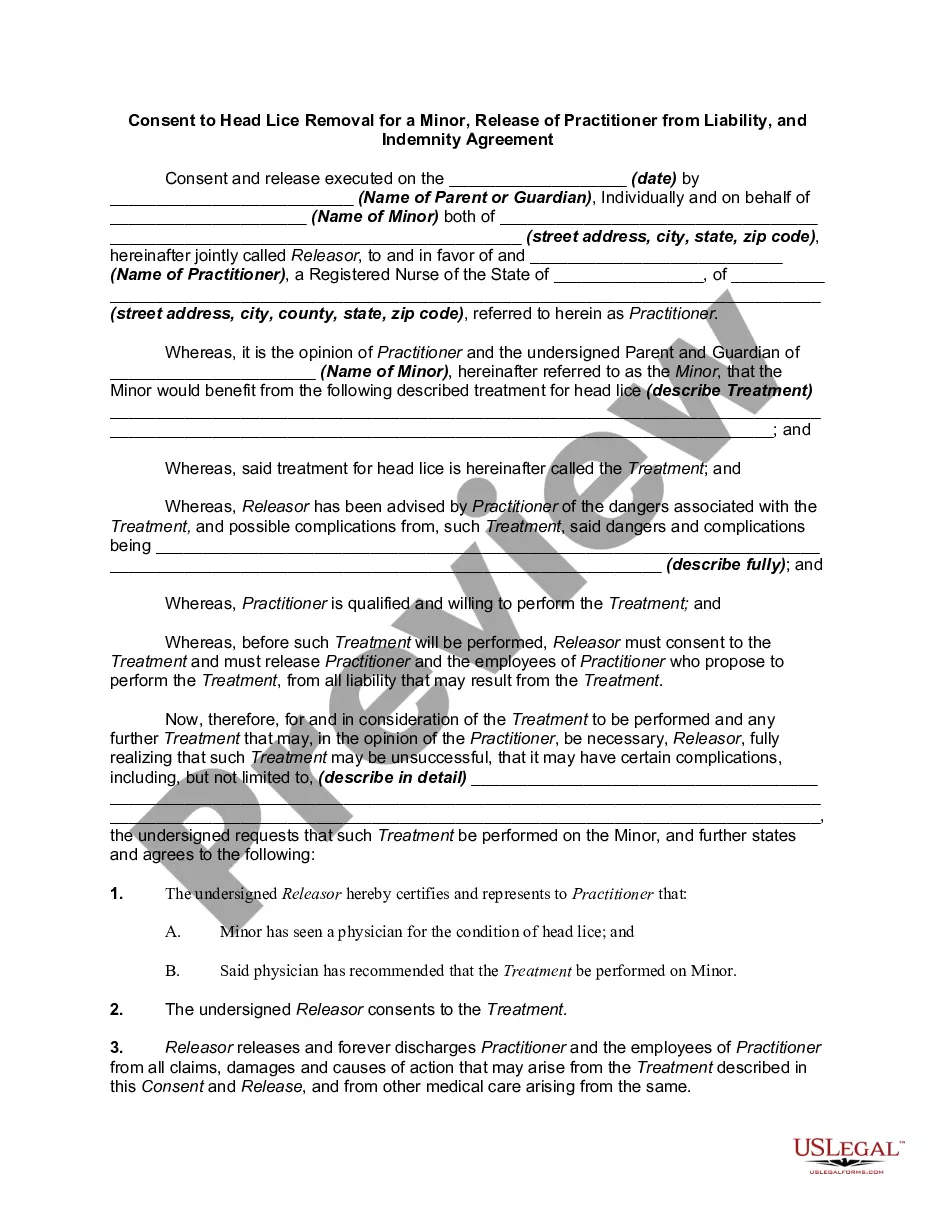
The Consent to Head Lice Removal for a Minor, Release of Practitioner from Liability, and Indemnity Agreement is a legal document that provides parental consent for the removal of head lice from a minor child. This form not only grants permission for the practitioner to perform the necessary treatment but also releases the practitioner from liability in case of any complications. This form is essential for ensuring that parents understand the risks associated with the treatment and confirm that they have consulted a physician regarding their child's condition.
Key parts of this document
- Date of consent execution.
- Name of the parent or guardian providing consent.
- Name of the minor receiving treatment.
- Description of the proposed treatment for head lice.
- Agreement to release the practitioner from liability.
- Certification that the minor has seen a physician regarding the condition.
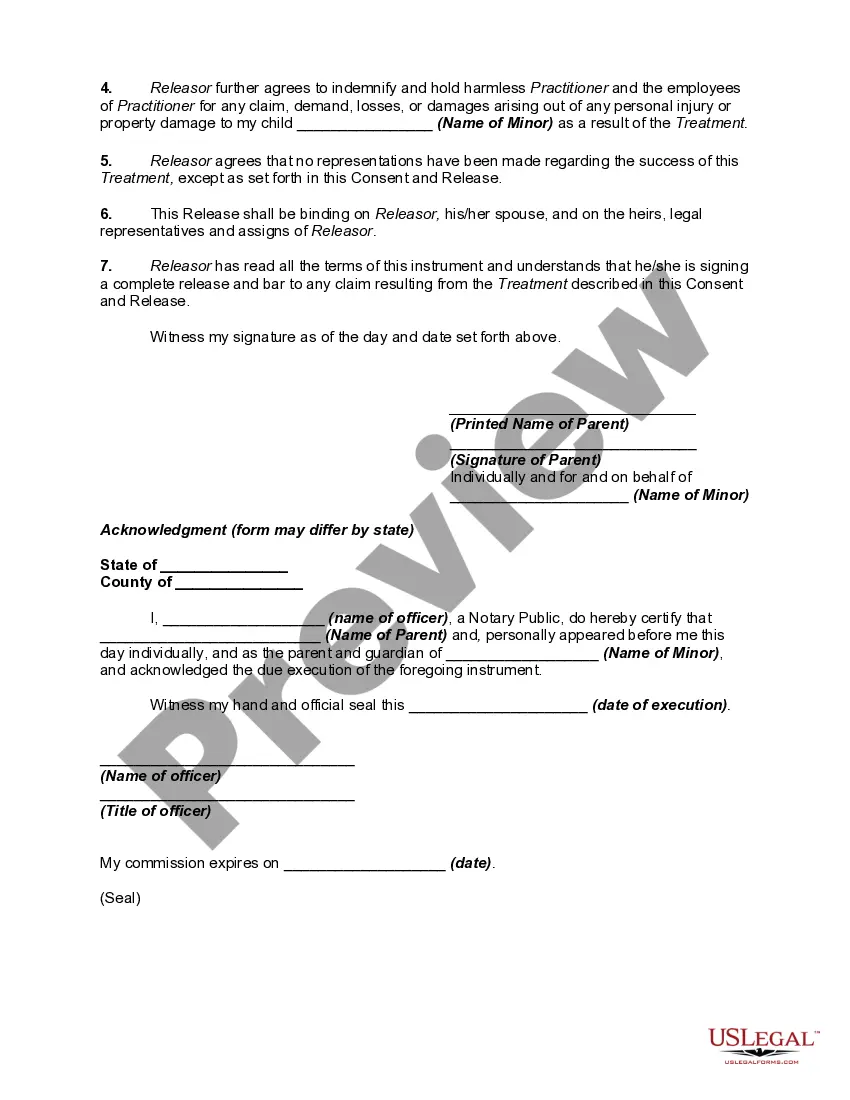
- Notarization requirement for legal validity.
When this form is needed
This form should be used when a parent or guardian needs to authorize head lice treatment for their minor child. It is particularly important in settings such as schools, daycares, or healthcare facilities, where written consent may be required to proceed with treatment. This form ensures that the practitioner is protected from legal claims related to the treatment process.
Who can use this document
Eligibility for this form includes:
- Parents or guardians of a minor child experiencing head lice.
- Practitioners or healthcare providers administering head lice treatment.
- Institutions requiring consent for treatment, such as schools or clinics.
How to complete this form
To complete this form, follow these steps:
- Identify the date of consent and enter it at the top of the form.
- Fill in the names of both the parent or guardian and the minor child.
- Describe the treatment to be performed for head lice clearly.
- List any known risks associated with the treatment as discussed with the practitioner.
- Sign and date the document, ensuring the signature is witnessed if required.
- Follow any state-specific procedures for notarization, if necessary.
Does this form need to be notarized?
Yes, this form must be notarized to be legally valid. Notarization ensures that the signatures are authentic and that the consent is being given voluntarily. US Legal Forms offers an integrated online notarization service, allowing you to complete the process securely via video call, ensuring legal equivalence without the need for travel.
Get your form ready online
Our built-in tools help you complete, sign, share, and store your documents in one place.
Make edits, fill in missing information, and update formatting in US Legal Forms—just like you would in MS Word.
Download a copy, print it, send it by email, or mail it via USPS—whatever works best for your next step.
Sign and collect signatures with our SignNow integration. Send to multiple recipients, set reminders, and more. Go Premium to unlock E-Sign.
If this form requires notarization, complete it online through a secure video call—no need to meet a notary in person or wait for an appointment.
We protect your documents and personal data by following strict security and privacy standards.

Make edits, fill in missing information, and update formatting in US Legal Forms—just like you would in MS Word.

Download a copy, print it, send it by email, or mail it via USPS—whatever works best for your next step.

Sign and collect signatures with our SignNow integration. Send to multiple recipients, set reminders, and more. Go Premium to unlock E-Sign.

If this form requires notarization, complete it online through a secure video call—no need to meet a notary in person or wait for an appointment.

We protect your documents and personal data by following strict security and privacy standards.
Typical mistakes to avoid
- Failing to fully describe the treatment, which can lead to misunderstandings.
- Not consulting a physician prior to consent, which is often a statutory requirement.
- Overlooking the need for notarization, which could render the form invalid in certain jurisdictions.
- Leaving sections blank, which might lead to challenges in enforcement of the release.
Why complete this form online
- Convenient online access to legally drafted forms created by licensed attorneys.
- Editable format allows customization to meet specific needs and requirements.
- Ensures reliability and up-to-date compliance with local laws.
- Ability to easily download and print for immediate use.
Legal use & context
- This form protects practitioners from liability by clearly stating the risks involved in head lice treatment.
- It ensures that informed consent is obtained from a parent or guardian before treatment can be performed on a minor.
- Courts may scrutinize releases signed on behalf of minors, so it's important to ensure compliance with applicable laws.
Summary of main points
- This form is essential for consent and liability release when treating head lice for minors.
- Both the minor's health interests and the practitioner's legal protection are addressed through this document.
- Consult local laws for any specific requirements or details related to minor consent forms.
Looking for another form?
Form popularity
FAQ
Taylor was admitted to practice in the Supreme Court of New South Wales.Consent Orders are a written agreement between the parties, which is filed in court and upon approval, becomes a legally binding Court Order.
The consent judgment was a final determination of the rights of the parties.Pursuant to California law, a party is allowed to expressly waive his or her right to appeal from any judgment. However, parties are not allowed to confer jurisdiction upon an appellate court by agreement when it otherwise does not exist.
Breaching a consent order. Once the Court has approved a draft consent order it is legally binding and cannot be changed unless an appeal is upheld by a judge.However, having an order approved by a judge does not always make the contents final.
During litigation, the parties will be encouraged by the courts (and hopefully their lawyers!) to attempt to reach an agreement to settle the matter to avoid the time and costs of going to a final hearing. Where an agreement is reached, a consent order will be drafted to record the agreement.
1 A consent decree is a negotiated agreement entered as a court order that is enforceable by the court. A settlement agreement is an out-of-court resolution that requires a signed agreement, or memorandum of understanding, and performance by the defendant.
A consent decree is a formal agreement (contract) created to resolve a dispute between parties without either party admitting blame. The decree document is a court order that establishes an enforceable plan for some kind of reform.
To make your agreement legally binding you need to draft a consent order and ask a court to approve it. If your agreement is not legally binding, a court cannot enforce it if there are any issues later. A consent order is a legal document that confirms your agreement.
A consent judgment is a court order signed by the judge and the parties (or their attorneys) that resolves a lawsuit. They are used in everything from collections cases to divorces to employment discrimination cases.
A consent order is an agreement negotiated out of court, regarding the terms of a custody arrangement that is submitted to the court for the judge's signature.A consent order is valid and enforceable because it evidences the signed consent of the parties and approval of the judge.