Notice to Buyer of Acceptance of Additional Terms
About this form
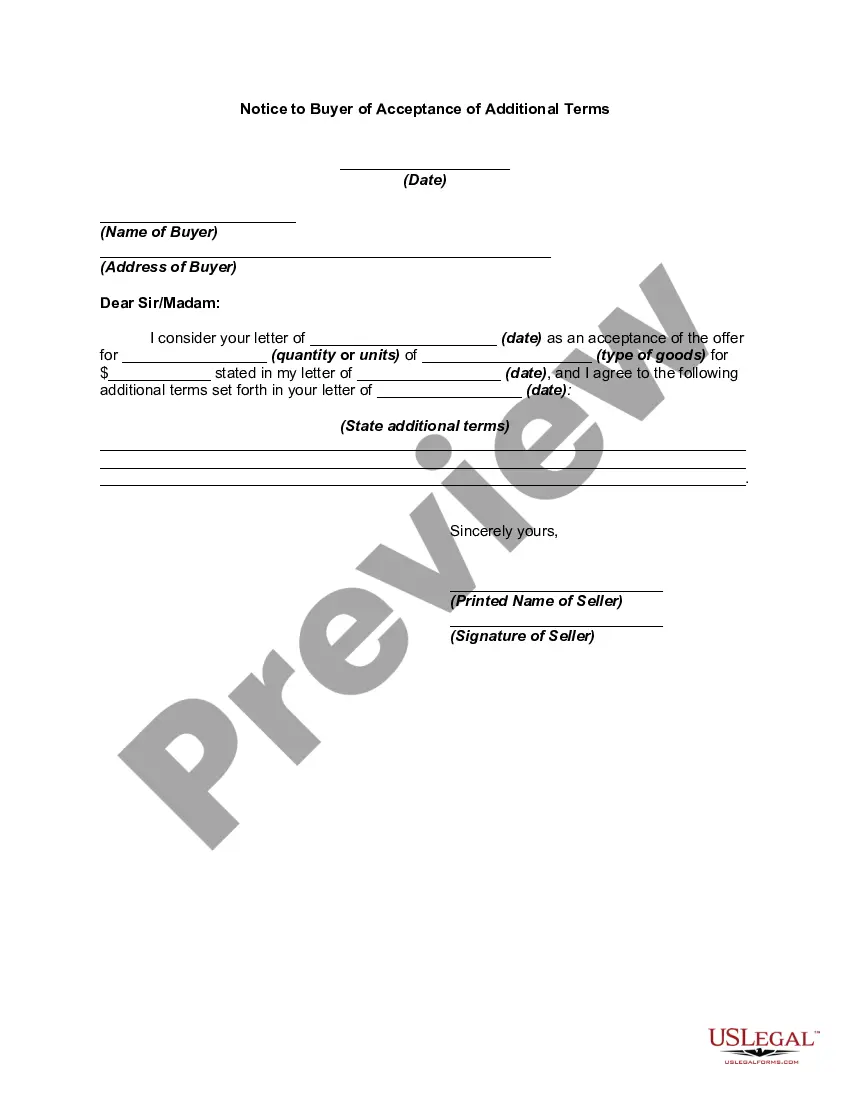
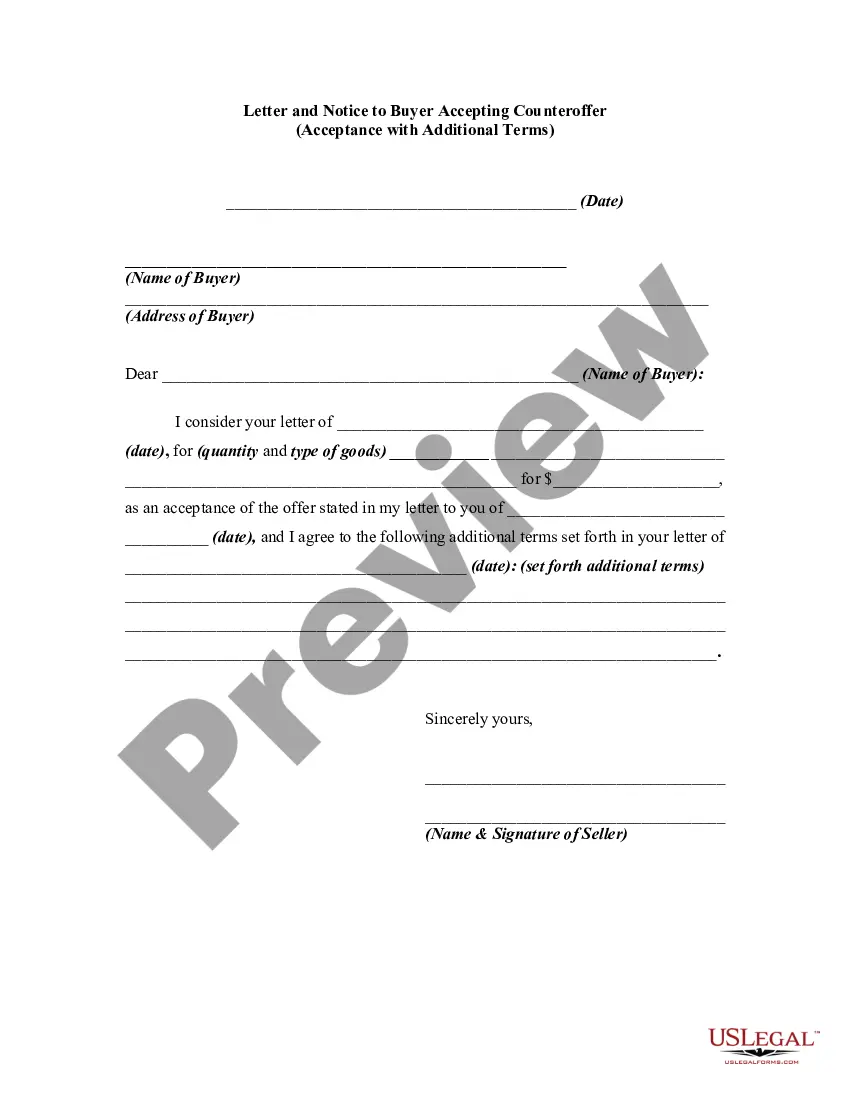
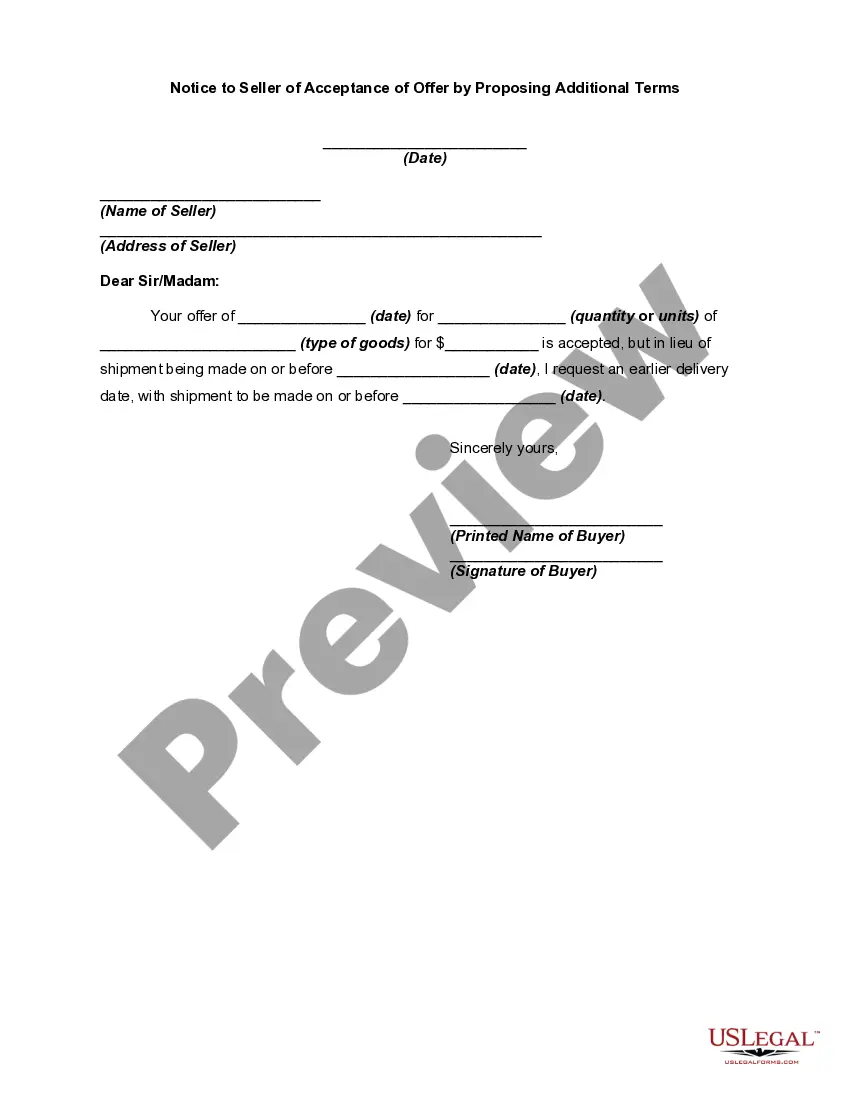
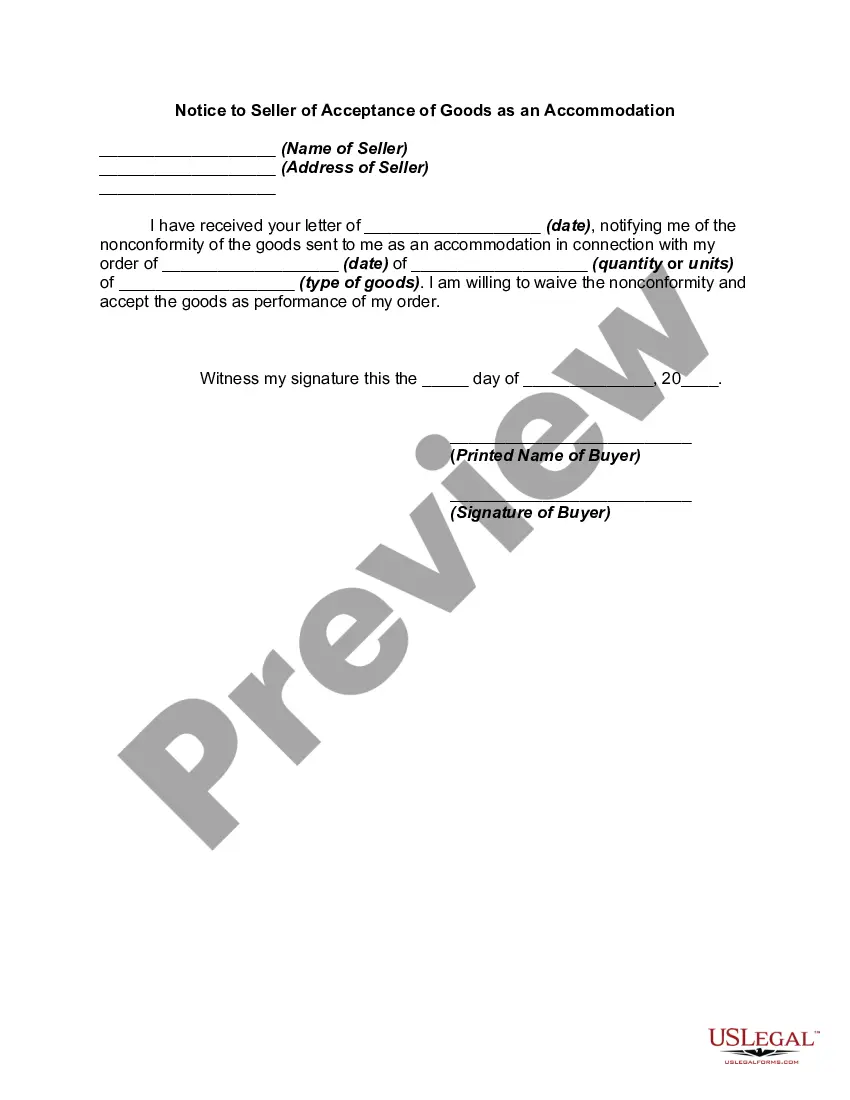
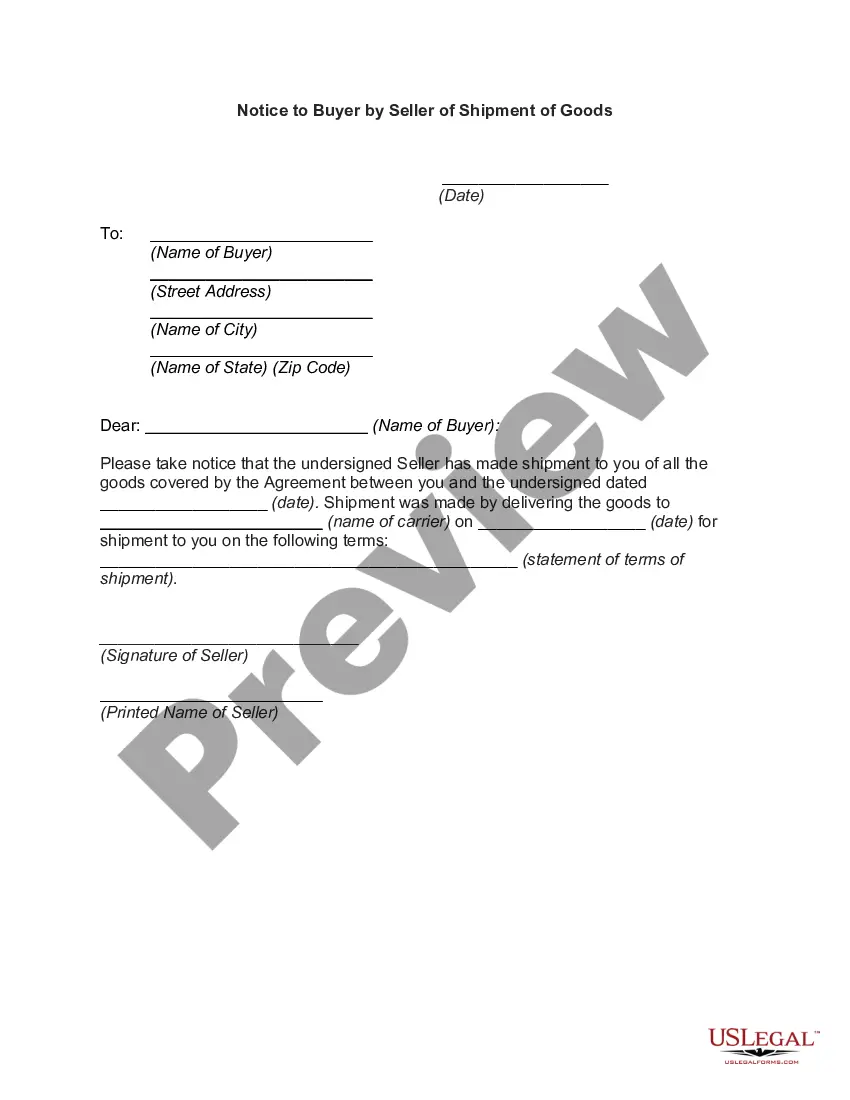
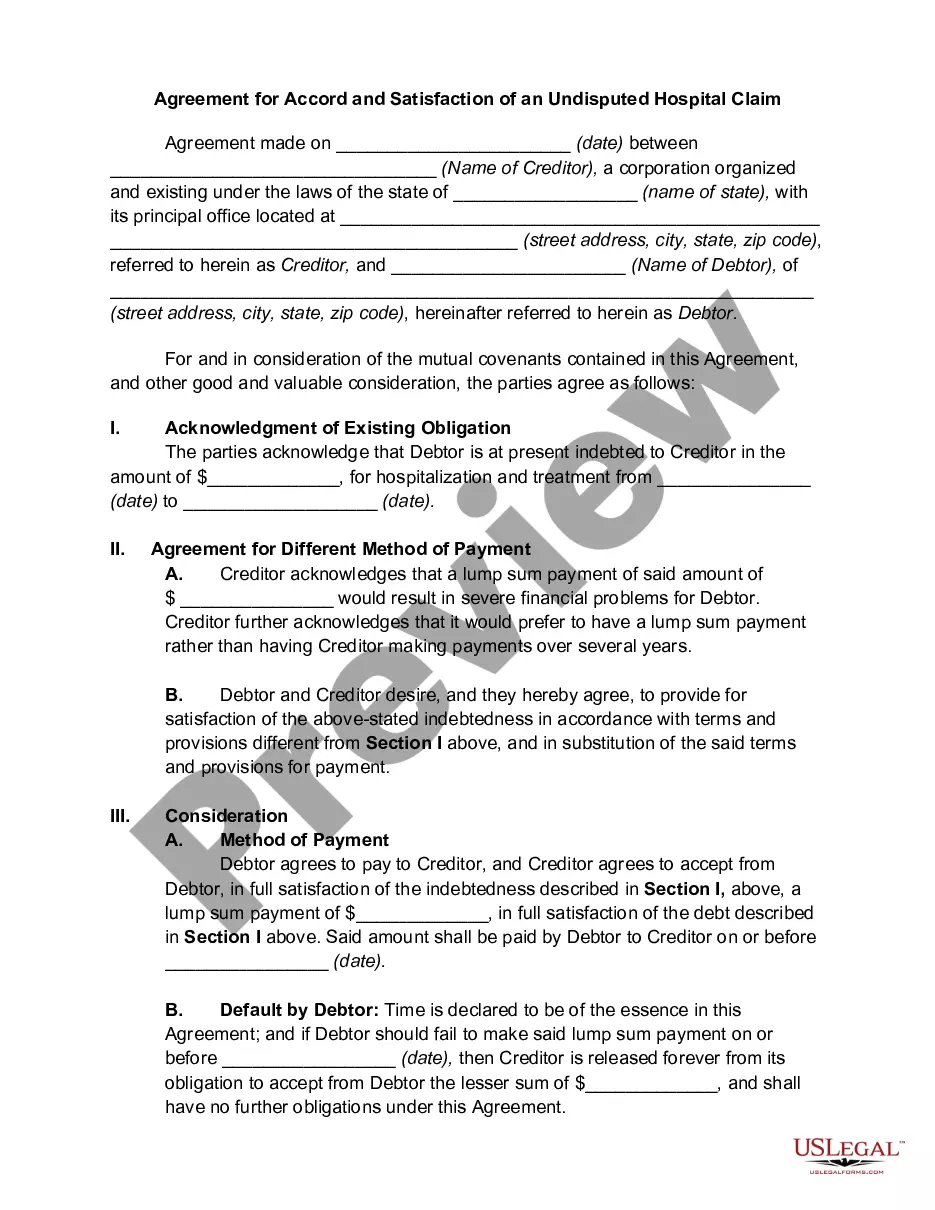
The Notice to Buyer of Acceptance of Additional Terms is a legal document used in commercial transactions involving the sale of goods. This form allows a seller to formally acknowledge and accept an additional term proposed by a buyer, without rejecting the original offer. Unlike a counteroffer in general contract law, this process is recognized under the Uniform Commercial Code, allowing both parties to maintain the initial agreement while incorporating new terms. This form is essential for clarity in future dealings and protects both parties' interests by ensuring all conditions are documented.
Form components explained
- Date of communication
- Name and address of the buyer
- Details of the original sale offer, including quantity and type of goods
- Reference date of the original offer
- List of additional terms proposed by the buyer
- Seller's printed name and signature
When to use this document
You should use this form when a buyer proposes additional terms after the initial offer has been made. It is particularly useful in situations where negotiations take place over email or written correspondence, and clarity is needed regarding the acceptance of new terms. This form helps prevent misunderstandings and ensures both parties are on the same page before finalizing the sale.
Who this form is for
- Business sellers and buyers engaging in the sale of goods
- Contract negotiators looking to clarify terms
- Individuals involved in transactions that require documentation of agreed-upon conditions
- Legal professionals assisting clients in contractual matters
How to complete this form
- Identify the date of the buyer's letter and your response.
- Clearly state the buyer's name and address.
- Specify the quantity and type of goods involved in the original offer.
- Reference the date of the original offer for clarity.
- List any additional terms proposed by the buyer as needed.
- Sign and print your name as the seller at the end of the document.
Does this document require notarization?
This form usually doesn’t need to be notarized. However, local laws or specific transactions may require it. Our online notarization service, powered by Notarize, lets you complete it remotely through a secure video session, available 24/7.
Get your form ready online
Our built-in tools help you complete, sign, share, and store your documents in one place.
Make edits, fill in missing information, and update formatting in US Legal Forms—just like you would in MS Word.
Download a copy, print it, send it by email, or mail it via USPS—whatever works best for your next step.
Sign and collect signatures with our SignNow integration. Send to multiple recipients, set reminders, and more. Go Premium to unlock E-Sign.
If this form requires notarization, complete it online through a secure video call—no need to meet a notary in person or wait for an appointment.
We protect your documents and personal data by following strict security and privacy standards.

Make edits, fill in missing information, and update formatting in US Legal Forms—just like you would in MS Word.

Download a copy, print it, send it by email, or mail it via USPS—whatever works best for your next step.

Sign and collect signatures with our SignNow integration. Send to multiple recipients, set reminders, and more. Go Premium to unlock E-Sign.

If this form requires notarization, complete it online through a secure video call—no need to meet a notary in person or wait for an appointment.

We protect your documents and personal data by following strict security and privacy standards.
Common mistakes to avoid
- Failing to accurately reference the dates of the original offer and buyer's communication.
- Not including all additional terms proposed by the buyer.
- Leaving out seller's signature or not printing their name.
- Using unclear language that could lead to misunderstandings.
Benefits of completing this form online
- Immediate access to legally vetted templates reduces the risk of errors.
- Easy editing allows you to customize terms that suit your specific situation.
- Secure and convenient downloadable formats for easy storage and sharing.
- Integration of notarization services available online for added legal security.
Legal use & context
- This form serves as documentation of the agreement between buyer and seller.
- It clarifies the terms accepted and prevents dispute over the additional terms proposed.
- The original offer remains valid as per the UCC until explicitly rejected by the seller.
What to keep in mind
- The form is crucial for documenting any additional terms proposed during a sales transaction.
- It ensures both parties are clear on the terms and reduces the risk of disputes.
- Using this form can streamline negotiations and formalize agreements effectively.
Looking for another form?








Form popularity
FAQ
Dickered terms are specific terms that are agreed upon by both parties, but not necessarily written. E.g., quantity, price, model, color, etc.
Goods: Article 2 of the UCC, which governs contracts, limits its application to contracts involving the sale and purchase of goods in the amount of $500 or more. Merchants: Generally speaking, the UCC applies to agreements in which at least one of the parties is a merchant as it defines that term.
Additional Term means any Contract term in addition to and after the Original Term, each of which is a 12-Month period beginning January 1.
The policy of section 2-207 is that the parties should be able to enforce their agreement, whatever it is, despite discripancies between the oral agreement and the confirmation (or between an offer and acceptance) if enforcement can be granted without requiring either party to be bound to a material term to which he
Under the UCC, a seller can accept a buyer's offer to purchase goods for prompt or current shipment in 1 of 3 ways. 1. by a promise - a promise to ship goods in conformity with the terms of the offer; 2. shipment of goods - prompt or current shipment of the goods in conformity with the terms of the offer; OR.
§ 2-207. Additional Terms in Acceptance or Confirmation. (3) Conduct by both parties which recognizes the existence of a contract is sufficient to establish a contract for sale although the writings of the parties do not otherwise establish a contract.
If both parties are merchants, additional terms in the acceptance will be included in the contract unless: (1) they materially alter the terms of the offer, (2) the offer expressly limits acceptance to the terms of the offer, or (3) the offeror objects to the terms within a reasonable time.