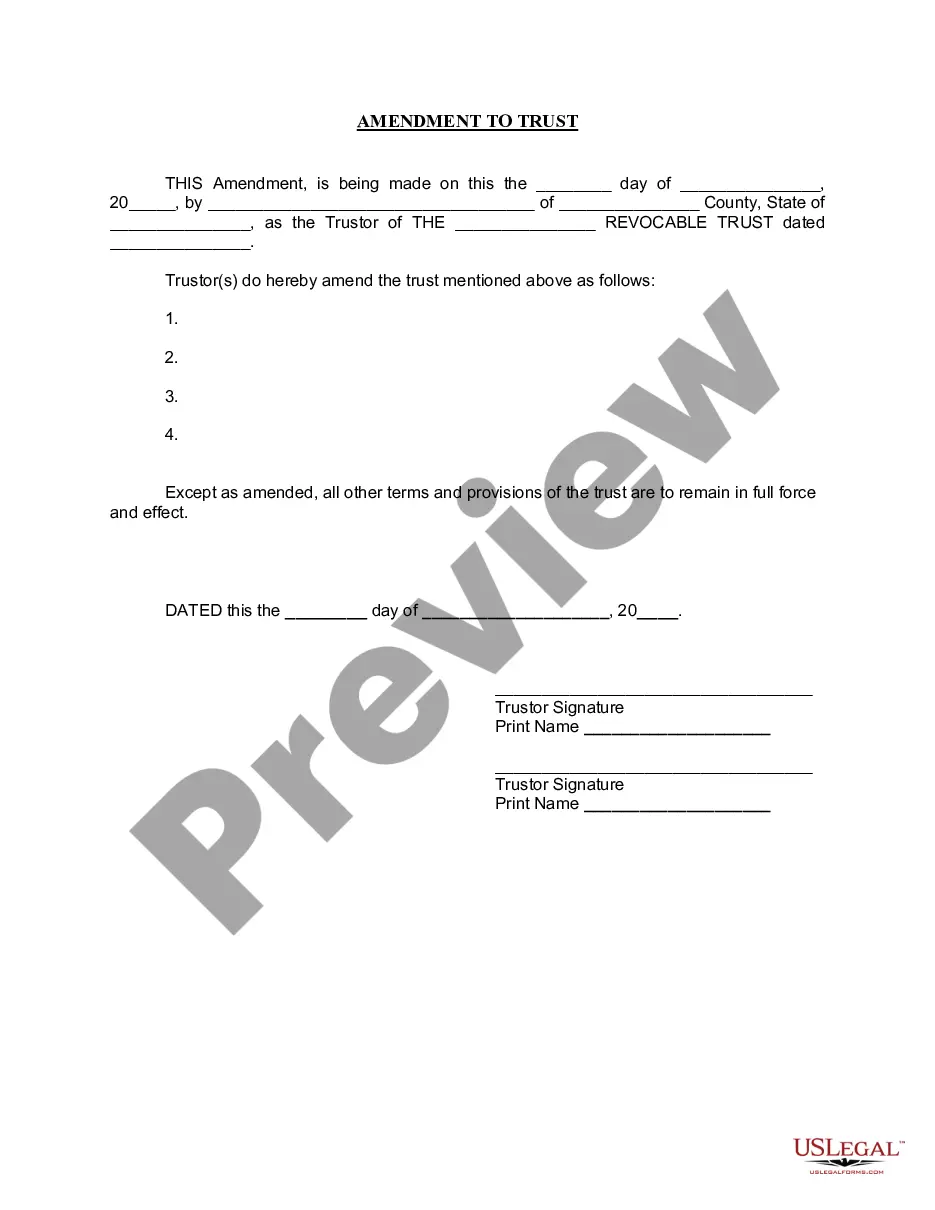
Boundary Line Agreement Regarding Fence and Driveway Inside Boundary Line
Overview of this form
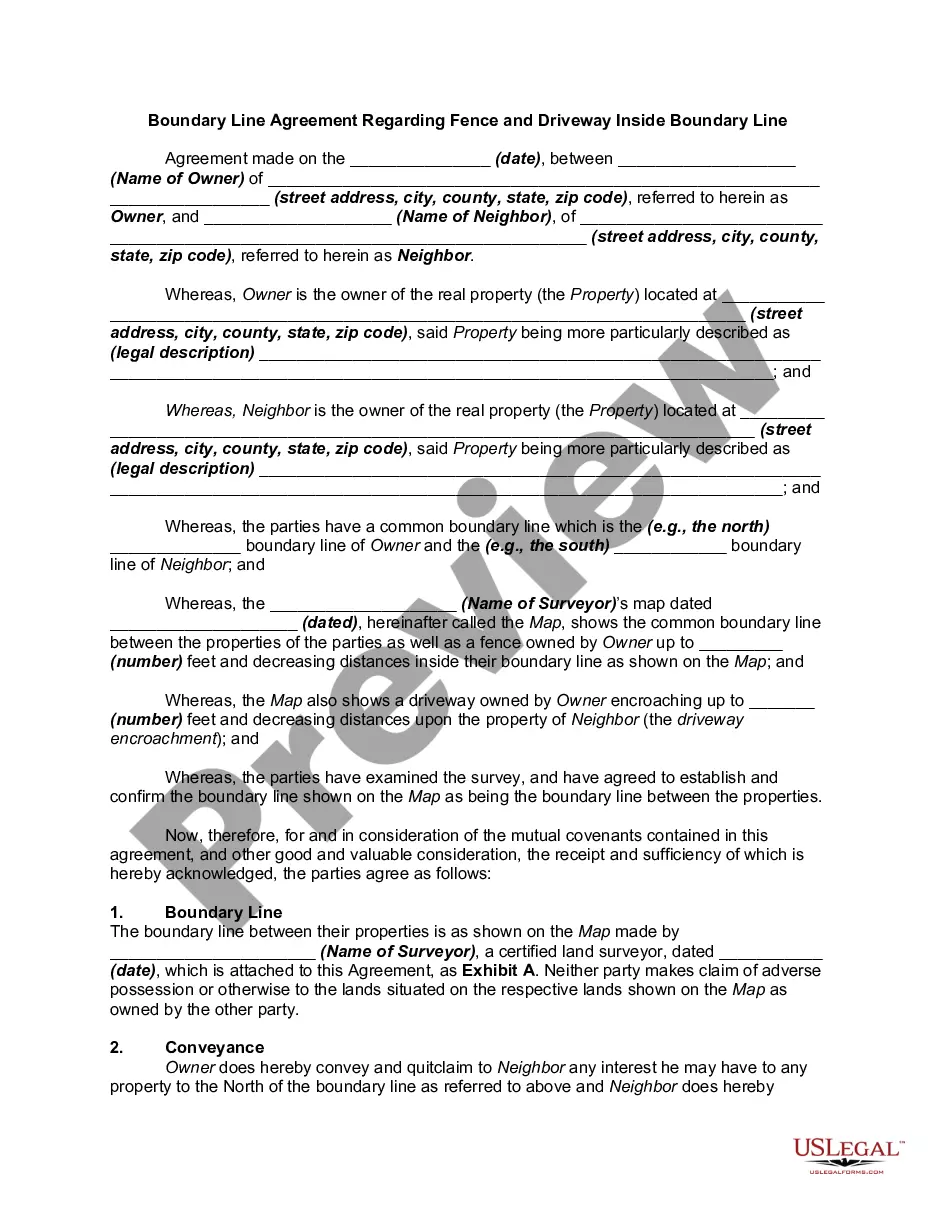
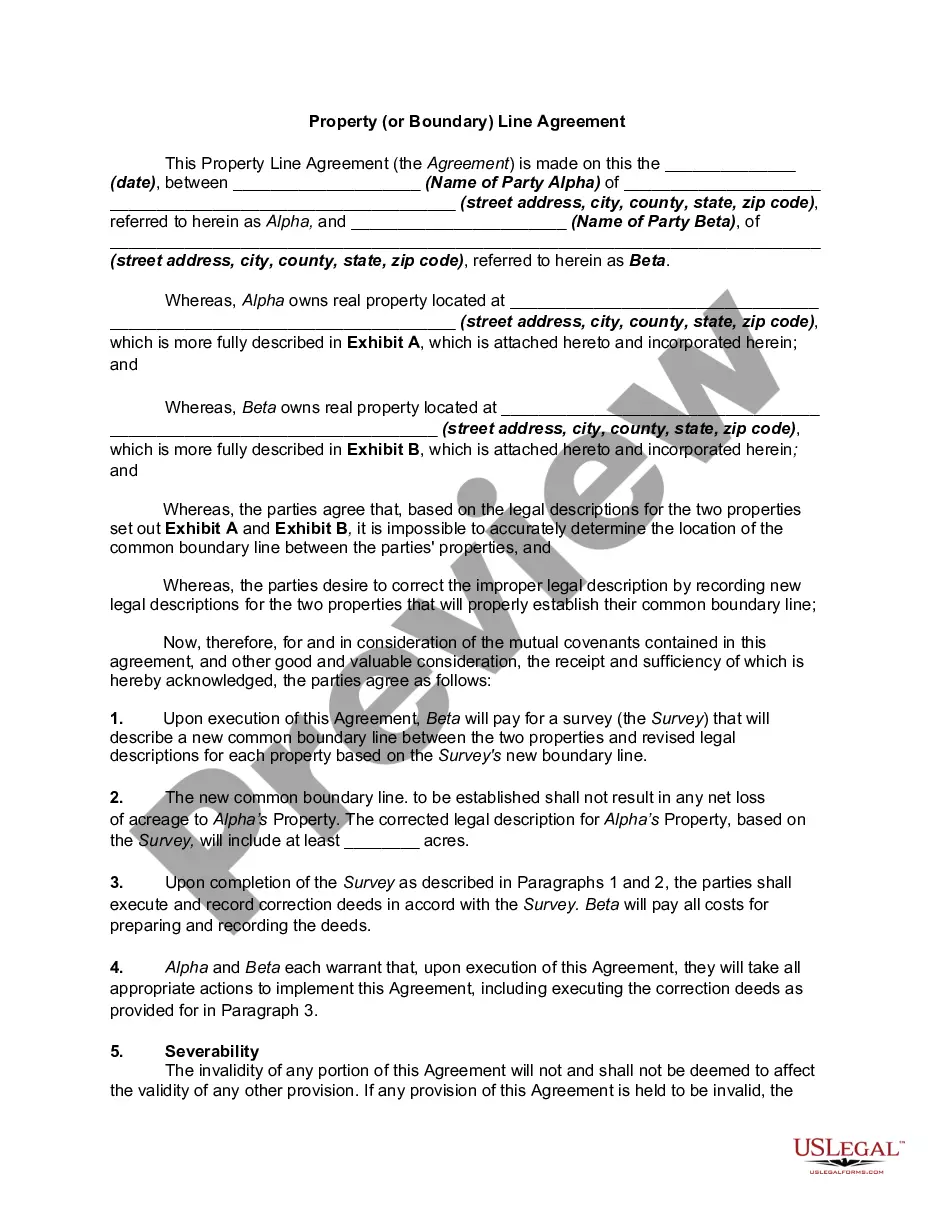
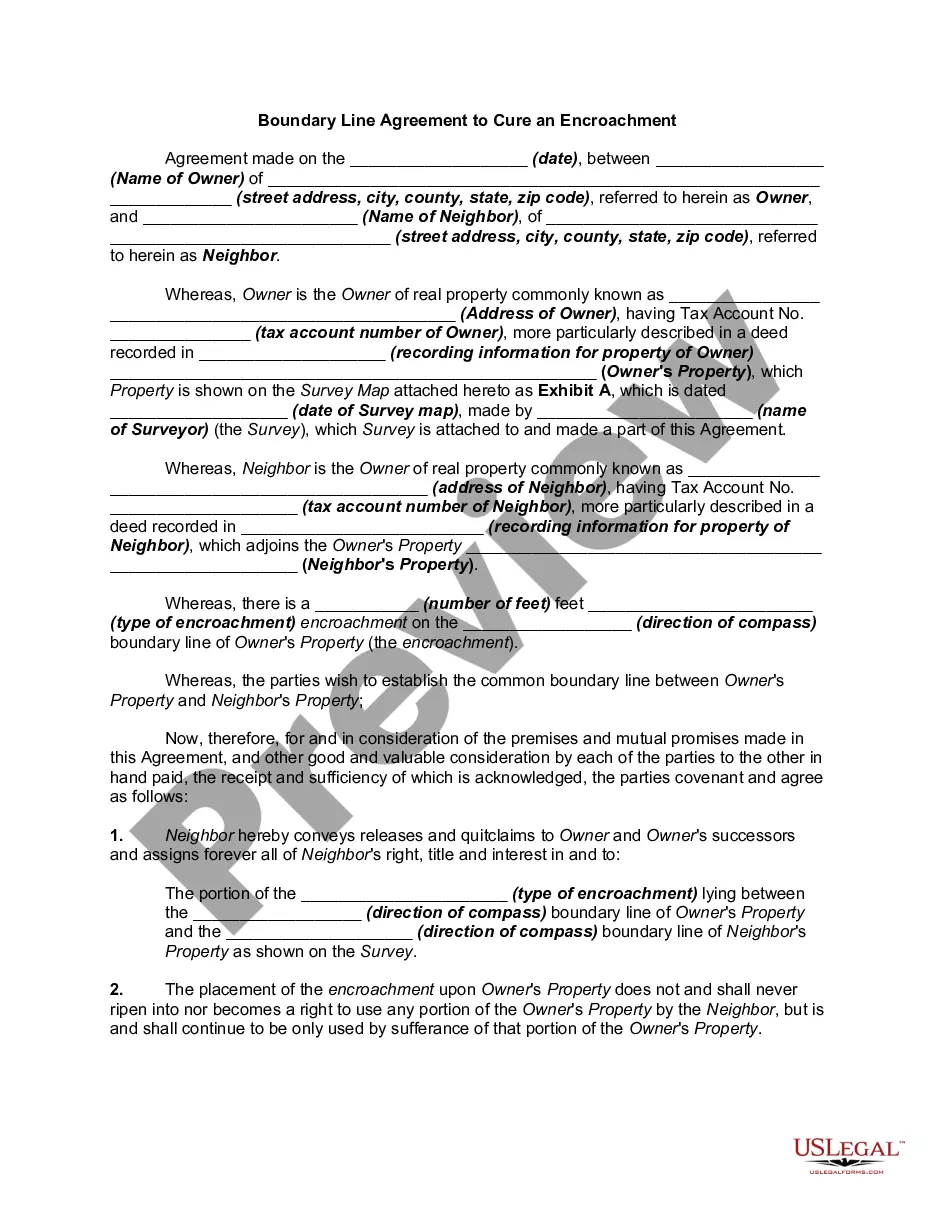
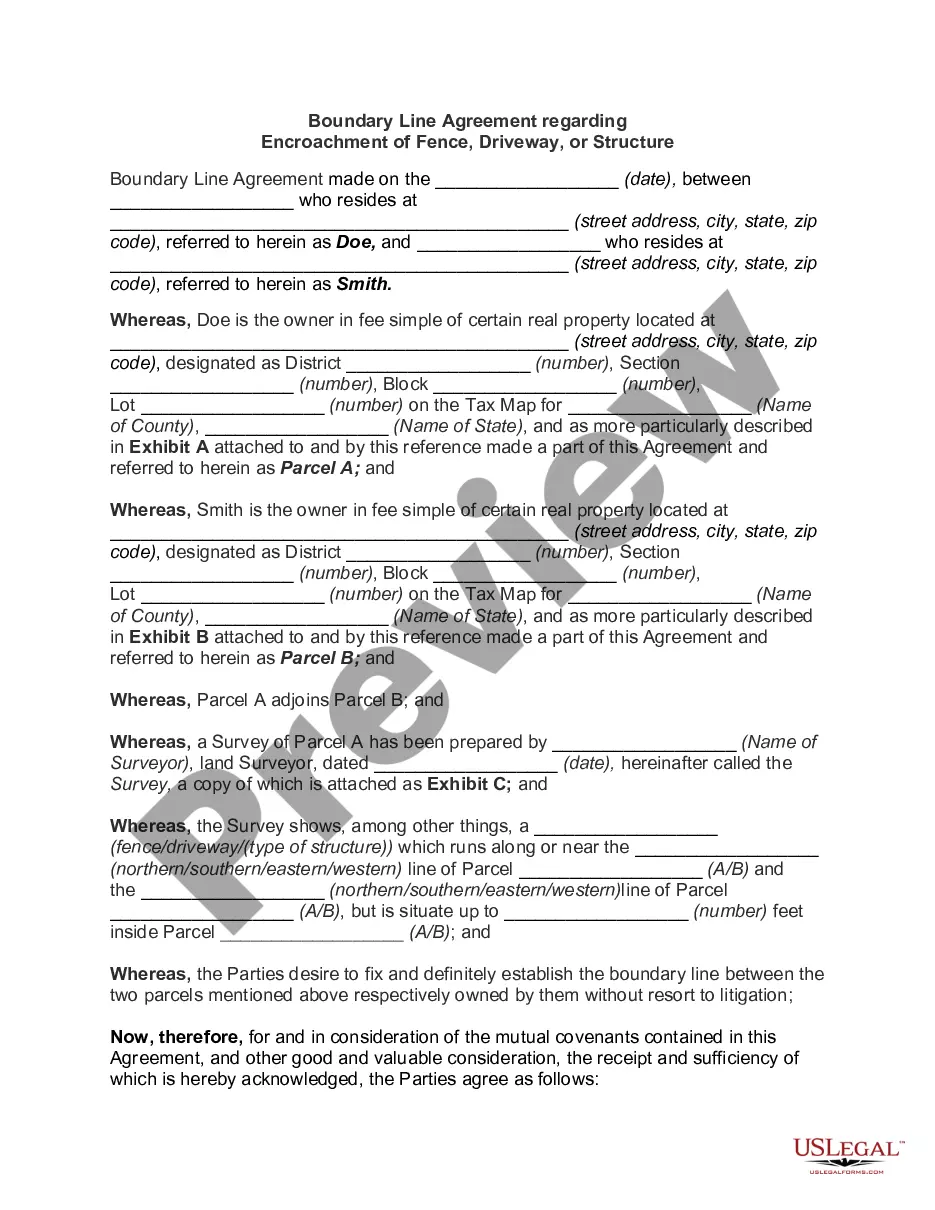
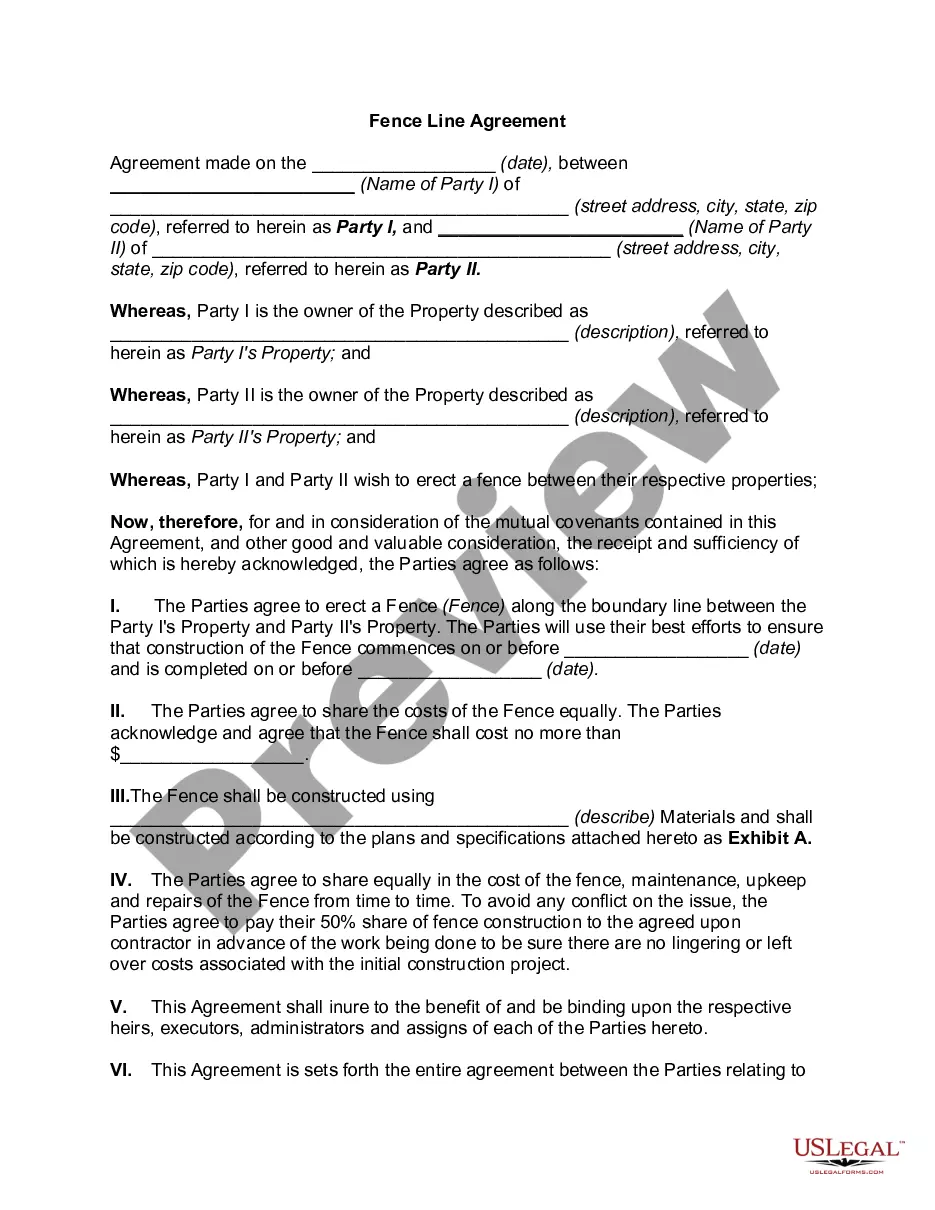
The Boundary Line Agreement Regarding Fence and Driveway Inside Boundary Line is a legal document designed to establish the formal boundary between two adjacent properties. This agreement addresses situations where a fence or driveway may encroach upon a neighbor's property, providing a clear understanding and mutual consent regarding property lines. Unlike a simple property deed, this form specifically details the encroachment, the boundaries, and the rights of each party concerning the shared boundary line and any constructions that may infringe upon it.
Form components explained
- Identification of the Owner and Neighbor along with their respective property addresses.
- A detailed description of the boundary line based on a certified land surveyor's map.
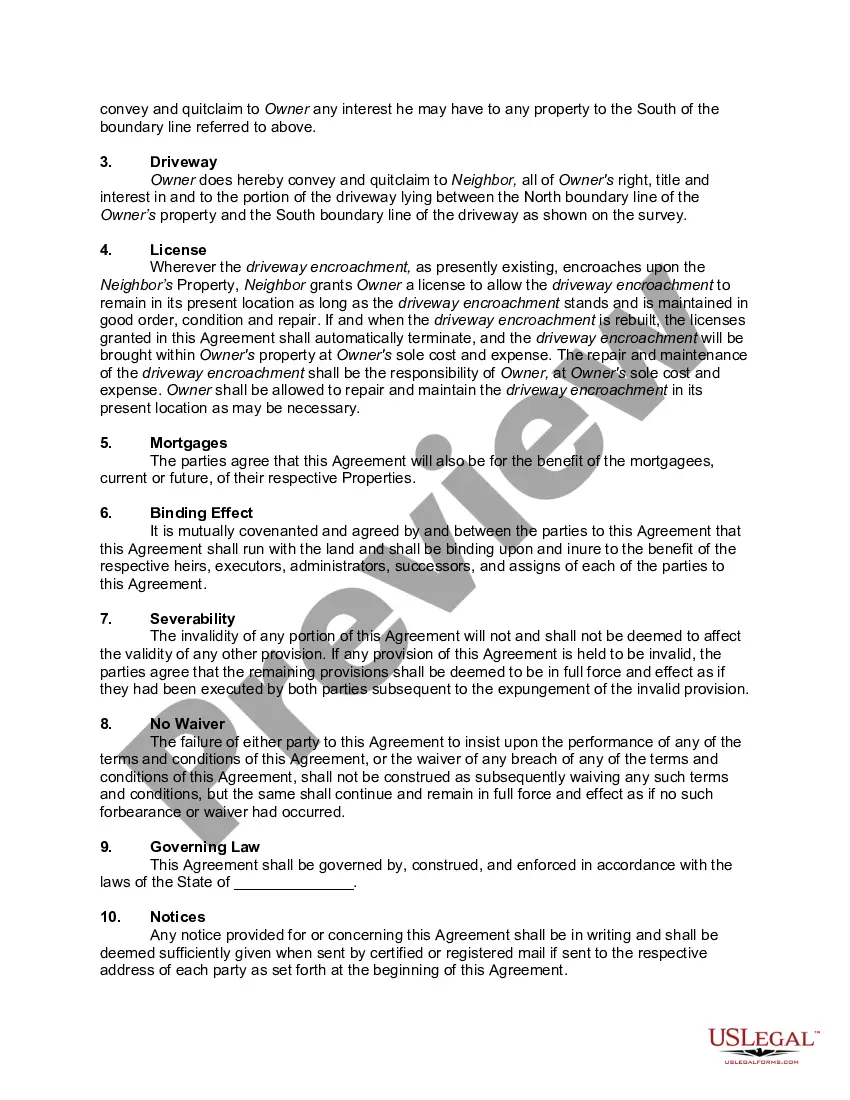
- Conveyance clauses that outline the rights each party transfers regarding the property.
- Licensing agreements for any encroaching driveway, including maintenance obligations.
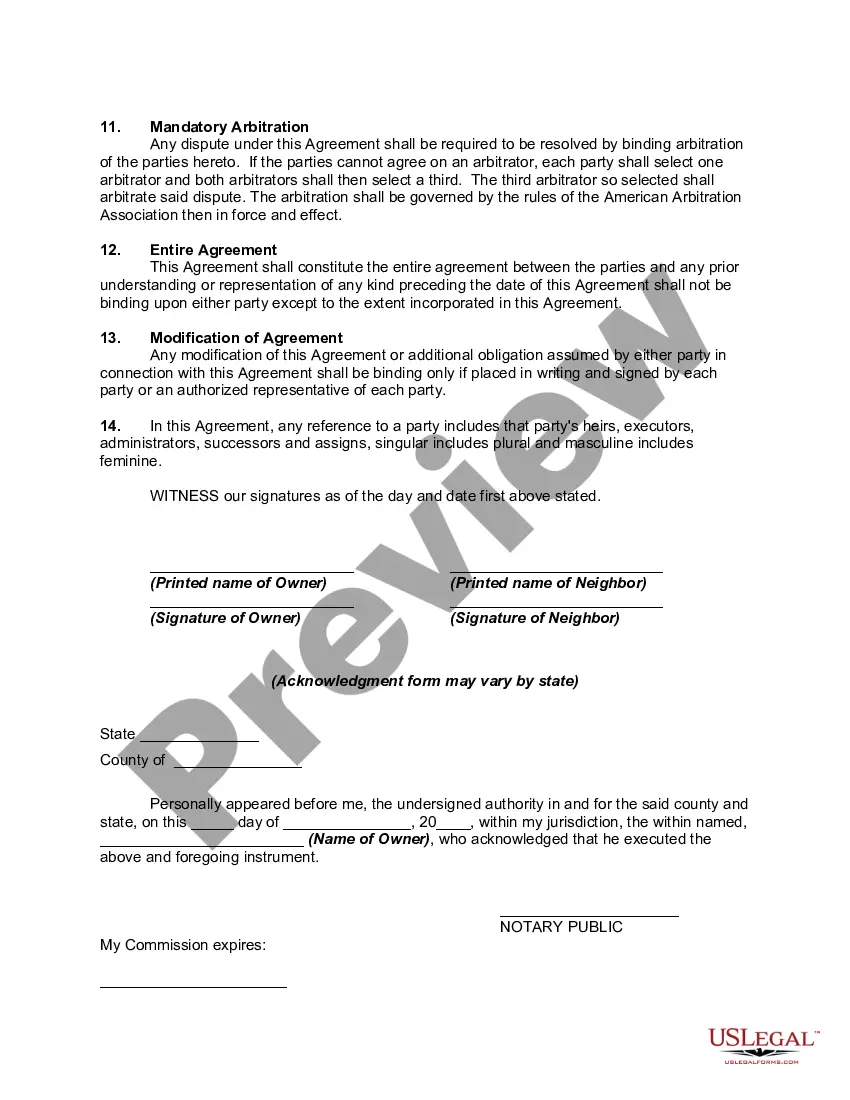
- Provisions for any future disputes, including mandatory arbitration clauses.
- Severability and governing law clauses to ensure the agreement's enforceability.

Situations where this form applies
This form is typically used in scenarios where two property owners share a boundary line and require an official agreement to clarify property lines. It is particularly useful when there are existing structures such as fences or driveways that infringe upon the neighboring property. This agreement can help prevent future disputes and establish mutual consent regarding property modifications or repairs.
Who should use this form
- Homeowners with adjacent properties where boundaries need to be formally defined.
- Neighbors concerned about property encroachments from fences or driveways.
- Property owners looking to clarify rights and responsibilities concerning shared boundaries.
- Individuals involved in property transactions needing clear boundary definitions.
Completing this form step by step
- Identify and enter the names and addresses of both the Owner and Neighbor.
- Include a detailed legal description of both properties based on a land survey.
- Specify the agreements regarding the boundary line, including identified encroachments.
- Detail the provisions for maintenance and repair of any structures (e.g., driveway).
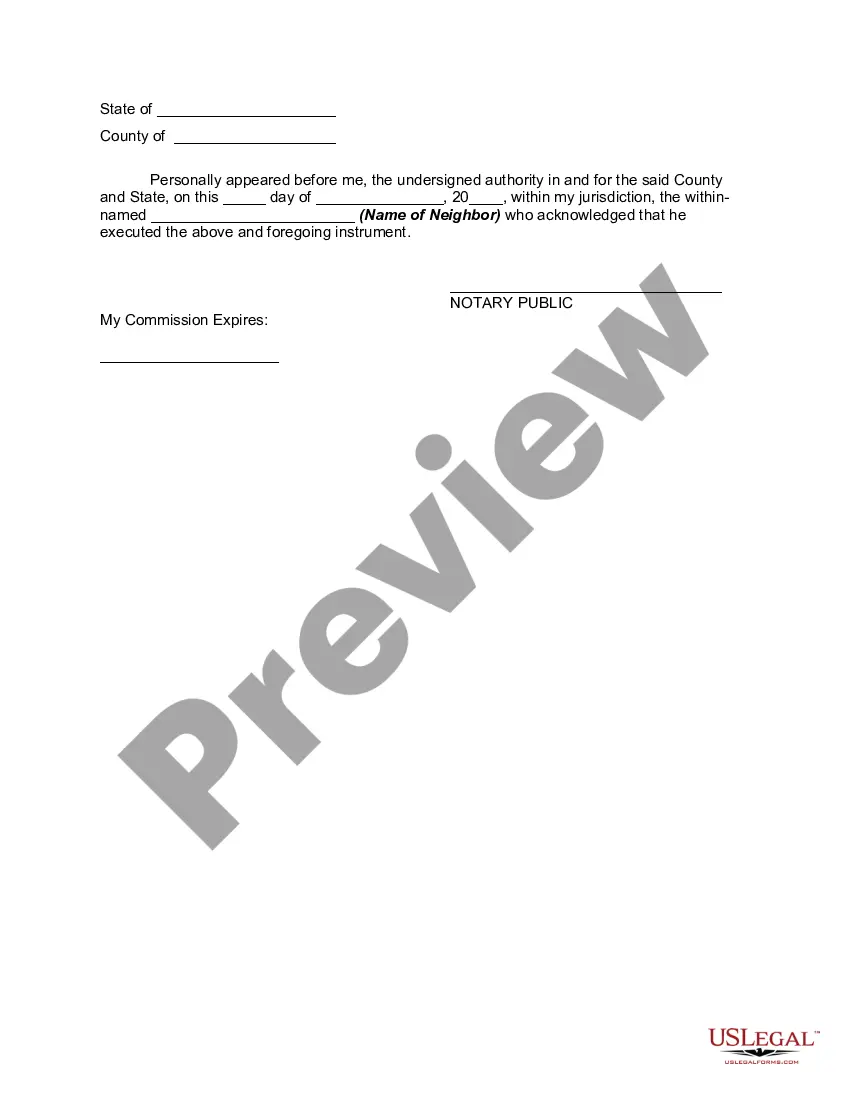
- Sign and date the agreement in the presence of a notary, if required.
Is notarization required?
Notarization is required for this form to take effect. Our online notarization service, powered by Notarize, lets you verify and sign documents remotely through an encrypted video session, available 24/7.
Get your form ready online
Our built-in tools help you complete, sign, share, and store your documents in one place.
Make edits, fill in missing information, and update formatting in US Legal Forms—just like you would in MS Word.
Download a copy, print it, send it by email, or mail it via USPS—whatever works best for your next step.
Sign and collect signatures with our SignNow integration. Send to multiple recipients, set reminders, and more. Go Premium to unlock E-Sign.
If this form requires notarization, complete it online through a secure video call—no need to meet a notary in person or wait for an appointment.
We protect your documents and personal data by following strict security and privacy standards.

Make edits, fill in missing information, and update formatting in US Legal Forms—just like you would in MS Word.

Download a copy, print it, send it by email, or mail it via USPS—whatever works best for your next step.

Sign and collect signatures with our SignNow integration. Send to multiple recipients, set reminders, and more. Go Premium to unlock E-Sign.

If this form requires notarization, complete it online through a secure video call—no need to meet a notary in person or wait for an appointment.

We protect your documents and personal data by following strict security and privacy standards.
Typical mistakes to avoid
- Failing to accurately describe the property boundaries and legal descriptions.
- Not including all parties involved, leading to future disputes.
- Overlooking the maintenance responsibilities of encroaching structures.
- Not notarizing the document when required by state law.
Why use this form online
- Convenient access and immediate download to complete from home.
- Editability allows for customization to fit individual property needs.
- Reliable templates drafted by licensed attorneys ensure legal compliance.
Legal use & context
- This form is legally binding and helps prevent future disputes between property owners.
- It clarifies the rights of each party and outlines responsibilities regarding shared boundaries.
- In cases of dispute, the arbitration clause specifies how conflicts will be resolved, minimizing litigation.
Quick recap
- The Boundary Line Agreement is essential for clarifying property boundaries with neighbors.
- It addresses encroachments and establishes rights and responsibilities of the involved parties.
- Using this form online provides convenience and legal assurance at your fingertips.
Looking for another form?







Form popularity
FAQ
Provided your fence is definitely within your property lines and complies with neighborhood regulations, you may not actually be required to talk to your neighbors about it. Still, it's common courtesy to askand it could save you future legal trouble if it turns out your neighbor wants to dispute your fence.
Your jurisdiction may have laws about how far back a fence needs to be set on your property, which is typically 2, 4, 6 or 8 inches from the property line. Other areas will allow you to go right up to the property line.
You should be aware that they are not legally obliged to put up a garden fence on their boundary at all. As long as there is a visible demarcation along the boundary, your neighbour could string a length of wire between some posts and call it a day.
If the structure is classified as fire resistive rated, it may be located closer than five (5) feet, but it shall not be located closer than three (3) feet from the property line.
If you decide to hire a licensed land surveyor, he or she will come out to your land and place markers that mark the boundary lines of your property. You can find a listing of licensed land surveyors in your area by simply consulting your local phone book or the internet.
One option for dividing property lines down a shared driveway is to install chain link fencing. A chain link fence is a relatively inexpensive fence to have installed, and can readily be placed over asphalt. Asphalt is soft enough to allow fence posts to be sunk into the driveway.
A general rule (not sure if your neighbors abide to it) is to build the fence 1-2 feet inside your property line.Your neighbors could have even blocked you from getting a fence because of easement right between yards, all things to look up before this endeavor.
The three most commonly used markings are the simple stakes, flags and pins. These surveyor symbols are common to any construction project and guarantee that everything gets put in the right place.
Property boundaries are often identified above ground with the use of stakes to mark the corner points. Years ago, wooden stakes were often used to mark property lines. More recently, long metal posts that are visible about 1 to 2 feet above ground have been used.