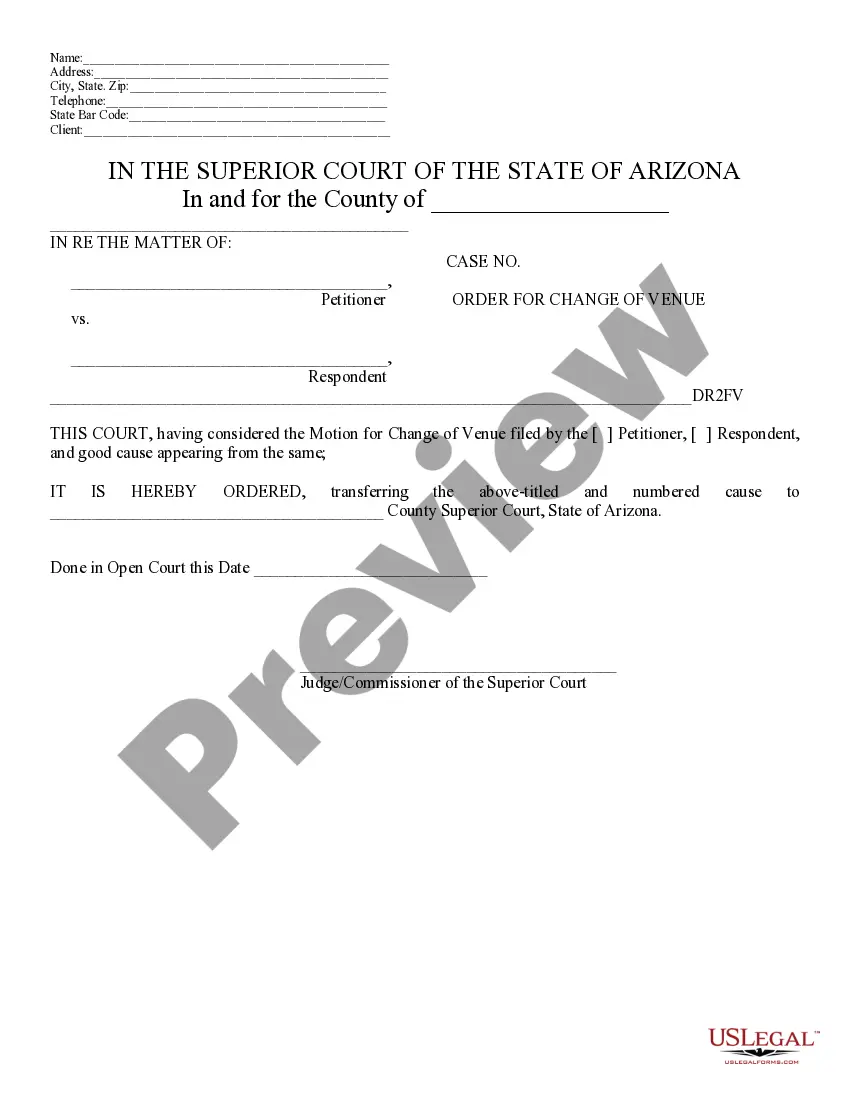
Complaint in Federal District Court for a Mandatory Injunction to Prevent the Substitution of an Honorable Discharge for Invalid, Punitive Court - Martial Ordered Discharge
What is this form?
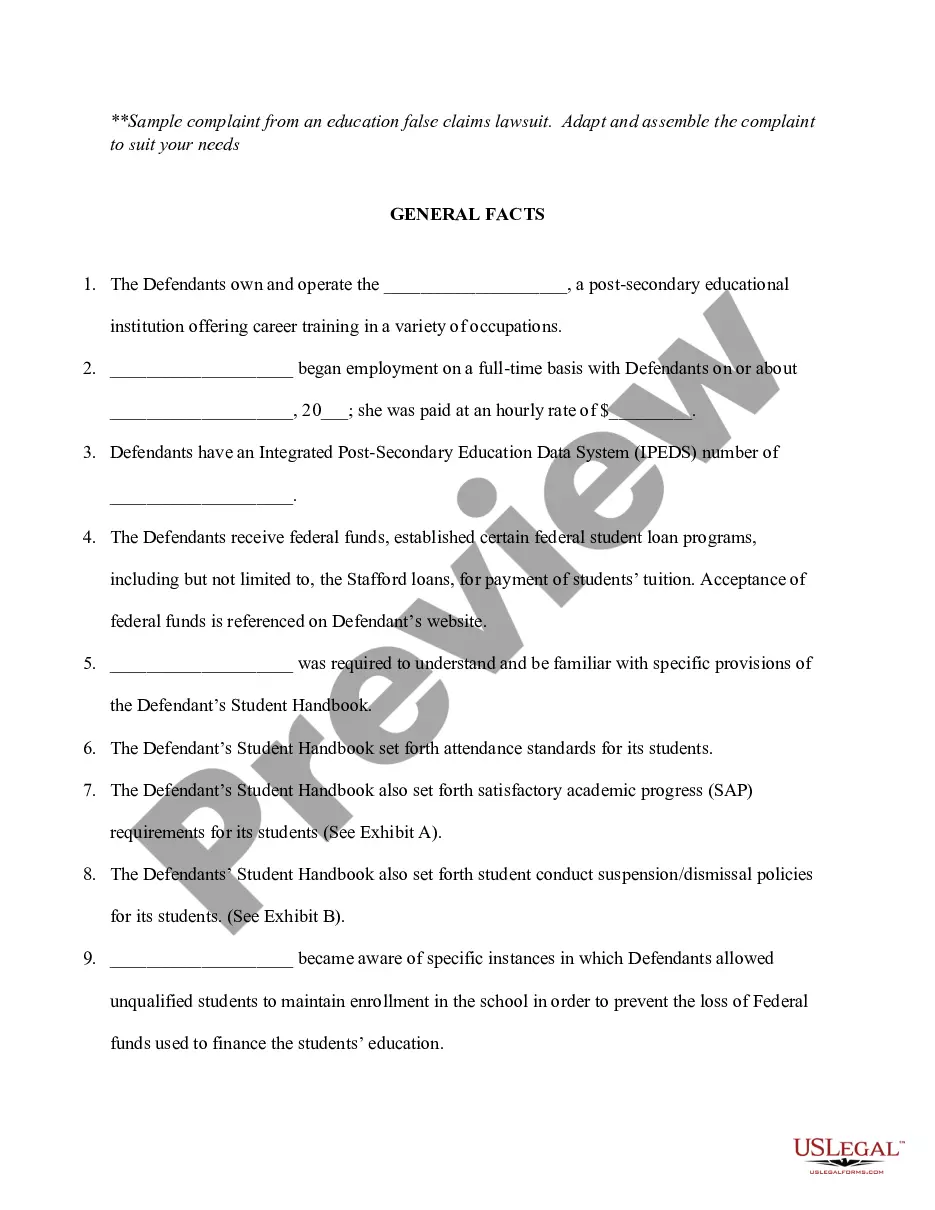
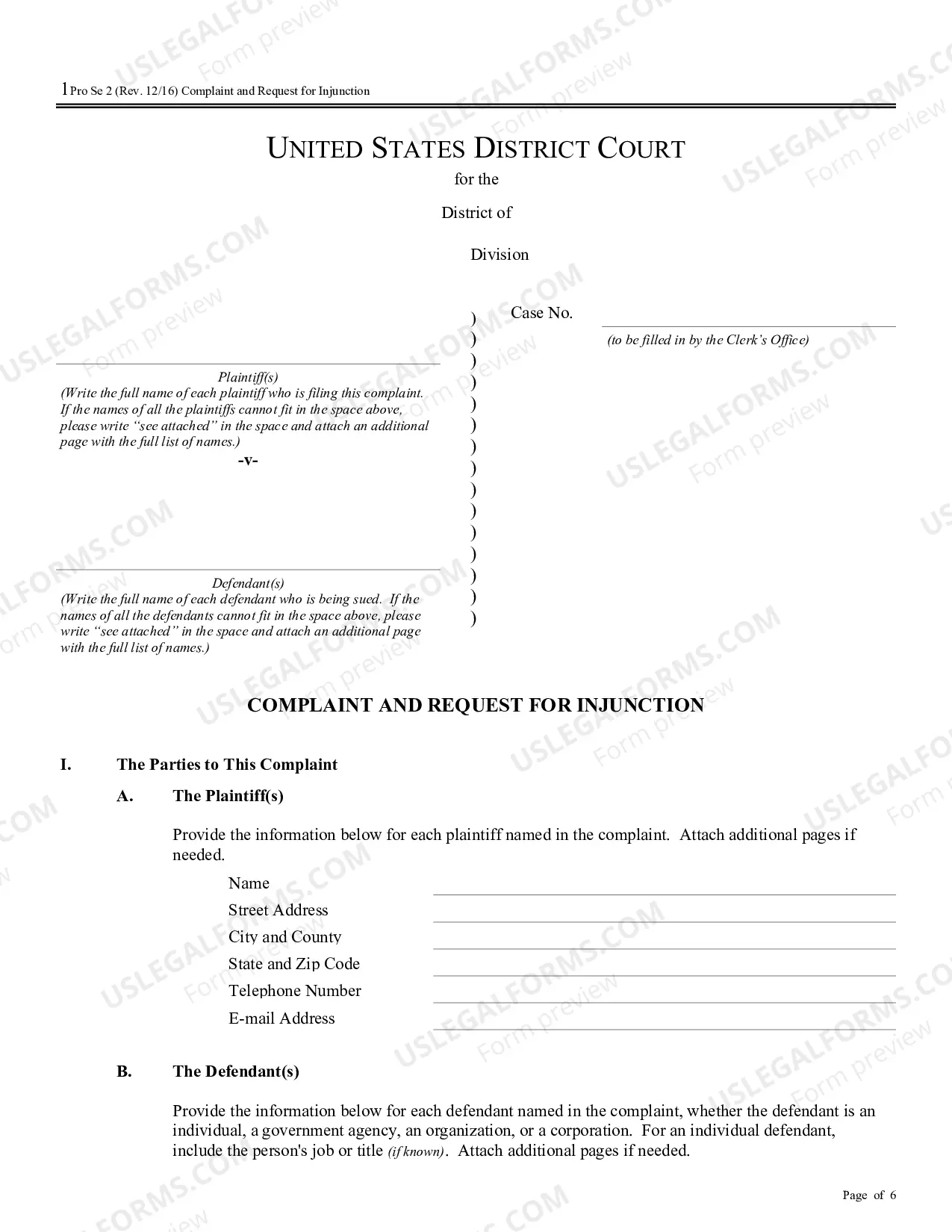
The Complaint in Federal District Court for a Mandatory Injunction to Prevent the Substitution of an Honorable Discharge for Invalid, Punitive Court-Martial Ordered Discharge is a legal document used to request a court-ordered injunction. This injunction aims to compel the U.S. Secretary of Defense to replace a punitive discharge with an honorable one. It is particularly useful for individuals who believe their discharge was issued in violation of their rights and seek to restore their honorable status through judicial intervention.
Key parts of this document
- Plaintiff and defendant identification, stating the case context.
- Claims of jurisdiction and basis for seeking injunctive relief.
- Details surrounding the plaintiff's military service and discharge circumstances.
- Documentation of efforts made to rectify the discharge through administrative channels.
- Specific requests for the court regarding the issuance of an honorable discharge.



When to use this document
This form should be used when a service member believes that their bad conduct or dishonorable discharge was issued improperly, such as without a fair trial or in violation of military regulations. It is especially relevant when administrative remedies have been exhausted without success, and the individual seeks judicial intervention to correct their discharge status.
Who can use this document
- Former service members who received a punitive discharge.
- Individuals seeking to challenge the validity of a discharge due to procedural errors in court martial proceedings.
- Plaintiffs who have exhausted administrative routes and seek judicial relief.
- Citizens of the United States residing in any county or state.
Instructions for completing this form
- Identify the plaintiff by entering their name and address.
- Specify the defendant as the U.S. Secretary of Defense.
- Provide the dates relevant to military service and the discharge details.
- Include detailed claims supporting the request for an injunction, referencing attached exhibits.
- State the specific relief sought from the court.
Does this form need to be notarized?
In most cases, this form does not require notarization. However, some jurisdictions or signing circumstances might. US Legal Forms offers online notarization powered by Notarize, accessible 24/7 for a quick, remote process.
Get your form ready online
Our built-in tools help you complete, sign, share, and store your documents in one place.
Make edits, fill in missing information, and update formatting in US Legal Forms—just like you would in MS Word.
Download a copy, print it, send it by email, or mail it via USPS—whatever works best for your next step.
Sign and collect signatures with our SignNow integration. Send to multiple recipients, set reminders, and more. Go Premium to unlock E-Sign.
If this form requires notarization, complete it online through a secure video call—no need to meet a notary in person or wait for an appointment.
We protect your documents and personal data by following strict security and privacy standards.

Make edits, fill in missing information, and update formatting in US Legal Forms—just like you would in MS Word.

Download a copy, print it, send it by email, or mail it via USPS—whatever works best for your next step.

Sign and collect signatures with our SignNow integration. Send to multiple recipients, set reminders, and more. Go Premium to unlock E-Sign.

If this form requires notarization, complete it online through a secure video call—no need to meet a notary in person or wait for an appointment.

We protect your documents and personal data by following strict security and privacy standards.
Mistakes to watch out for
- Failing to attach necessary exhibits that support the claims made.
- Not providing clear details about the military service background and the discharge process.
- Omitting the date of events which can impact the credibility of claims.
Why use this form online
- Convenience of downloading and filling the form at your own pace.
- Access to well-drafted templates created by licensed attorneys.
- Ability to edit and customize the form according to individual circumstances.
Legal use & context
- This form can be used to seek a legal remedy in federal court when all other administrative options have been exhausted.
- It is crucial in preserving the plaintiff's rights as it relates to their military service record.
- The courts view injunctions as serious remedies; hence careful legal strategy should be employed.
What to keep in mind
- The form is specifically designed for challenging punitive military discharges.
- Gathering all necessary documentation is essential for a successful petition.
- Legal representation is recommended to navigate the complexities of federal court procedures.
Looking for another form?
Form popularity
FAQ
A legal doctrine that prevents people who are injured as a result of military service from successfully suing the federal government under the Federal Tort Claims Act.Also known as the Feres-Stencel doctrine or the Feres rule.
You can obtain an Army honorable discharge simply by fulfilling your enlistment commitment. You may also be discharged for falling short of Army standards, failing basic training, committing a major infraction of Army rules or an outright crime.
Other-Than-Honorable Conditions Discharge In most cases, veterans who receive an other-than-honorable discharge cannot re-enlist in the Armed Forces or reserves, except under very rare circumstances. Veterans benefits are not usually available to those discharged through this type of discharge.
Veterans with this character of service are eligible for all benefits through the VA, such as disability pay, education benefits, and healthcare benefits. Veterans must have an honorable discharge to receive education benefits through the Post-9/11 GI Bill or Montgomery GI Bill.
Military Pay Claims at the U.S. Court of Federal Claims Federal law allows you to sue the U.S. government for payment of money as a result of the wrongful discharge, improper retirement, denial of promotion, service-related disability, and incorrect military records under some circumstances.
In exchange for getting off active duty early, servicemembers agree to serve double the time left on their contract in the Air National Guard. Other branches may have similar programs that allow active duty members off early in exchange for transitioning into the Guard or Reserves.
Here is a list of most types of military discharges: 1 honorable discharge; 2 general discharge under honorable conditions; 3 other than honorable (OTH) discharge; 4 bad conduct discharge (issued by special court-martial or general court-martial); 5 dishonorable discharge; 6 entry-level separation; 7
Think of the military as any big company if that company is responsible for a wrong you have suffered, you are generally able to seek financial compensation. Unfortunately, most active duty members of the military CANNOT sue the military.
No you cannot sue the military since it's protected from frivolous lawsuits like this under the Ferres Doctrine - otherwise every individual with hurt feelings would be filing lawsuits and bury the military in this nonsense.