Sample Complaint under False Claims Act
What is this form?
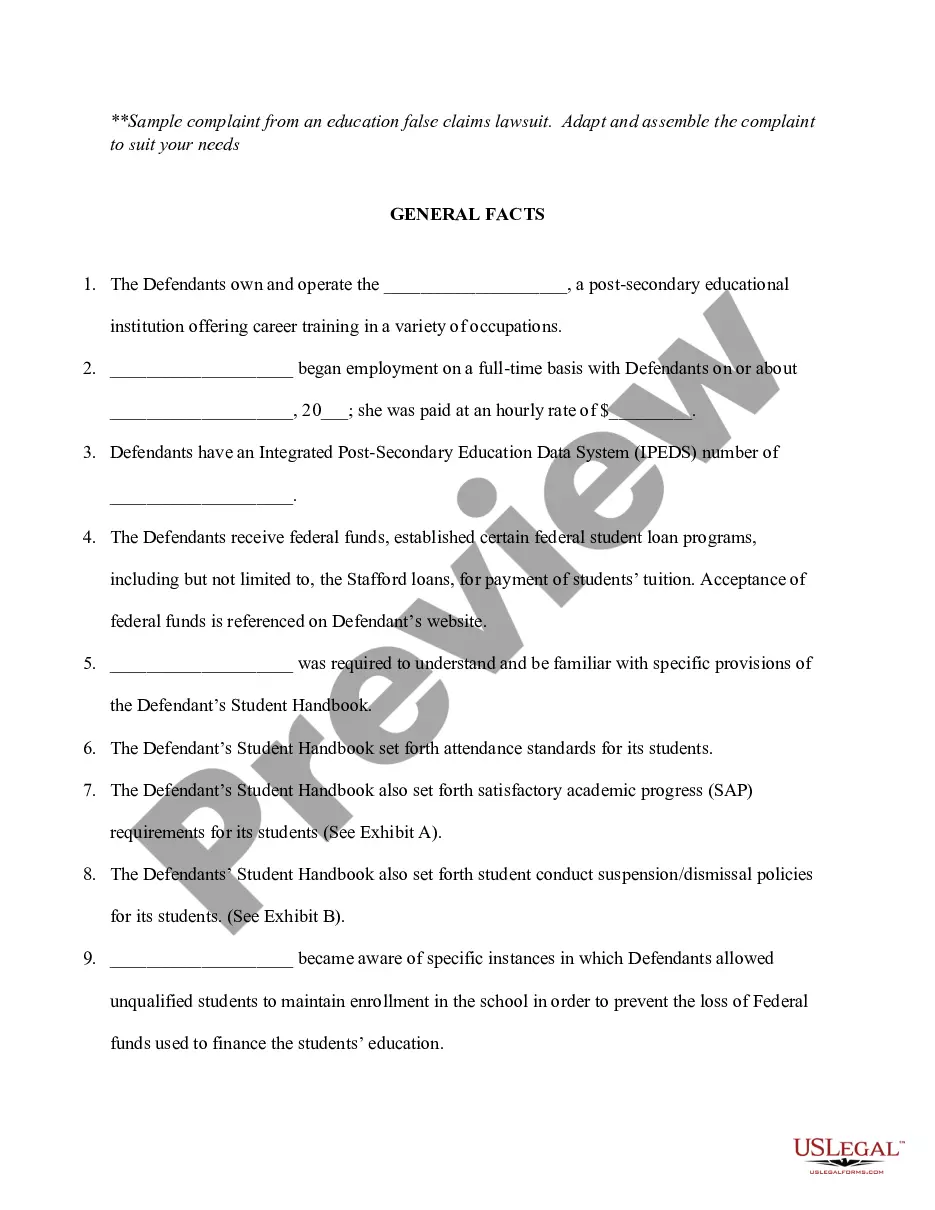
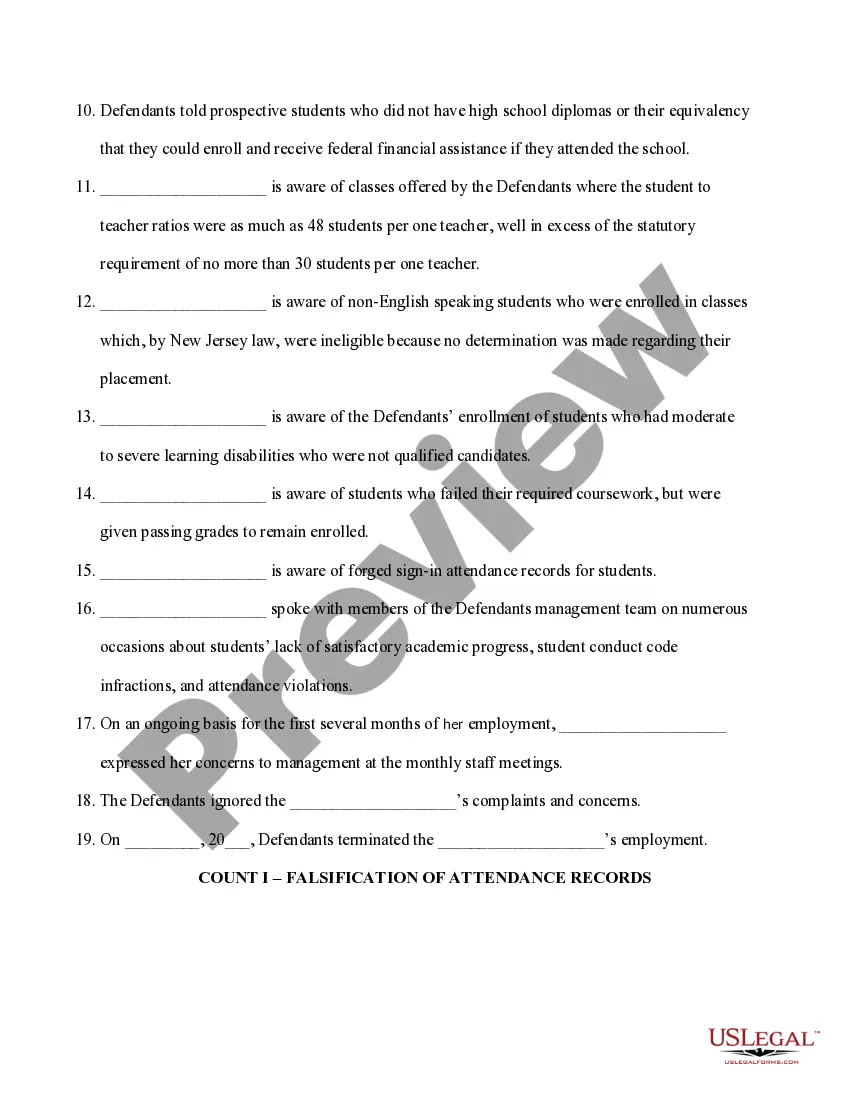
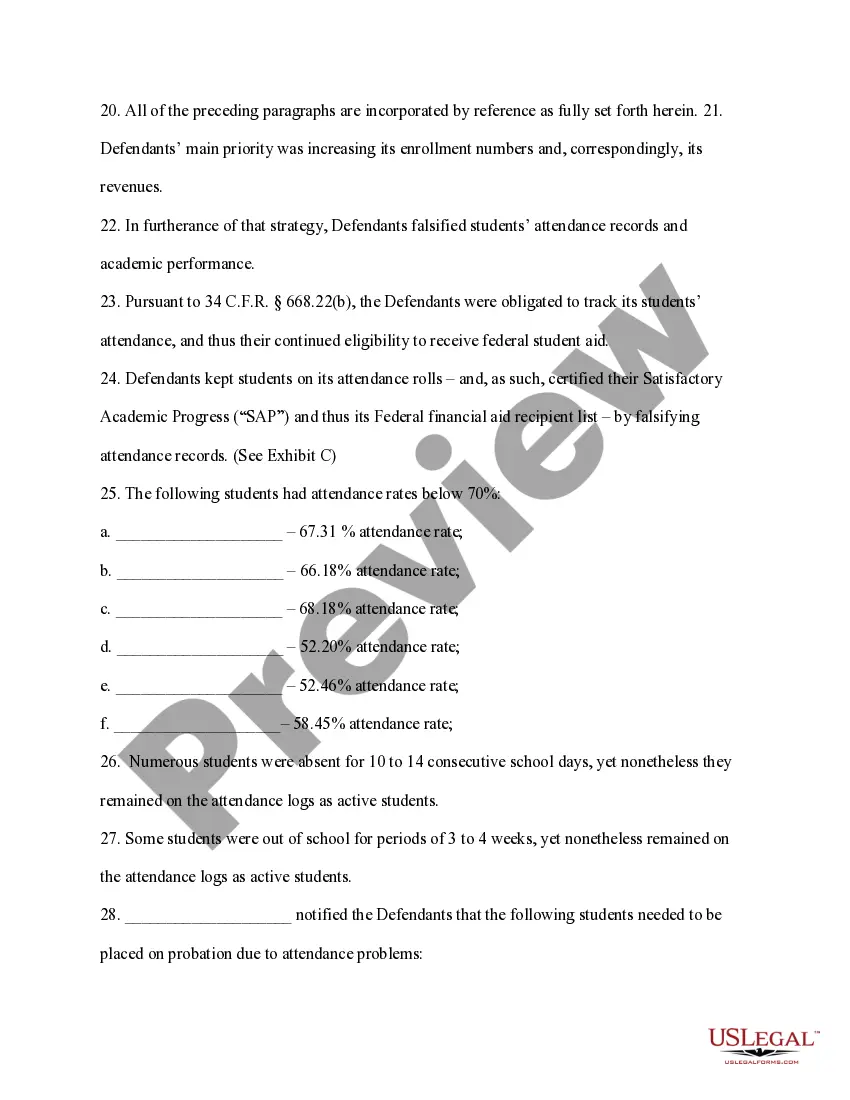
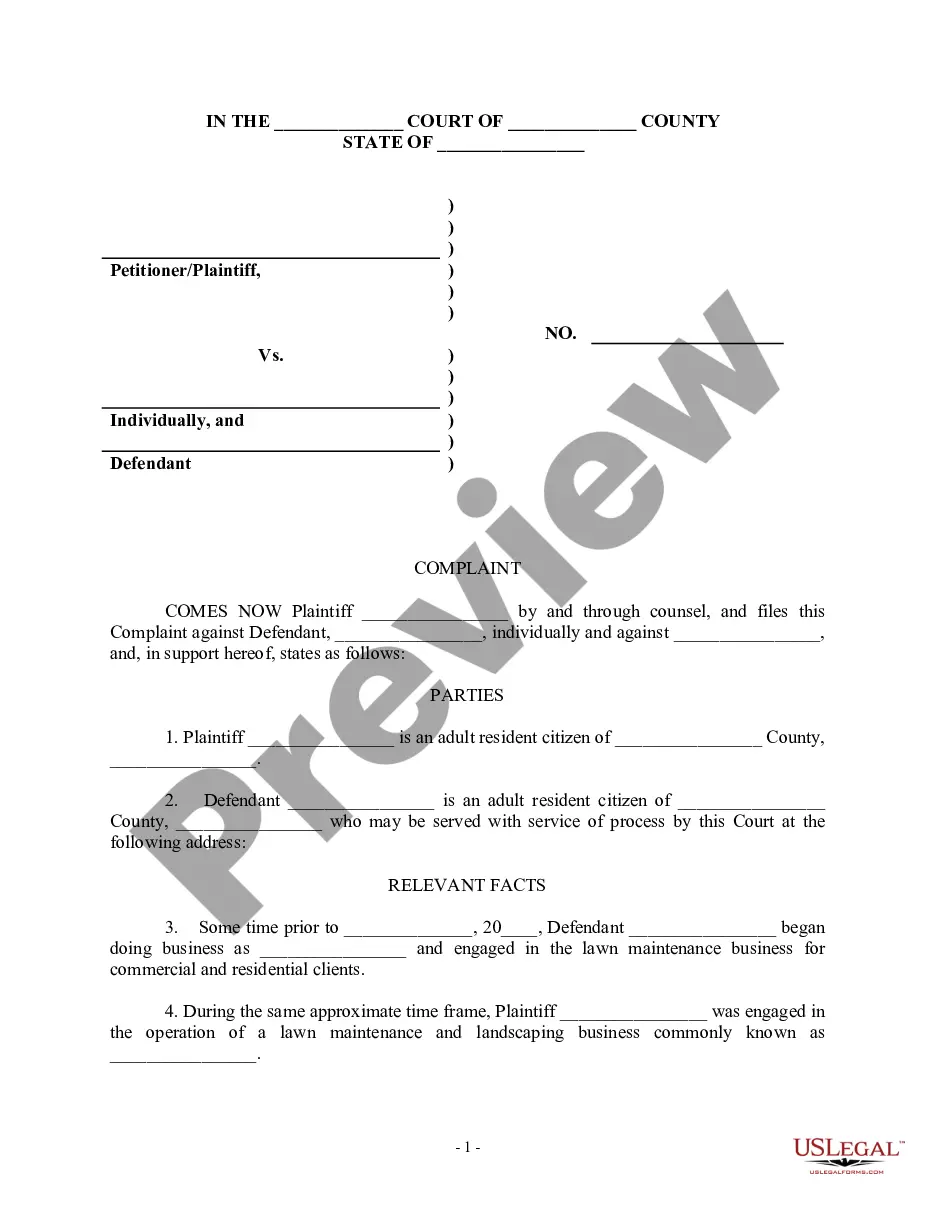
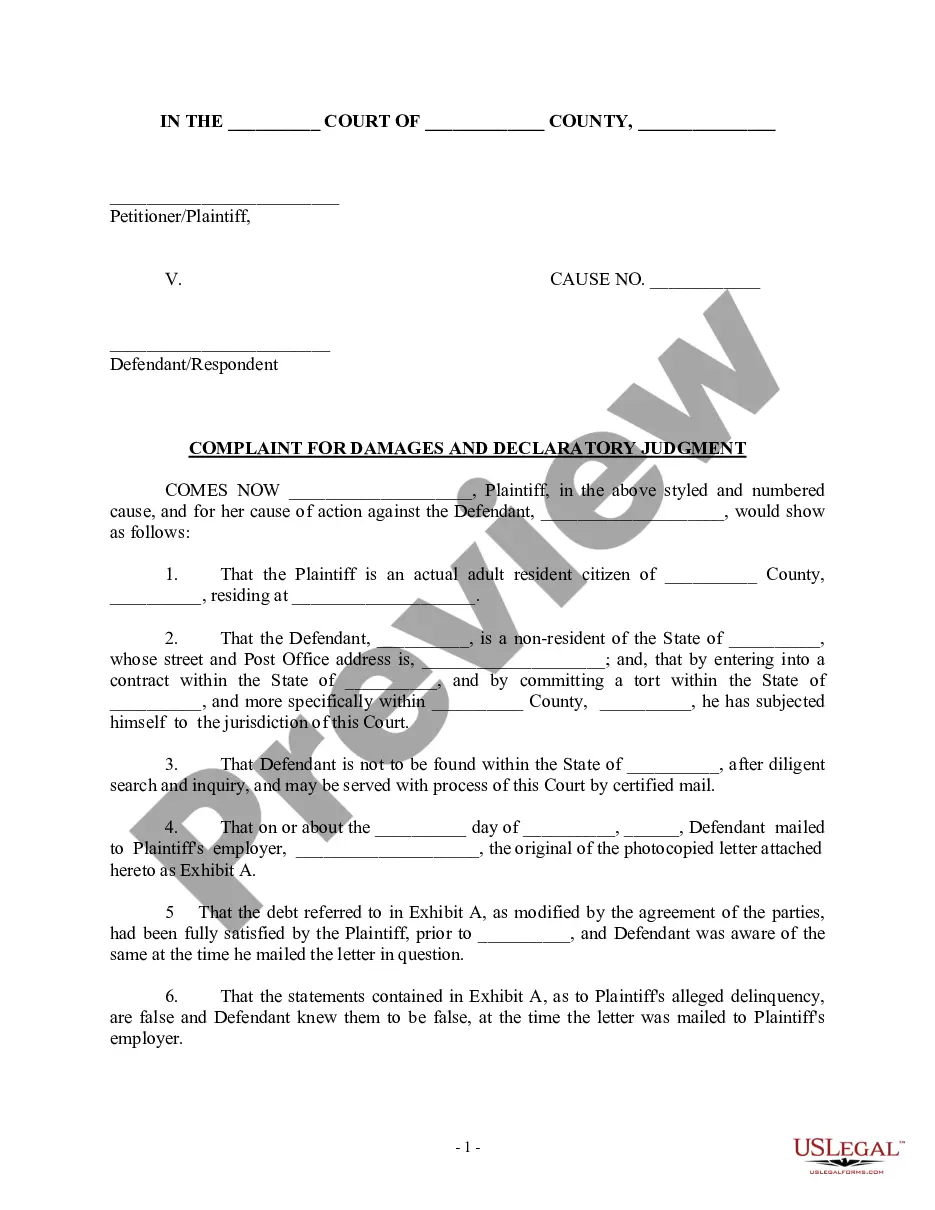
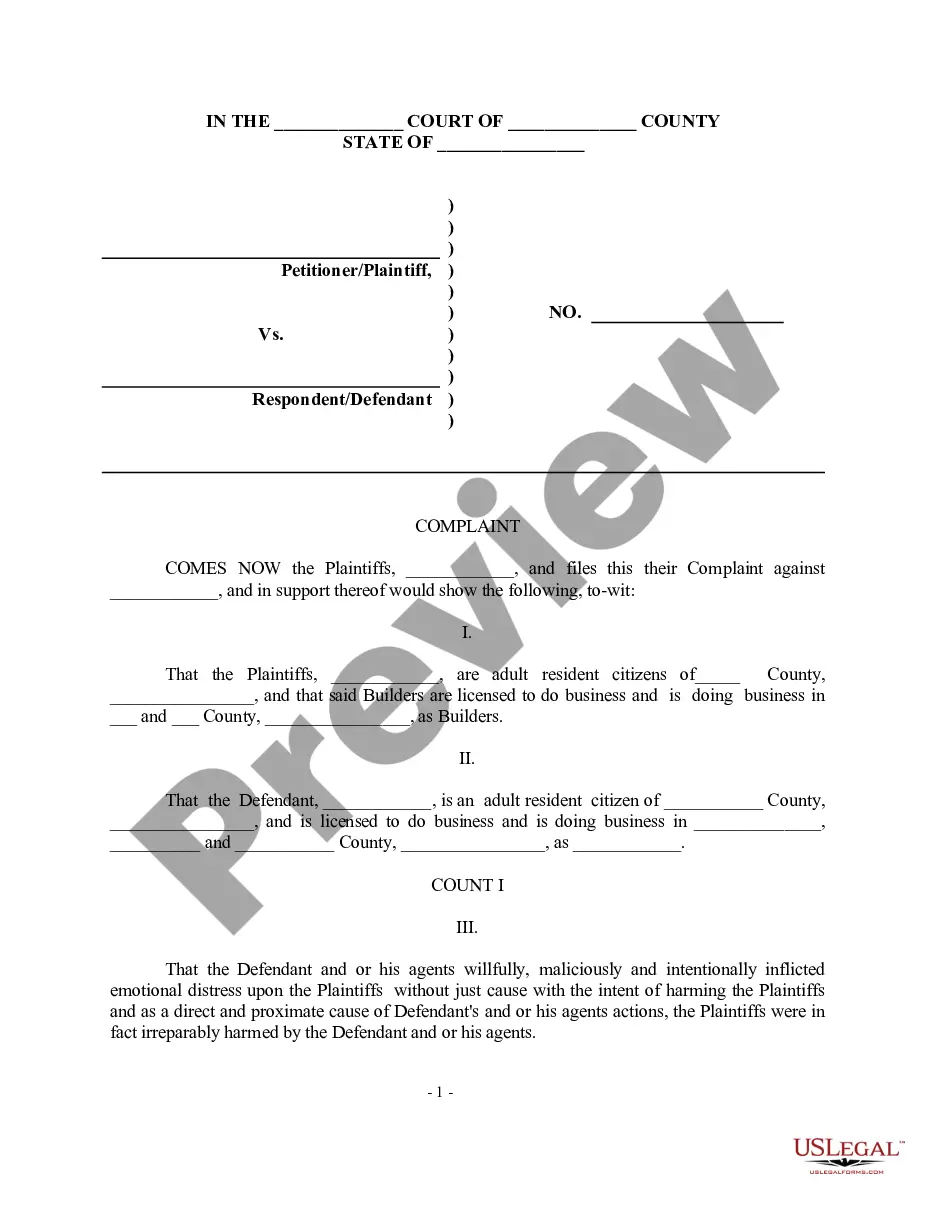
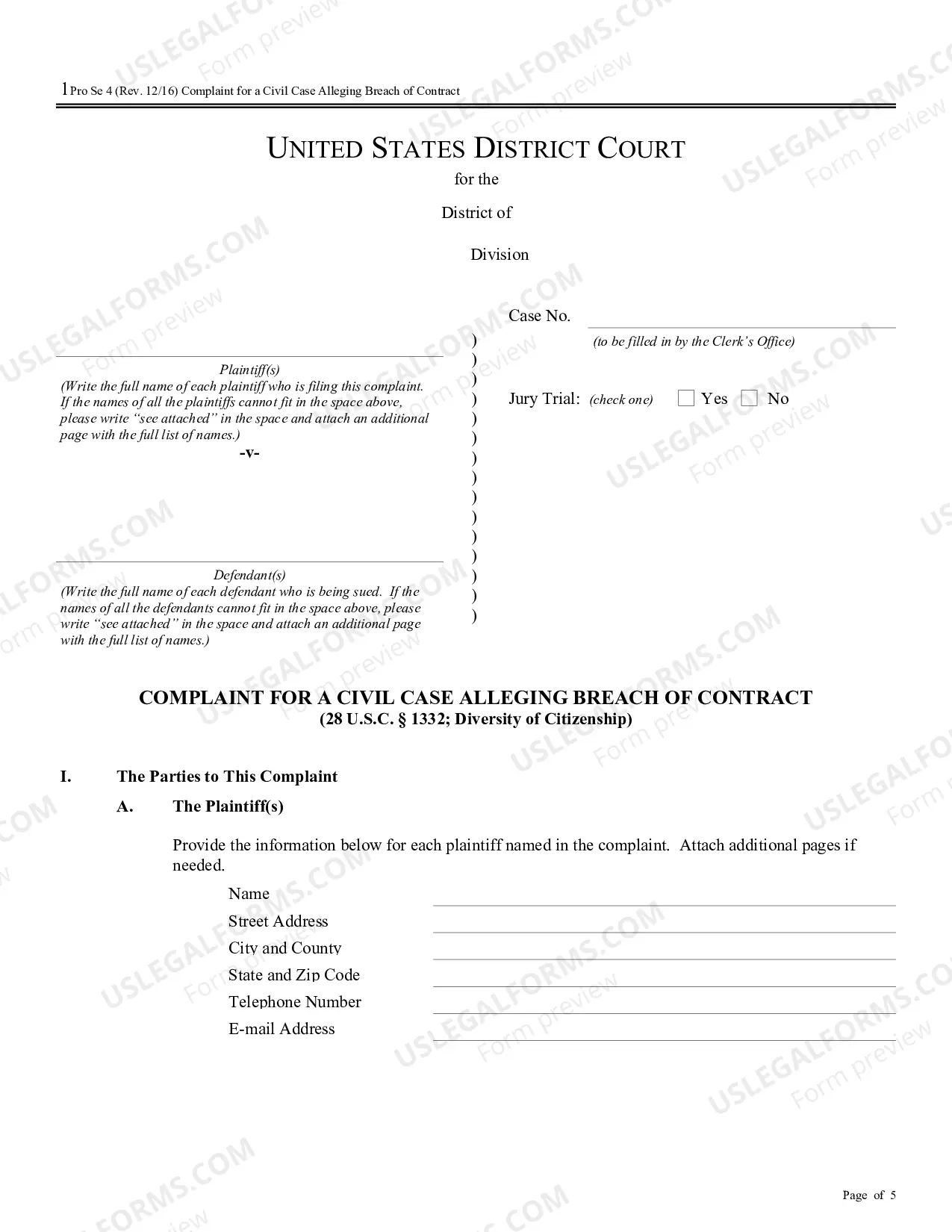
This Sample Complaint under the False Claims Act is a legal document that outlines allegations against a post-secondary educational institution for violating federal law. Specifically, it addresses issues related to the manipulation of school attendance records, inaccurate reporting of student demographics, and retaliatory termination of an employee raising concerns about these practices. This form serves as a framework for individuals seeking to file a complaint under the False Claims Act, enabling them to adapt the sample language to their specific situation.
Key parts of this document
- General facts about the educational institution and employment details.
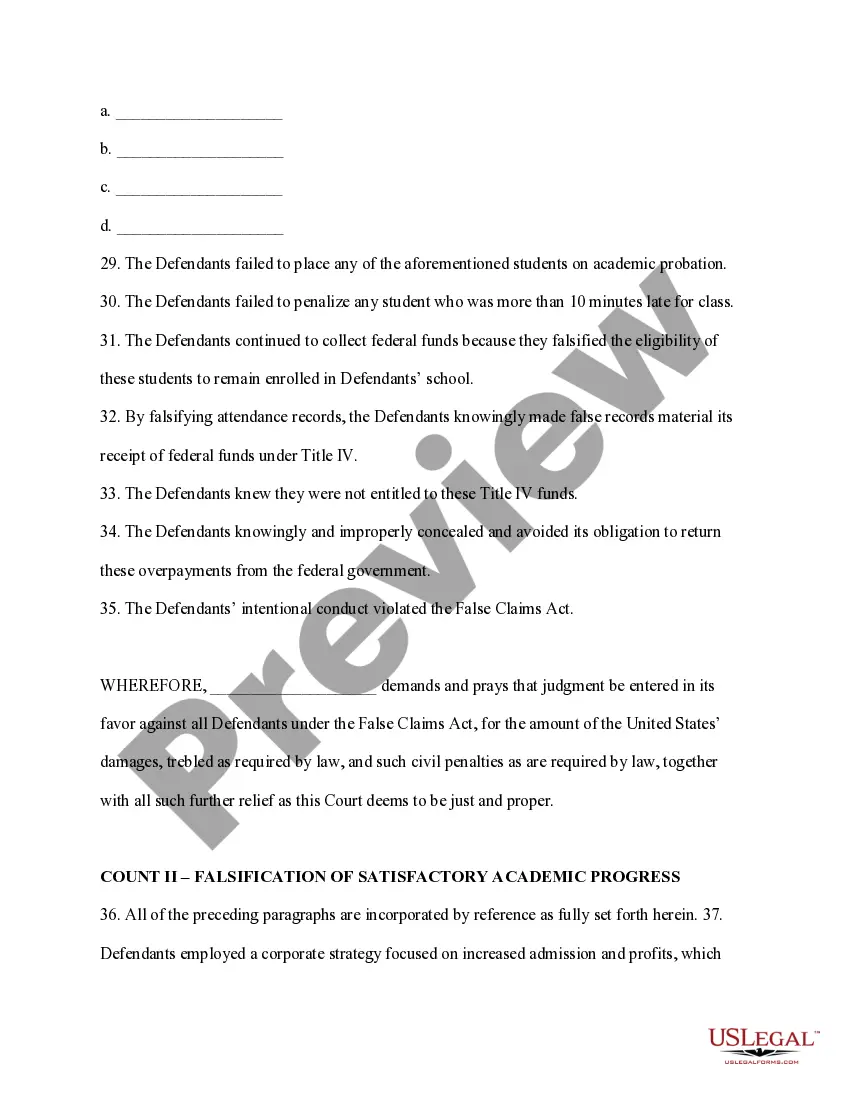
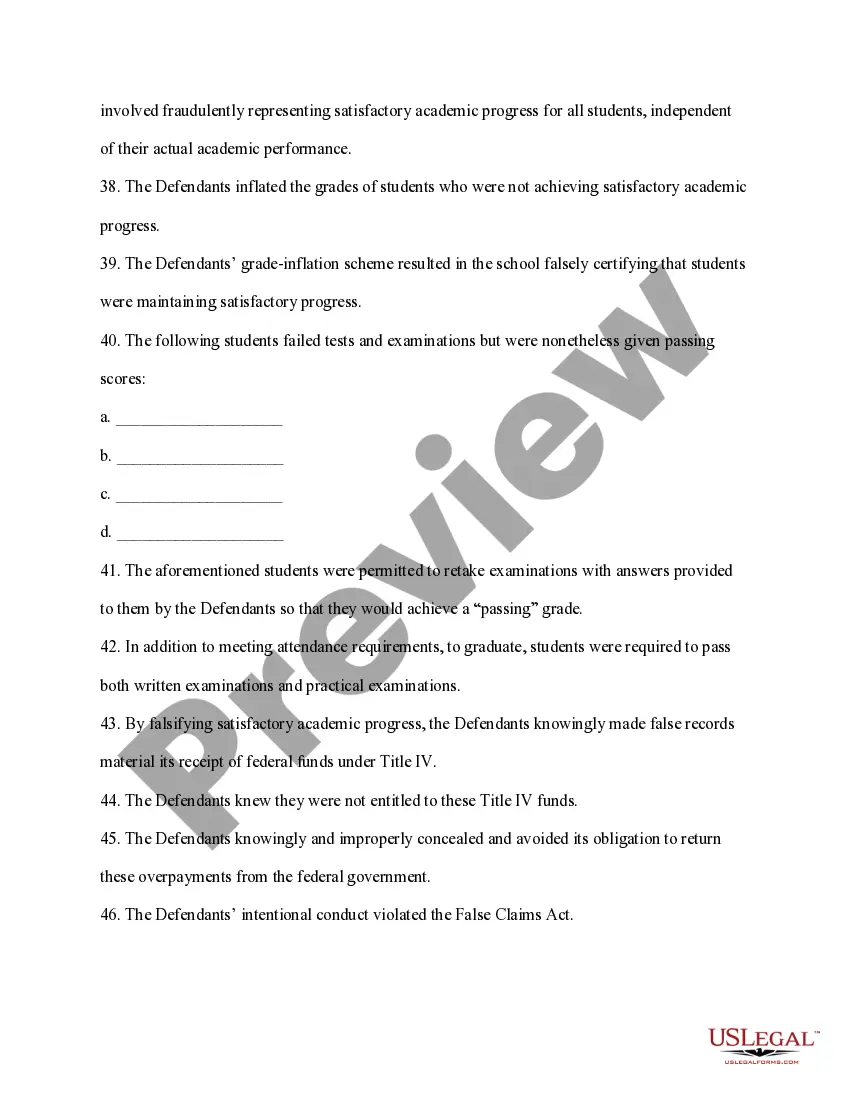
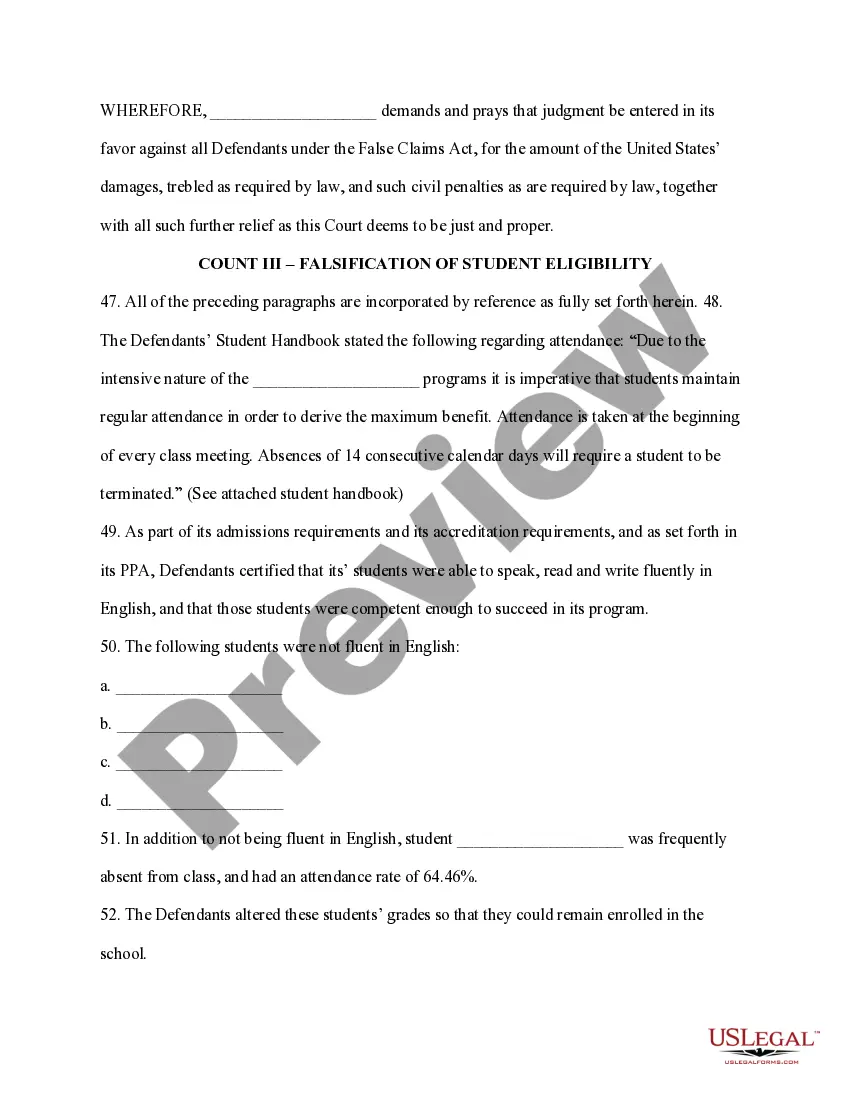
- Claims regarding falsification of attendance records and satisfactory academic progress.
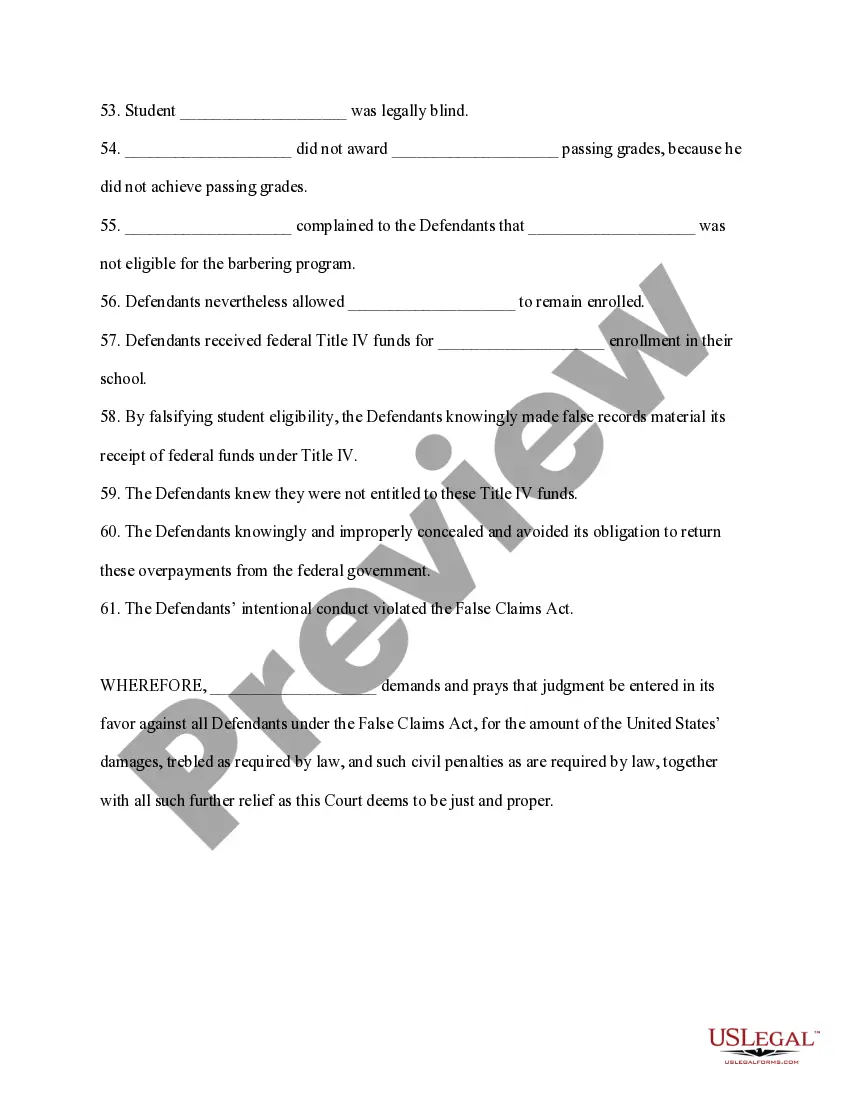
- Specific examples of students affected by the improper practices.
- Counts detailing various violations under the False Claims Act.
- Prayers for relief, including requests for damages and penalties.
Common use cases
This form is necessary when filing a complaint against an educational institution for practices that violate the False Claims Act. You should consider using it if you have evidence that the institution misrepresented student attendance or academic performance in order to defraud the federal government, or if you were terminated as a result of reporting these issues.
Who needs this form
This form is suitable for:
- Employees of educational institutions who have knowledge of fraudulent practices.
- Whistleblowers who have been retaliated against for reporting such activities.
- Legal representatives or attorneys preparing complaints for clients under the False Claims Act.
How to complete this form
- Identify the educational institution involved and fill in its name and relevant details.
- Document the dates of employment and the hourly wage of the employee raising concerns.
- Provide specific examples of the alleged misconduct related to attendance and academic progress.
- Complete the counts by detailing the violations of the False Claims Act.
- Sign the complaint and include a date for filing.
Notarization requirements for this form
Notarization is not commonly needed for this form. However, certain documents or local rules may make it necessary. Our notarization service, powered by Notarize, allows you to finalize it securely online anytime, day or night.
Get your form ready online
Our built-in tools help you complete, sign, share, and store your documents in one place.
Make edits, fill in missing information, and update formatting in US Legal Forms—just like you would in MS Word.
Download a copy, print it, send it by email, or mail it via USPS—whatever works best for your next step.
Sign and collect signatures with our SignNow integration. Send to multiple recipients, set reminders, and more. Go Premium to unlock E-Sign.
If this form requires notarization, complete it online through a secure video call—no need to meet a notary in person or wait for an appointment.
We protect your documents and personal data by following strict security and privacy standards.

Make edits, fill in missing information, and update formatting in US Legal Forms—just like you would in MS Word.

Download a copy, print it, send it by email, or mail it via USPS—whatever works best for your next step.

Sign and collect signatures with our SignNow integration. Send to multiple recipients, set reminders, and more. Go Premium to unlock E-Sign.

If this form requires notarization, complete it online through a secure video call—no need to meet a notary in person or wait for an appointment.

We protect your documents and personal data by following strict security and privacy standards.
Mistakes to watch out for
- Failing to include specific evidence or examples of misconduct, which can weaken the complaint.
- Leaving blank fields or vague references instead of providing precise information.
- Not signing or dating the form appropriately before submission.
Why use this form online
- Convenience of downloading and completing the form at your own pace.
- Editable fields allow for customization to suit specific allegations and circumstances.
- Access to professionally drafted content ensures a higher level of compliance with legal standards.
Legal use & context
- This form is grounded in the legal framework of the False Claims Act, holding individuals and entities accountable for defrauding government programs.
- Understanding the context of federal funding and educational regulations is crucial to successfully utilizing this form.
Looking for another form?
Form popularity
FAQ
The FCA provides that any person who knowingly submits, or causes to submit, false claims to the government is liable for three times the government's damages plus a penalty that is linked to inflation .
Examples of practices that may violate the False Claims Act if done knowingly and intentionally, include the following: Billing for services not rendered. Knowingly submitting inaccurate claims for services.
A person does not violate the False Claims Act by submitting a false claim to the government; to violate the FCA a person must have submitted, or caused the submission of, the false claim (or made a false statement or record) with knowledge of the falsity.
Common Examples of False Claims Billing for goods/services never delivered. Double billing for the same good/service. Failing to report government overpayments. Misrepresenting costs or records related to performance or quality. Billing for non-FDA approved drugs or devices. Performing unnecessary medical procedures.
A person does not violate the False Claims Act by submitting a false claim to the government; to violate the FCA a person must have submitted, or caused the submission of, the false claim (or made a false statement or record) with knowledge of the falsity.
Identifying a false claim is seldom straightforward, so a False Claims Act case filing may take a variety of forms. Generally, however, there are three main elements seen in every false claim case: 1). a claim made by an individual or 2) for government money or funds and 3) which is somehow fraudulent or false.
The elements of a violation under the first prong of the reverse?FCA provisions are that (1) a record or statement was false, (2) the defendant had knowledge of the falsity, (3) the defendant made or used (or caused to be made or used) the false record or statement, (4) the defendant's purpose was to conceal, avoid, or