Request for Copy of Notice of Default and Sale - Intent to Foreclose
What is this form?
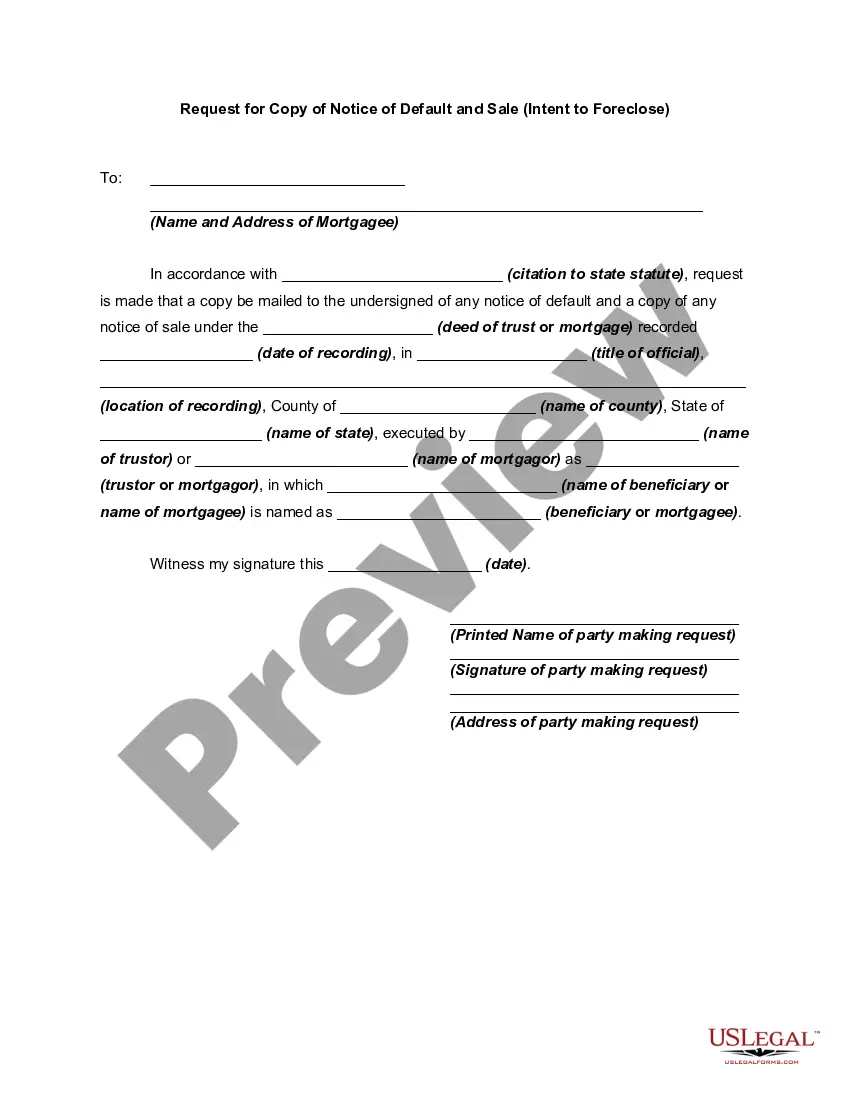
The Request for Copy of Notice of Default and Sale - Intent to Foreclose is a legal document that allows a borrower to formally request copies of default notices related to their mortgage or deed of trust. This form is essential when a borrower believes they may be at risk of foreclosure, as it notifies involved parties that legal proceedings may occur if outstanding payments are not made. It is critical for borrowers to understand that this form is not the same as a foreclosure notice itself; it is a request for important information regarding the status of their loan and property.
Main sections of this form
- Name and address of the mortgagee to whom the request is addressed.
- Citation to the relevant state statute allowing the request.
- Details regarding the deed of trust or mortgage, including recording date and location.
- Name of the trustor or mortgagor involved in the transaction.
- Space for the requestor's printed name, signature, and address.
- Date of request confirmation.
When to use this form
This form should be used when a borrower has received or suspects that a notice of default has been issued on their property. It is particularly useful in scenarios where the borrower needs clarification on whether foreclosure proceedings could be initiated due to overdue payments. By requesting this information, the borrower can gain insight into the situation, allowing them to take potential corrective measures.
Who needs this form
- Borrowers who are in default on their mortgage payments.
- Individuals who believe they are facing potential foreclosure.
- Anyone who has a mortgage or deed of trust securing a property and wants to keep track of their status regarding default notices.
How to complete this form
- Identify the mortgagee by providing their name and address at the top of the form.
- Cite the relevant state statute that governs the request for the notice.
- Fill in details regarding the deed of trust or mortgage, including the date it was recorded.
- Include the name of the trustor or mortgagor associated with the notice.
- Sign and date the form, ensuring your printed name and address are also included.
Notarization guidance
This form does not typically require notarization unless specified by local law. However, it is advisable to check your stateâs requirements to confirm any necessary authentication processes.
Get your form ready online
Our built-in tools help you complete, sign, share, and store your documents in one place.
Make edits, fill in missing information, and update formatting in US Legal Forms—just like you would in MS Word.
Download a copy, print it, send it by email, or mail it via USPS—whatever works best for your next step.
Sign and collect signatures with our SignNow integration. Send to multiple recipients, set reminders, and more. Go Premium to unlock E-Sign.
If this form requires notarization, complete it online through a secure video call—no need to meet a notary in person or wait for an appointment.
We protect your documents and personal data by following strict security and privacy standards.

Make edits, fill in missing information, and update formatting in US Legal Forms—just like you would in MS Word.

Download a copy, print it, send it by email, or mail it via USPS—whatever works best for your next step.

Sign and collect signatures with our SignNow integration. Send to multiple recipients, set reminders, and more. Go Premium to unlock E-Sign.

If this form requires notarization, complete it online through a secure video call—no need to meet a notary in person or wait for an appointment.

We protect your documents and personal data by following strict security and privacy standards.
Avoid these common issues
- Failing to include the correct name or address for the mortgagee.
- Not citing the appropriate state statute, which can invalidate the request.
- Incomplete information regarding the deed of trust or mortgage.
Why use this form online
- Convenience of completing the form from anywhere without the need for physical paperwork.
- Editable template that allows you to customize the form according to your specific circumstances.
- Reliable and accurate forms prepared by licensed attorneys to ensure compliance with legal standards.
- This form ensures that you are legally entitled to request documentation related to a mortgage default.
- Failure to use this form could result in not receiving critical information about foreclosure proceedings.
- Ensure compliance with local regulations to enhance enforceability.
Key takeaways
- The form requests crucial information regarding foreclosure notices.
- It is important for informing involved parties of their legal standing.
- Using the form online enhances accessibility and ease of completion.
Looking for another form?
Form popularity
FAQ
The term notice of default refers to a public notice filed with a court that states that the borrower of a mortgage is in default on a loan. The lender may file a notice of default when a mortgagor falls behind on their mortgage payments.
If a borrower falls behind on his mortgage payments, the mortgage lender might file a notice of default, which is an official public notice that the borrower is in arrears. It is one of the initial steps in the foreclosure process.
After the lender files the Notice of Default, you get 90 days to bring your past-due bill current. After the 90 days pass, the lender files a Notice of Sale with the clerk. The Notice of Sale displays the location, date and time of the sale. It lists the trustee's name and contact information.
A notice of default is the first step to a bank or mortgage lender's foreclosure process.If the mortgage is not paid up to date, the lender will seize the home. A notice of default is also known as a reinstatement period, notice of public auction, or notice of foreclosure.
"Commencement of Foreclosure" for HUD's purposes is the first public action required by law such as filing a complaint or petition, recording a notice of default, or publication of a notice of sale.
After you've received a Notice of Default, you have 3 months in which to attempt to get your loan current. As mentioned above, that means paying all back payments, interest, fees, property taxes, and insurance. After 3 months, the bank can officially set a date for the auction of your home.
You can stop the foreclosure process by informing your lender that you will pay off the default amount and extra fees. Your lender would prefer to have the money much more than they would have your home, so unless there are extenuating circumstances, this should work.
The borrower defaults on the loan. The lender issues a notice of default (NOD). A notice of trustee's sale is recorded in the county office. The lender tries to sell the property at a public auction.