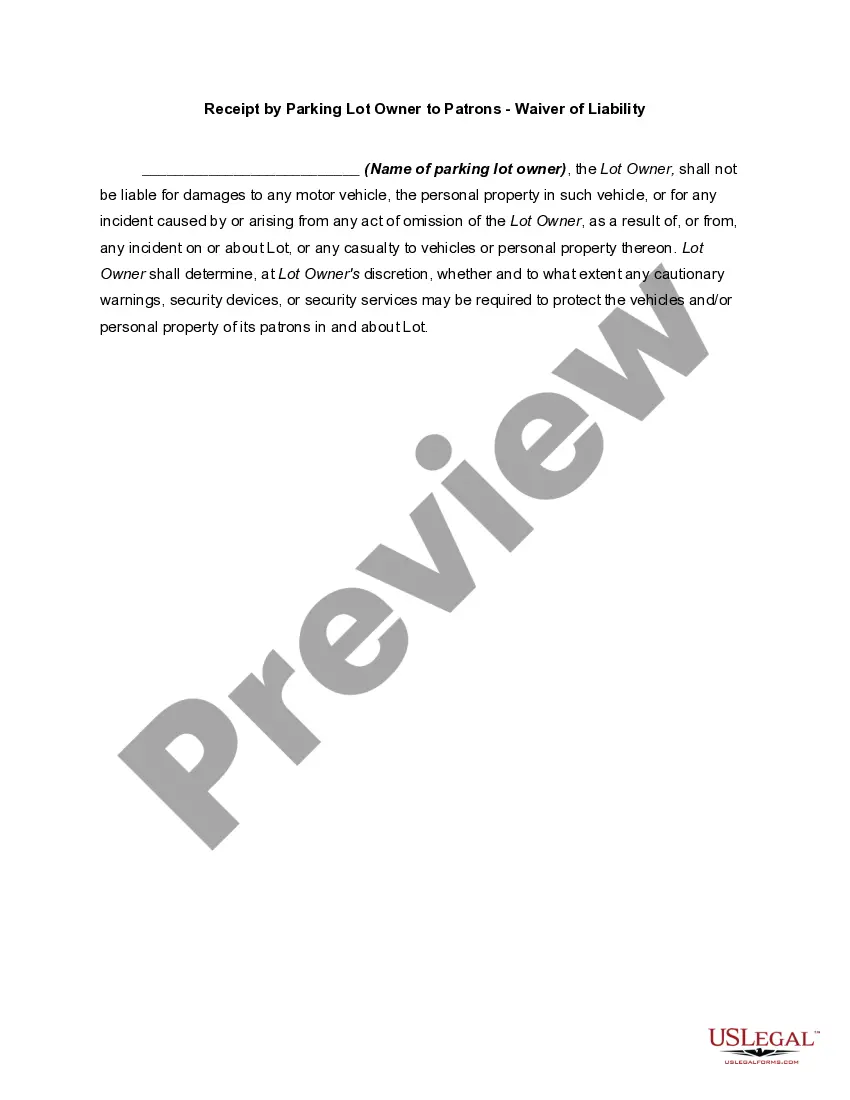
Receipt by Parking Lot Owner to Patrons - Waiver of Liability
What is this form?
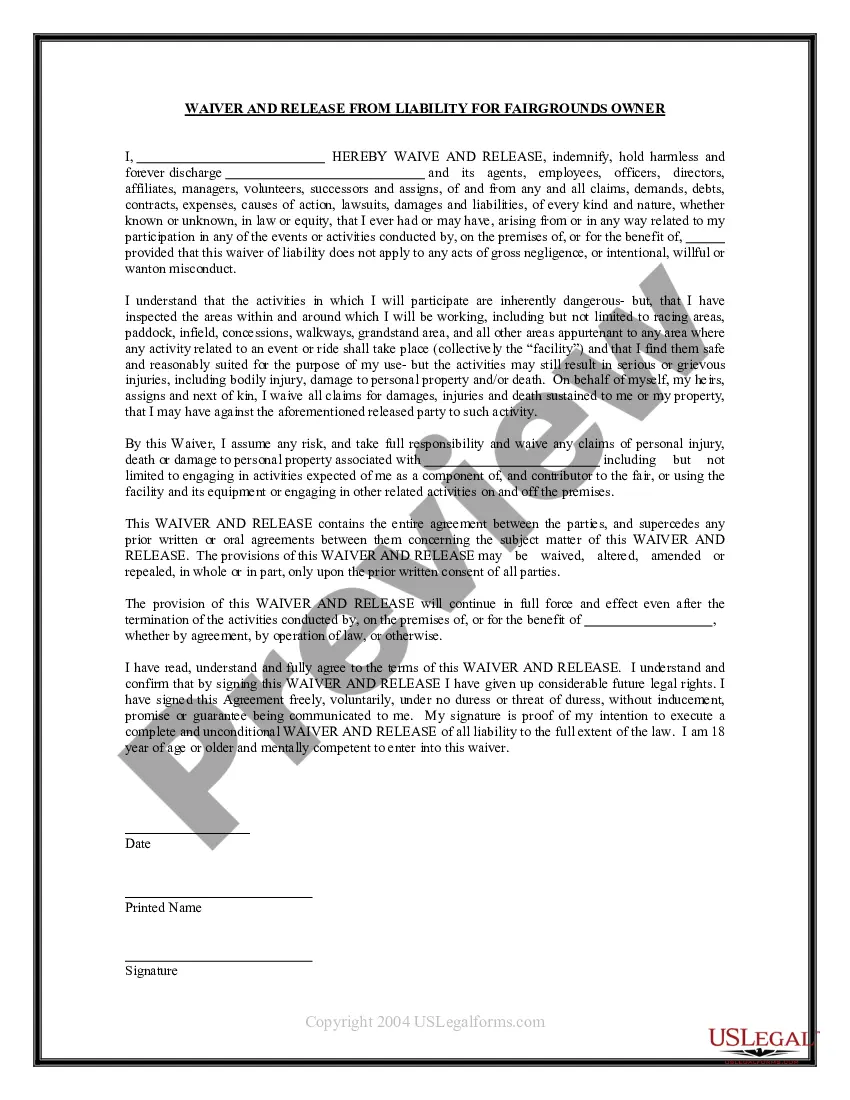
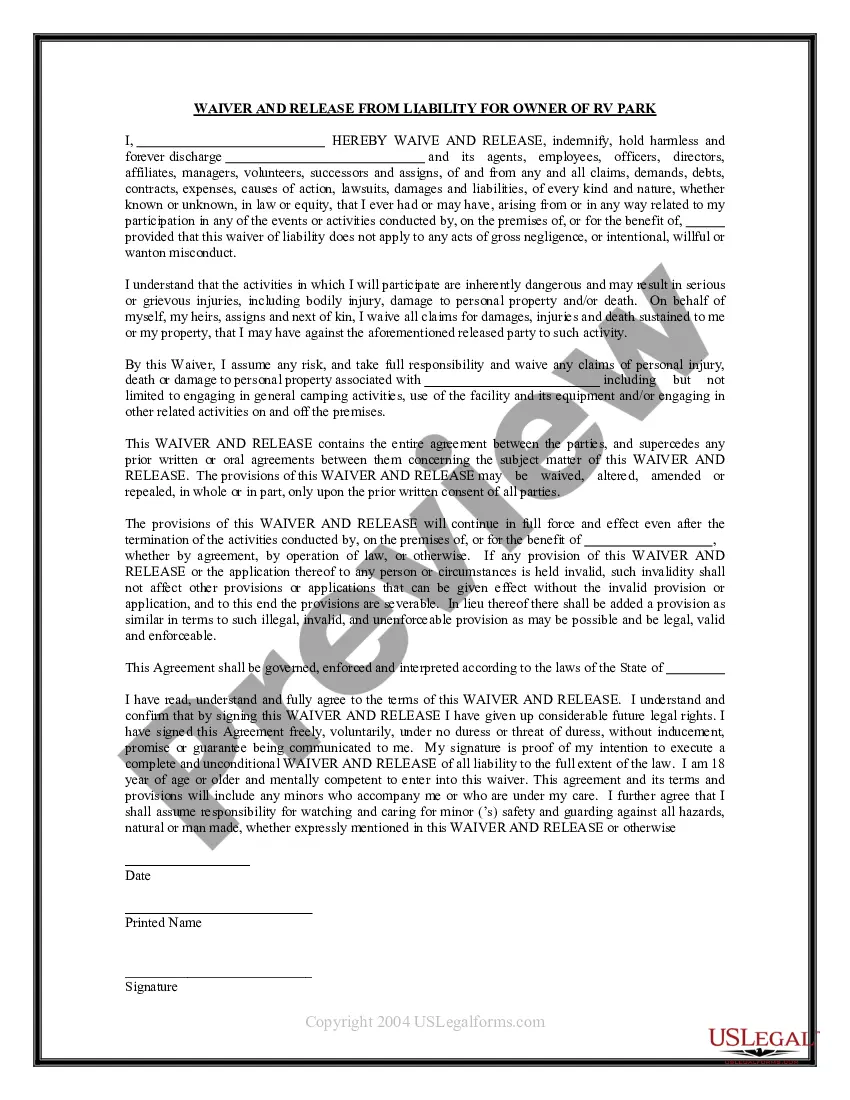
The Receipt by Parking Lot Owner to Patrons - Waiver of Liability form is a legal document that allows parking lot owners to limit their liability for damages to vehicles parked on their premises. This form provides a clear waiver of responsibility, informing patrons that the parking lot owner is not liable for any damage that may occur while their vehicle is parked. It differs from other agreements by specifically addressing the terms of liability in a parking context.
Key components of this form
- Name of the parking lot owner.
- Clear statements that waive liability for damages to vehicles and personal property.
- Clarification regarding the parking lot owner's discretion to provide security measures.

When to use this form
This form should be used whenever a parking lot owner wants to protect themselves from claims arising from damages to vehicles parked on their property. It is especially useful in scenarios where patrons may park their vehicles without direct oversight, such as in public garages or unattended lots. The waiver can help clarify responsibilities and set expectations for both the owners and users of the parking facility.
Intended users of this form
- Parking lot owners or operators seeking to limit their liability.
- Businesses that provide parking services for customers.
- Establishments that wish to clarify terms with patrons regarding vehicle safety and liability.
Steps to complete this form
- Identify and enter the name of the parking lot owner.
- Clearly state the liability waiver regarding damages to vehicles and personal property.
- Include any conditions or limitations as determined by the parking lot owner regarding security measures.
Notarization guidance
Notarization is not commonly needed for this form. However, certain documents or local rules may make it necessary. Our notarization service, powered by Notarize, allows you to finalize it securely online anytime, day or night.
Get your form ready online
Our built-in tools help you complete, sign, share, and store your documents in one place.
Make edits, fill in missing information, and update formatting in US Legal Forms—just like you would in MS Word.
Download a copy, print it, send it by email, or mail it via USPS—whatever works best for your next step.
Sign and collect signatures with our SignNow integration. Send to multiple recipients, set reminders, and more. Go Premium to unlock E-Sign.
If this form requires notarization, complete it online through a secure video call—no need to meet a notary in person or wait for an appointment.
We protect your documents and personal data by following strict security and privacy standards.

Make edits, fill in missing information, and update formatting in US Legal Forms—just like you would in MS Word.

Download a copy, print it, send it by email, or mail it via USPS—whatever works best for your next step.

Sign and collect signatures with our SignNow integration. Send to multiple recipients, set reminders, and more. Go Premium to unlock E-Sign.

If this form requires notarization, complete it online through a secure video call—no need to meet a notary in person or wait for an appointment.

We protect your documents and personal data by following strict security and privacy standards.
Common mistakes to avoid
- Not including the name of the parking lot owner, which is essential for identification.
- Failing to inform patrons about the waiver, which can lead to misunderstandings.
- Neglecting to check local laws, which may impact the waiver's enforceability.
Benefits of using this form online
- Convenience of accessing a professionally drafted form without the need for legal consultation.
- Ability to edit the form as needed to fit specific circumstances of the parking lot.
- Time-saving, as the form can be downloaded immediately after completion.
Legal use & context
- This form serves as a written waiver, which can be crucial in legal proceedings.
- Courts generally look for clear communication of waivers, making this form useful for compliance.
- The waiver may not protect against damages caused by negligence or intentional actions of the parking lot employees.
Quick recap
- The form protects parking lot owners from liability for damages to vehicles.
- Patrons must understand the limitations of liability when using the facility.
- State laws may impact the enforceability of this waiver.
Looking for another form?
Form popularity
FAQ
Get help. Writing a waiver should not be complicated. Use the correct structure. Waivers should be written in a certain structure. Proper formatting. Include a subject line. Include a caution! Talk about the activity risks. Do not forget an assumption of risk. Hold harmless.
While not necessary for a release and waiver agreement, money is often offered as a consideration. Other goods and services can also be offered as consideration. When the consideration is something of value, usually both parties agree to the release and waiver agreement.
Consideration is a necessary element for a release to be valid. A release is made for valuable consideration. The consideration should be a thing of value. There will be a presumption as to the existence of consideration when the release is made in a sealed document.
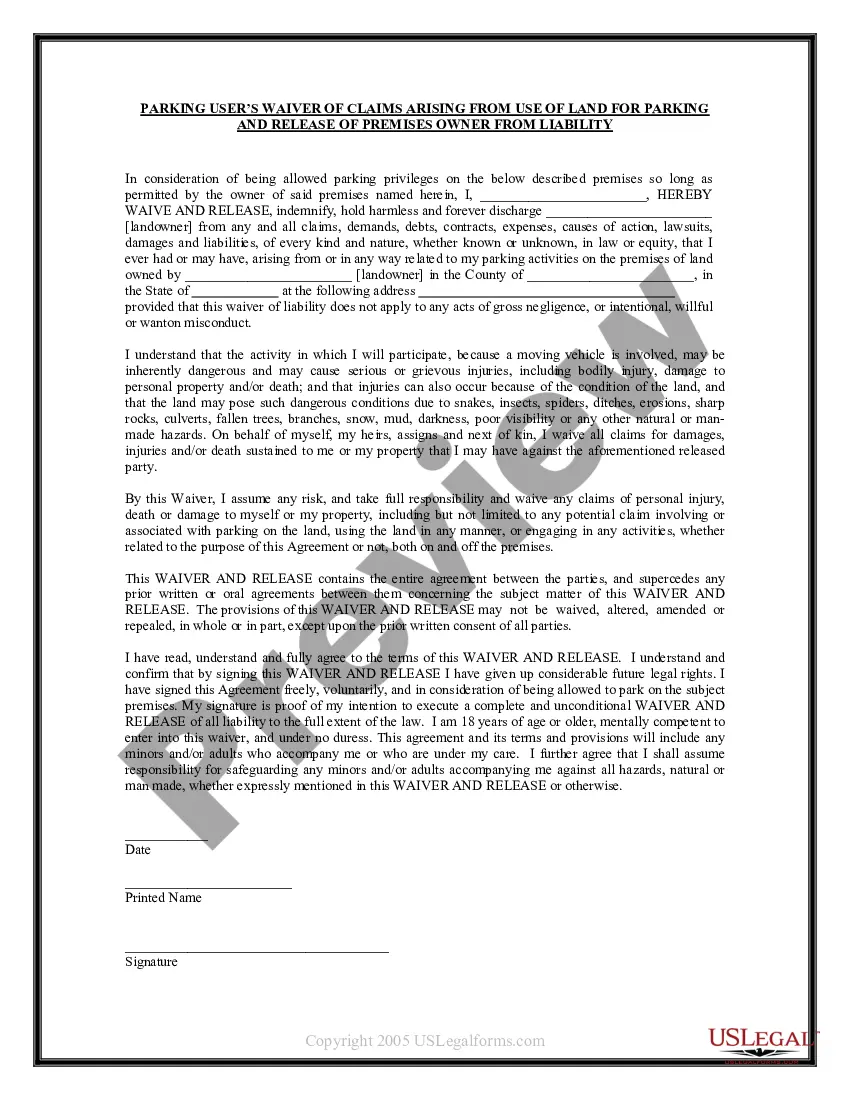
In California, a liability waiver must be clear, unambiguous, and explicit. In other words, waivers cannot be printed in faded ink, in small font, on the back of a paper, or in an otherwise ambiguous form. If the waiver that you sign is not represented clearly, it may not hold up in the event of a lawsuit.
200bStart the letter off with a clear explanation regarding your request. For instance, explain that you're requesting certain fees or charges to be waived or to be released from a previous engagement. Communicate any supporting or relative dates, names of parties, monetary figures, or venues as facts.
Get help. Writing a waiver should not be complicated. Use the correct structure. Proper formatting. Include a subject line. Include a caution! Talk about the activity risks. Do not forget an assumption of risk. Hold harmless.
Under California law, a liability waiver cannot excuse an injury caused by a defendant's gross negligence, recklessness or intentional wrongful act.
The General Release is a broad release from all possible civil claims resulting from a dispute. Since the Releasing Party is giving up all known and unknown claims against the other party, care should be taken to ensure that the Releasor is fully aware of their rights.