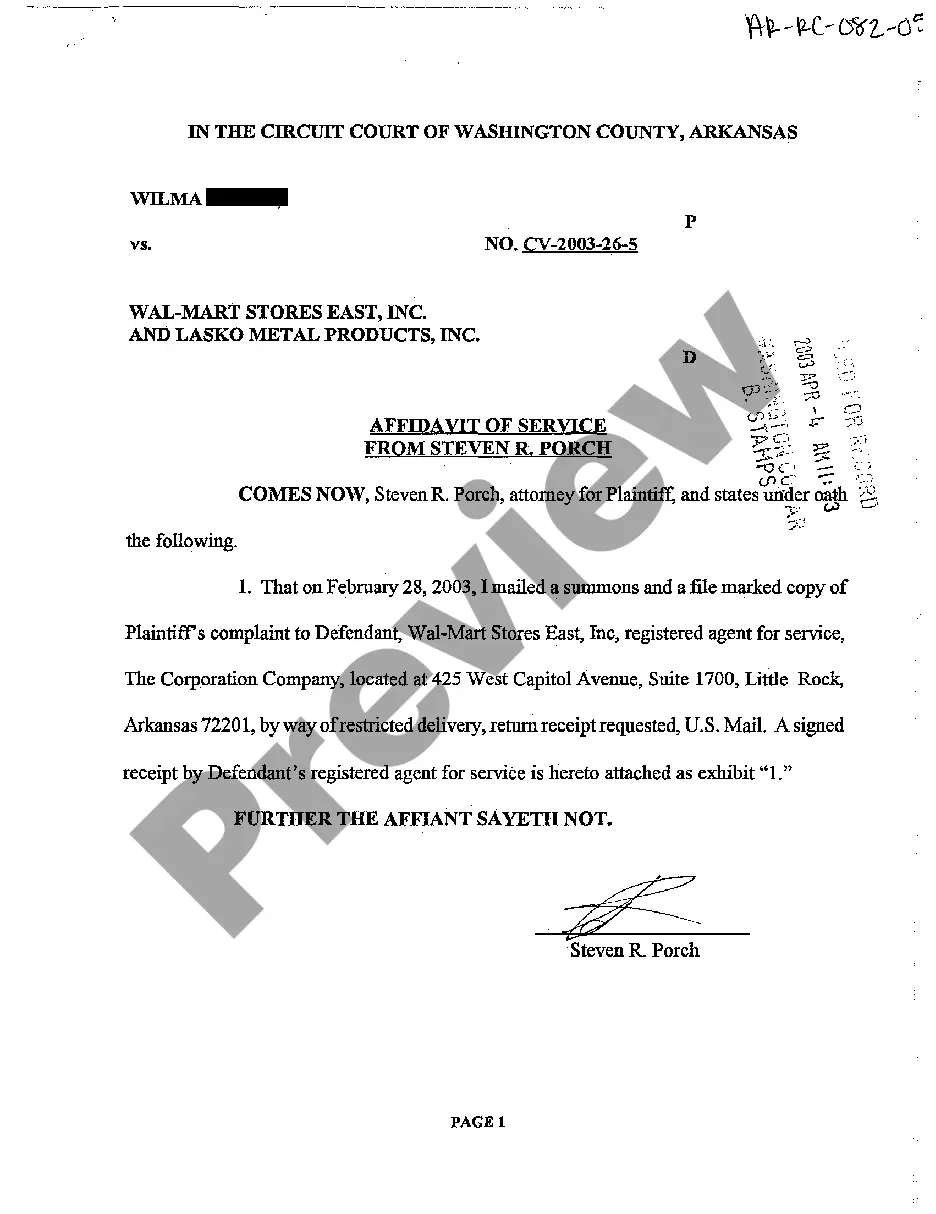
Fiduciary - Estate or Trust - Tax Return Engagement Letter
Understanding this form
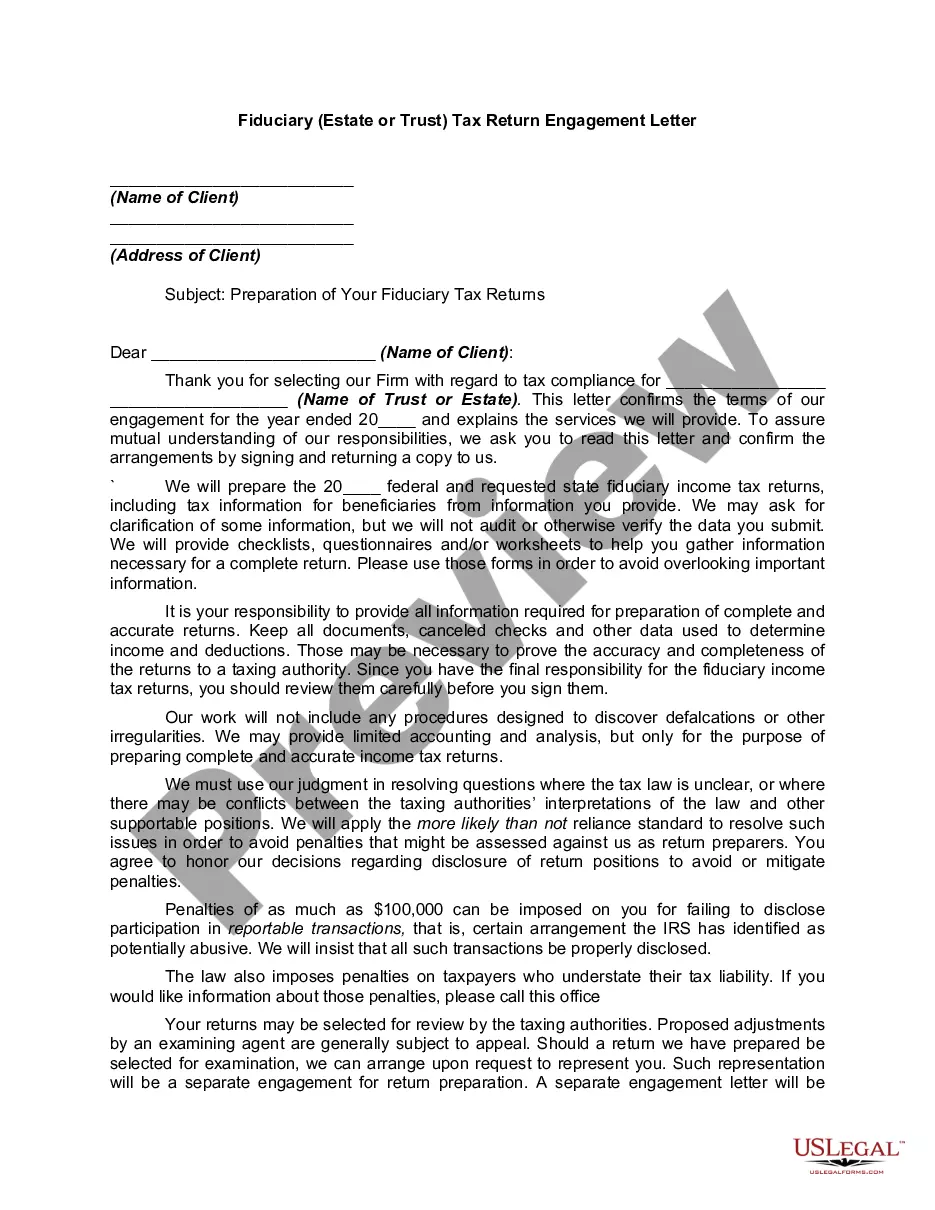
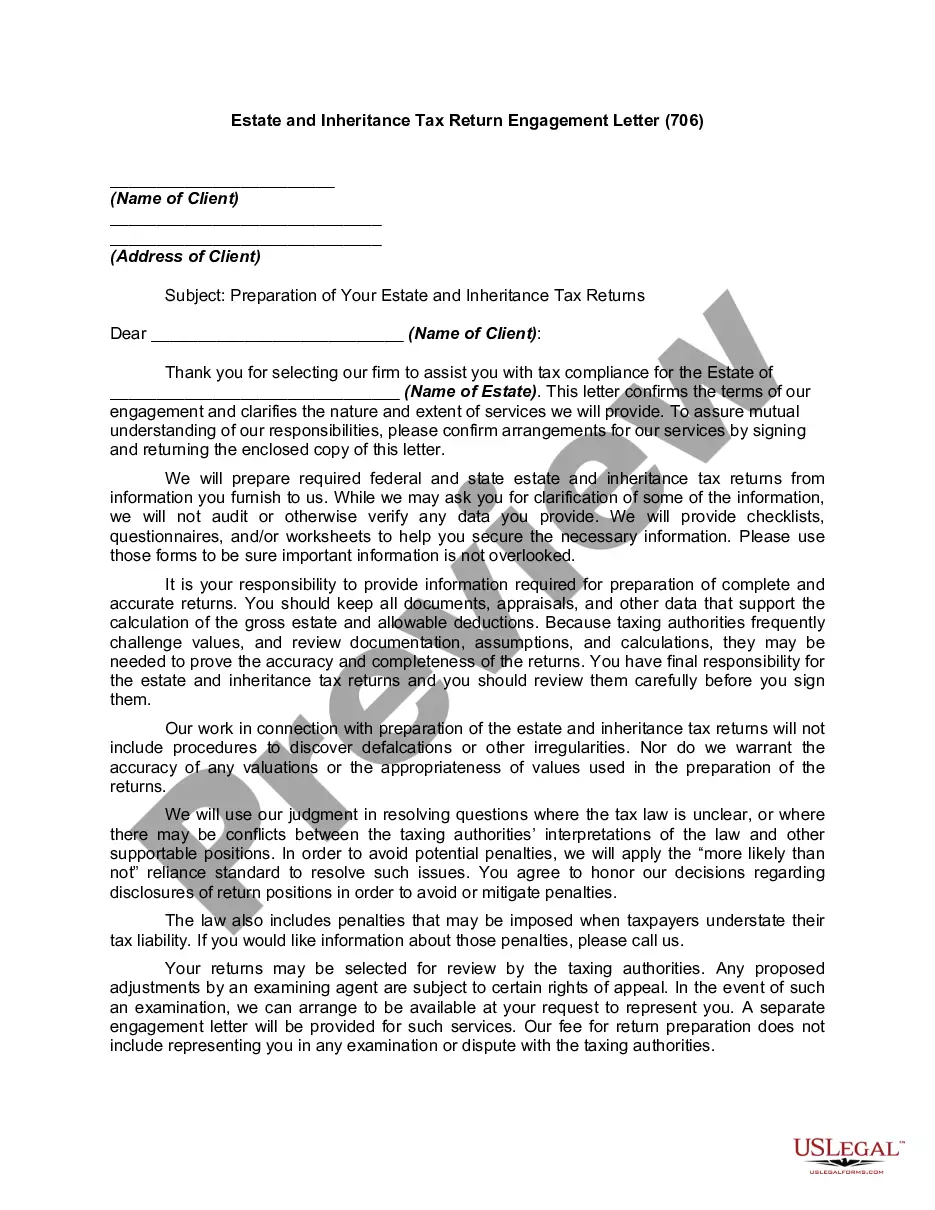
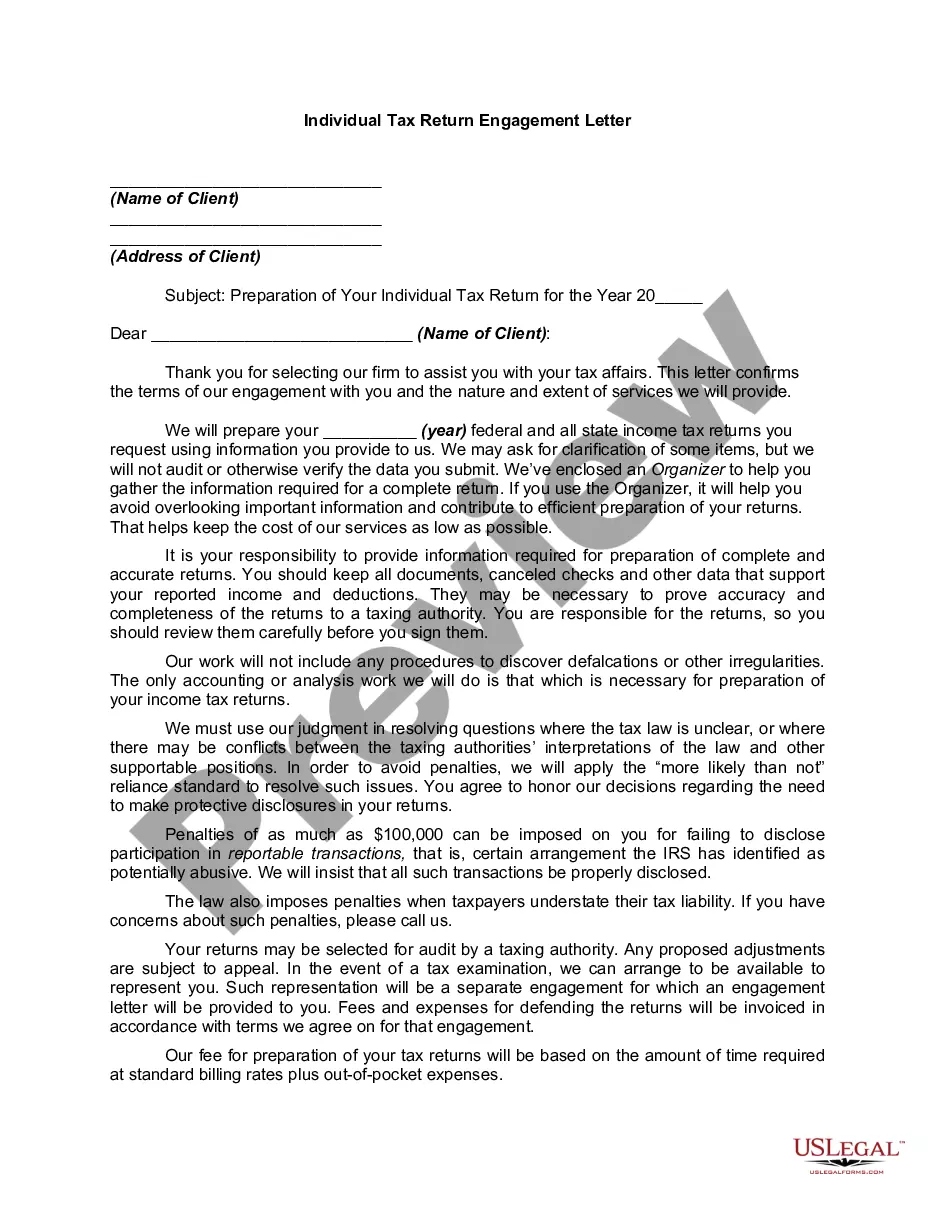
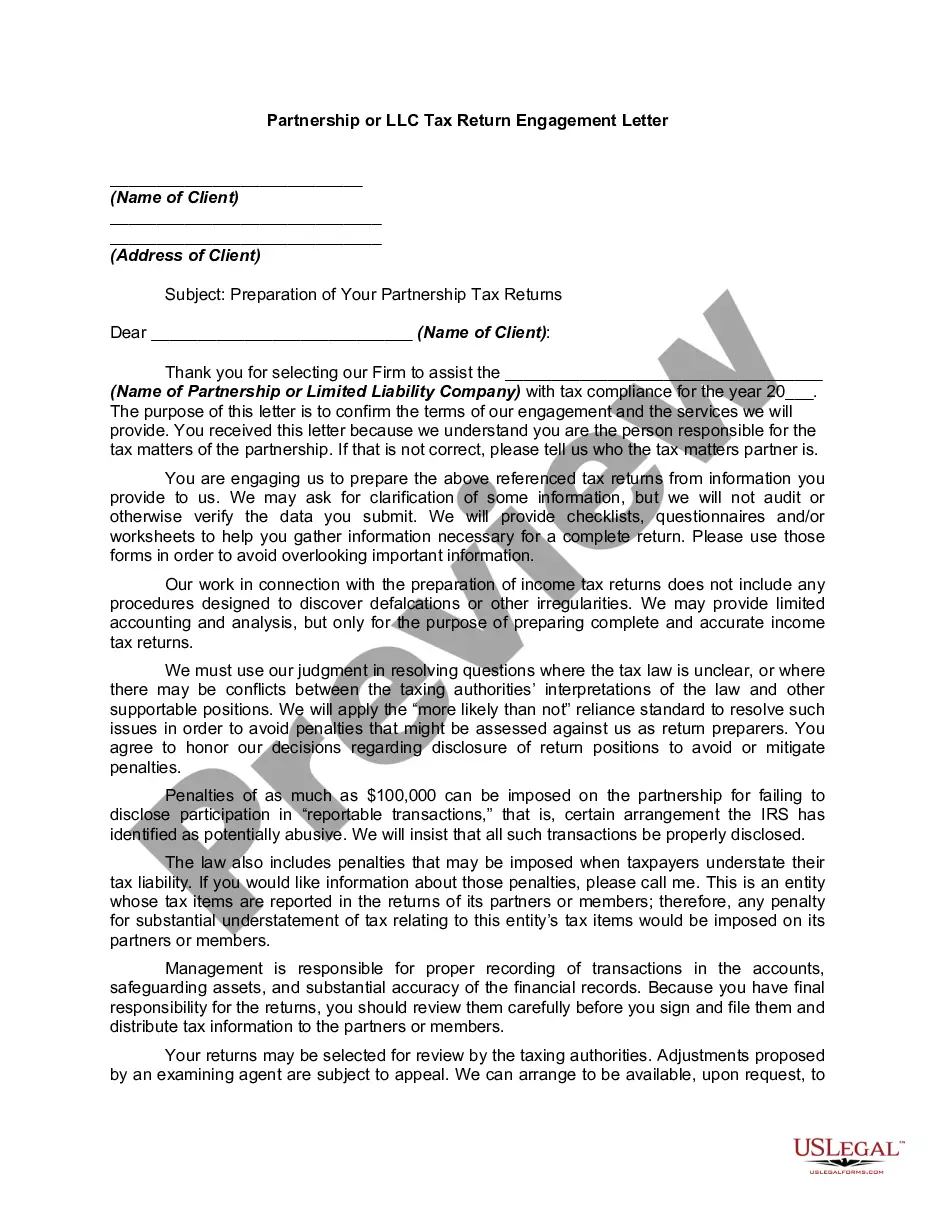
The Fiduciary - Estate or Trust - Tax Return Engagement Letter is a legal document that confirms the agreement between a client and a certified public accountant (CPA) for the preparation of fiduciary tax returns. This letter outlines the scope of services to be provided, the responsibilities of both parties, and the fee structure. Unlike typical contracts, which may not need to be in writing, this engagement letter helps avoid misunderstandings by clearly stating the terms and obligations related to complex tax compliance matters. It is crucial for ensuring proper communication and accountability between the accountant and the client.
What’s included in this form
- Name and contact information of the client and accountant.
- Details regarding the preparation of federal and state fiduciary tax returns.
- Responsibilities of the client in providing accurate information.
- Fee structure based on time and expenses incurred.
- Agreement on the confidentiality and return of original documents.
When to use this form
This engagement letter should be used when a fiduciaryâtypically an executor, administrator, or trusteeâengages a CPA to prepare tax returns for an estate or trust. It serves to clearly define the working relationship and ensures that both parties understand their commitments, particularly during tax seasons or when filing complex returns. Utilizing this letter can also help mitigate potential disputes related to fees or responsibilities.
Who can use this document
- Executors or administrators managing an estate's tax obligations.
- Trustees overseeing the financial aspects of a trust.
- Certified public accountants providing fiduciary tax preparation services.
- Individuals who want to ensure clarity in tax preparations for estates or trusts.
Instructions for completing this form
- Gather the necessary information about the client and the fiduciary entity (trust or estate).
- Fill in the names and addresses for both the client and the accounting firm.
- Specify the tax year and the type of returns to be prepared.
- Review and fill out any checklists or questionnaires provided by the accountant to ensure accurate information gathering.
- Sign and return a copy of the letter to confirm the engagement terms.
Notarization guidance
Notarization is generally not required for this form. However, certain states or situations might demand it. You can complete notarization online through US Legal Forms, powered by Notarize, using a verified video call available anytime.
Get your form ready online
Our built-in tools help you complete, sign, share, and store your documents in one place.
Make edits, fill in missing information, and update formatting in US Legal Forms—just like you would in MS Word.
Download a copy, print it, send it by email, or mail it via USPS—whatever works best for your next step.
Sign and collect signatures with our SignNow integration. Send to multiple recipients, set reminders, and more. Go Premium to unlock E-Sign.
If this form requires notarization, complete it online through a secure video call—no need to meet a notary in person or wait for an appointment.
We protect your documents and personal data by following strict security and privacy standards.

Make edits, fill in missing information, and update formatting in US Legal Forms—just like you would in MS Word.

Download a copy, print it, send it by email, or mail it via USPS—whatever works best for your next step.

Sign and collect signatures with our SignNow integration. Send to multiple recipients, set reminders, and more. Go Premium to unlock E-Sign.

If this form requires notarization, complete it online through a secure video call—no need to meet a notary in person or wait for an appointment.

We protect your documents and personal data by following strict security and privacy standards.
Common mistakes
- Failing to provide complete and accurate information to the CPA.
- Not reviewing the engagement letter thoroughly before signing.
- Overlooking state-specific requirements that may apply to fiduciary tax preparations.
Benefits of completing this form online
- Convenient access to a professionally drafted template that ensures compliance with legal standards.
- Editable format allows for customization to meet specific needs and requirements.
- Reliability of using a form vetted by licensed attorneys for accuracy and completeness.
Legal use & context
- This engagement letter serves as a formal agreement between the CPA and the client, outlining the scope of services and responsibilities.
- It helps maintain proper documentation for tax purposes and protects both parties in case of disputes.
- Ensures compliance with tax laws and regulations governing fiduciary income tax returns.
Summary of main points
- The engagement letter clarifies the relationship between the client and the CPA for fiduciary tax returns.
- Accurate completion depends on the client providing thorough and correct information.
- This form may require customization to meet specific state laws.
Looking for another form?


Form popularity
FAQ
You must file Form 1041 (U.S. Income Tax Return for Estates and Trusts) by the 15th day of the fourth month after the tax year-end (adjusted for weekends and holidays). So for a person who died in 2018, the deadline is April 15, 2019, when the standard Dec. 31 tax year-end is chosen.
The IRS Form 1041 is the federal tax filing form for estates and trusts. The 1041 serves the same purpose as the Form 1040 used by individuals to file a personal income tax return.The major difference concerns the handling of net income earned by the trust or estate.
Filing requirementsTrusts with any taxable income, trusts with a nonresident alien beneficiary, and trusts with gross income of $600 or more must file Federal Form 1041. Federal Form 1041 must be filed if the estate's gross income is $600 more or if one of its beneficiaries is a nonresident alien.
The executor or personal representative of an estate must file Form 1041 when a domestic estate has gross income during the tax year of $600 or more. A 1041 tax return must also be filed if one or more of the estate's beneficiaries are nonresident aliens even if it earned less than $600.
Q: Do trusts have a requirement to file federal income tax returns? A: Trusts must file a Form 1041, U.S. Income Tax Return for Estates and Trusts, for each taxable year where the trust has $600 in income or the trust has a non-resident alien as a beneficiary.
You will not owe any extra tax. You'll still need to complete a Self Assessment tax return to show the income you receive from an interest in possession trust but you will get a credit for the tax paid by the trustees. This means the income is not taxed twice.
The executor or personal representative of an estate must file Form 1041 when a domestic estate has gross income during the tax year of $600 or more. A 1041 tax return must also be filed if one or more of the estate's beneficiaries are nonresident aliens even if it earned less than $600.
IRS Form 1041, U.S. Income Tax Return for Estates and Trusts, is required if the estate generates more than $600 in annual gross income. The decedent and their estate are separate taxable entities. Before filing Form 1041, you will need to obtain a tax ID number for the estate.
The fiduciary of a domestic decedent's estate, trust, or bankruptcy estate files Form 1041 to report: The income, deductions, gains, losses, etc. of the estate or trust. The income that is either accumulated or held for future distribution or distributed currently to the beneficiaries.