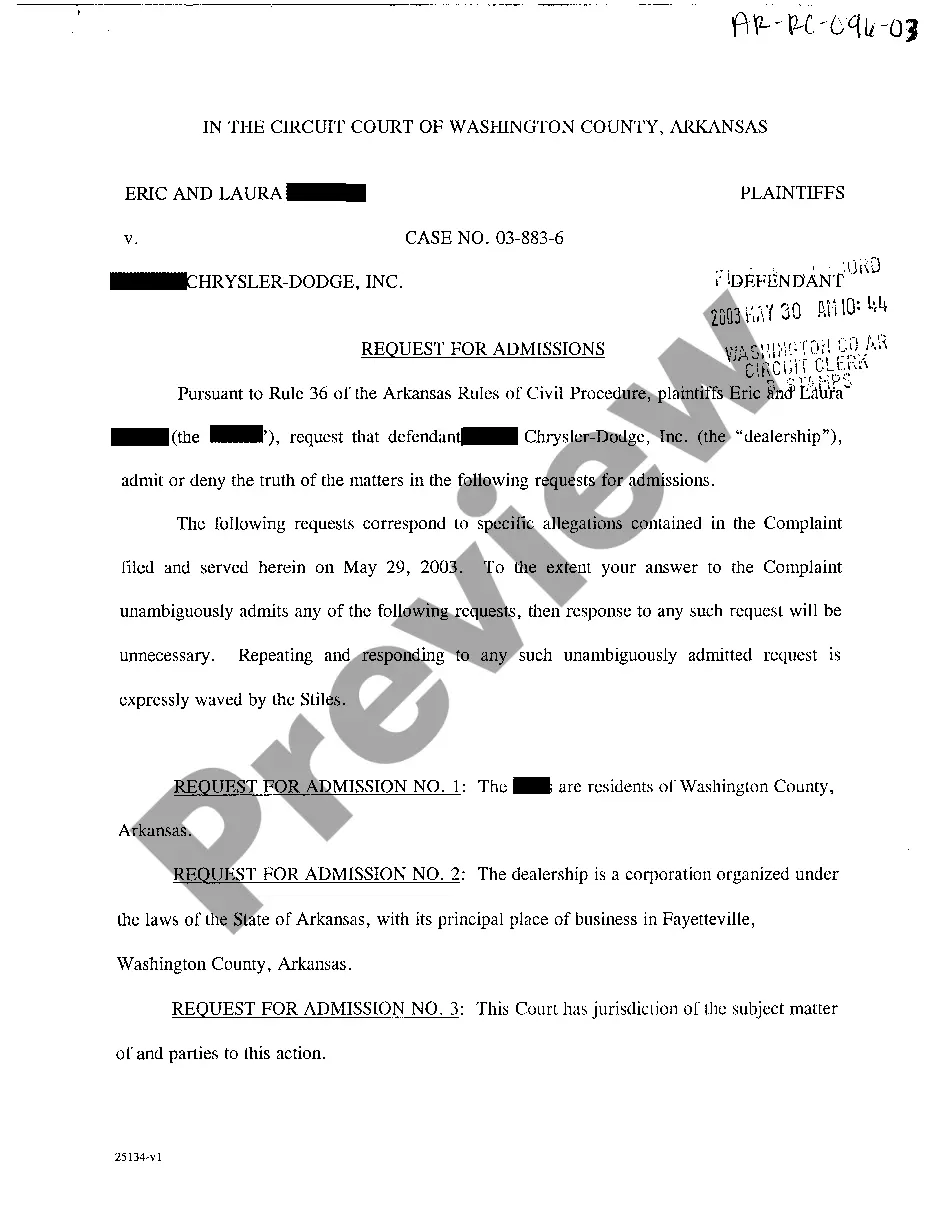
Affidavit of Plaintiff Supporting Motion for Summary Judgment by Plaintiff
Understanding this form
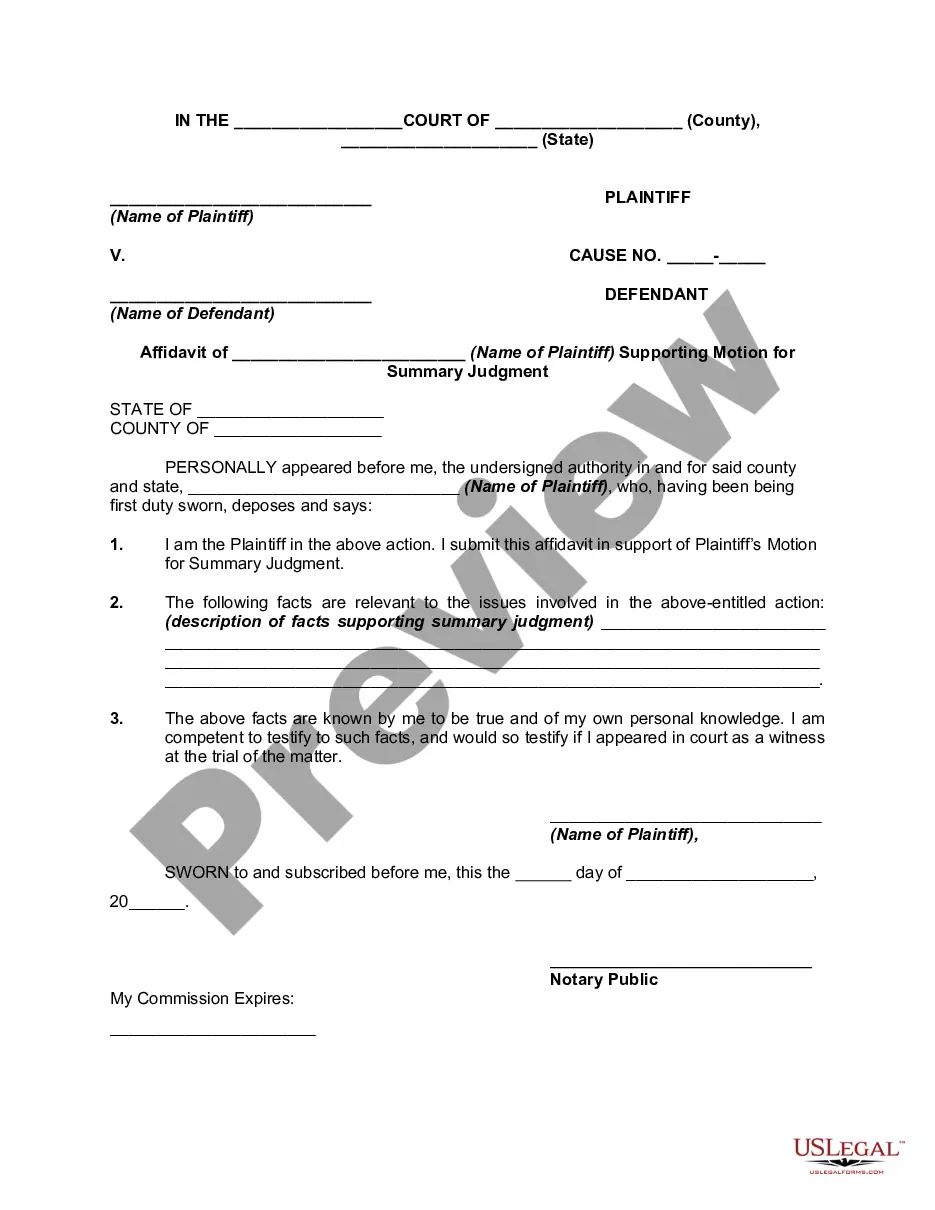
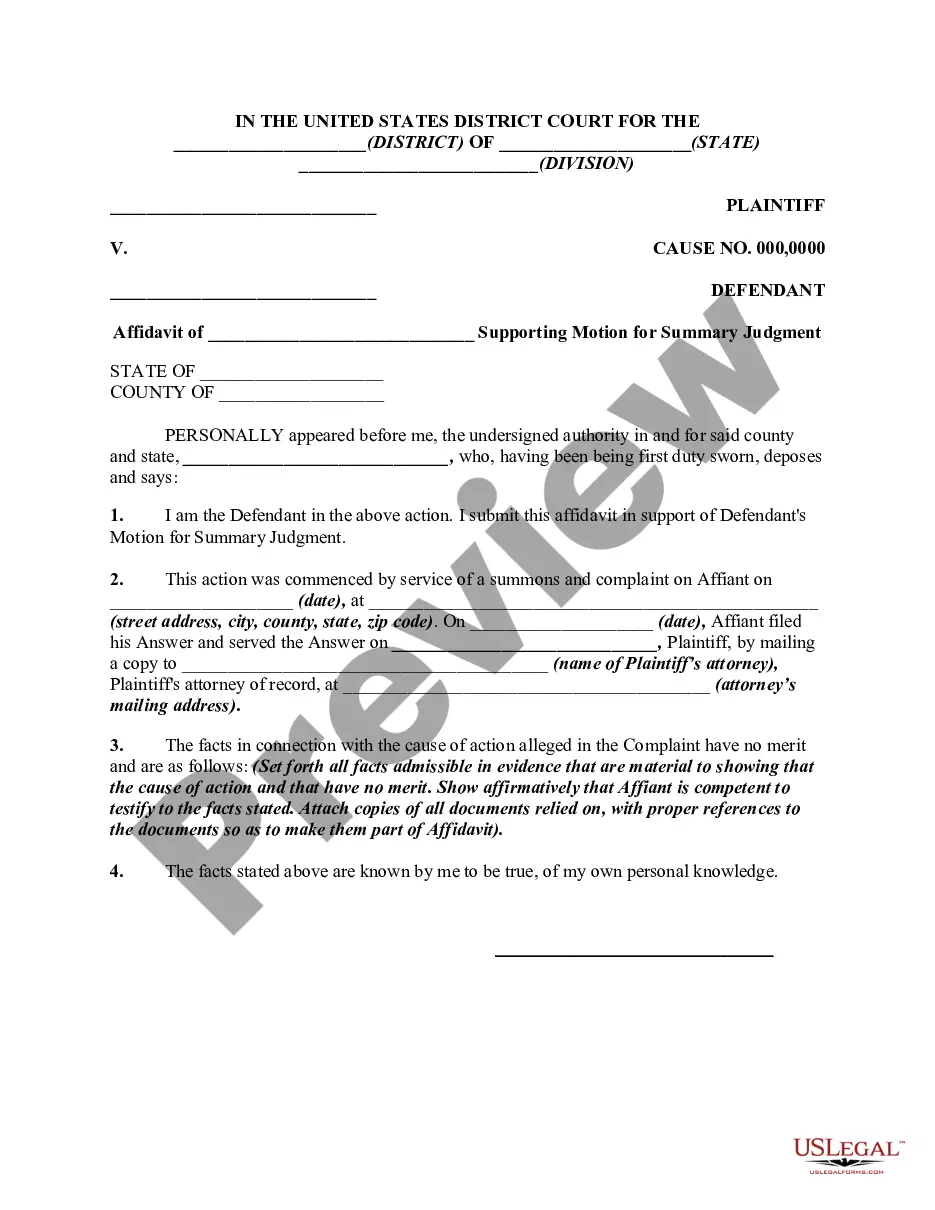
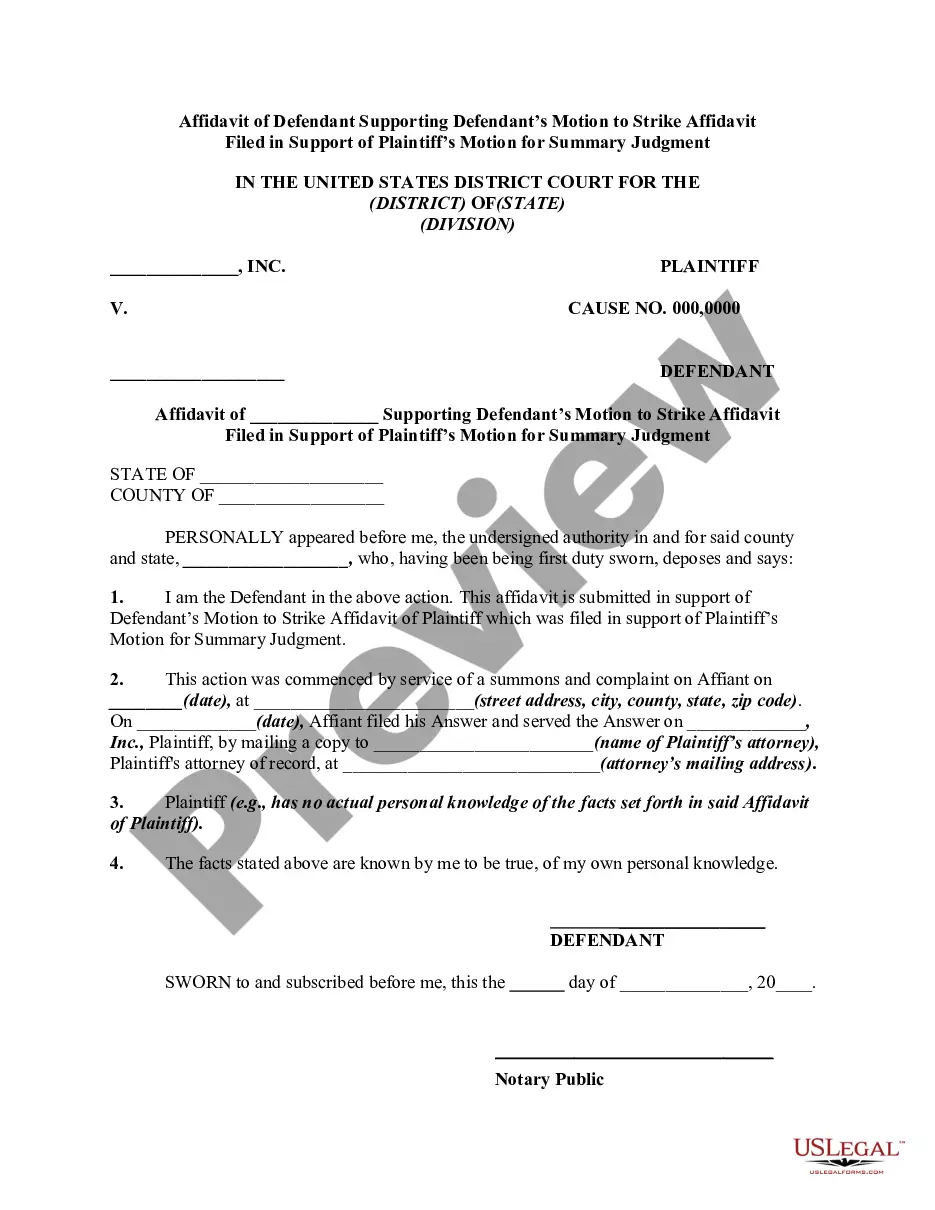
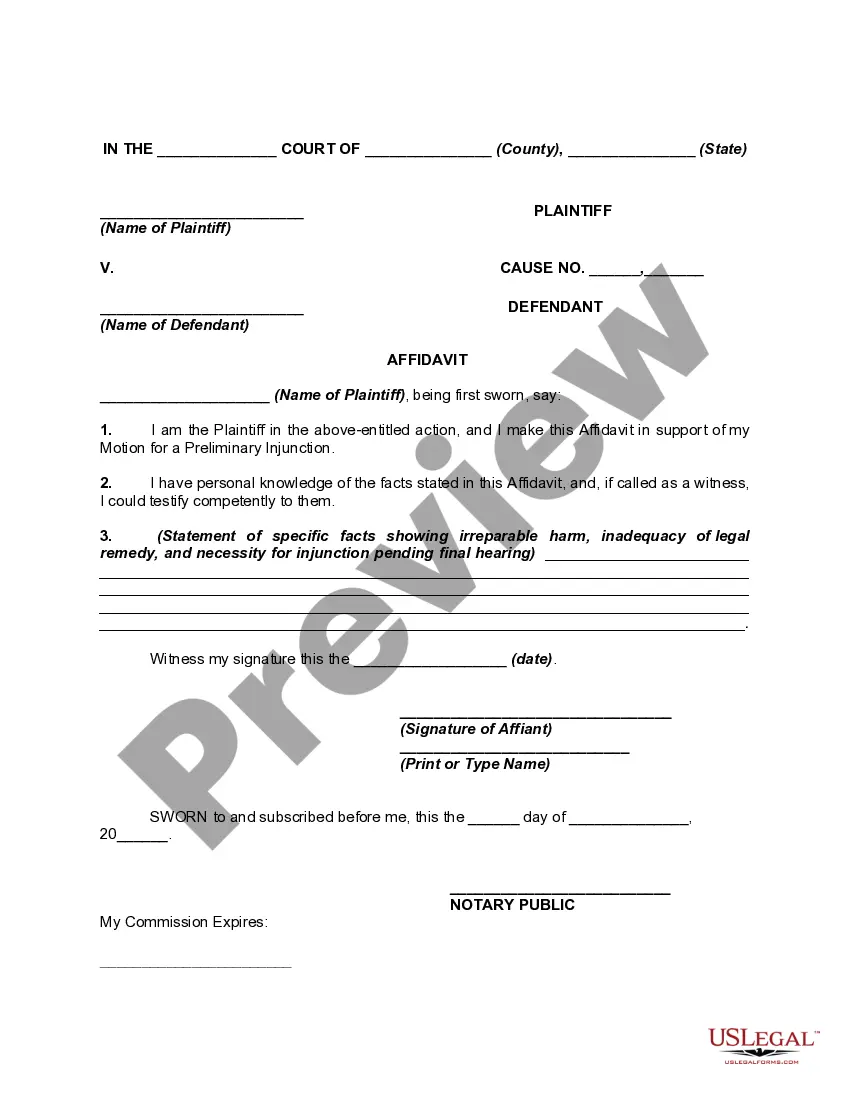
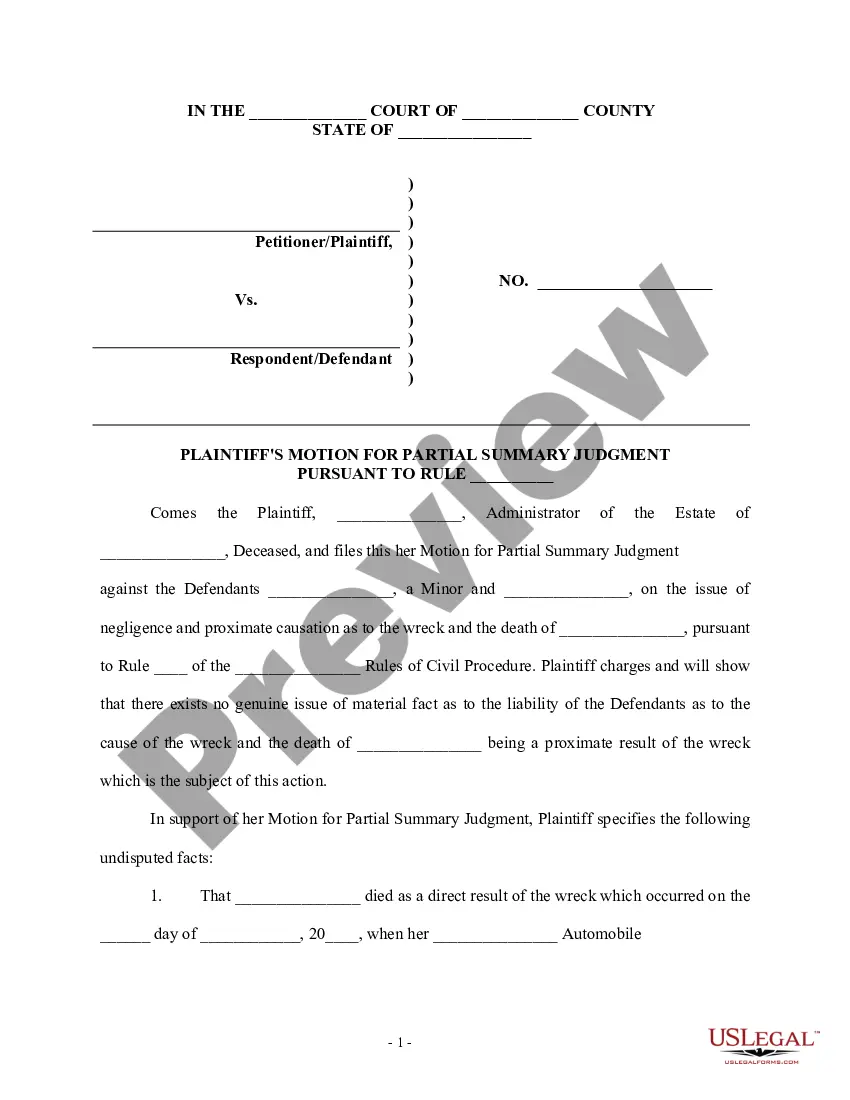
The Affidavit of Plaintiff Supporting Motion for Summary Judgment by Plaintiff is a legal document used to support a motion for summary judgment in a civil case. This form is unique as it requires the plaintiff to provide sworn statements based on personal knowledge, which are intended to substantiate the motion for summary judgment. It differs from other affidavits as it specifically addresses the need for summary judgment, making it crucial in cases where a quick resolution is sought without a full trial.
Form components explained
- Caption: Identifies the plaintiff and defendant along with the cause number.
- Affiant Identification: Includes the name of the plaintiff who is making the affidavit.
- Statement of Personal Knowledge: The plaintiff asserts their competence to testify and verifies the truth of the facts presented.
- Factual Support: Detailed description of facts that support the motion for summary judgment.
- Notary Section: A designated area for the notary public to affirm the validity of the affidavit.
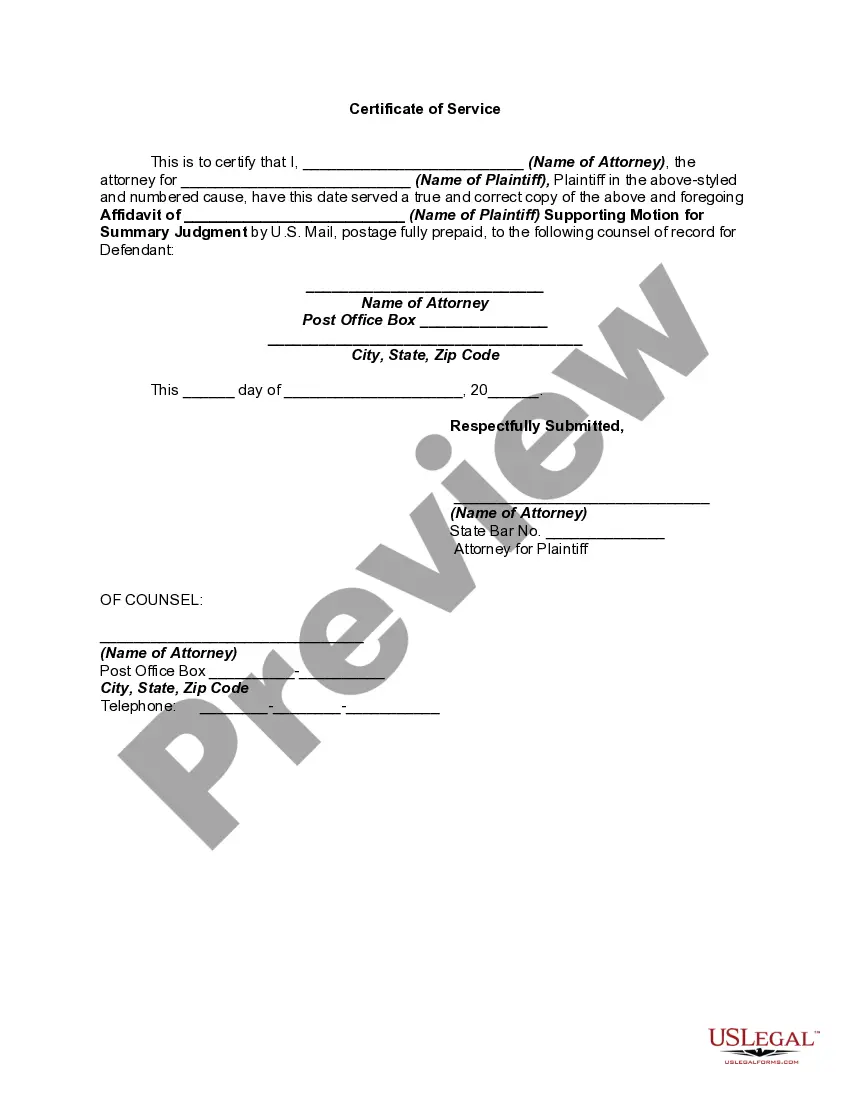
- Certificate of Service: Confirms that copies have been served to all relevant parties.
When to use this form
This form should be used when a plaintiff wishes to request a summary judgment from the court, particularly in cases where the facts are clear and undisputed. It is applicable in civil litigation where a party believes there is enough evidence to decide the case without a trial. This affidavit supports the motion by affirming the truth of the facts, enhancing the chances of a favorable ruling.
Who needs this form
This form is intended for individuals or legal representatives acting as plaintiffs in civil lawsuits. It is suitable for those who have sufficient evidence to support their claims and want to streamline the legal process by potentially avoiding a trial.
Completing this form step by step
- Fill in the caption with the names of the plaintiff and defendant, along with the cause number.
- Identify yourself as the plaintiff in the designated section.
- Provide a clear statement of the facts relevant to the motion for summary judgment.
- Sign the affidavit before a notary public to confirm its validity.
- Complete the certificate of service to verify that the affidavit has been shared with all involved parties.
Does this document require notarization?
Yes, this form must be notarized to be legally valid. The affidavit must be signed in front of a notary public to verify the identity of the affiant and the authenticity of the document. US Legal Forms offers online notarization through secure video calls, making it accessible 24/7 without the need for travel.
Get your form ready online
Our built-in tools help you complete, sign, share, and store your documents in one place.
Make edits, fill in missing information, and update formatting in US Legal Forms—just like you would in MS Word.
Download a copy, print it, send it by email, or mail it via USPS—whatever works best for your next step.
Sign and collect signatures with our SignNow integration. Send to multiple recipients, set reminders, and more. Go Premium to unlock E-Sign.
If this form requires notarization, complete it online through a secure video call—no need to meet a notary in person or wait for an appointment.
We protect your documents and personal data by following strict security and privacy standards.

Make edits, fill in missing information, and update formatting in US Legal Forms—just like you would in MS Word.

Download a copy, print it, send it by email, or mail it via USPS—whatever works best for your next step.

Sign and collect signatures with our SignNow integration. Send to multiple recipients, set reminders, and more. Go Premium to unlock E-Sign.

If this form requires notarization, complete it online through a secure video call—no need to meet a notary in person or wait for an appointment.

We protect your documents and personal data by following strict security and privacy standards.
Typical mistakes to avoid
- Failing to provide sufficient facts to support the motion for summary judgment.
- Not signing the affidavit in the presence of a notary public.
- Omitting the certificate of service, which is necessary to inform the other party.
Benefits of completing this form online
- Convenience of downloading and completing the form at your own pace.
- Editability allows for easy customization to fit your specific case needs.
- Reliability of using a form drafted by licensed attorneys to ensure compliance with legal standards.
What to keep in mind
- The Affidavit of Plaintiff Supporting Motion for Summary Judgment is crucial for plaintiffs seeking a quick resolution to their cases.
- Accurate and truthful statements are necessary to support the affidavit.
- Notarization is required for the affidavit to hold legal weight.
Looking for another form?

Form popularity
FAQ
When it comes to summary judgment, plaintiff lawyers are often guilty of forgetting the fact that either party can file one. If you have solid evidence that can't be disputed, you may very well be able to prove your claim without going to trial.
When a motion for summary judgment is denied, the nonmoving party achieves a form of premium that enables a case to settle for an additional amount. Put simply, the settlement value of a case increases when a motion for summary judgment is denied.
(b) (1) A party may move for judgment on the pleadings.(A) If the moving party is a plaintiff, that the complaint states facts sufficient to constitute a cause or causes of action against the defendant and the answer does not state facts sufficient to constitute a defense to the complaint.
Rule 56 of the Federal Rules of Civil Procedure governs summary judgment for federal courts. Under Rule 56, in order to succeed in a motion for summary judgment, a movant must show 1) that there is no genuine dispute as to any material fact, and 2) that the movant is entitled to judgment as a matter of law.
A response must be in writing and include the same supporting documents as a motion for summary judgment. The opposition to the motion for summary judgment should also include a statement of facts showing the dispute and supporting documents.
Instead the party who believes that the undisputed facts compel a ruling in his or her favor will file a motion for summary judgment. The motion asks the court to consider the undisputed facts and apply the law to them, and argues that the law requires a judgment for the party bringing the motion.
A summary judgement occurs when, in a civil case, one party wants to move to a court decision without a trial. That only happens however, when the two parties agree to the critical facts of the issue, and the law allows summary judgement based on the undisputed facts at hand.
Completely resolve a case (e.g., entry of judgment for plaintiff or defendants) Completely resolve a claim. Completely determine the status of a particular party. Resolve a particular claim's application to a particular party. Establish a fact or ruling applicable to the case as it is further adjudicated.