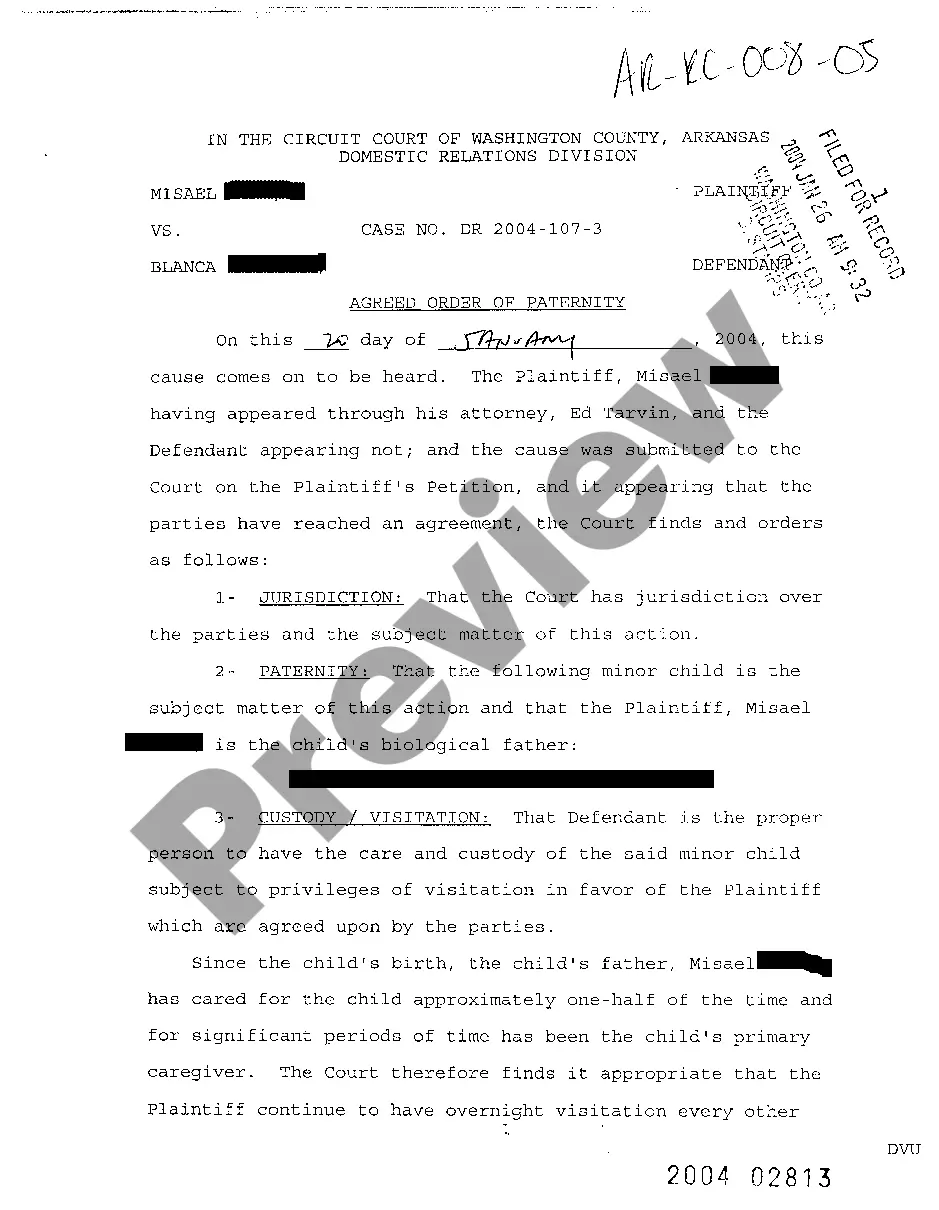
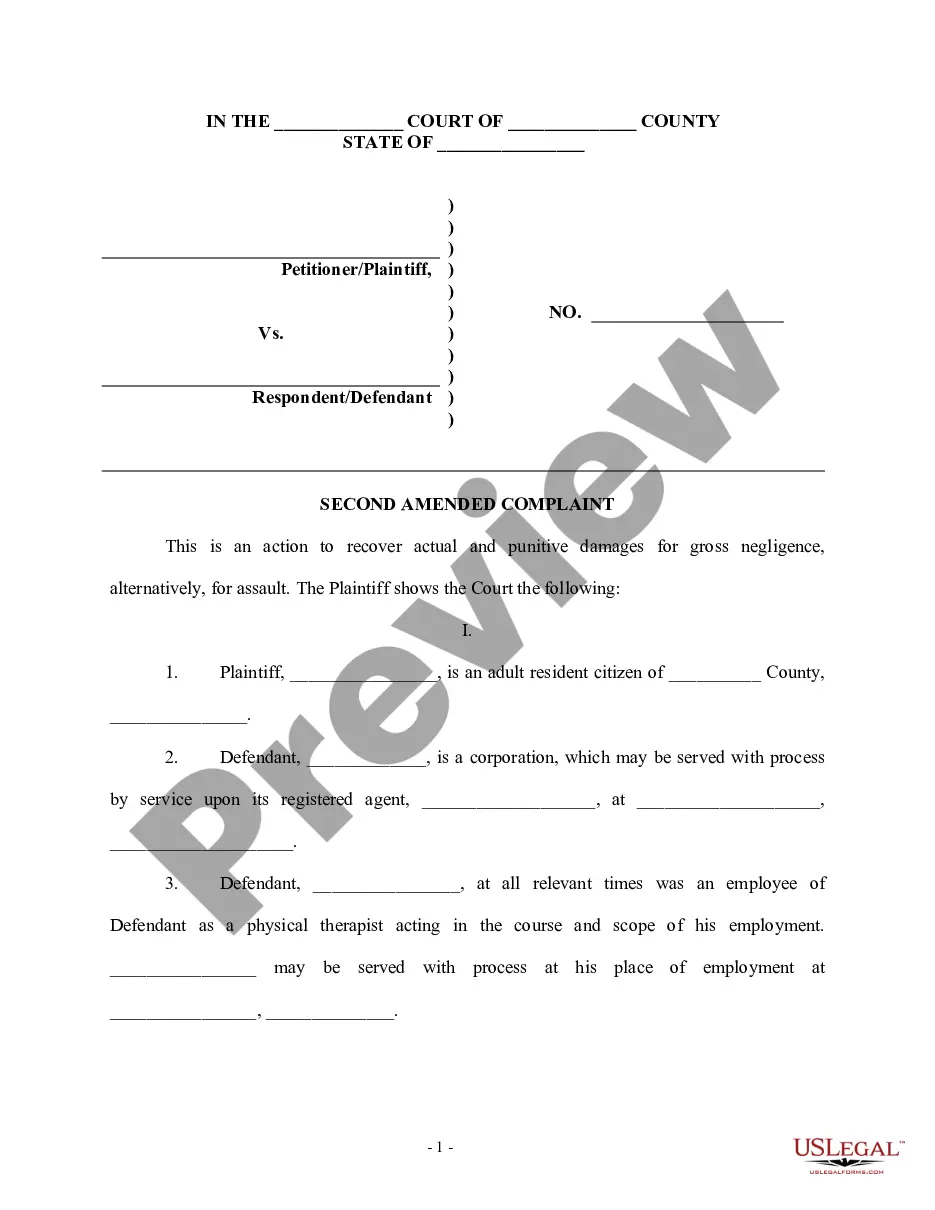
Complaint against Nurse and Correctional Institute for Damages for Failure to Give Medication to an Inmate
Overview of this form
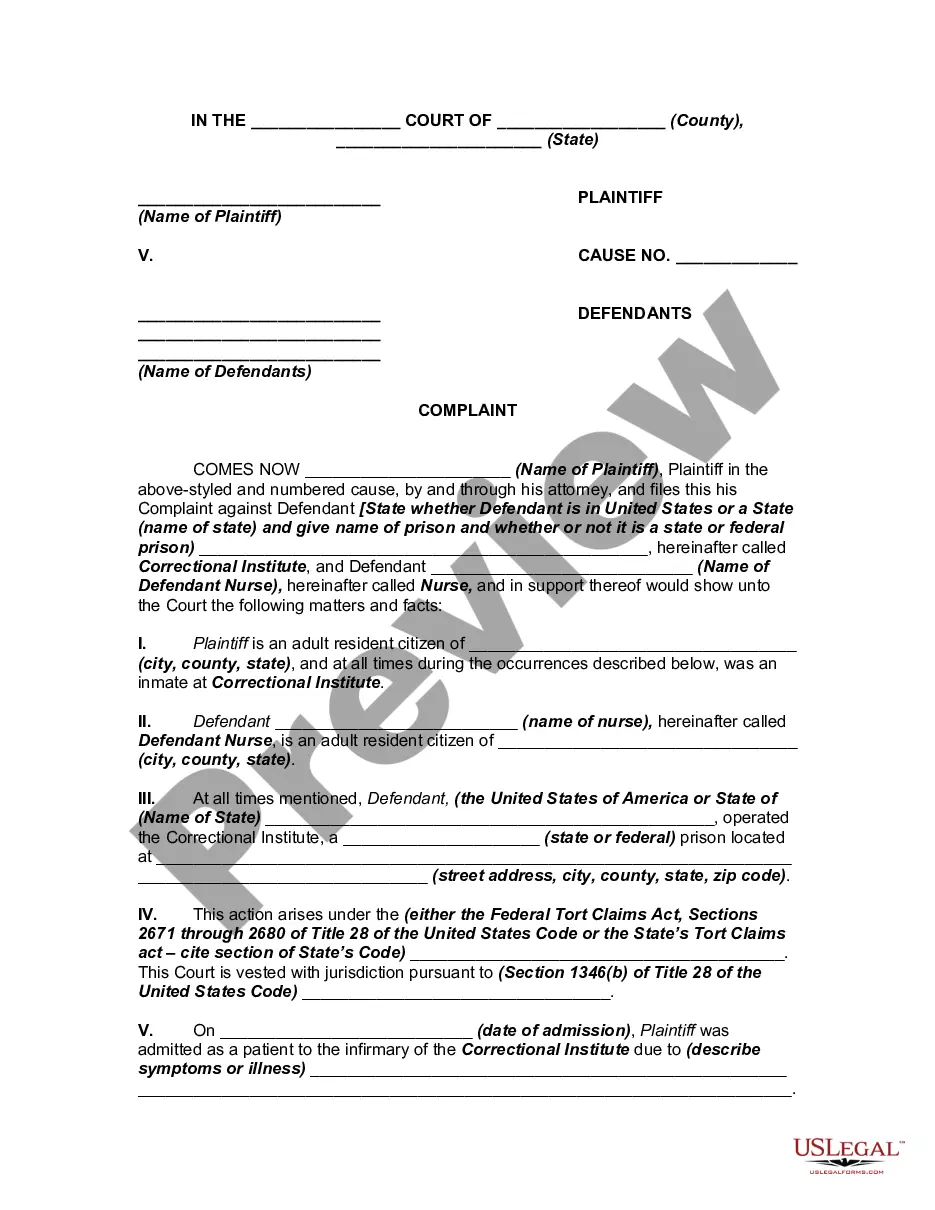
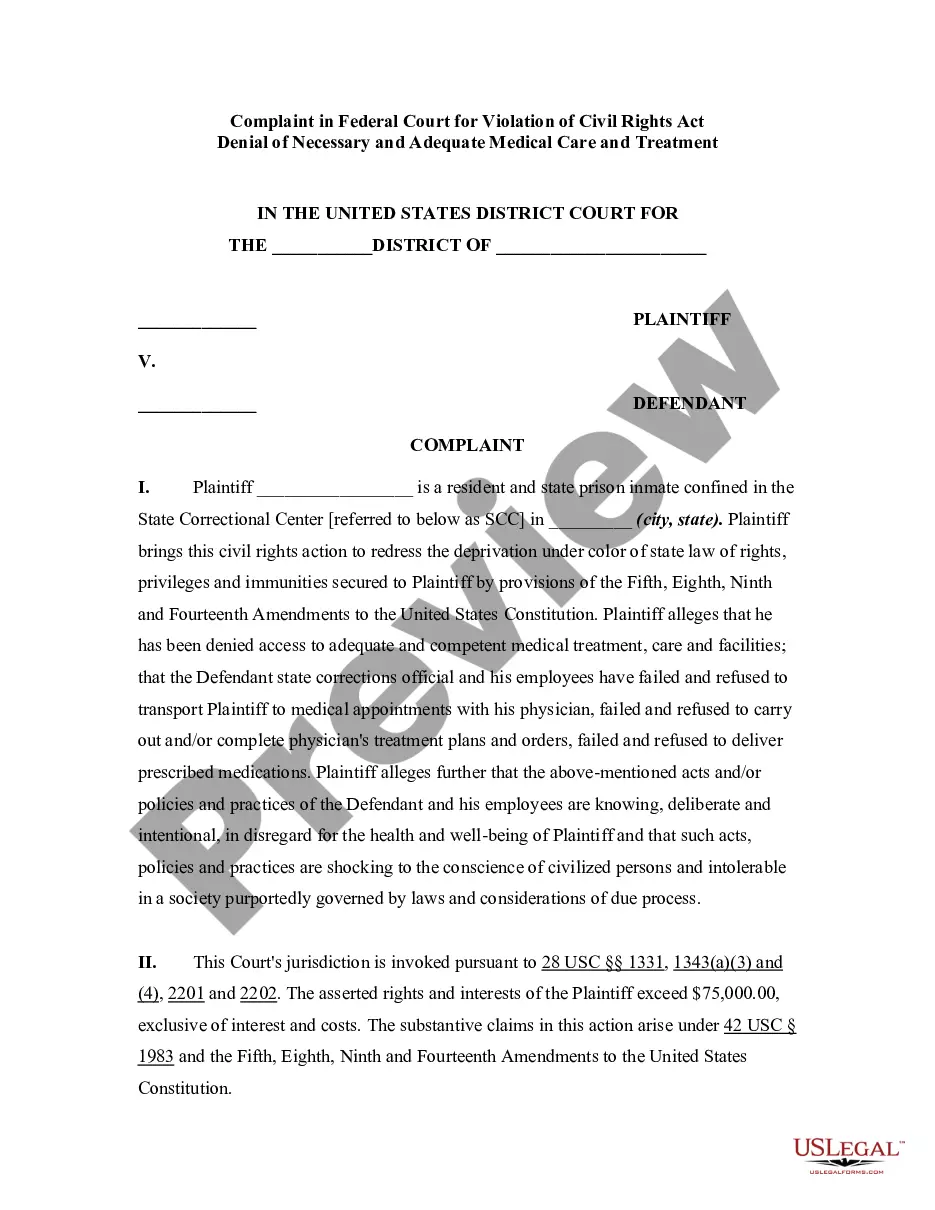
This form is a Complaint against Nurse and Correctional Institute for Damages for Failure to Give Medication to an Inmate. Under the Federal Tort Claims Act, this legal document allows an inmate to seek compensation for damages resulting from the negligence of prison staff, specifically concerning the failure to administer prescribed medication. Unlike standard medical malpractice claims, this form addresses the unique circumstances arising within a correctional setting involving federal or state institutions.
Form components explained
- Identification of the plaintiff and defendants, including relevant parties involved.
- Jurisdictional basis for the claim under the Federal Tort Claims Act or state laws.
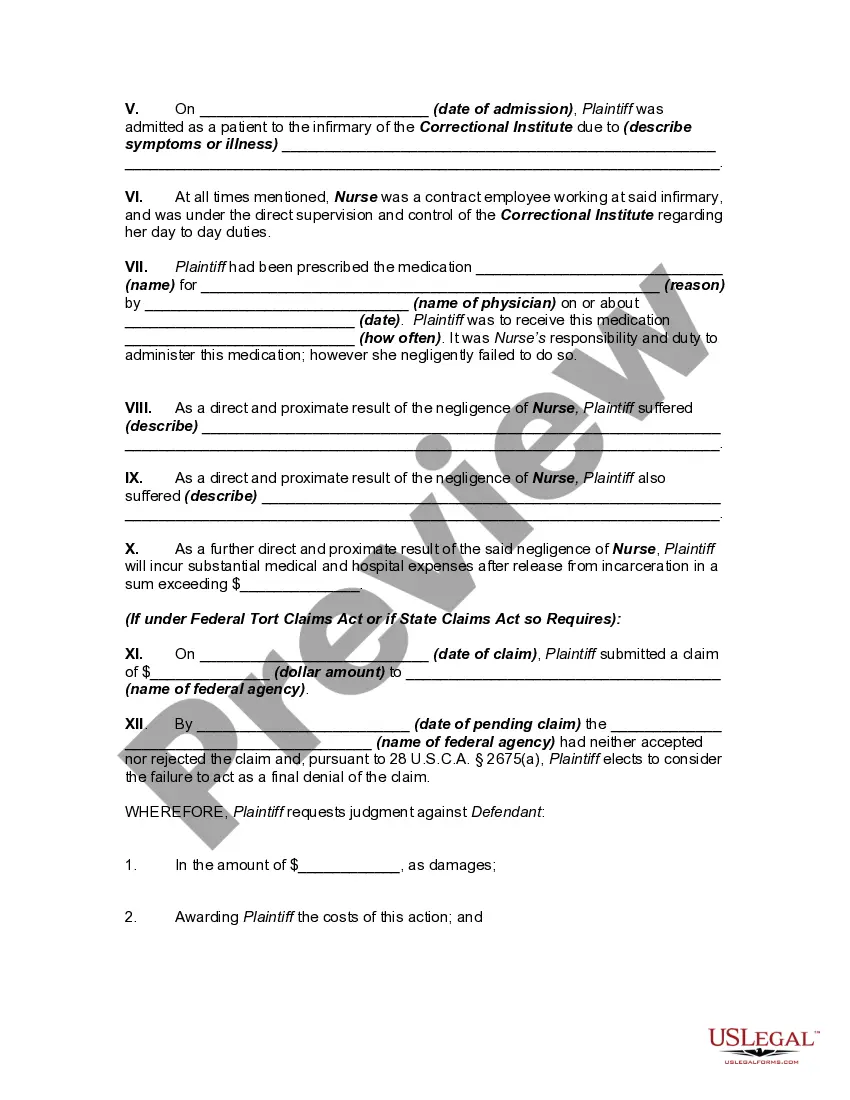
- Details of the plaintiff's medical condition and prescribed treatment.
- Claims of negligence by the nursing staff and the resulting injuries or damages.
- Documentation of the administrative claim process prior to filing the lawsuit.
- Request for specific damages and other forms of relief from the court.

When to use this form
This form should be used by inmates who have suffered harm due to the failure of correctional facility staff to provide necessary medication. It is appropriate when all conditions of the Federal Tort Claims Act are satisfied, particularly if the inadequacy in care has led to physical or psychological harm. It serves as a vital step toward seeking justice and compensation for damages incurred while under federal or state custody.
Intended users of this form
- Inmates who believe their health was compromised due to neglect in a correctional facility.
- Individuals who are acting on behalf of an inmate who has experienced such issues.
- Legal representatives assisting inmates in filing claims for damages.
Completing this form step by step
- Identify the plaintiff and defendants, including the full names and relevant titles.
- Provide specific details about the correctional institute and the nurse involved in the claim.
- Clearly state the circumstances of the plaintiff's admission and the prescribed medication.
- Detail the negligence and the direct consequences faced by the plaintiff.
- Document past communications regarding any administrative claims filed with the relevant agency.
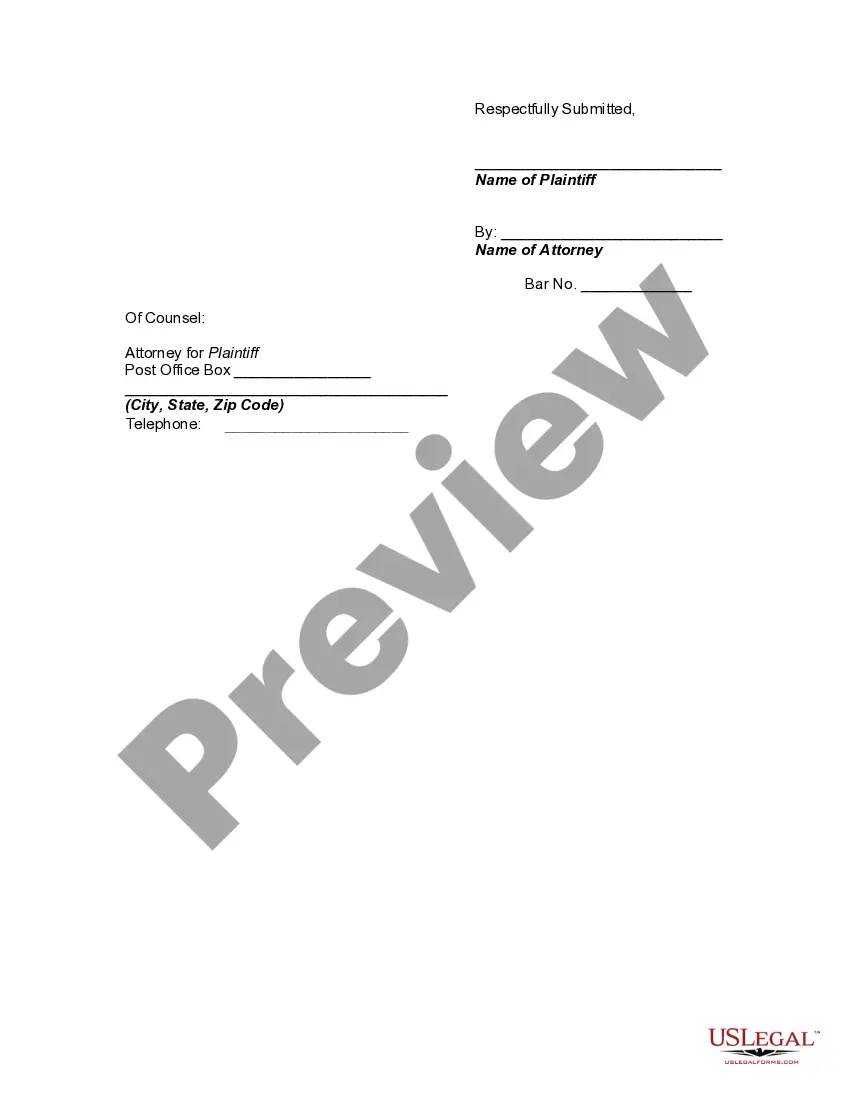
- Enter the specific relief sought and ensure all parties sign and date the document.
Does this form need to be notarized?
This form does not typically require notarization to be legally valid. However, some jurisdictions or document types may still require it. US Legal Forms provides secure online notarization powered by Notarize, available 24/7 for added convenience.
Get your form ready online
Our built-in tools help you complete, sign, share, and store your documents in one place.
Make edits, fill in missing information, and update formatting in US Legal Forms—just like you would in MS Word.
Download a copy, print it, send it by email, or mail it via USPS—whatever works best for your next step.
Sign and collect signatures with our SignNow integration. Send to multiple recipients, set reminders, and more. Go Premium to unlock E-Sign.
If this form requires notarization, complete it online through a secure video call—no need to meet a notary in person or wait for an appointment.
We protect your documents and personal data by following strict security and privacy standards.

Make edits, fill in missing information, and update formatting in US Legal Forms—just like you would in MS Word.

Download a copy, print it, send it by email, or mail it via USPS—whatever works best for your next step.

Sign and collect signatures with our SignNow integration. Send to multiple recipients, set reminders, and more. Go Premium to unlock E-Sign.

If this form requires notarization, complete it online through a secure video call—no need to meet a notary in person or wait for an appointment.

We protect your documents and personal data by following strict security and privacy standards.
Common mistakes to avoid
- Failing to accurately identify all parties involved, which may lead to dismissal of the case.
- Omitting details regarding the timeline and specifics of the medication prescribed.
- Not following the correct procedures for filing an administrative claim prior to the lawsuit.
Advantages of online completion
- Convenience of completing and downloading the form from the comfort of your home.
- Editability allows users to customize the form to fit their specific needs.
- Access to legal forms prepared by licensed attorneys ensures reliability and compliance.
Legal use & context
- This form is legally recognized for filing under the Federal Tort Claims Act, allowing claims against the federal government for negligence.
- It is essential to submit all related documentation to support your claims, as improperly completed forms could lead to rejections.
Looking for another form?


Form popularity
FAQ
To establish deliberate indifference, a Santa Fe civil rights lawyer must prove that the prison guard or other prison official was subjectively aware of the prisoners serious medical condition and chose to do nothing or to delay taking action.
Do California inmates have a right to health care? Inmates have a right to health care under the Eighth Amendment constitutional right against cruel and unusual punishment. It is not a right to the best possible health care.
State and federal employees (such as prison guards in state prisons) are immune from lawsuits (meaning they cannot be sued) unless the lawsuit alleges a violation of a clearly established statutory or constitutional right.
The Federal Tort Claims Act (FTCA) Although qualified immunity protects federal prison authorities, the immunity can be challenged when it comes to prison inmate injuries caused by negligence. To begin your injury claim, you must file a Standard Form 95.The forms for your lawsuit are in the prison library.
You may have a case for a lawsuit and compensation. A jail or prison is required by law to provide the medical needs of their inmates. Failure to do so is constitutionally prohibited cruel and unusual punishment, and when it leads to injury or death, the prison can be found liable and forced to pay compensation.
Do California inmates have a right to health care? Inmates have a right to health care under the Eighth Amendment constitutional right against cruel and unusual punishment. It is not a right to the best possible health care.
Gamble, 429 U.S. 97 (1976), was a case in which the Supreme Court of the United States established the standard of what a prisoner must plead in order to claim a violation of Eighth Amendment rights under 42 U.S.C.
Although prisoners do not have full constitutional rights, they are protected by the Eighth Amendment's prohibition against cruel and unusual punishment. This protection also requires that prisoners be afforded a minimum standard of living.