Notice by Mail to Debtor of Action if Payment not Made
Understanding this form
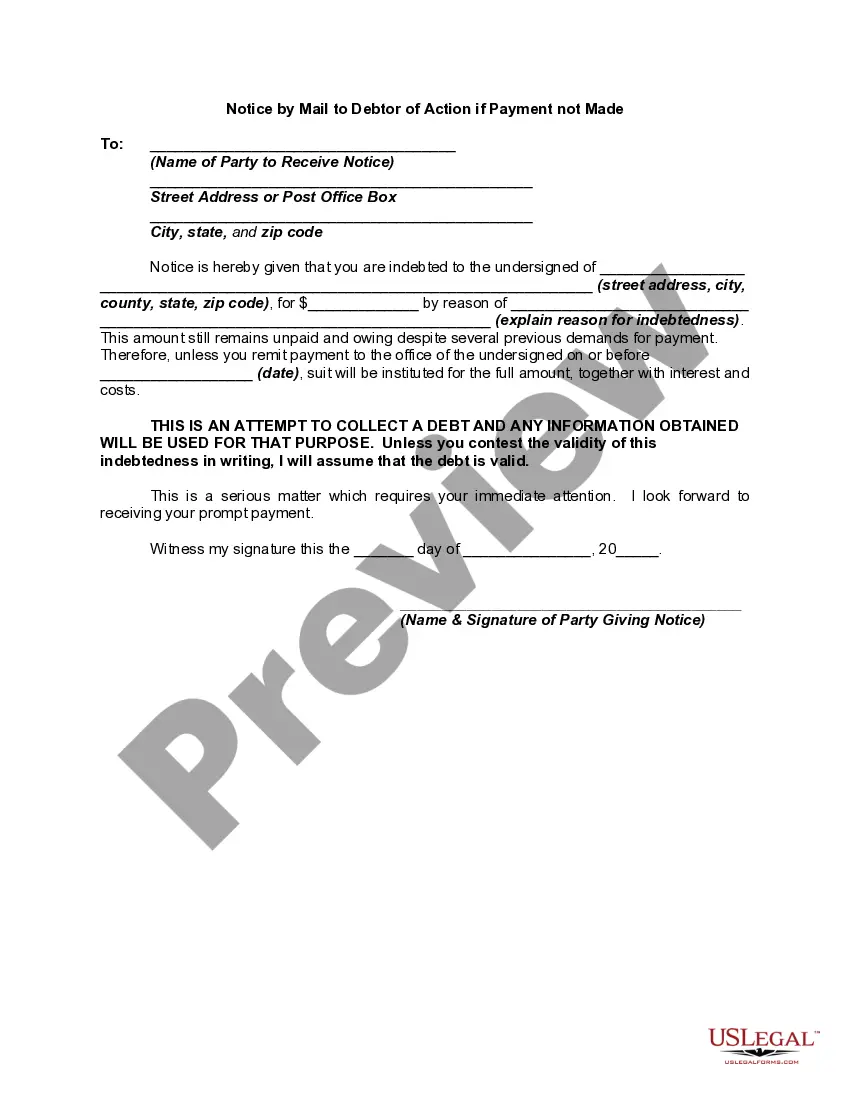
This form, known as the Notice by Mail to Debtor of Action if Payment not Made, serves as a formal communication from a creditor to a debtor. It notifies the debtor of their indebtedness and warns them that legal action may be pursued if payment is not received by a specified date. Unlike communications from debt collectors, this notice comes directly from the party owed money, emphasizing the seriousness of the situation and requesting immediate payment to avoid further action.
Form components explained
- Name and address of the debtor receiving the notice.
- Identification of the creditor and their address.
- Details of the debt, including the amount and reason for the indebtedness.
- A deadline by which payment should be made to avoid legal action.
- A declaration that failure to contest the debt will result in the assumption of its validity.
- Signature of the creditor, affirming the notice is an attempt to collect a debt.
When to use this form
Who can use this document
- Creditors seeking to collect unpaid debts.
- Businesses or individuals who have previously contacted the debtor about the outstanding amount.
- Anyone who needs to formally communicate a debt before pursuing legal action.
How to prepare this document
- Identify the debtor's name and address at the top of the form.
- Clearly state your name and address as the creditor.
- Specify the amount owed and provide the reason for the debt.
- Set a deadline for payment, ensuring it allows reasonable time for the debtor to respond.
- Sign and date the form to validate your notice.
Notarization requirements for this form
This form usually doesn’t need to be notarized. However, local laws or specific transactions may require it. Our online notarization service, powered by Notarize, lets you complete it remotely through a secure video session, available 24/7.
Get your form ready online
Our built-in tools help you complete, sign, share, and store your documents in one place.
Make edits, fill in missing information, and update formatting in US Legal Forms—just like you would in MS Word.
Download a copy, print it, send it by email, or mail it via USPS—whatever works best for your next step.
Sign and collect signatures with our SignNow integration. Send to multiple recipients, set reminders, and more. Go Premium to unlock E-Sign.
If this form requires notarization, complete it online through a secure video call—no need to meet a notary in person or wait for an appointment.
We protect your documents and personal data by following strict security and privacy standards.

Make edits, fill in missing information, and update formatting in US Legal Forms—just like you would in MS Word.

Download a copy, print it, send it by email, or mail it via USPS—whatever works best for your next step.

Sign and collect signatures with our SignNow integration. Send to multiple recipients, set reminders, and more. Go Premium to unlock E-Sign.

If this form requires notarization, complete it online through a secure video call—no need to meet a notary in person or wait for an appointment.

We protect your documents and personal data by following strict security and privacy standards.
Typical mistakes to avoid
- Failing to include accurate contact information for both parties.
- Not providing sufficient detail about the nature of the debt.
- Setting an unrealistic deadline for payment.
- Not signing the notice, which may render it less formal.
Advantages of online completion
- Convenient access to templates that can be downloaded and completed quickly.
- Editability allows for customization to fit specific circumstances and information.
- Reliable format that adheres to legal standards, ensuring compliance with necessary requirements.
Looking for another form?


Form popularity
FAQ
Send a Final Demand for Payment. Before taking any formal legal action, it's a good idea to send a final demand for payment to the client. Assess How Much You're Owed. Get Legal Advice. Consider Small Claims Court. Consider A Civil Lawsuit.
Type your letter. Concisely review the main facts. Be polite. Write with your goal in mind. Ask for exactly what you want. Set a deadline. End the letter by stating you will promptly pursue legal remedies if the other party does not meet your demand. Make and keep copies.
Be polite, but firm, in your tone. For example, if you are writing with regard to a personal loan, you could begin by saying: "As you are aware, on date you contacted me for help regarding your delinquent car payment. I lent you the sum of dollar amount and you promised to pay back the money within time period."
If you loaned someone money and they refuse to pay, it's only natural to think, Can I sue someone who owes me money? The answer is, yes, you can. That's why the small claims court exists. It is a specific type of court that hears cases between two parties without the need to have expensive, drawn-out lawsuits.
Type your letter. Concisely review the main facts. Be polite. Write with your goal in mind. Ask for exactly what you want. Set a deadline. End the letter by stating you will promptly pursue legal remedies if the other party does not meet your demand. Make and keep copies.
The lawsuit is not based on whether you can payit is based on whether you owe the specific debt amount to that particular plaintiff. Even if you have no money, the court can decide: the creditor has won the lawsuit, and, you still owe that sum of money to that person or company.
An attorney is usually not necessary at this point and you can write a demand letter on your own. To write one, gather necessary documents, draft your letter, and send the letter to your opposing party.
Your company name and address. recipient's name and address. today's date. a clear reference and/or any account reference numbers. the amount outstanding. original payment due date. a brief explanation that no payment has been received.
Order 37 of Civil Procedure Code: This order is a power given to the person who wants to recover his money. This order permits creditor to file a summary suit. Negotiable Instruments Act, 1881- This is act which deals with the non payment through cheque or bill of exchange etc.