Waiver and Release for Furniture and Related Personal Property Stored by Bailee
What this document covers
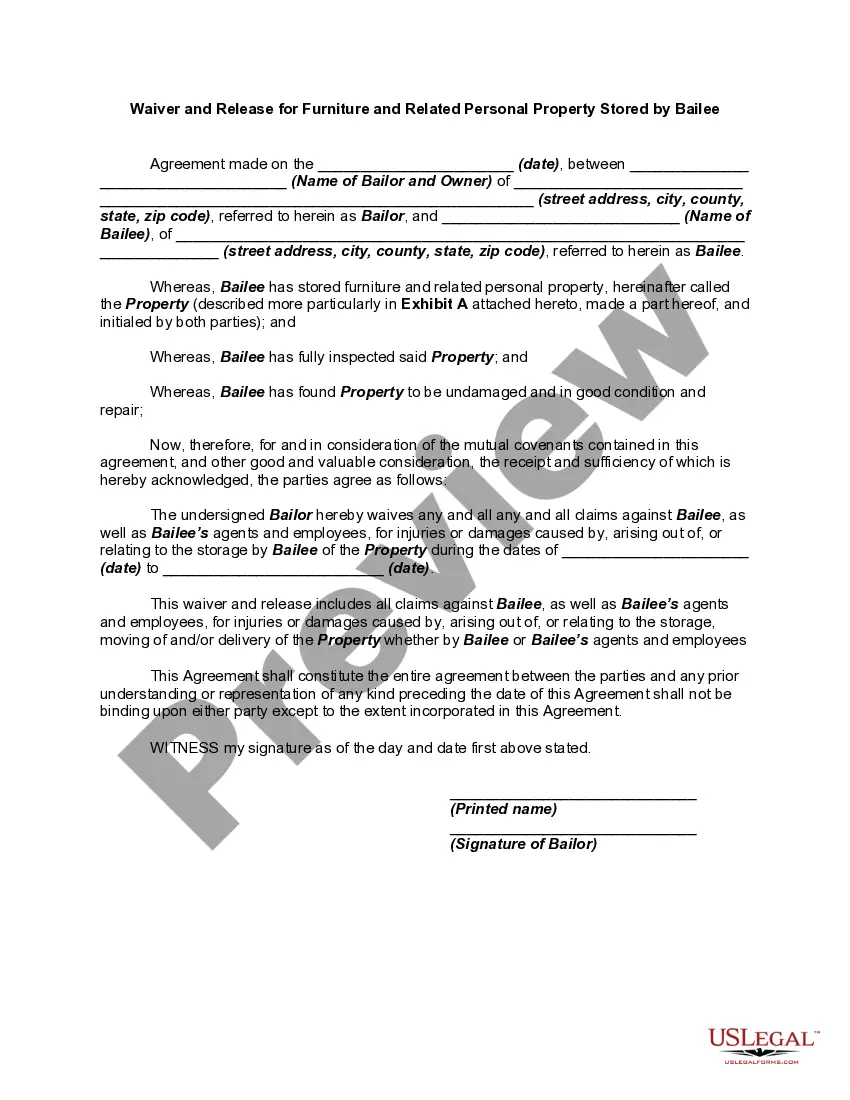
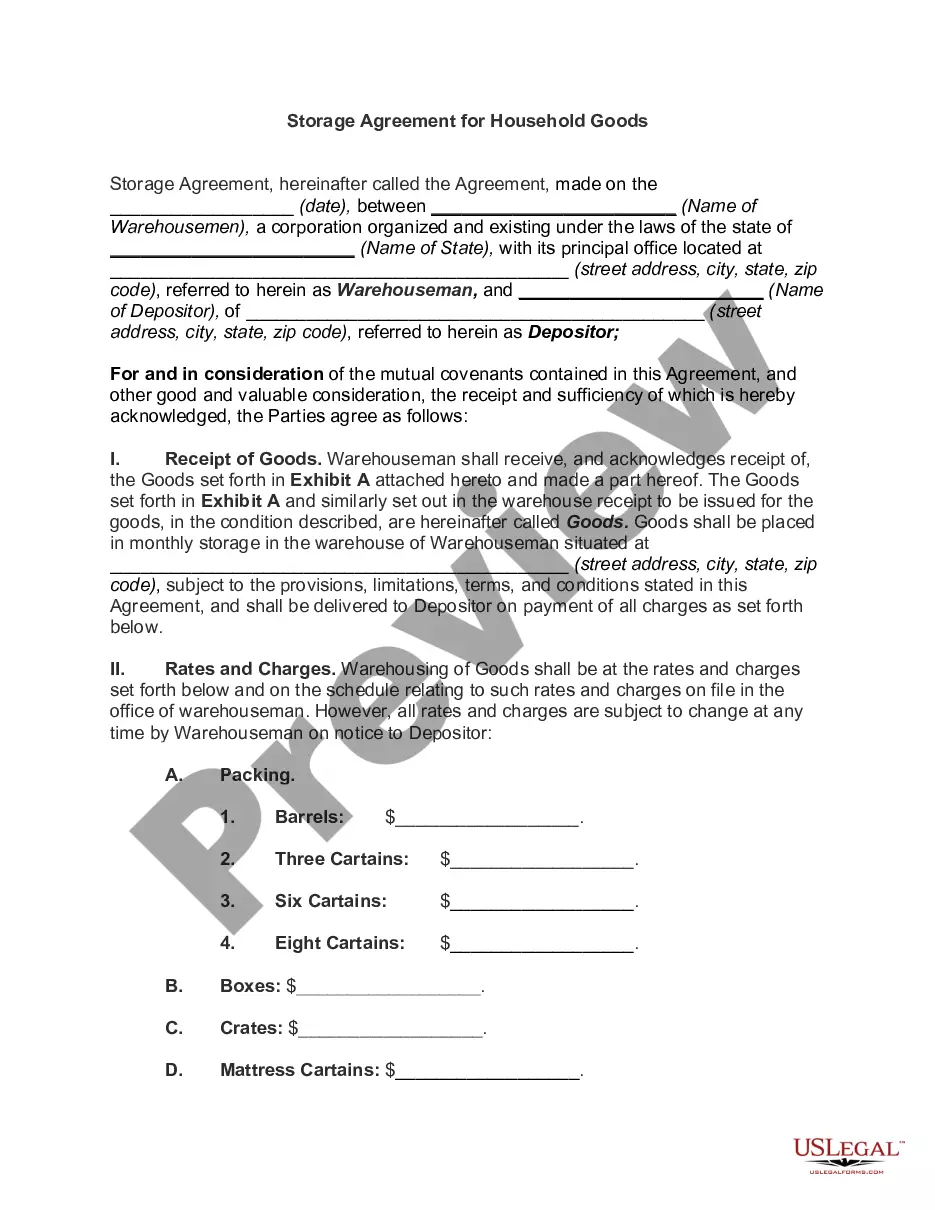
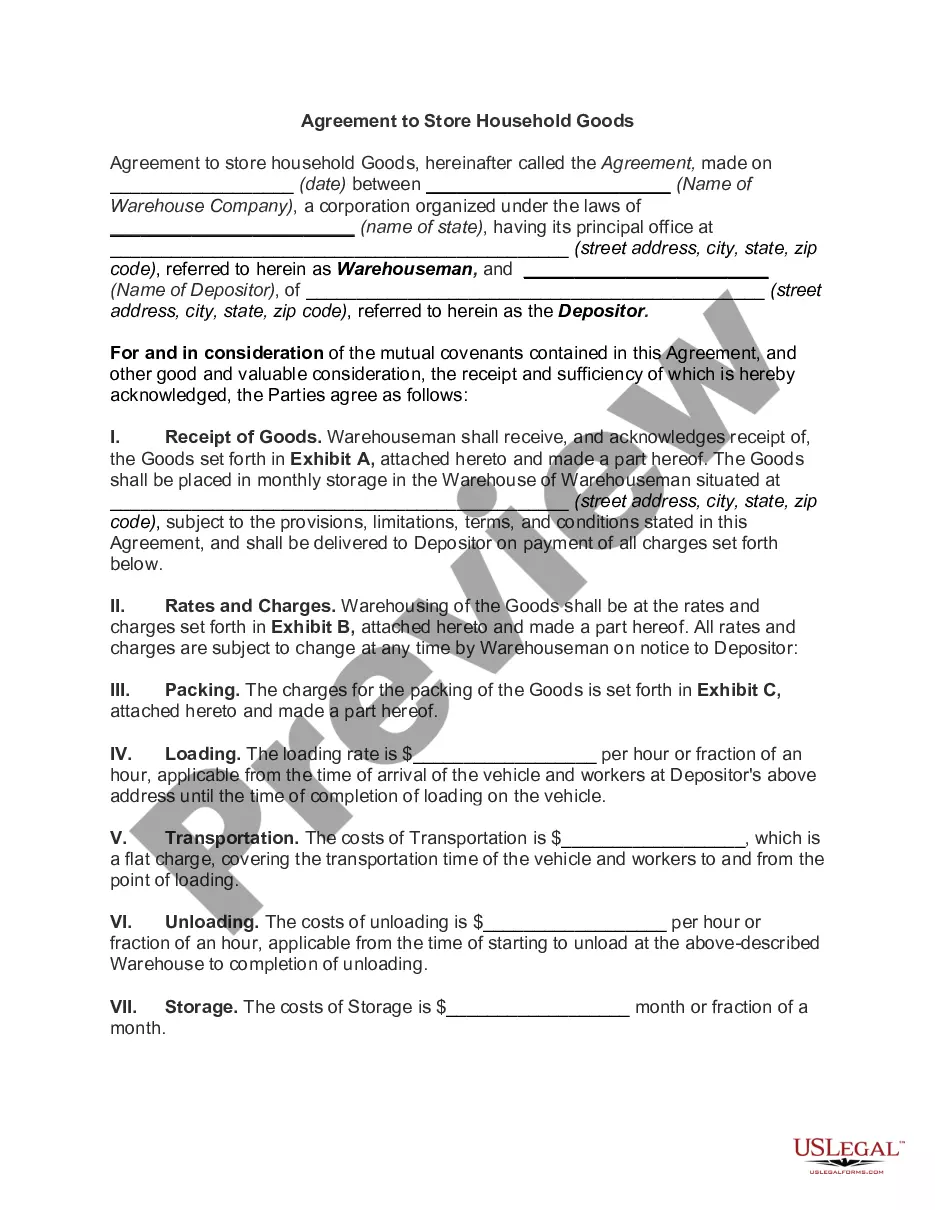
The Waiver and Release for Furniture and Related Personal Property Stored by Bailee is a legal document that allows the bailor (the owner of the property) to waive any claims against the bailee (the person storing the property) for damages or injuries arising from the storage of the property. This form establishes a contractual relationship between the bailee and the bailor, ensuring that the bailee is not held liable for issues that may occur during the storage period. It differs from a sales contract in that it does not involve the transfer of ownership but rather the safe keeping of property.
Main sections of this form
- Date of the agreement.
- Names and addresses of the bailor and bailee.
- Description of the property being stored, included in Exhibit A.
- Clauses outlining the waiver of claims for damages during the storage period.
- Signatures of both parties to validate the agreement.
When this form is needed
You should use the Waiver and Release for Furniture and Related Personal Property Stored by Bailee when you are entering into an agreement to store personal property with another party. This could occur in various situations such as renting storage space, leaving furniture with a friend or a moving company, or any scenario where property is entrusted to another person for safekeeping.
Who this form is for
- Bailors who wish to store their property and protect themselves from liability.
- Bailees who need to clarify their responsibilities and limitations of liability regarding stored goods.
- Individuals or businesses involved in rental agreements for storage facilities.
- Friends or family members temporarily storing each other's belongings.
Steps to complete this form
- Identify and enter the date of the agreement.
- Fill in the full names and addresses of both the bailor and the bailee.
- Describe the property being stored, referencing Exhibit A for detailed specifications.
- Indicate the storage period during which the waiver applies.
- Both parties should review the agreement and sign at the designated areas.
Does this form need to be notarized?
This form does not typically require notarization unless specified by local law. It is advisable to check local regulations to ensure compliance and legal enforceability of the agreement.
Get your form ready online
Our built-in tools help you complete, sign, share, and store your documents in one place.
Make edits, fill in missing information, and update formatting in US Legal Forms—just like you would in MS Word.
Download a copy, print it, send it by email, or mail it via USPS—whatever works best for your next step.
Sign and collect signatures with our SignNow integration. Send to multiple recipients, set reminders, and more. Go Premium to unlock E-Sign.
If this form requires notarization, complete it online through a secure video call—no need to meet a notary in person or wait for an appointment.
We protect your documents and personal data by following strict security and privacy standards.

Make edits, fill in missing information, and update formatting in US Legal Forms—just like you would in MS Word.

Download a copy, print it, send it by email, or mail it via USPS—whatever works best for your next step.

Sign and collect signatures with our SignNow integration. Send to multiple recipients, set reminders, and more. Go Premium to unlock E-Sign.

If this form requires notarization, complete it online through a secure video call—no need to meet a notary in person or wait for an appointment.

We protect your documents and personal data by following strict security and privacy standards.
Typical mistakes to avoid
- Failing to provide a complete description of the property being stored.
- Not specifying the dates for the storage period.
- Leaving out required signatures, which may render the agreement unenforceable.
- Using incorrect or incomplete names and addresses of the involved parties.
Benefits of completing this form online
- Convenience of downloading and completing the form at your own pace.
- Immediate access to a professional legal template drafted by licensed attorneys.
- Customizable fields to suit your specific storage agreement needs.
- Ability to securely store and retrieve your completed documents online.
Looking for another form?
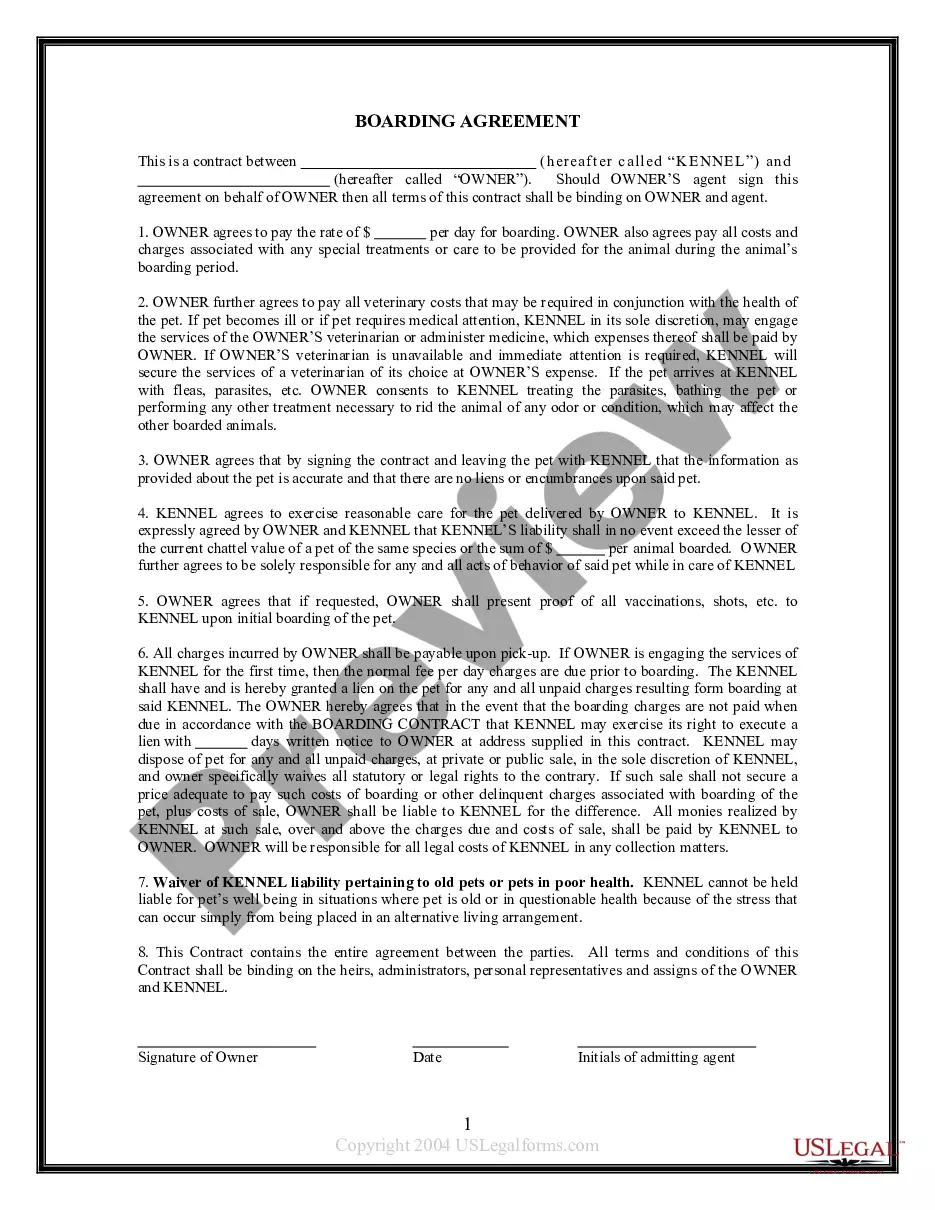
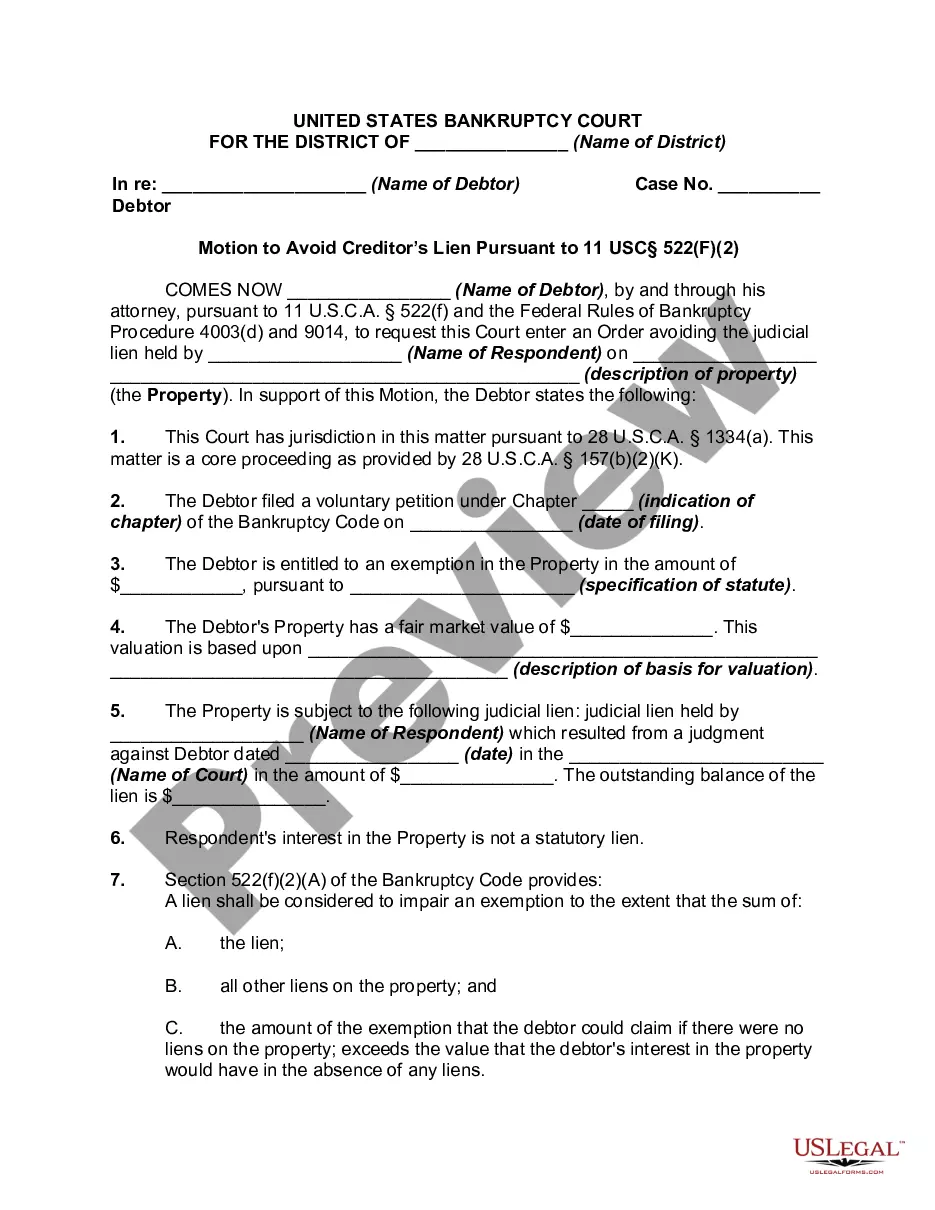
Form popularity
FAQ
Be completely honest on your seller disclosure. Put everything in writing. Only allow preapproved buyers to see your home. Clear away personal and valuable items. Remove dogs or other pets during showings. Provide a home warranty for your buyer.
What is Personal Property? Personal property is a class of property that can include any asset other than real estate. The distinguishing factor between personal property and real estate, or real property, is that personal property is movable; that is, it isn't fixed permanently to one particular location.
Identify the releasor. Describe the photo, image, likeness, or video. Address any payment the model receives for the release. Address royalties. Address whether the model has the ability to revoke their authorization. The parties sign and date the release.
A legal release is a legal instrument that acts to terminate any legal liability between the releasor and the releasee(s), signed by the releasor. A release may also be made orally in some circumstances.A general release may release any claims known or unknown that the releasor may have against the releasee.
The standard talent release form is designed for the purpose of an individual to grant full permission to have images of their likeness and the sound of their voice to be recorded on audio or video and used at the user's discretion and without payment, other compensation or legal repercussion to the grantee.
The answer to this question can be found in HUD 4155.1, Chapter Two, Section A. That part of the FHA loan rulebook states: Personal property given by a seller and/or another interested third party to consummate the sale of a property results in a reduction in the mortgage amount.
Unless specifically itemized, such personal property is not included in the home sale.The buyer has maximum leverage over the seller before the seller receives the buyer`s money. But after the sale closes, the buyer loses control over the seller and the realty agent.
Release Document means a form of release by which existing holders of Common Stock Equity Interests may agree to third-party releases as provided in the Plan, which Release Document shall be executed and delivered to the Debtor (or Reorganized Debtor) and the Lenders no later than sixty (60) days after the Effective
What do you Leave When Selling a House? You are under no legal obligation to leave anything, but it is the normal practice that you would leave the fixtures of the home.