Non-Waiver Agreement between Contractor and Owner Regarding Accepting Late Payments
About this form
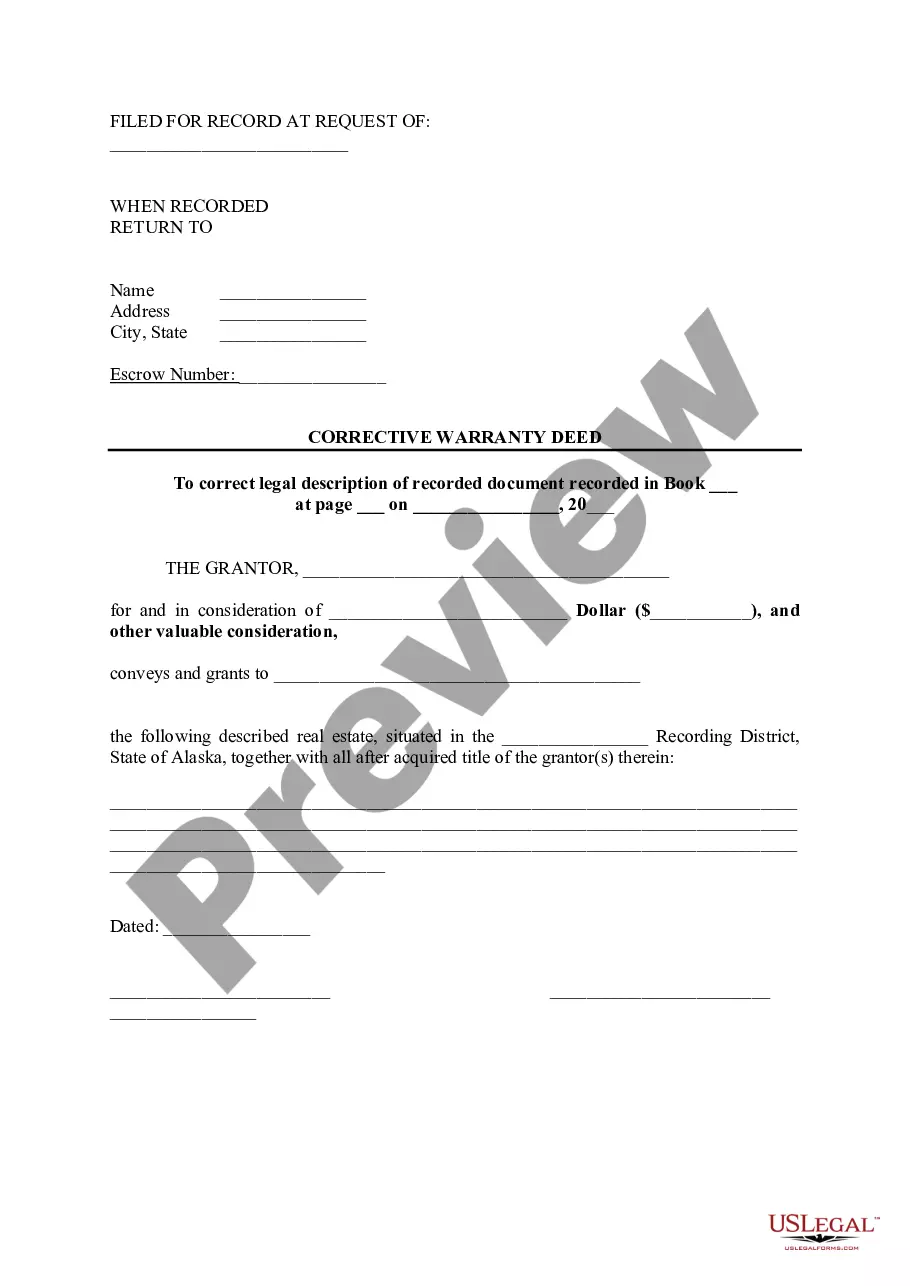
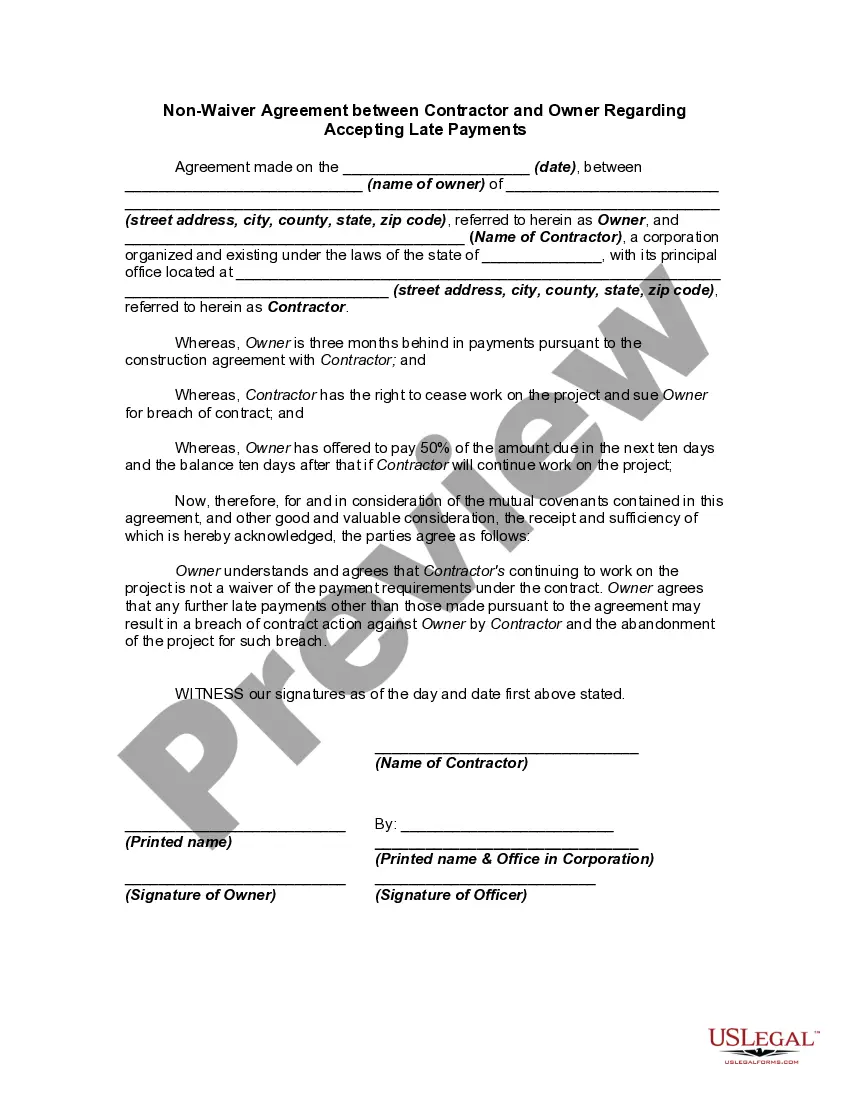
The Non-Waiver Agreement between Contractor and Owner Regarding Accepting Late Payments is a legal document that outlines an agreement between a property owner and a contractor. Its primary purpose is to ensure that if the contractor accepts late payments from the owner, it does not waive their right to demand timely payments in the future. This form is essential for maintaining clarity in payment expectations and protecting the contractor's legal interests.
Key components of this form
- Date of the agreement
- Identifying information for both the owner and contractor
- Details of payment delays and amounts owed
- Mutual agreements about the impact of accepting late payments
- Signatures of both parties, including printed names and titles
When this form is needed
This Non-Waiver Agreement is useful in scenarios where a contractor has been accepting late payments from an owner but wants to ensure that this does not affect future payment expectations. It is particularly relevant when construction work is ongoing, and the owner has fallen behind on payments but is offering to rectify the situation while the contractor continues work.
Who needs this form
- Property owners who are behind on payments to contractors
- Contractors working on projects with owners experiencing payment delays
- Any party seeking to clarify payment terms in a construction agreement
How to prepare this document
- Identify the date of the agreement.
- Enter the full names and contact details of the owner and contractor.
- Specify the amount due and the terms of the late payments.
- Include any relevant clauses regarding the rights of the contractor.
- Ensure all parties sign and print their names where indicated.
Is notarization required?
This form does not typically require notarization to be legally valid. However, some jurisdictions or document types may still require it. US Legal Forms provides secure online notarization powered by Notarize, available 24/7 for added convenience.
Get your form ready online
Our built-in tools help you complete, sign, share, and store your documents in one place.
Make edits, fill in missing information, and update formatting in US Legal Forms—just like you would in MS Word.
Download a copy, print it, send it by email, or mail it via USPS—whatever works best for your next step.
Sign and collect signatures with our SignNow integration. Send to multiple recipients, set reminders, and more. Go Premium to unlock E-Sign.
If this form requires notarization, complete it online through a secure video call—no need to meet a notary in person or wait for an appointment.
We protect your documents and personal data by following strict security and privacy standards.

Make edits, fill in missing information, and update formatting in US Legal Forms—just like you would in MS Word.

Download a copy, print it, send it by email, or mail it via USPS—whatever works best for your next step.

Sign and collect signatures with our SignNow integration. Send to multiple recipients, set reminders, and more. Go Premium to unlock E-Sign.

If this form requires notarization, complete it online through a secure video call—no need to meet a notary in person or wait for an appointment.

We protect your documents and personal data by following strict security and privacy standards.
Mistakes to watch out for
- Failing to include the date of the agreement.
- Omitting important details about payment amounts and terms.
- Not having both parties sign the document.
- Using unclear or vague language in payment terms.
- Neglecting to keep a copy of the signed agreement for future reference.
Benefits of completing this form online
- Convenient downloading and immediate access to the template.
- Editability, allowing customization to meet specific needs.
- Reliability, as the forms are drafted by licensed attorneys.
- Time-saving, as it simplifies the paperwork process.
Looking for another form?









Form popularity
FAQ
Identifying/Contact Information. Title and Description of the Project. Projected Timeline and Completion Date. Cost Estimate and Payment Schedule. Stop Work Clause and Stop Payment Clause. Act of God Clause. Change Order Agreement. Warranty.
A non-waiver agreement is one method by which an insurer can reserve the right to make the decision about coverage until after an investigation has been conducted. Such an agreement is bilateral, with the insured, to reserve this right and set the expectations of the investigation and indemnification process.
In which of the following situations should a non-waiver agreement be used? Explanation: Non-waivers should be executed when there are unresolved questions regarding coverage, limits, or both. The adjuster would be wise to present such a waiver to the claimant/insured during the initial site visit.
When a party to a contract waives a breach of that contract by the other party, it voluntarily abandons its legal rights to enforce the contract, or to claim any remedy, in relation to that breach. A waiver must be clear, but may be oral or written.
Name of contractor and contact information.Name of homeowner and contact information.Describe property in legal terms.List attachments to the contract.The cost.Failure of homeowner to obtain financing.Description of the work and the completion date.Right to stop the project.19 Things Every Construction Contract Should Have .com\nwww..com > articles > 19-things-every-construction-contract-sho...
In most cases, an insured should not sign a non-waiver agreement. However, there are circumstances in which an insured may wish to do so. For example, there are significant benefits to an insured when the insurer provides and pays for a defence.
The non-waiver agreement is signed by the policyholder; its purpose is to protect the insurer. Insurer reserves all of its rights under the policy to investigate and defend a claim without admission of any liability for loss.
Are Waiver Clauses Always Enforceable? Unfortunately, no. Even if a contract contains a complete non-waiver clause, extreme behavior on the part of the enforcing party may cause a court to find that the party waived its right to enforcement.
Rather, a non-waiver clause generally provides that the parties to a contract may not change or modify their agreement unless both parties agree to the proposed change or modification in writing.