Employment Agreement Between a Bartender - as Self-Employed Independent Contractor - and a Business that Supplies Bartenders to Parties and Special Events
About this form
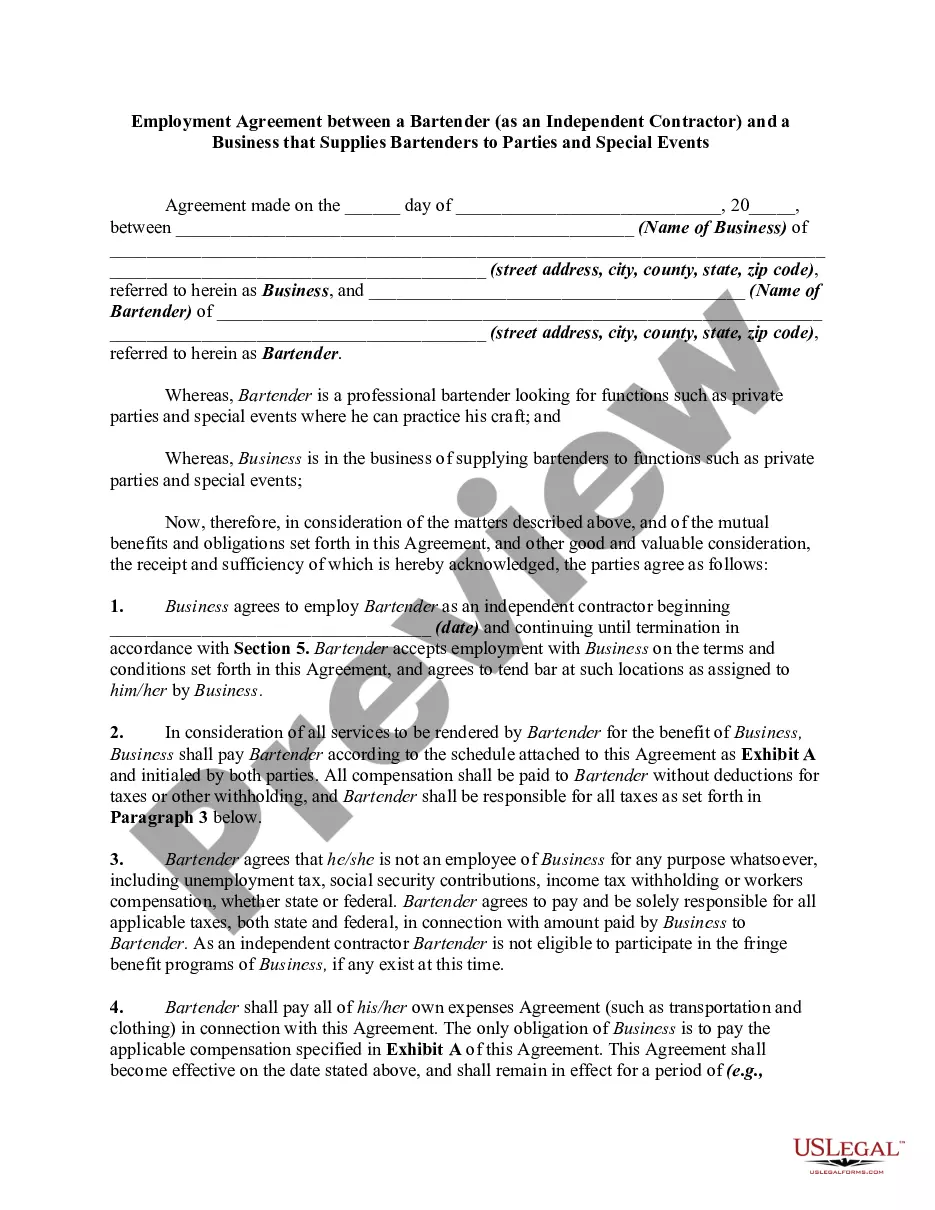
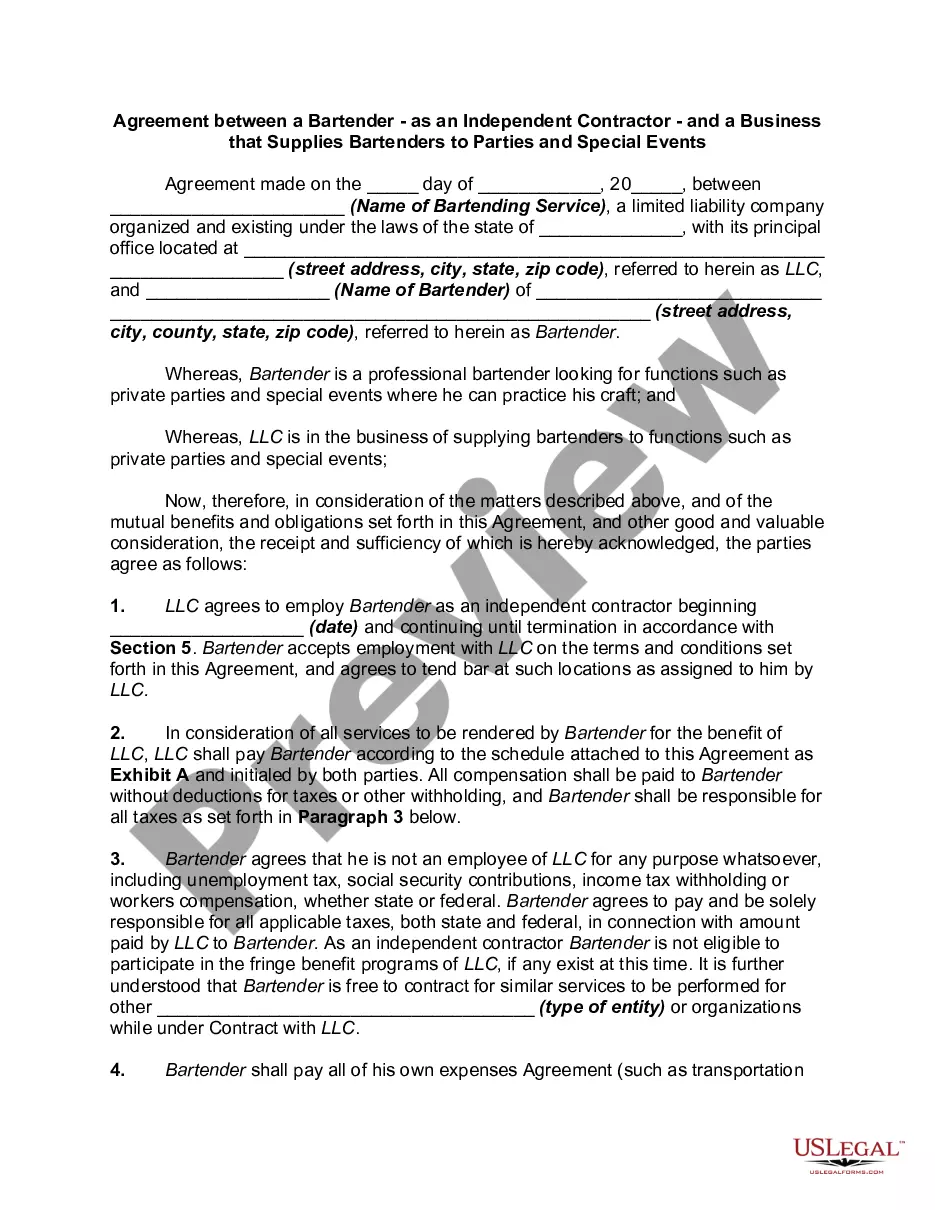
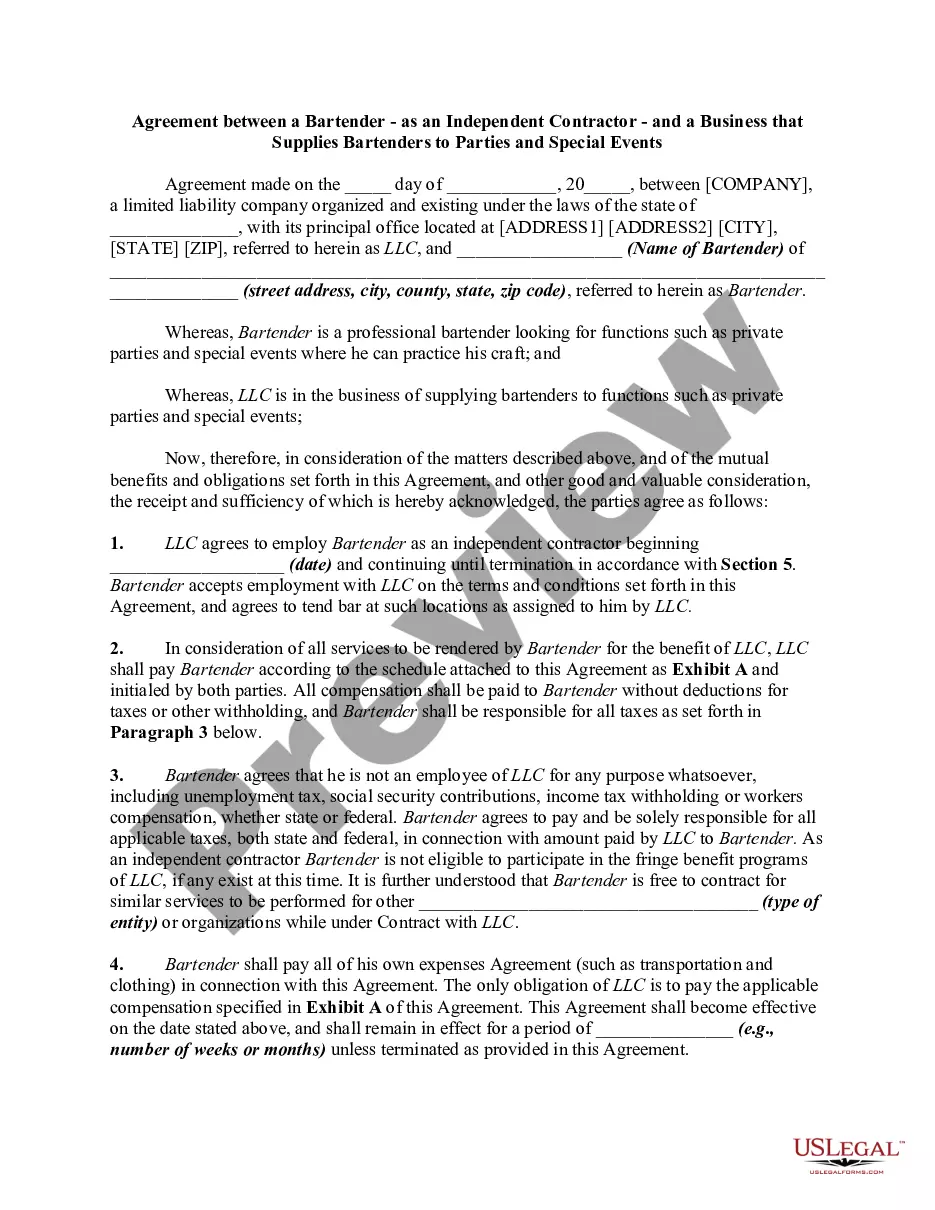
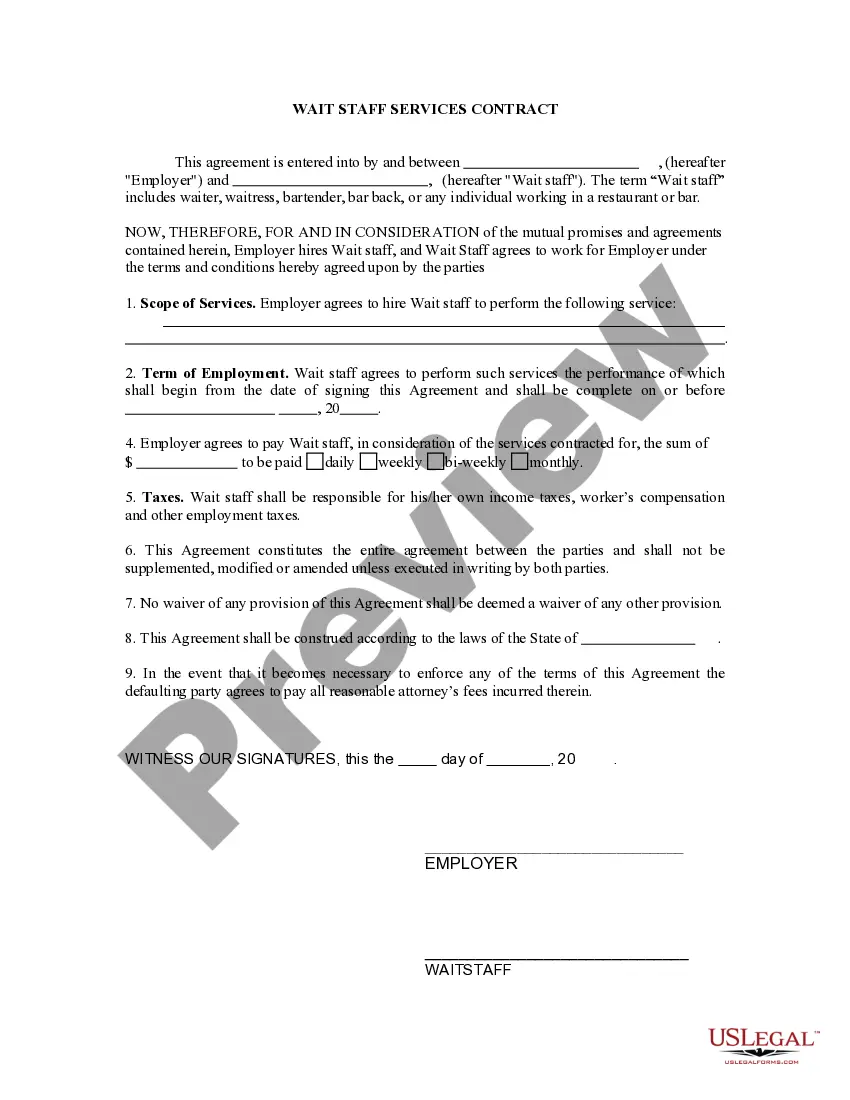
This Employment Agreement Between a Bartender as Self-Employed Independent Contractor and a Business that Supplies Bartenders to Parties and Special Events establishes the terms of service for bartenders working as independent contractors. This form clarifies the working relationship, ensuring that the bartender is not treated as an employee and is responsible for their own taxes and expenses. It differs from traditional employment agreements as it focuses on the independent status of the bartender, outlining responsibilities and rights specific to such a relationship.
Key parts of this document
- Identification of the parties involved: the business and the bartender.
- Terms of compensation, including payment schedules and responsibilities for taxes.
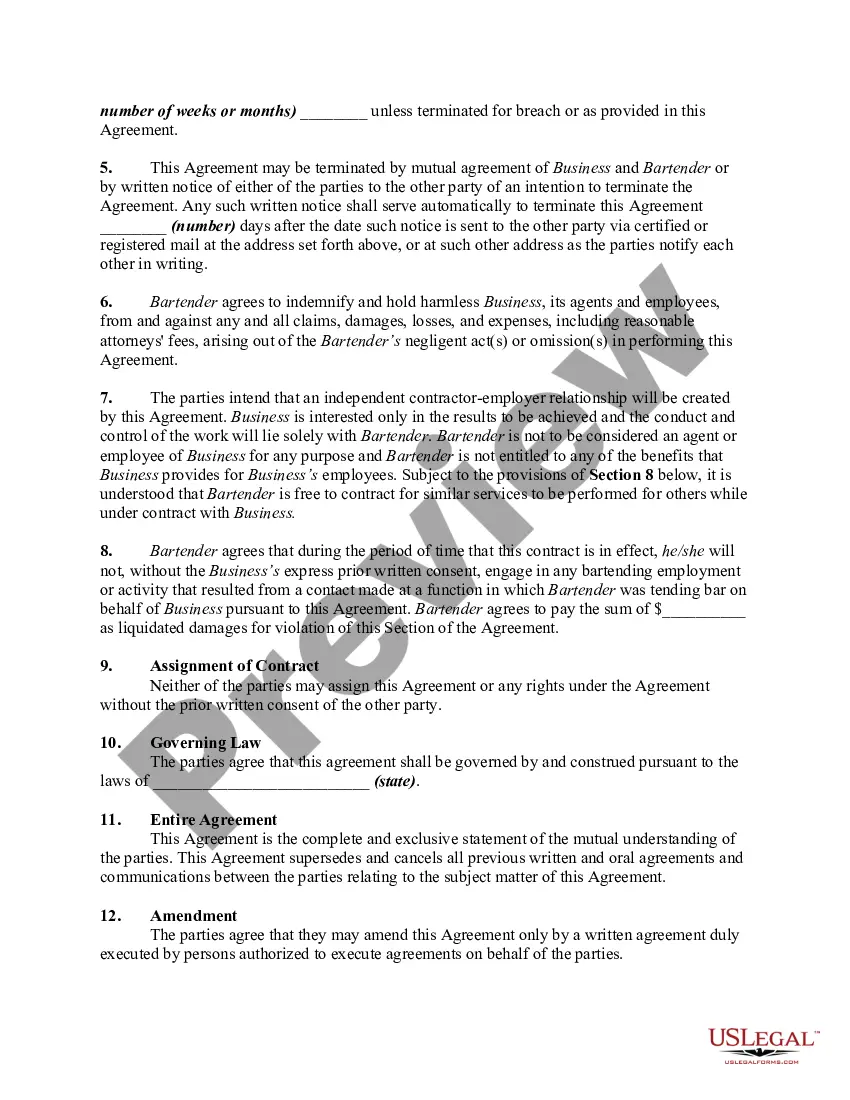
- Clauses regarding the termination of the agreement and process for mutual consent.
- Indemnification clause to protect the business from claims arising from the bartender's actions.
- Liquidated damages clause specifying penalties for breaching contract terms.
- Governing law specifying the applicable jurisdiction for the agreement.
Situations where this form applies
This agreement is useful in scenarios where a business requires bartending services for events or parties but prefers to hire bartenders as independent contractors rather than employees. It is ideal for event coordinators, private party planners, and catering businesses that frequently need temporary bartending services without the obligations of permanent employment.
Who should use this form
This agreement is suitable for:
- Businesses supplying bartenders for events, such as catering companies or event planners.
- Self-employed bartenders seeking to formalize their service agreements.
- Event hosts and organizations needing temporary bar services for private or special events.
Instructions for completing this form
- Identify the parties: Fill in the names and addresses of both the business and the bartender.
- Specify the start date for the agreement and the expected duration of the services.
- Outline the payment terms by attaching Exhibit A detailing compensation structure.
- Include clauses on indemnification and termination to clarify the responsibilities of both parties.
- Both parties should sign and date the agreement to make it legally binding.
Notarization guidance
Notarization is not commonly needed for this form. However, certain documents or local rules may make it necessary. Our notarization service, powered by Notarize, allows you to finalize it securely online anytime, day or night.
Get your form ready online
Our built-in tools help you complete, sign, share, and store your documents in one place.
Make edits, fill in missing information, and update formatting in US Legal Forms—just like you would in MS Word.
Download a copy, print it, send it by email, or mail it via USPS—whatever works best for your next step.
Sign and collect signatures with our SignNow integration. Send to multiple recipients, set reminders, and more. Go Premium to unlock E-Sign.
If this form requires notarization, complete it online through a secure video call—no need to meet a notary in person or wait for an appointment.
We protect your documents and personal data by following strict security and privacy standards.

Make edits, fill in missing information, and update formatting in US Legal Forms—just like you would in MS Word.

Download a copy, print it, send it by email, or mail it via USPS—whatever works best for your next step.

Sign and collect signatures with our SignNow integration. Send to multiple recipients, set reminders, and more. Go Premium to unlock E-Sign.

If this form requires notarization, complete it online through a secure video call—no need to meet a notary in person or wait for an appointment.

We protect your documents and personal data by following strict security and privacy standards.
Avoid these common issues
- Failing to clarify the compensation schedule can lead to disputes over payment.
- Not specifying the termination process may create confusion about ending the agreement.
- Overlooking tax responsibilities, which can lead to personal liabilities for the bartender.
Benefits of using this form online
- Convenience of downloading and filling out the form at any time.
- Editability allows for customization to suit specific needs before finalizing.
- Access to legally vetted forms ensures reliability and compliance with legal standards.
Legal use & context
- The agreement outlines the independent contractor status, essential for difference from employment benefits.
- Ensures both parties understand their obligations, mitigating potential legal issues.
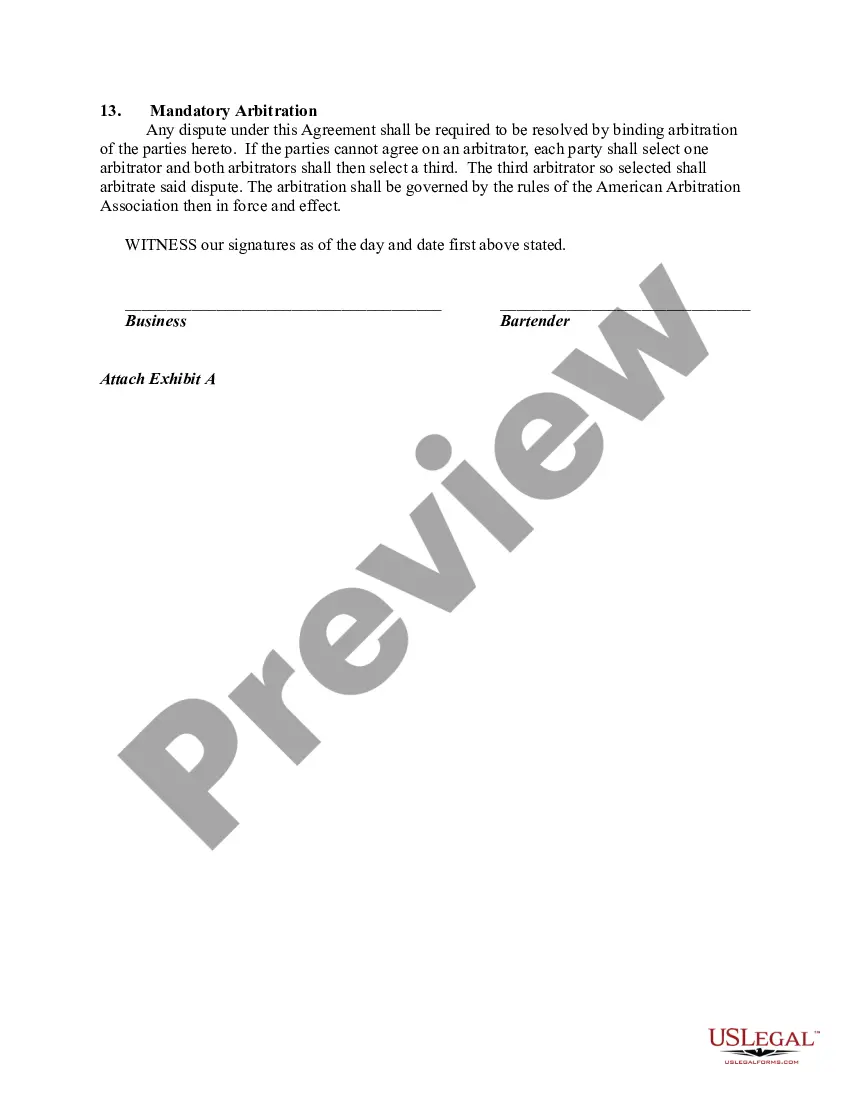
- Includes clauses for effective conflict resolution through arbitration, making the process smoother if disputes arise.
Key takeaways
- This agreement formalizes the relationship between a bartender and a business while clarifying tax responsibilities.
- It protects both parties through clear terms regarding compensation, termination, and indemnification.
- Using this form online offers convenience and ensures legal compliance for the services rendered.
Looking for another form?
Form popularity
FAQ
The IRS requires contractors to fill out a Form W-9, request for Taxpayer Identification Number and Certification, which you should keep on file for at least four years after the hiring. This form is used to request the correct name and Taxpayer Identification Number, or TIN, of the worker or their entity.
OSHA literature doesn't typically use the term "independent contractor." It uses "self-employed." There's a pretty simple reason self-employed are exempted from OSHA. OSHA exists to protect workers from unsafe or "unhealthful" conditions that their employer might force them into using economic leverage.
Terms. This is the first section of any agreement or contract and states the names and locations of the parties involved. Responsibilities & Deliverables. Payment-Related Details. Confidentiality Clause. Contract Termination. Choice of Law.
An independent contractor (IC) is someone who is in an independent trade or profession offering services to the general public. An IC is considered to be able to control their own work, not the employer. 1fefffeff By contrast, an employee's work is controlled and directed by the employer.
While the occasional family member/friend helping out as a server on a busy day, or an attorney who comes in once or twice a year to update corporate documents or assist with legal matters are typically classified as independent contractors, regular servers, bartenders, and even cooks usually fall under the employee
Since independent contractors are not employees the contractor is responsible for paying employment taxes, income taxes, social security, and insurance.Self-employed workers are usually hired by a company to carry out a certain service.
Terms. This is the first section of any agreement or contract and states the names and locations of the parties involved. Responsibilities & Deliverables. Payment-Related Details. Confidentiality Clause. Contract Termination. Choice of Law.
For most types of projects you hire an independent contractor (IC) to do, the law does not require you to put anything in writing. You can meet with the IC, agree on the terms of your arrangement, and have an oral contract or agreement that is legally binding. Just because you can doesn't mean you should, however.
The earnings of a person who is working as an independent contractor are subject to Self-Employment Tax. If you are an independent contractor, you are self-employed. To find out what your tax obligations are, visit the Self-Employed Tax Center.